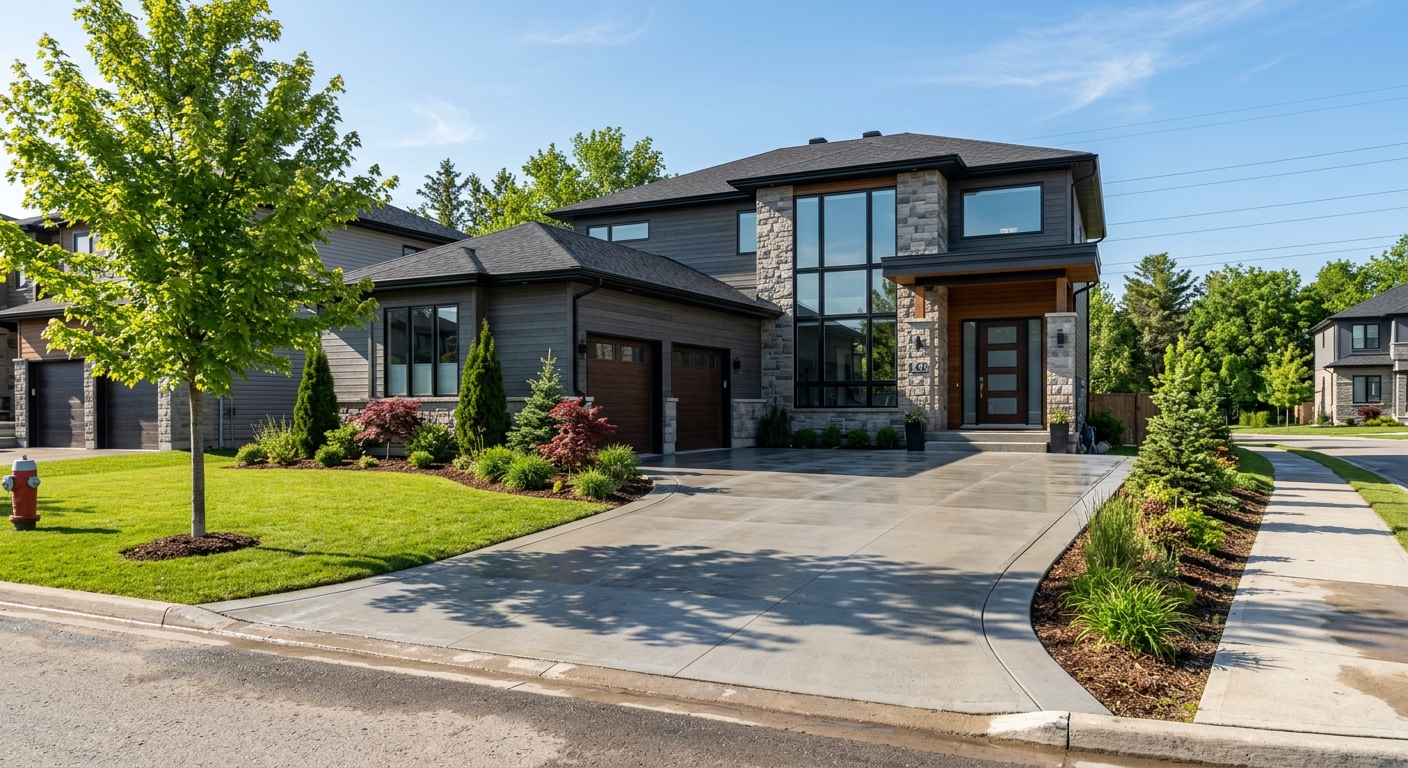
Concrete work options and costs in Ranchlands
Ranchlands, Alberta is a growing family community where concrete flatwork gets used hard—driveways take snowplows and de-icing salt, patios see freeze–thaw every winter, and garages have heavy tire traffic. With Ranchlands drawing homeowners in the range of growing, owner-occupied housing (single-detached homes are the dominant style across the broader Calgary area), most concrete bids you’ll see are for driveways, patios/walkways, and foundation upgrades. Statistics Canada reported Ranchlands’ population at 7,490 in the 2021 Census (Statistics Canada, 2021 Census), and that steady demand matters because available crews and concrete truck scheduling tighten in peak pour months.
In the Calgary economic region, our cold continental climate changes the math. Local engineering practice uses a design frost depth of about 1.2 m (roughly 4 ft) as a baseline, which means excavation is more intensive and footing volumes are often higher than in milder parts of the country. Frequent freeze–thaw cycles also require air-entrained mixes for exterior slabs and a careful control-joint pattern to reduce random cracking and long-term spalling. Finally, the short exterior pour season and colder placement windows can add cost for winter-grade materials, insulated blankets, or temporary heat so the concrete cures properly instead of scaling at the surface.
Demand is especially strong around established residential pockets near the Ranchlands-area amenities, where homeowners often refresh aging walkways and expand driveways to match wider vehicles and snow-storage needs. Below is a practical comparison of common options and typical price bands—use it as a baseline before you request an itemised quote.
| Application |
Typical Size |
Key Spec |
Finish Option |
Price Range |
| Concrete driveway (standard broom finish) |
24' x 10' (240 sq. ft.) |
4" slab on compacted base, air-entrained mix |
Broom finish |
$12,000–$18,000 |
| Exposed aggregate driveway |
24' x 10' (240 sq. ft.) |
4" slab, proper cure + surface exposure |
Exposed aggregate |
$14,500–$21,500 |
| Stamped concrete driveway or patio |
20' x 12' (240 sq. ft.) |
4" slab, air-entrained mix, release system |
Stamped pattern + colour |
$15,000–$26,000 |
| Plain concrete patio or walkway |
12' x 12' (144 sq. ft.) |
4" slab with compacted base |
Float + broom/wood-trowel edge |
$5,000–$9,000 |
| Garage floor (interior slab) |
22' x 20' (440 sq. ft.) |
Interior slab, vapour barrier, control joints |
Standard float/trowel finish |
$8,500–$14,500 |
| Foundation footings (structural, below frost) |
Typical house footprint |
Excavation to design frost depth, rebar/mesh, engineered size |
Structural concrete |
$28,000–$45,000 |
Prices are estimates only and vary by project scope, site access and material selection.
What affects the price of concrete work in Ranchlands
In Ranchlands and across the Calgary market, quotes for “the same” concrete job can vary by 30–50% because the big cost drivers are rarely identical: excavation depth, base thickness, reinforcement needs, concrete mix specifications, and the curing steps used when it’s cold. Two contractors may both list a “concrete driveway,” but one may be building to a frost- and freeze–thaw-ready spec (air-entrained mix, proper base, control joints and sealing), while another may treat it like a simple slab. That difference shows up fast in labour hours, materials, and truck time.
Here’s the climate-driven part: Calgary’s freeze–thaw cycles require exterior concrete to be air-entrained to resist scaling and spalling. Also, footings must bear on undisturbed soil below the design frost depth. In Alberta, frost depth is commonly in the up-to-2.4 m range for parts of the province depending on exposure and engineered site conditions, so excavation and formwork can be substantial. Exterior slabs also face a shorter pour season; cold placement may call for insulated blankets and/or temporary heat to protect curing quality. Finally, de-icing salt aggressively attacks surfaces—proper sealing (typically after cure) helps reduce deterioration and extends service life.
Local examples: (1) A driveway poured when the base is frozen or improperly dried often costs less on paper but can fail sooner—good contractors coordinate thawing/grading and may target the same driveway costs closer to the $12,000–$18,000 band with proper prep. (2) If you’re near mature trees or have tight access, haul routes and disposal can push your project toward the upper end or beyond, especially for stamped work in the $15,000–$26,000 band. (3) If the grade requires thicker granular base due to soft spots, you’ll see it in the earthwork line item—sometimes saving money by doing the right base first prevents future re-lifting and patching that can cost nearly as much again.
| Price Factor |
Why It Matters |
Cost Impact |
| Frost line depth — determines footing depth and form height |
Footings must sit below local design frost depth on undisturbed soil to prevent frost heave |
Higher excavation and concrete volumes can add significant cost |
| Site preparation — excavation, grading, compacted granular base |
Proper sub-base compaction reduces settlement and cracking |
More stripping/base material increases labour and hauling |
| Reinforcement — rebar or wire mesh requirement |
Reinforcement controls cracking and strengthens slab/footings |
Materials and tying/cutting labour add to total price |
| Mix design — air-entrainment and compressive strength spec |
Freeze–thaw durability depends on air content; strength affects durability and service life |
Winter-grade or higher-spec mixes cost more but reduce failure risk |
| Finish type — broom vs. stamped vs. exposed aggregate |
More complex finishes need additional labour steps and materials |
Decorative work typically pushes toward upper driveway/patio bands |
| Pour size and concrete truck access to site |
Large pours need efficient placement; limited access increases time and staging |
Extra equipment/crew hours can swing the price meaningfully |
| Cold-weather curing precautions — heating and blankets |
Proper curing prevents scaling and strength loss in cold placement windows |
Temporary heat/blankets can add line-item cost in shoulder seasons |
| Control joint pattern and sealing cost |
Joints manage crack locations; sealing helps with de-icing salt exposure |
Good joints + sealing add cost, but reduce long-term repair risk |
Permits & regulations in Alberta
In Alberta, structural concrete work generally requires a building permit. That includes footings, foundation walls, grade beams, and other structural elements that support the house. In many cases, engineered drawings are required or reviewed as part of permit review, because those parts must be designed for loads and local conditions like frost depth and soil bearing. For Ranchlands homeowners, that means if your project involves altering the foundation system, don’t rely on “it’s just concrete” reasoning—confirm with the municipality before excavation.
Concrete flatwork (driveways, patios, walkway slabs, sidewalks, and interior garage slabs) typically does not require a permit by default. However, permits can become relevant if the work affects lot grading, changes drainage patterns, or triggers impervious surface and right-of-way considerations. If you’re tying into an existing driveway, changing elevations, or modifying drainage to avoid directing water toward neighbours, it’s worth checking first.
To verify contractor coverage in Alberta, follow a simple checklist: (1) confirm the contractor is insured for liability (ask for a current Certificate of Insurance showing your jobsite and coverage period); (2) verify WSIB/WCB coverage for workers—ask for documentation rather than verbal confirmation; (3) request clearance letters if applicable for your project size; and (4) ask for recent references on similar foundation and slab scopes. When in doubt, request proof before you sign—then lock the scope, exclusions, and curing/finishing specifications into the written contract.
Getting concrete right in Ranchlands's freeze-thaw climate
Concrete fails in Ranchlands mainly through surface scaling, cracking, and eventual spalling—usually because the mix, base, or curing wasn’t engineered for repeated freeze–thaw and de-icing salt exposure. The fix starts before the truck arrives: (1) base preparation—use a compacted granular sub-base to the right depth and to correct density for your soil conditions so the slab doesn’t settle; (2) mix design—spec air-entrainment and a minimum compressive strength so freeze–thaw cycles don’t destroy durability; (3) control joints—plan the joint layout to limit uncontrolled cracking; (4) curing—protect the slab so it reaches adequate early strength (minimum 7 days under proper conditions); and (5) sealing—apply a penetrating sealer after the slab has cured (commonly around 28 days) to repel moisture and reduce the impact of salt.
Air-entrainment is the big one. Exterior flatwork in Calgary should target about 5–7% air content and a minimum 32 MPa compressive strength, because inadequate air void systems are strongly linked to spalling in cold winters. Ask for a documented mix spec, not a guess.
Example on dollars: If you choose broom-finish standard driveway work, you may land in the $12,000–$18,000 band. Spending more for stamped decorative work (often $15,000–$26,000) is justified when you want the appearance and you’re also insisting on the same durability specs (air-entrainment, proper curing and base, and control joints). If a contractor offers “decorative stamping” but skips the base and curing steps, you’re paying extra for failure—no finish can hide that.
| Spec |
Why It Matters in Ranchlands |
What to Ask For |
Impact if Skipped |
| Compacted granular base (depth?) |
Sets the slab on stable support and reduces settlement and cracking through freeze–thaw |
Base depth and compacted fill specs based on your soil/excavation plan |
Uneven settling, wider cracks, premature surface deterioration |
| Air-entrained concrete mix (target air %?) |
Improves freeze–thaw durability and reduces spalling from salt and winter cycles |
Air content target (about 5–7% for exterior flatwork) |
Higher risk of scaling/spalling within a few seasons |
| Compressive strength (MPa rating) |
Strength development supports durability and resists early damage |
Minimum 32 MPa compressive strength spec |
Lower long-term performance and damage under traffic and freeze cycles |
| Control joints (spacing per ACI guidelines) |
Keeps cracking in predictable locations and limits random fracture |
Joint spacing plan and how joints will be cut/formed |
Random cracking, trip hazards, and more moisture ingress |
| Minimum 7-day curing period |
Proper curing is crucial in cold-weather placement windows |
Curing method and protection plan (including winter blankets/heating if needed) |
Surface scaling and reduced early strength |
| Penetrating sealer (when applied after cure) |
Reduces water and salt penetration that accelerates freeze–thaw damage |
Sealer product type and timing (commonly ~28 days post-pour) |
Faster spalling and staining, shorter service life |
How to choose a concrete work contractor in Ranchlands
Choosing the right contractor in Ranchlands is mostly about verifying coverage, then comparing apples-to-apples scopes. Start with Alberta liability insurance: ask for a current Certificate of Insurance and confirm it lists your job or coverage period. Next, verify WSIB/WCB coverage—request documentation (and clearance letter information where relevant) instead of relying on a “we’re registered” statement. A crew without clear coverage is a risk you don’t want on a concrete project involving heavy equipment, excavation, and long cure schedules.
Then get 2–3 itemised written quotes. Look for line items that show what you’re actually buying: excavation and disposal, compacted granular base depth and compaction method, reinforcement type/placement, concrete mix spec (including air content), and finish steps. Insist that permit pulling is clear—if permits are required for your structural scope, confirm who is responsible. Also check what’s excluded: de-icing salt protection, sealing, winter-grade curing precautions, temporary heat, and any coring/cutting for tie-ins.
Warranty matters too. Ask for the workmanship warranty length, whether product/manufacturer warranties apply to admixtures or decorative systems, and whether any warranty is transferable if you sell your home. For payment schedule, never pay more than 10–15% upfront; hold back money until you’ve completed key milestones (base inspection, finishing, joints/sealing where included, and cleanup). Finally, get the start date and completion estimate in writing, because missed cure windows can affect durability in Calgary’s freeze–thaw climate.
- Proof of liability insurance dated for your project window
- WSIB/WCB clearance/documentation provided before work starts
- Itemised quote with excavation, base, reinforcement, mix spec, and finish steps
- Written curing plan (especially if pouring in shoulder seasons)
- Control joint layout and how/when joints will be cut/installed
- Whether penetrating sealer is included (timing after cure)
- Material list for decorative work (stamp mats, release agents, colours)
- Confirm disposal/haul-away is included or excluded
- Site access plan for concrete trucks and any pumping/hoisting costs
- Payment schedule capped at 10–15% upfront with holdback for completion
- Warranty terms in writing: workmanship and any limitations
- References for projects of similar scale in the Calgary/Rocky View area
Concrete red flags in Ranchlands: missing proof of insurance/WSIB/WCB coverage, vague mix/spec language (“regular concrete” with no air-entrainment details), no plan for winter curing (blankets/heating) when temperatures drop, joint cuts or sealing skipped or described as “optional,” and quotes that lump excavation and finishing together without specifying base depth, reinforcement, or disposal.
Frequently asked questions — concrete work in Ranchlands
How much does concrete work cost in Ranchlands?
In Ranchlands, pricing tracks the Calgary region’s frost and freeze–thaw realities, so “cheap concrete” usually means shortcuts in base prep, air-entrainment, or curing. For homeowners, common driveway and flatwork budgets typically land in the established bands: a concrete driveway or slab often falls around $12,000–$18,000, while a plain patio or walkway is commonly $5,000–$9,000. If you’re going decorative, stamped concrete driveway or patio work is frequently $15,000–$26,000. Foundation/footings are more variable because excavation volume can change with soil and engineered requirements, commonly $28,000–$45,000. For Ranchlands (population 7,490 in 2021, Statistics Canada, 2021 Census), steady demand can also tighten scheduling in peak season, which affects labour and truck coordination—another reason itemised quotes matter.
How deep must footings be for Ranchlands's frost line?
Footings in Alberta must be designed to bear below the local frost depth so they don’t heave with freeze–thaw. In practice around Calgary—including Ranchlands—design frost depth is commonly about 1.2 m (roughly 4 ft) as a baseline for many residential considerations, but engineered site conditions can require deeper excavations (up to around 2.4 m in Alberta depending on exposure and soil). That’s why you’ll see bigger foundation quotes than in warmer provinces: more digging, more formwork, and more structural concrete. The homeowner takeaway: don’t accept a footing depth “estimate” over a site condition review. Ask your contractor (or builder/engineer) to confirm the designed footing level relative to frost depth, bearing on undisturbed soil, and the intended backfill/drainage plan.
Why does concrete crack in Ranchlands and how is it prevented?
Cracking in Ranchlands is usually predictable: concrete shrinks as it cures, temperatures swing during Calgary winters, and freeze–thaw cycles push moisture in and out of the slab. If the base isn’t properly compacted or if the mix/freeze durability isn’t right, small stresses become bigger problems. The most reliable prevention steps are: correct granular base prep, air-entrained exterior mix (to reduce freeze–thaw damage), and a control-joint layout that limits where cracks occur. For example, a driveway poured and finished well but without proper joint pattern often develops random cracking that later turns into moisture pathways. Sealing after full cure helps too because de-icing salt and water accelerate deterioration. In short: crack prevention is engineered—broom finish alone doesn’t stop cracking.
Stamped vs broom-finish concrete — cost difference?
Stamped concrete costs more than broom-finish because it adds labour steps, materials, and coordination—colouring, release agents, stamp timing, and more careful finishing to keep the pattern crisp. In Ranchlands and the Calgary region, broom-finish driveways and standard slabs commonly fall around $12,000–$18,000 depending on size and access, while stamped concrete driveway or patio projects frequently land around $15,000–$26,000. The important nuance: the price difference should reflect decorative work—not shortcuts. Ask whether the stamped option includes the same air-entrainment, base prep, control joints, curing protection, and sealing timing as the standard option. If those core specs aren’t matched, you may pay the higher decorative price without the durability benefits that actually matter in Calgary’s freeze–thaw climate.
When is the best time to pour concrete in Ranchlands?
The best time to pour exterior concrete in Ranchlands is when you can achieve proper curing—typically late spring through summer, when temperatures stay within workable ranges for hydration and when the crew can protect the slab if cold nights occur. Calgary’s freeze–thaw cycles shorten the safe pour window for exterior flatwork. If you must pour in shoulder seasons, a reputable contractor plans winter-grade mixes, insulated blankets, and sometimes temporary heat to reach the curing targets. Without that, you can see surface scaling or weak early strength even if the slab looks fine right after finishing. The homeowner approach: ask your contractor for the forecast-based plan (how they’ll protect during the first 7 days) rather than just the pour date.
How long does concrete take to cure?
Concrete curing isn’t one single day. For Ranchlands exterior slabs, you should expect at least a minimum 7-day curing period under proper conditions for the slab to reach adequate early strength and durability performance. In cold or late-season pours, that timeline can require more protection (blankets/heat) so curing happens consistently. Full performance continues developing beyond that; for sealing and long-term resistance to de-icing salts, many contractors apply penetrating sealer after cure—commonly around 28 days post-pour. This matters because sealing too early or rushing cold placement increases the chance of scaling, especially in Calgary’s freeze–thaw cycle. Ask your contractor what curing method they’ll use, what “protected cure” means in writing, and when you can safely resume traffic and maintenance.