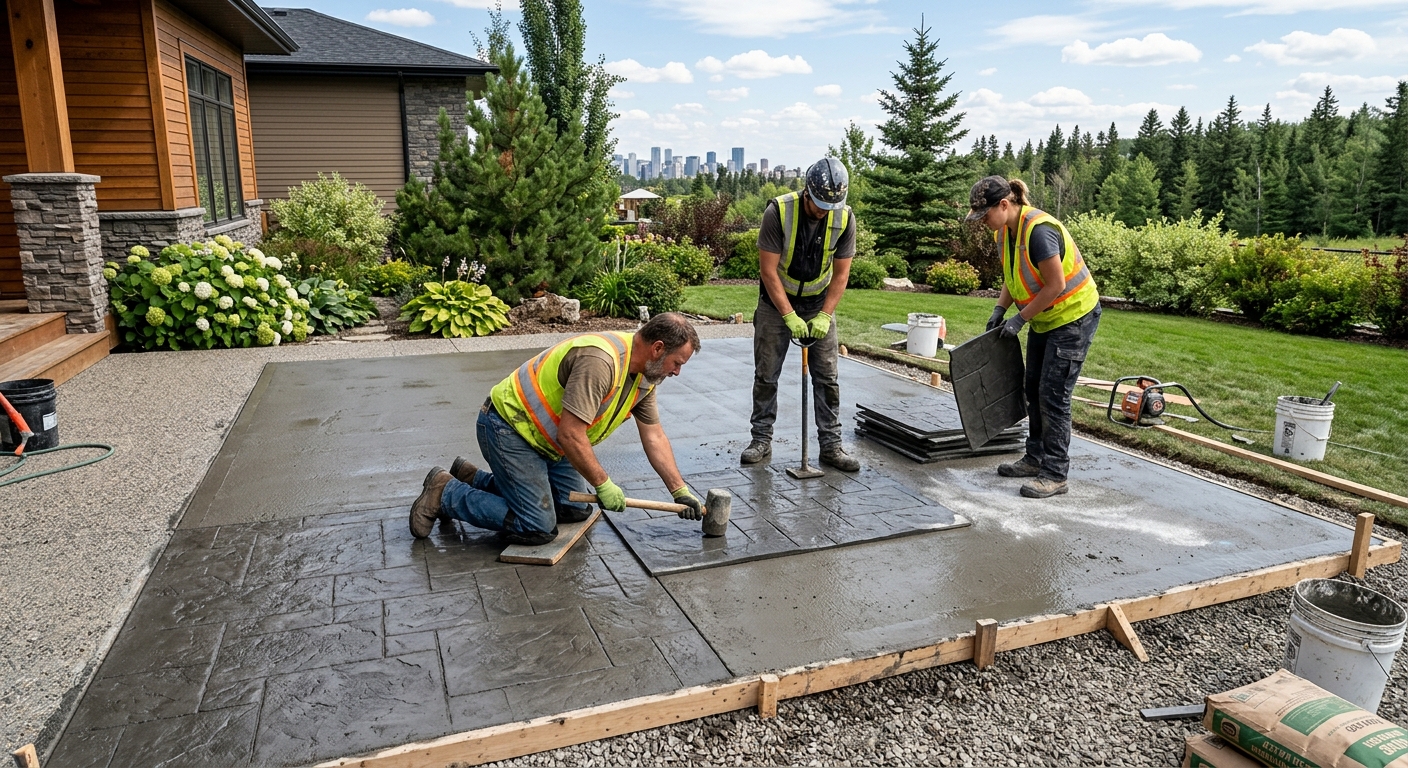
Concrete work options and costs in Copperfield
Copperfield, Alberta is a young community—its concrete needs track closely with new housing and ongoing yard development. With a population of 14,095 (Statistics Canada, 2021 Census), you’ll typically see steady demand for driveways, patios, walkways, garage slabs, and the structural concrete that goes under many of the homes being built in the Calgary region. Concrete flatwork is especially common where homeowners are finishing lots for everyday use: think of the Copperfield neighbourhood pockets where people are adding sidewalks, widening access paths, and upgrading backyard patios as soon as fencing and grading settle.
Pricing in Copperfield is shaped by Calgary’s cold continental climate. Frost and frequent freeze–thaw cycles are the big drivers: local engineering practice assumes a design frost depth of about 1.2 m (roughly 4 ft), so footings must bear on undisturbed soil below that level. That means excavation is deeper and footing volumes are higher than in milder regions, and it directly pushes foundation costs upward. Exterior slabs also require air-entrained mixes, plus proper cold-weather placement and curing protection when temperatures drop—especially late fall or early spring—because rushed curing increases the risk of scaling and longer-term deterioration. On top of that, Calgary-area labour and equipment availability can shift quickly during the short pour season, which influences how tight pricing can be between bids.
Below is a practical comparison of common options. Use these as planning ranges, then match the spec to your site and finish preference in your quote.
| Application |
Typical Size |
Key Spec |
Finish Option |
Price Range |
| Concrete driveway (standard broom finish) |
24 ft x 10 ft (240 sq ft) |
Air-entrained exterior mix, control joints |
Broom finish, saw-cut joints |
$12,000–$18,000 |
| Exposed aggregate driveway |
24 ft x 10 ft (240 sq ft) |
Vibrated mix, appropriate aggregate exposure time |
Exposed aggregate finish |
$14,500–$21,500 |
| Stamped concrete driveway or patio |
20 ft x 12 ft (240 sq ft) |
Air-entrained exterior mix, release agent system |
Stamp pattern + colour hardener/sealer |
$15,000–$26,000 |
| Plain concrete patio or walkway |
12 ft x 10 ft (120 sq ft) |
Air-entrained mix for exterior exposure |
Float finish + broom edges |
$5,000–$9,000 |
| Garage floor (interior slab) |
22 ft x 20 ft (440 sq ft) |
Vapour barrier, thickness to spec, interior curing |
Broom/steel-trowel hybrid |
$10,000–$17,000 |
| Foundation footings (structural, below frost) |
Typical single detached: engineered footing layout |
Concrete placed below design frost depth, reinforcement as required |
Structural finish only (not decorative) |
$28,000–$45,000 |
Prices are estimates only and vary by project scope, site access and material selection.
What affects the price of concrete work in Copperfield
In Copperfield and the broader Calgary market, two contractors can quote the “same” concrete job and end up 30–50% apart. Most of that difference comes down to how each team engineers for frost, drainage, and durability in freeze–thaw conditions—not just the final finish you can see. In a cold climate like Calgary’s, the design frost depth of about 1.2 m (roughly 4 ft) governs footing excavation depth and formwork height. For exterior slabs, air-entrained concrete and a durable base setup are non-negotiable because repeated freezing and thawing punish weak mixes and under-compacted granular layers. Finally, the short pour season and cold-weather curing precautions (insulated blankets, sometimes temporary heat, and tighter scheduling) can add labour and materials costs.
Local conditions also shift costs upward or downward. A driveway that needs heavy regrading or removal of unsuitable soil will cost more than a job on stable grade. Similarly, a narrow access lane can mean smaller batching options or additional labour time to place and consolidate concrete properly. Conversely, if your forms can be set quickly and the sub-base is already prepared to grade, your costs come down.
Finish selection plays a big role too. A standard broom-finished driveway often lands in the $12,000–$18,000 band, while stamped concrete typically climbs into the $15,000–$26,000 range because of higher labour intensity, colour materials, and sealing requirements. For foundations, thicker reinforced footing packages below frost can move within the $28,000–$45,000 range depending on engineered rebar demand and excavation volume—two things directly tied to local soil conditions and site grading.
| Price Factor |
Why It Matters |
Cost Impact |
| Frost line depth |
Determines footing depth and form height |
More excavation and concrete volume; higher labour for deeper trenches |
| Site preparation |
Excavation, grading, compacted granular base |
Unstable soil and trucking/grading time can add significant cost |
| Reinforcement |
Rebar or wire mesh requirement |
Rebar schedules and steel placement time vary by engineering and loads |
| Mix design |
Air-entrainment and compressive strength spec |
Exterior air-entrainment and winter-grade mixes can cost more but reduce failure risk |
| Finish type |
Broom vs. stamped vs. exposed aggregate |
Stamped/exposed systems add labour hours, materials, and tighter workmanship control |
| Pour size and concrete truck access to site |
Placement efficiency and time on-site |
Narrow access or long wheelbarrow distances increases labour and placement cost |
| Cold-weather curing precautions |
Heating and blankets |
Winter protection materials and extra monitoring can add days and labour |
| Control joint pattern and sealing cost |
Crack control and surface protection |
Correct jointing reduces random cracking; sealing adds a separate line item |
Permits & regulations in Alberta
In Alberta, the concrete work that’s part of a foundation structure—such as footings, foundation walls, and grade beams—typically falls under building permitting. Many homes also require engineered drawings that get reviewed during the permit process. For concrete flatwork like patios, walkways, and driveways, a permit is often not required by default, unless the project affects lot grading, drainage, or impervious surface limits, or ties into municipal right-of-way requirements (for example, modifications near a driveway approach). Because rules can vary by project scope and municipality conditions, confirm with the local authority before breaking ground.
Before signing, make sure your contractor carries liability insurance and has the required coverage for workers. In practice, you should also ask for references on similar-scale jobs in the Calgary region, because exterior durability (air-entrainment, control joints, cold-weather curing) is where the workmanship shows up over time.
Step-by-step for Copperfield homeowners:
- Verify the contractor’s licence/registration status using Alberta’s online contractor registry tools (search their legal entity name).
- Request a Certificate of Insurance (COI) for liability and ensure it lists your project address or at least the correct named insured.
- Ask for proof of workers’ coverage (commonly WSIB/WCB coverage) and check the coverage is active.
- Confirm their experience with exterior, air-entrained concrete pours in cold-weather conditions and ask to see recent photos of finished work and joint sealing.
- Get everything in writing: scope, exclusions, curing approach, and timelines.
Getting concrete right in Copperfield's freeze-thaw climate
Concrete failures in Copperfield usually trace back to water movement and inadequate durability details under Calgary’s freeze–thaw cycles. The most common issue homeowners notice is spalling and scaling: the surface flakes or pops off after winter, often because the concrete wasn’t properly air-entrained, the base wasn’t prepared to drain and compact correctly, or curing was rushed in cold conditions. To spec the job correctly, start with base preparation. The granular sub-base must be excavated to the right depth for your site and compacted properly; weak or over-wet base material leads to settlement and micro-cracking.
Next, lock in mix design: for exterior flatwork, you want air-entrainment typically in the 5–7% air content range, plus a minimum 32 MPa compressive strength (as specified for the application). Control joints are how you manage cracking: you’re not preventing cracks—you’re directing them to predictable locations. Then curing matters. Plan for minimum 7-day curing under proper conditions, and in cold weather use insulated blankets and/or appropriate heat protection so the slab reaches strength without freezing. Finally, apply a penetrating sealer after the cure (often at 28 days post-pour) to repel de-icing salt moisture and reduce surface deterioration.
To help you ask the right technical questions: if one contractor can’t clearly explain air-entrainment targets, joint spacing, and curing protection, that’s a risk. If you’re choosing between broom finish and stamped concrete, the price jump can be justified—stamped driveways often sit in the $15,000–$26,000 range because the labour is higher and sealing is part of the finish system. A broom driveway around $12,000–$18,000 can be the smarter choice when your priority is long-term durability and budget certainty, assuming the base and mix specs are correct.
| Spec |
Why It Matters in Copperfield |
What to Ask For |
Impact if Skipped |
| Compacted granular base (depth?) |
Stable support and drainage against freeze–thaw pressure |
Granular base thickness to engineering/schedule and compaction method |
Settlement, rocking, and premature cracking or surface failure |
| Air-entrained concrete mix (target air %?) |
Protects concrete from freeze–thaw scaling |
5–7% air for exterior flatwork (documented in the mix ticket/spec) |
Spalling and scaling within a few winters |
| Compressive strength (MPa rating) |
Strength development for load performance and durability |
Minimum 32 MPa (or higher if engineered/required for your slab) |
Surface wear, higher cracking risk, and reduced long-term performance |
| Control joints (spacing per ACI guidelines) |
Limits random cracking patterns |
Saw-cut timing and joint spacing plan (exterior slab layout) |
Wider random cracks that allow water ingress and scaling |
| Minimum 7-day curing period |
Cold-weather curing is critical to prevent freezing-related damage |
Curing method (blankets/heat if needed) and strength timeline |
Surface defects, reduced strength gain, and early deterioration |
| Penetrating sealer (when applied after cure) |
Reduces salt and moisture penetration during winter cycles |
Penetrating sealer applied after cure—commonly around 28 days |
Faster salt-driven spalling and higher maintenance over time |
How to choose a concrete work contractor in Copperfield
Choosing a contractor in Copperfield should be less about the lowest number and more about who can prove they understand Calgary-area durability. Start by verifying Alberta licensing/registration using the online registry for the company that will actually do the work (not just the salesperson). Then request a Certificate of Insurance and confirm it’s active and appropriate for the job (liability coverage) and that it covers your project period. Ask for proof of workers’ coverage (WSIB/WCB coverage) and check it’s current—don’t accept “we’re covered” without documentation. If they can’t produce these items quickly, that’s a warning sign.
Next, ask for 2–3 quotes that are itemised, not lump-sum alone. You want a breakdown of labour and materials (concrete supply, reinforcement, granular base, formwork, finishing, joints, sealing, and disposal). Carefully read exclusions: what’s included in excavation, hauling away unsuitable material, and topsoil replacement? Is the permit pull included if structural work requires it? Is concrete truck access assumed as-is, or is there an allowance for limited access?
Review warranty details. A workmanship warranty (how long they stand behind placement and finishing) matters, and you should understand whether product/manufacturer warranties apply to the concrete materials or sealer system. Also ask whether warranties are transferable if you sell your home. For payment, keep deposits reasonable: never pay more than 10–15% upfront, and hold back a portion until completion and final cleanup. Require an in-writing timeline with a start date and completion estimate—especially important for cold-weather curing windows.
- Provide licence/registration verification for the contracting entity.
- Show active liability insurance via COI (and match project address/name).
- Confirm WSIB/WCB coverage with current documentation.
- Give an itemised quote (materials + labour lines) with quantities.
- State foundation/slab thickness, base depth, and reinforcement requirements clearly.
- Explain the air-entrainment and curing approach for exterior pours.
- Include joint spacing and whether joints will be saw-cut to plan.
- Specify sealing product type and the target application timing (after cure).
- Confirm disposal/haul-away is included or listed separately.
- Outline cold-weather precautions (blankets/heating) if scheduling is in shoulder season.
- Provide a written start date and completion estimate with weather contingencies.
- Include a workmanship warranty term and what it covers.
Concrete contractor red flags in Copperfield: they won’t discuss air-entrainment or curing protection; their quote omits control joints or sealing; they ask for a large upfront deposit (beyond 10–15%); they can’t produce insurance/coverage documentation; or they provide a vague scope that doesn’t state base preparation depth, reinforcement, and disposal/excavation details.
Frequently asked questions — concrete work in Copperfield
What is the difference between concrete and cement?
In Copperfield and across Alberta, people often use “concrete” and “cement” interchangeably, but they’re not the same. Cement is the binding material inside the mix—think of it as the powder component. Concrete is the full mixture: cement plus water, sand, and gravel/aggregate, sometimes with additives like air-entrainment and plasticizers. In Calgary’s freeze–thaw climate, the concrete mix design matters more than the word “cement” does, because air-entrainment (typically 5–7% for exterior flatwork) helps protect against scaling and spalling during winter cycles. When you’re comparing quotes, ask for the concrete mix spec (air content and compressive strength), not just whether “cement is Portland.” That’s where durability is engineered.
How much does concrete work cost in Copperfield?
For typical homeowner projects in Copperfield, you’ll usually see pricing bands that track the Calgary region’s climate-driven specs. A standard concrete driveway (about 240 sq ft) commonly lands in the $12,000–$18,000 range, assuming proper granular base prep and exterior air-entrained mix. Plain patios and walkways often fall in the $5,000–$9,000 band depending on size and site access. If you want decorative upgrades, stamped concrete usually moves into the $15,000–$26,000 range because it requires heavier finishing labour and a coordinated colour/sealer system. For structural foundation work, footing packages below frost depth are typically in the $28,000–$45,000 band. Your final number can shift based on excavation volume, truck access, and whether the schedule falls into cold-weather curing conditions.
How deep must footings be for Copperfield's frost line?
For Copperfield-area projects, footings are designed based on frost depth considerations for Calgary’s cold continental climate. Local engineering practice uses a design frost depth of about 1.2 m (roughly 4 ft), which means structural footings should bear on undisturbed soil below that level to reduce frost heave and seasonal movement. In practice, the exact depth can vary by engineered foundation design and site conditions (soil type and bearing conditions), so your builder’s engineer and the drawings control the final specification. When you compare foundation quotes, don’t just compare totals—confirm excavation depth assumptions, reinforcement details, and whether the contractor is placing the footings below the design frost level (not “close to it”). That single detail often explains why foundation bids differ.
Why does concrete crack in Copperfield and how is it prevented?
Concrete cracking in Copperfield is usually normal to expect to some degree—what matters is controlling where cracks occur and keeping water out. In freeze–thaw conditions, temperature changes, moisture movement, and restrained shrinkage can cause cracking even in well-built slabs. Prevention is about controlling the system: (1) correct base prep and compaction so the slab doesn’t settle, (2) proper air-entrainment for durability, and (3) a planned control joint pattern to direct cracking to saw-cut lines. Contractors should also specify curing conditions, because rushed curing (especially during colder shoulder seasons) can increase surface and micro-crack risk. Finally, sealing after cure helps repel de-icing salt moisture. If a quote doesn’t clearly mention joint layout and cold-weather curing precautions, it’s not detailed enough for Copperfield durability.
Stamped vs broom-finish concrete — cost difference?
Stamped concrete costs more than broom-finished concrete mainly because the work is more labour-intensive and more detail-driven. A broom-finished driveway (often in the $12,000–$18,000 band for a typical size) is simpler: pour, screed, finish, and broom textures with control joints. Stamped concrete adds steps such as pattern layout, release agent application, careful timing for stamping, and a coordinated colour/hardener system plus sealing. That’s why stamped driveways and patios often land in the $15,000–$26,000 range in the Calgary region. The important part is that the extra cost still depends on the same engineering basics—air-entrainment, base prep, and curing. If those fundamentals are weak, stamped surfaces may look good initially but still fail early. Always ask what’s included in the sealer and when it’s applied after the cure.
When is the best time to pour concrete in Copperfield?
In Copperfield, the best time to pour is when temperatures support proper curing without excessive protection. In Calgary’s cold continental climate, exterior concrete can be poured in fall and spring, but it must be engineered for cold-weather placement: insulated blankets, appropriate heat if needed, and careful scheduling so the slab doesn’t freeze before it gains strength. Many contractors prefer late spring through summer for simpler curing and more predictable results. If you need a pour during colder periods, insist the contractor explains their cold-weather plan and curing timeline—minimum 7-day curing under the right conditions is critical. Weather windows matter for workmanship and long-term performance, especially to reduce surface scaling. Your quote should reflect whether the job is scheduled in shoulder season and what measures (blankets/heat) are included.