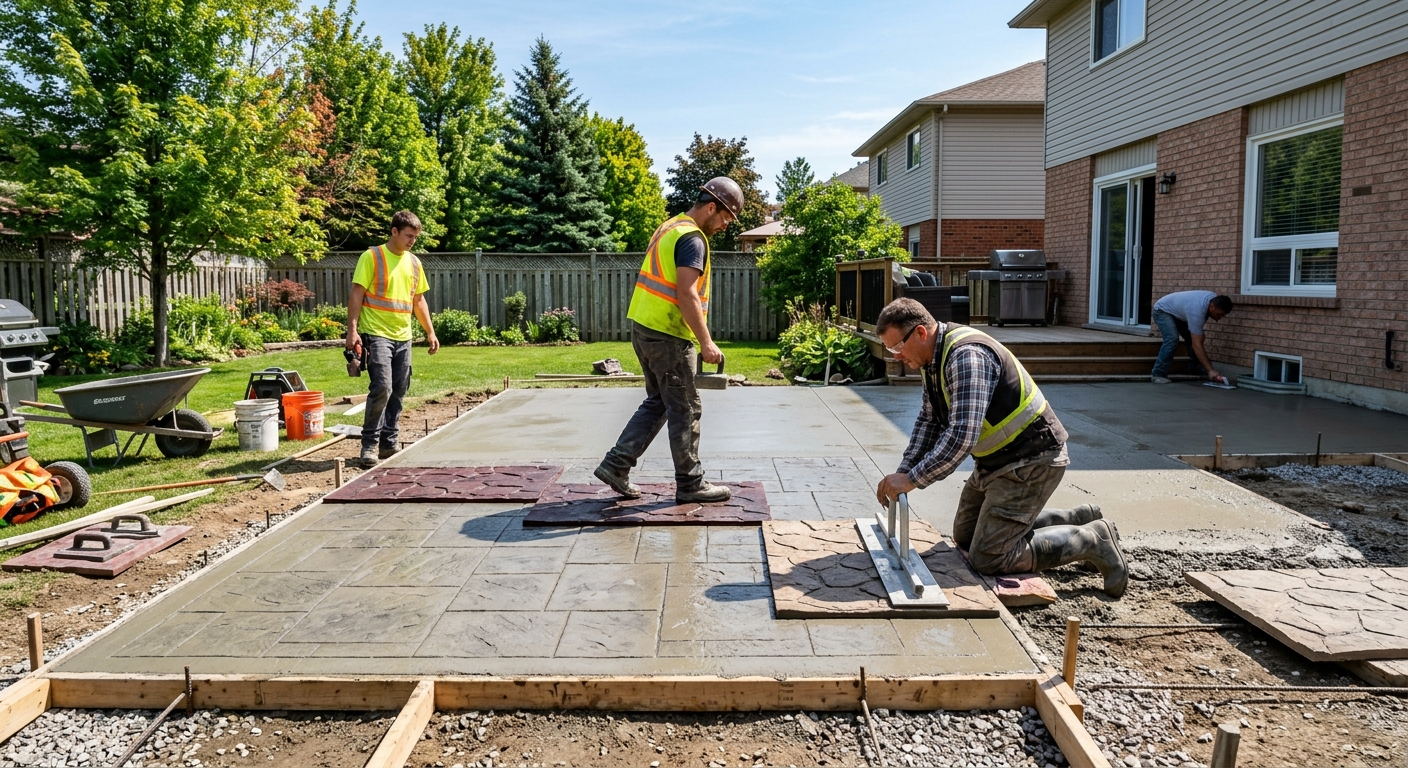
Concrete work options and costs in Aspen Gardens
Aspen Gardens, Alberta is a small community (population 1,638 per the Statistics Canada, 2021 Census), and that matters because local contractors can be selective about scheduling—good crews get booked for exterior pours when weather is workable. In this part of Calgary’s economic region, most neighbourhood development is geared toward family homes, and the demand for dependable flatwork is steady around household hubs like the Aspen Gardens driveways and backyard walkways that connect daily life to the road year-round. That’s why homeowners typically compare driveway, patio/walkway, garage slab, and foundation options before they choose a contractor.
Concrete pricing here is shaped as much by frost and freeze–thaw as by materials. In the Calgary area, local engineering practice uses a design frost depth of about 1.2 m (roughly 4 ft), so foundation footings and retaining elements must reach undisturbed soil below that depth. On the exterior side, the frequent temperature swings push contractors toward granular base prep, air-entrained mixes, control joints, and careful curing—especially when late fall or early spring compresses the pour window. It also means “cheap” bids can turn expensive later if curing precautions or air-entrainment specs are skipped.
Below is a realistic price comparison for common jobs in Aspen Gardens, including finish choices that homeowners in Calgary and nearby communities ask for most often.
| Application |
Typical Size |
Key Spec |
Finish Option |
Price Range |
| Concrete driveway (standard broom finish) |
24 ft x 12 ft (288 sq ft) |
Air-entrained exterior mix, compacted granular base, control joints |
Broom finish |
$12,000 – $18,000 |
| Exposed aggregate driveway |
24 ft x 12 ft (288 sq ft) |
Air-entrained mix, proper surface exposure timing |
Exposed aggregate |
$15,000 – $22,000 |
| Stamped concrete driveway or patio |
20 ft x 20 ft (400 sq ft) |
Air-entrained mix, colour hardener, sealed finish |
Stamped pattern |
$18,000 – $26,000 |
| Plain concrete patio or walkway |
10 ft x 16 ft (160 sq ft) |
Air-entrained mix, compacted base, saw-cut joints |
Plain/float finish |
$5,000 – $9,000 |
| Garage floor (interior slab) |
24 ft x 22 ft (528 sq ft) |
Vapour barrier, steel reinforcement, proper curing |
Plain finished surface (light broom) |
$10,000 – $16,000 |
| Foundation footings (structural, below frost) |
Typical single-family layout (engineered) |
Below design frost depth, excavation, rebar, engineered volume |
Structural concrete |
$28,000 – $45,000 |
Prices are estimates only and vary by project scope, site access and material selection.
What affects the price of concrete work in Aspen Gardens
In Aspen Gardens and across the Calgary region, it’s common to see quotes for the “same” concrete job land 30–50% apart once you look past the square footage. The biggest drivers are frost-engineered excavation depth, how the base is built, whether the mix is properly air-entrained for freeze–thaw, and how much labour is allocated to curing and jointing. Two contractors can both quote a driveway in the $12,000–$18,000 range, but one may include the granular base and proper finishing timing, while another may under-spec access logistics or curing precautions—cost shows up later as scaling or spalling.
In this climate, the design frost depth of about 1.2 m means footing excavation and formwork are more intensive than in milder areas. Meanwhile, freeze–thaw cycles across Calgary and nearby communities demand air-entrained concrete and a well-spaced control joint pattern to reduce random cracking. Cold-weather placement also shortens the practical exterior pour season; contractors may need winter-grade mixes, insulated curing blankets, or temporary heat to protect the slab. Add in de-icing salt use, and sealing becomes a practical “maintenance cost” that helps reduce surface breakdown.
Here are a few Aspen Gardens examples that routinely swing the final price: a driveway with tight turns and limited truck access often increases labour for placement; a patio that sits over poor subsoil can require extra granular replacement before you ever pour; and a stamped surface costs more up front, but it’s justified when you’re replacing a larger worn area because the finished appearance lasts longer with the right seal.
| Price Factor |
Why It Matters |
Cost Impact |
| Frost line depth — determines footing depth and form height |
Footings must reach undisturbed soil below the design frost depth to prevent frost heave |
Can increase foundation costs significantly; often the largest variable for footings |
| Site preparation — excavation, grading, compacted granular base |
Proper base prep prevents settlement and reduces freeze–thaw pumping at the slab underside |
Higher if soil is soft, drainage is poor, or excavation is deeper than expected |
| Reinforcement — rebar or wire mesh requirement |
Supports slab integrity and reduces cracking under load |
Mesh/rebar adds material and labour; omitting it can void performance targets |
| Mix design — air-entrainment and compressive strength spec |
Air entrainment helps protect concrete during repeated freeze–thaw cycles |
May raise material cost, but it’s critical for durability in Alberta winters |
| Finish type — broom vs. stamped vs. exposed aggregate |
Finish affects labour time, materials, and quality control |
Stamped/exposed typically pushes projects toward higher bands (e.g., $15,000–$26,000) |
| Pour size and concrete truck access to site |
Smaller pours and limited access increase placement time or require pumping |
Access constraints can add truck/pump coordination and labour |
| Cold-weather curing precautions — heating and blankets |
Cold reduces early strength gain; protective curing prevents scaling and damage |
Adds cost, especially when work lands near cold snaps |
| Control joint pattern and sealing cost |
Joints manage cracking; sealing helps resist de-icing salt-related surface spalling |
Skipping or underdoing joints/sealing can increase future repair expenses |
Permits & regulations in Alberta
In Alberta, concrete work is handled in two buckets: structural concrete that affects a home’s engineered system, and non-structural flatwork that mainly affects surface drainage and lot grading. Generally, structural concrete such as foundation walls, grade beams, and footings requires a building permit and often engineered drawings reviewed through the municipality process. By contrast, concrete flatwork like patios, walkways, and standard driveways typically does not require a permit unless it impacts lot grading, stormwater handling, impervious surface considerations, or the municipal right-of-way (for example, work that changes drainage toward a curb or sidewalk). Before breaking ground in Aspen Gardens, confirm the requirement with your local authority.
To verify a contractor in Alberta step-by-step:
- Check licensing/registration (when applicable for the trade): look for the contractor’s business name and standing in the relevant online registry for Alberta.
- Request a Certificate of Insurance and ensure it’s current: verify general liability limits and the address/jobsite listed match your scope.
- Confirm clearance for workers: ask for WSIB/WCB coverage details and whether they can provide proof of coverage or clearance.
- Verify references on similar-scale projects: ask for photos and addresses of recent pours in the Calgary area.
- Use your quote as a checklist: scope should state excavation, reinforcement, concrete mix spec, curing method, and disposal.
If anything is vague—especially on insurance/coverage or the engineered elements—treat it as a red flag and slow down before signing.
Getting concrete right in Aspen Gardens's freeze-thaw climate
In Aspen Gardens, concrete failures almost always trace back to how the slab is built to survive Alberta’s freeze–thaw cycles. The two common problems I see are spalling/scaling (surface breakdown) and random cracking from settlement or thermal movement. The fix starts with spec’ing the job around climate performance, not just appearance.
First is base preparation: excavate to the proper depth and build a compacted granular sub-base so the slab is supported below the frost-susceptible zone. Second is mix design: for exterior flatwork, air-entrainment is essential—commonly targeting 5–7% air content for durable freeze–thaw resistance—and a minimum 32 MPa compressive strength is a realistic baseline for home flatwork in this market. Third is control joints: joints should be cut to a planned pattern so cracks occur where you can manage them, not randomly through the surface.
Fourth is curing: allow a minimum 7-day curing period under proper conditions. In cold snaps, curing blankets or temporary heat aren’t “extras”—they’re what keep early strength gain on track. Fifth is sealing: apply a penetrating sealer after the concrete has cured properly (commonly around 28 days) to help repel de-icing salts.
How to avoid spalling: don’t bargain away air entrainment. For example, if you choose a standard broom-finish patio in the $5,000–$9,000 band, the right mix and curing might cost a few hundred dollars more, but it’s typically far cheaper than a resurfacing or early replacement. If you add a stamped look (often $15,000–$26,000 depending on scope), the curing and jointing quality still matters just as much—decorative finish doesn’t protect weak concrete.
| Spec |
Why It Matters in Aspen Gardens |
What to Ask For |
Impact if Skipped |
| Compacted granular base (depth?) |
Prevents settlement and reduces freeze–thaw pumping under the slab in Alberta winters |
State excavation depth and granular base thickness; compaction testing if available |
Uneven settlement, cracking, and early edge deterioration |
| Air-entrained concrete mix (target air %?) |
Helps protect concrete from repeated freezing and thawing cycles |
Confirm target air content (commonly 5–7% for exterior flatwork) |
Surface scaling/spalling, especially where de-icing salt is used |
| Compressive strength (MPa rating) |
Ensures the concrete reaches adequate strength for load and durability |
Minimum 32 MPa (or higher if specified by engineer for the application) |
Reduced durability and higher risk of surface damage |
| Control joints (spacing per ACI guidelines) |
Manages where shrinkage and thermal cracks relieve themselves |
Planned joint spacing and joint depth for your slab size |
Random cracking across the finished surface |
| Minimum 7-day curing period |
Cold weather slows strength gain; curing protects against scaling and structural weakness |
Confirm cure protection approach if temperatures drop during placement |
Weak early-age concrete and premature surface failure |
| Penetrating sealer (when applied after cure) |
Repels moisture and helps reduce salt-driven surface breakdown |
Apply after proper cure (commonly around 28 days), and confirm product type |
Faster surface wear, staining, and increased spalling risk |
How to choose a concrete work contractor in Aspen Gardens
Choosing the right concrete contractor in Aspen Gardens is mostly about verification and clarity, not just the lowest number on the estimate. Start by confirming Alberta licensing/registration where applicable for the scope they’re providing, and always ask for current liability insurance. Then verify WSIB/WCB coverage: request proof of clearance or coverage documentation and confirm it covers the specific jobsite work. If they can’t provide documentation quickly, that’s a sign to move on.
Next, get 2–3 itemised written quotes that break labour and materials apart (concrete volume, reinforcement, excavation/grading, granular base, finish labour, forms, disposal, and curing/blankets if needed). Avoid “lump sum only” proposals if you can—lump sums hide the compromises. Read the scope carefully for exclusions: Is debris/disposal included? Is the permit pull included where required? Who handles restoring grass/landscaping around the perimeter?
For warranty, ask for both the workmanship warranty length and whether there’s any product/manufacturer warranty on sealer, concrete admixtures, or decorative colour systems. Clarify if warranties are transferable to the next owner. For payment, a typical safe approach is to pay no more than 10–15% upfront, with a holdback until completion and walk-through. Finally, insist on a written start date and completion estimate.
- Request proof of insurance and WSIB/WCB before signing.
- Ask for recent references within the Calgary area.
- Confirm the concrete mix is air-entrained for exterior work.
- Demand a detailed scope for excavation and compacted granular base.
- Ask who supplies reinforcement (mesh/rebar) and how it’s supported.
- Verify joint plan: location, spacing, and whether joints are sealed.
- Confirm curing method for cold-weather conditions (blankets/heating if needed).
- Get finish specifications: broom profile, stamped system, or exposed aggregate method.
- Check whether sealing is included and when it will be applied after cure.
- Clarify concrete delivery plan and whether pumping is included if access is tight.
- Ensure site restoration is specified (grading, topsoil, sod/seed touch-ups where applicable).
- Use a written schedule and define what happens if temperatures drop mid-pour.
Red flags I see in Aspen Gardens include: contractors who won’t discuss air-entrainment or curing; quotes that ignore frost-depth excavation requirements; vague “standard mix” wording; failure to provide a joint plan for exterior slabs; and payment schedules asking for large upfront deposits without a written holdback.
Frequently asked questions — concrete work in Aspen Gardens
How long does a concrete project take in Aspen Gardens?
In Aspen Gardens, the schedule depends on whether you’re doing flatwork or structural concrete, plus temperature windows. Most exterior slabs like patios and walkways are usually a few working days end-to-end: form/setup, base prep and compaction (often a day), the pour day, then curing management. You typically need at least a minimum 7-day curing period before expecting full durability, even if you can walk on it earlier. Driveways can take longer because excavation and forming usually take more time, and finish timing matters. For context, a driveway in the $12,000–$18,000 band often runs longer than homeowners expect if access is tight or the base needs extra replacement. Cold snaps in the Calgary area also affect start dates—good crews may pause or add insulation/heat to protect curing.
What is a concrete overlay and is it suited to Aspen Gardens?
A concrete overlay is a resurfacing system placed over an existing concrete surface—either a thin topping or a thicker bonded overlay—designed to restore appearance and add a new wearing surface. It can be suited to Aspen Gardens when the original slab is still structurally sound: minimal settlement, no major heaving, and cracks that aren’t actively moving. The catch in this freeze–thaw climate is that overlays can struggle if water infiltration has already compromised the base, or if the slab is failing from frost action. If your current driveway or walkway is spalling from de-icing salts or has recurring cracking, the overlay may not fix the root cause. In many Calgary-area cases, replacement or localized repair can be the better long-term value versus paying for a topping that won’t fully address movement.
How do I seal concrete to protect it in Aspen Gardens?
For sealing in Alberta winters, timing and product type matter. After your pour, wait for proper curing—commonly about 28 days—before applying a penetrating sealer. Penetrating sealers help repel moisture and can reduce how quickly de-icing salts and water get into the surface pores, which helps lower the risk of scaling/spalling in freeze–thaw cycles. In Aspen Gardens, you’ll usually get better results if the surface is clean, dry, and free of curing compounds or contaminants before sealing. Ask your contractor to specify the sealer type and coverage rate, and whether they recommend reapplication timelines. Also note: sealing doesn’t replace good specs—air-entrainment, a compacted base, control joints, and proper curing are what prevent failures in the first place.
What is the difference between concrete and cement?
People use these terms interchangeably, but they aren’t the same. Cement is the binding material (typically Portland cement) that reacts with water to create paste. Concrete is the finished product made by combining cement, water, sand, gravel (or crushed stone), and sometimes admixtures (like air-entrainment agents for freeze–thaw durability). In Aspen Gardens and the wider Calgary region, that mix design is critical because exterior flatwork is exposed to repeated freeze–thaw cycles and de-icing salt use. That’s why you’ll hear contractors specify an air-entrained mix and a target compressive strength. Your quote should reference the concrete mix performance, not just “cement,” especially for driveways, patios, and walkways.
How much does concrete work cost in Aspen Gardens?
Concrete costs in Aspen Gardens largely follow the regional pricing bands for the Calgary area, but your site conditions can push the job higher. For example, a standard broom-finish driveway typically lands around $12,000–$18,000 depending on size, excavation, and access. Plain patio or walkway work often sits around $5,000–$9,000 for common residential footprints. Stamped concrete adds labour and materials, and decorative work commonly ranges around $15,000–$26,000 depending on scope. For foundations and footings (structural, below frost), pricing often sits around $28,000–$45,000 because excavation and engineered volumes are driven by the local frost depth approach. If you share your approximate dimensions and whether you need excavation/replacement of poor subsoil, I can help you estimate where your project is most likely to land.
How deep must footings be for Aspen Gardens's frost line?
In the Calgary area, local engineering practice uses a design frost depth of about 1.2 m (roughly 4 ft). Practically, that means footings for houses, garages, decks, and retaining structures must bear on undisturbed soil below that design frost depth to prevent frost heave and seasonal movement. Because actual conditions vary by site soil type and drainage, the final footing depth should follow the engineered foundation design for your home or drawing set. In other words, the “rule” is about designing for the frost depth, but your approved drawings determine exact depths and excavation sizes. When homeowners review bids for footings in the $28,000–$45,000 band, they should confirm the contractor is planning excavation to the engineered level (not just “dig until it looks solid”).