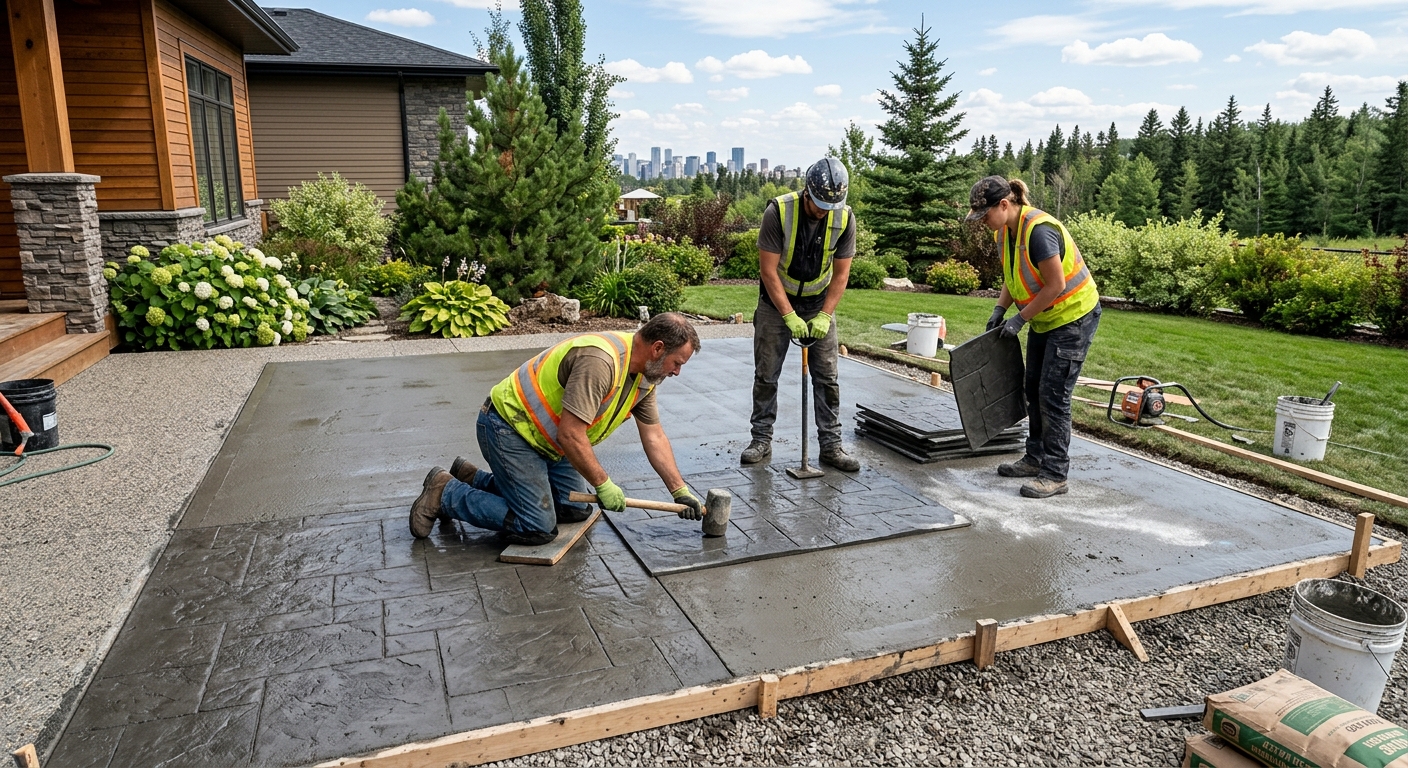
Concrete work options and costs in Grande Cache
Concrete work in Grande Cache is a regular part of keeping homes and cottages usable in winter, especially as yards, driveways, and entrances move through freeze–thaw cycles. With a population of 3,276 (Statistics Canada, 2021 Census), the local market is smaller than Calgary’s, and pricing reflects fewer crews nearby plus more scheduling time needed for mobilization. It’s also the type of community where many homeowners focus on durable flatwork—like driveways, patios, and walkways—that can handle snow storage, tire scraping, and de-icing salt. On top of that, new builds and renovations continue across the area; in an Alberta growth region, concrete flatwork demand tends to concentrate around convenient access routes near the town core and along commonly used access roads.
In the Calgary economic region, costs are engineered around frost depth and air requirements. A design frost depth of about 1.2 m (roughly 4 ft) means footings for garages, decks, retaining structures, and foundations need to extend below undisturbed soil depth. Exterior slabs also require air-entrained concrete, granular base prep, and good joint layout to limit cracking and surface scaling. Because exterior placement has a shorter practical pour season, some jobs in late fall or early spring require cold-weather curing measures (insulated blankets and sometimes temporary heat). That curing window affects both labour time and material selection, which is why “same-size” projects can land at different totals.
Below are realistic ranges you can use to sanity-check quotes, then we’ll break down what moves pricing the most in the next section.
| Application |
Typical Size |
Key Spec |
Finish Option |
Price Range |
| Concrete driveway (standard broom finish) |
16 ft x 30 ft (480 sq. ft.) |
Air-entrained mix, compacted granular base, control joints |
Broom finish, optional edging |
$12,000–$18,000 |
| Exposed aggregate driveway |
16 ft x 30 ft (480 sq. ft.) |
Air-entrained mix, proper curing, exposed/washed stone |
Exposed aggregate with sealant-ready finish |
$15,000–$22,000 |
| Stamped concrete driveway or patio |
12 ft x 24 ft (288 sq. ft.) |
Air-entrained mix, integral colour, release agent compatible with stamping |
Stamp mat texture + colour hardener |
$15,000–$26,000 |
| Plain concrete patio or walkway |
10 ft x 20 ft (200 sq. ft.) |
Air-entrained mix, compacted base, joints as required |
Float/steel trowel then broom or light broom finish |
$5,000–$9,000 |
| Garage floor (interior slab) |
24 ft x 24 ft (576 sq. ft.) |
Vapour control/insulation plan (as applicable), reinforcement, proper curing |
Steel trowel finish |
$14,000–$22,000 |
| Foundation footings (structural, below frost) |
Typical single-family footprint (engineered) |
Excavate to frost depth, reinforced concrete footings |
Structural plain finish (not decorative) |
$28,000–$45,000 |
Prices are estimates only and vary by project scope, site access and material selection.
What affects the price of concrete work in Grande Cache
In Grande Cache, you can see surprisingly wide quote gaps for the same “concrete size” because the hidden work is where most of the cost lives. Across Calgary and the wider Alberta market, it’s common to see 30–50% differences driven by excavation quantity, base prep, reinforcement detailing, mix design, and whether the contractor includes cold-weather curing measures. If one quote assumes normal spring weather and another builds in insulated blankets and heated curing, the totals will diverge quickly. Also, with a smaller local workforce—Grande Cache sits at 3,276 residents (Statistics Canada, 2021 Census)—mobilization and scheduling can add to labour overhead when crews are coming from farther out.
Climate is the big driver. With a design frost depth of about 1.2 m (roughly 4 ft), footings must bear below that depth to prevent frost heave. Exterior slabs also need air-entrained concrete to survive repeated freeze–thaw cycles. Add a shorter pour season and contractors have fewer comfortable placement days, so cold-weather precautions (heating, insulated blankets, curing protection) can add both material and labour time. De-icing salts then accelerate spalling if the mix and finishing aren’t done for this environment—sealing becomes a smart line item rather than an afterthought.
In practical terms, a driveway that’s priced near the lower end of the driveway band might be based on straightforward access and standard broom finish (often aligning with the $12,000–$18,000 range). A driveway requiring thicker granular base, more reinforcement, or longer truck/boom reach can push closer to the higher end. Likewise, a stamped driveway may look “only decorative,” but it often includes added prep, colour work, and labour time; that’s where the $15,000–$26,000 stamped range is justified versus plain concrete.
| Price Factor |
Why It Matters |
Cost Impact |
| Frost line depth — determines footing depth and form height |
Footings must extend below frost to reduce seasonal movement |
Higher excavation and concrete volume; can materially lift foundation/footing quotes |
| Site preparation — excavation, grading, compacted granular base |
Proper base prevents settlement and helps control cracking |
More trucking and labour for removal/haul and deeper base increases cost |
| Reinforcement — rebar or wire mesh requirement |
Controls cracking and improves slab performance |
Material plus labour installation; small change can affect total by thousands |
| Mix design — air-entrainment and compressive strength spec |
Freeze–thaw survival depends on air content and strength |
Cold-region mixes cost more; wrong spec can lead to failure and rework |
| Finish type — broom vs. stamped vs. exposed aggregate |
Finish affects labour time, materials, and curing/handling |
Decorative systems add colour, mats, wash/exposure labour, and sealing prep |
| Pour size and concrete truck access to site |
Access impacts pumping/placement time and waste |
Limited access can require pump or additional crew time |
| Cold-weather curing precautions — heating and blankets |
Ensures strength gain and reduces scaling risk |
Temporary heat/blankets and monitoring can add noticeable cost in fall/spring |
| Control joint pattern and sealing cost |
Joints reduce random cracking; sealing helps against salt damage |
Better joint layout and sealing usually add value rather than optional “extras” |
Permits & regulations in Alberta
In Alberta, most structural concrete work requires a building permit—especially foundation footings, foundation walls, grade beams, and other engineered structural elements. Your municipality typically expects engineered drawings for structural portions, and those get reviewed before the work starts. For concrete flatwork like driveways, patios, and walkways, permits often are not required, unless the project affects lot grading, stormwater/lot drainage plan compliance, impervious surface coverage limits, or involves work within municipal right-of-way. Since requirements can depend on how the slab ties into drainage and site servicing, always confirm with the local authority before breaking ground.
For homeowners in Grande Cache, verifying compliance is straightforward. Step 1: ask the contractor for their AB business/labour authorization details (and whether they’re operating as a registered contractor). Step 2: request a certificate of insurance showing current liability coverage (and ideally whether it names you as an additional insured). Step 3: verify WSIB/WCB coverage—ask for clearance or proof of coverage and confirm coverage applies to the specific crews on your site. Step 4: request a few references on similar-scale Alberta flatwork and foundations. Step 5: keep a paper trail—written scope, start date, and the permit responsibility (if any) clearly stated.
If your quote is unclear about whether permits are needed, treat that as a red flag. In Alberta, it’s better to clarify early than discover a scope mismatch after excavation.
Getting concrete right in Grande Cache's freeze-thaw climate
Concrete failure in Grande Cache most often traces back to a few predictable issues: inadequate base preparation, poor mix design for freeze–thaw, weak curing, and weak joint/sealing strategy. To spec the job correctly, start with the foundation of the slab: use a compacted granular sub-base to the right depth for local soil conditions and the frost performance required for this region. Next, require an air-entrained mix—typical target air content for exterior flatwork is in the 5–7% range—to resist freeze–thaw damage. Then set a concrete performance target: a minimum 32 MPa compressive strength is a common baseline for durable exterior slabs when combined with proper finishing and curing.
Cracking is controlled, not eliminated. Specify a control joint pattern that limits random cracking to planned lines. Finally, protect curing: give concrete at least 7 days of proper curing conditions, and in cold placement windows use blankets/heat as needed. For surface protection, use a penetrating sealer applied after the cure window—often around 28 days post-pour—especially where de-icing salts are used.
When comparing options, the price difference is sometimes justified. For example, moving from plain broom-finish concrete to stamped concrete can add roughly the extra labour/materials that put you into the $15,000–$26,000 stamped band versus $5,000–$9,000 for a plain patio/walkway band. But if a contractor claims the cheaper option will “perform the same,” ask how they’re handling air content, joints, and sealing—those are the real drivers of longevity here.
| Spec |
Why It Matters in Grande Cache |
What to Ask For |
Impact if Skipped |
| Compacted granular base (depth?) |
Reduces settlement and helps manage freeze–thaw movement |
“What base depth and material type are you compacting to, and how will you prove compaction?” |
Uneven settlement, cracking, and premature failure |
| Air-entrained concrete mix (target air %?) |
Creates freeze–thaw resistance in cold Alberta winters |
“What is the target air content (5–7%) and how will it be verified?” |
Increased scaling/spalling and surface deterioration |
| Compressive strength (MPa rating) |
Strength gain supports long-term slab durability |
“What minimum MPa will you pour and how do you control curing temperature?” |
Weak concrete, higher cracking risk, reduced lifespan |
| Control joints (spacing per ACI guidelines) |
Limits random cracking to planned locations |
“What joint spacing will you use and where will joints be placed?” |
Random cracks, water infiltration, and accelerated freeze–thaw damage |
| Minimum 7-day curing period |
Ensures strength development in our shorter, colder seasons |
“What curing protection will you use if temperatures drop?” |
Surface scaling and poor performance even if the slab looks fine initially |
| Penetrating sealer (when applied after cure) |
Repels de-icing salt impact on the surface |
“When exactly will you apply sealer—after cure (around 28 days)?” |
Faster spalling and staining, more maintenance over time |
How to choose a concrete work contractor in Grande Cache
Choosing the right concrete contractor in Grande Cache is less about a low per-square-foot number and more about whether the company can execute the specs that keep concrete standing up to Alberta winters. Start by verifying Alberta compliance: ask for their liability insurance certificate (current coverage), and proof of WSIB/WCB coverage for the crews working on your site. If they can’t provide documentation quickly, that’s a major warning sign. Next, get 2–3 itemised written quotes—not just totals. Look for labour + materials breakdown and clarity on what’s included: excavation, granular base and compaction, reinforcement, concrete supply, forming, finishing, curing protection, saw-cutting, disposal, and any required sealing. A proper quote also states whether they will pull permits if the scope triggers them.
Read the scope line-by-line. Concrete projects frequently have exclusions like “surface staining not covered,” “no repair of existing settlement,” or “sealer not included.” Ask for warranty terms in writing: workmanship warranty length, whether product/manufacturer warranties apply, and whether warranties transfer to you as the homeowner. For payment schedule, avoid contractors who demand most of the money upfront—typical good practice is keeping deposits to about 10–15%, then paying the remainder on milestones and holding back until key completion items are done. Finally, insist on a written timeline with a start date and completion estimate. With Grande Cache’s freeze–thaw timing, the schedule is part of the performance.
- Confirm liability insurance is current and scoped to the work (not expired).
- Verify WSIB/WCB clearance/proof for the crews listed on your project.
- Request an itemised quote: excavation, base prep, reinforcement, concrete mix, curing, and finishing.
- Ask what frost-protection approach they use for footings and slab edges.
- Check that the mix is air-entrained for exterior work (5–7% target) and meets MPa requirements.
- Confirm joint plan: locations and spacing, not just “we’ll cut joints.”
- Ask how they handle cold-weather curing (blankets/heat) if temperatures drop.
- Clarify disposal: who hauls away spoil and how far are they transporting?
- Confirm truck access plan (direct chute vs pump) and placement method.
- Require a written start date, pour window, and completion date estimate.
- Review warranty coverage for workmanship and any exclusions.
- Don’t sign until you understand what’s excluded and what changes pricing.
Concrete red flags in Grande Cache include: contractors who won’t discuss air-entrainment and curing; quotes that omit base depth/compaction; “we always broom it” finish promises without joint spacing; unclear responsibility for permits where structural work is involved; and demanding large upfront payments without milestones or documentation.
Frequently asked questions — concrete work in Grande Cache
What is air-entrained concrete and why does it matter here?
Air-entrained concrete is a mix designed to include tiny, evenly distributed air bubbles that act like pressure relief during freeze–thaw cycles. In Grande Cache and the wider Calgary region, repeated freezing and thawing drives moisture movement through the concrete surface; without proper air entrainment, the freeze–thaw pressure can damage the paste and lead to scaling and spalling. That’s why reputable contractors specify air content (commonly targeting about 5–7% air for exterior flatwork) and don’t treat it as optional. If you’re budgeting, exterior slabs and driveways often align with the local driveway band of $12,000–$18,000 for standard broom finish—good air entrainment and correct curing are part of what keeps that cost from turning into rework later. Always ask for the mix spec, not just the finish.
How do I prepare the base for a concrete slab?
Base prep is where slab performance is won or lost in Alberta’s freeze–thaw climate. The goal is to excavate to the proper depth for frost performance, then place and compact a granular sub-base in lifts using the right material (commonly well-graded granular base) and compaction approach. In Grande Cache, the frost depth considerations drive deeper excavation for footings and can also affect how thick your slab’s base and edge detailing need to be so frost doesn’t push or allow settlement. A good contractor will explain the base depth, compaction method, and how they’ll confirm grade before pouring. If your project is a patio/walkway, skipping the compacted granular base can cause cracking and uneven surfaces; if it’s a driveway (often in the $12,000–$18,000 range), base errors can show up as early surface deterioration and joint failures.
How do I compare concrete quotes?
When comparing quotes in Grande Cache, compare apples to apples—finish is only part of the story. Ask each contractor to provide itemised pricing and the technical inclusions: base depth and compaction, reinforcement (if any), concrete mix spec (air entrainment and minimum strength), joint placement plan, curing method, and whether sealing is included. Cold-weather curing can change totals; if one quote assumes normal temperatures and another includes blankets/heat monitoring, expect real differences. Also confirm disposal and concrete truck access (direct chute vs pump) because access affects labour time and waste. A practical benchmark is the regional pricing bands: standard driveway broom finish often falls around $12,000–$18,000, while stamped decorative work commonly lands in $15,000–$26,000. If a quote is much lower than the band, it may be missing key specs or excluding sealing and curing protection.
Can concrete be poured in cold weather in Grande Cache?
Concrete can be poured in cold weather in Grande Cache, but it must be treated as a controlled placement. The risk isn’t just “it’s cold,” it’s whether the mix reaches adequate early strength before it’s exposed to freezing conditions that can disrupt strength gain. Contractors typically manage this with winter-grade considerations such as insulated blankets, heating strategies when required, and monitoring temperatures so curing stays within acceptable ranges. Reputable firms build a plan for the short practical exterior pour season and will tell you what temperature thresholds trigger different curing steps. If a contractor promises an exterior pour without any mention of curing protection when nights are near-freezing, ask direct questions. Even when costs stay within your driveway or patio bands (for example, $5,000–$9,000 for many plain patio/walkway scopes), skipping curing measures increases the odds of surface scaling and long-term durability problems.
How do I maintain concrete in Grande Cache's freeze-thaw climate?
Maintenance in Grande Cache is mostly about managing moisture and salt impact. Keep joints clear so water doesn’t sit and freeze repeatedly; if your slab has intentional control joints, don’t fill or block them with debris or heavy coatings. Use de-icing products carefully—salt can accelerate surface wear—then prioritize sealing where appropriate. A common practice is applying a penetrating sealer after the cure period (often around 28 days post-pour) so the concrete surface resists salt penetration and moisture uptake. Visually inspect your slab each winter and spring: if you see early scaling, spalling, or joint deterioration, address it promptly instead of waiting for bigger repairs. The better the original specs—air entrainment, joint spacing, and curing—the less maintenance you’ll need. That’s especially true for exterior slabs that sit near traffic paths where snow storage and traction sanding are common.
What causes concrete to spall in Grande Cache winters?
Spalling is usually the result of freeze–thaw damage combined with moisture and de-icing salt exposure. The most common root causes in Grande Cache are insufficient air entrainment (no built-in freeze–thaw durability), inadequate or shortened curing in cold weather, and water entering through cracks or poorly planned joints. When moisture gets into the concrete and freezes, internal expansion can pop the surface layer—especially on driveways and walkways that get salt and repeated tire wear. Base issues can also contribute indirectly: settlement or inadequate support increases cracking, and cracks become pathways for water. Sealing helps reduce salt and moisture ingress, but it’s not a substitute for correct mix design and curing. If you’re choosing between options within typical pricing bands—like plain patios around $5,000–$9,000 versus decorative driveways around $15,000–$26,000—the performance difference still comes back to the same fundamentals: air, joints, curing protection, and sealing.