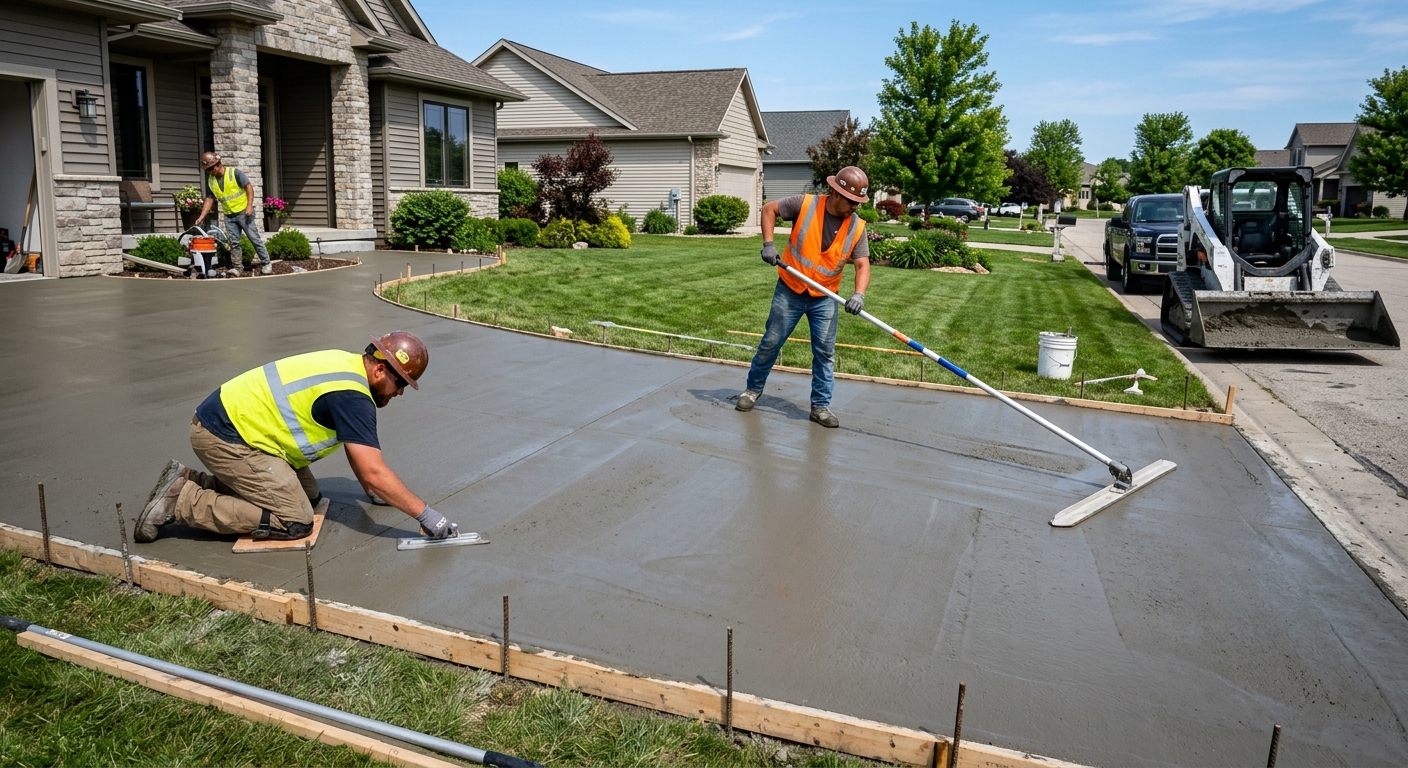
Concrete work options and costs in Rutland Park
In Rutland Park, Alberta, homeowners usually choose concrete for driveways, patios, walkways and basement upgrades because it’s dependable in the deep cold cycles of the Calgary area. With a population of 2,140 (Statistics Canada, 2021 Census), Rutland Park is small enough that word-of-mouth matters—so you’ll often see certain contractors in the same neighbourhoods around town, particularly in the busier residential pockets where flatwork is most common. Most concrete flatwork demand is tied to older and growing housing stock around Calgary’s established communities, where many lots have existing slabs that eventually need replacement. That matters because freeze–thaw wear is a real driver of replacement timing here, and it shows up in budgeting.
Calgary’s cold continental climate means engineered concrete specs are focused less on look, and more on durability: footings must be placed below the design frost depth (about 1.2 m in this region), exterior slabs need air-entrained mixes, and the pour season is shorter. Labour availability can also swing seasonally—late fall and early spring projects often cost more because crews schedule around cold-weather curing requirements (insulated blankets, sometimes temporary heat) to protect the concrete during the early set and cure window. That’s why the same-size project can land at different price points; for example, a standard broom-finished driveway may cost less than stamped decorative work, while foundation/footing work can jump significantly when excavation and structural engineering volumes increase.
Below is a practical comparison of common concrete options and what typically drives the price.
| Application |
Typical Size |
Key Spec |
Finish Option |
Price Range |
| Concrete driveway (standard broom finish) |
400–600 sq. ft. |
Air-entrained exterior mix; reinforced base; control joints |
Broom finish |
$12,000–$18,000 |
| Exposed aggregate driveway |
400–600 sq. ft. |
Air-entrained mix; proper curing to avoid surface scaling |
Exposed aggregate |
$14,000–$22,000 |
| Stamped concrete driveway or patio |
300–500 sq. ft. |
Air-entrained mix; higher labour density for stamping and detailing |
Stamped pattern + release + sealing |
$15,000–$26,000 |
| Plain concrete patio or walkway |
200–400 sq. ft. |
Air-entrained mix; compacted granular base; edge forms |
Float + broom/brush finish |
$5,000–$9,000 |
| Garage floor (interior slab) |
300–600 sq. ft. |
Vapour barrier; proper thickness; reinforcement as required |
Plain finish (broom or smooth-trowel) |
$10,000–$17,000 |
| Foundation footings (structural, below frost) |
Typical house/garage footing run |
Engineered excavation/footing elevations; below design frost depth |
Structural concrete (no decorative finish) |
$28,000–$45,000 |
Prices are estimates only and vary by project scope, site access and material selection.
What affects the price of concrete work in Rutland Park
In Rutland Park, it’s common to see concrete quotes vary by 30–50% even when homeowners think they’re comparing the “same” job. The reason is that Calgary-area concrete pricing is driven by engineering choices and cold-weather logistics, not just the volume of concrete. One contractor may price a typical broom-finished driveway under best-season conditions, while another may include deeper excavation, additional granular base, reinforcement, and cold-weather curing measures for a late-fall pour. The result can shift a driveway project from the $12,000–$18,000 band toward the upper end, especially when truck access, removal, and curing protection are added.
Two big technical drivers are frost depth and freeze–thaw. In this region, design frost depth is about 1.2 m (roughly 4 ft), so exterior projects that interact with the ground—driveways tied into slopes, retaining-related work, and any foundation/footings—often require excavation and footing volumes built around frost prevention. For exterior slabs, air-entrained concrete and a well-prepared granular base are essential to manage freeze–thaw cycling and reduce cracking and spalling. Cold-weather curing also costs more: crews may need insulated blankets, heaters, and tighter scheduling, and that can meaningfully change cost on patios and walkways compared with warmer-month pours (often within the $5,000–$9,000 patio/workwalk band).
Local conditions can raise or lower cost quickly. For example, clay-rich or poorly compacted soils can force deeper granular base prep before you can pour—adding hauling and compaction time. Tight access near rear lanes or hillside lots in parts of Rutland Park can reduce concrete truck productivity, so labour and pumping/placement labour increase. On the flip side, straightforward sites with good equipment access may keep you closer to the middle of the price ranges. Also, if your project replaces an older slab affected by salt scaling, the removal and disposal can be a bigger line item than the new concrete itself.
| Price Factor |
Why It Matters |
Cost Impact |
| Frost line depth — determines footing depth and form height |
Footings must bear below design frost depth to prevent frost heave and movement |
More excavation and concrete volume; can be a major driver for foundations/footings |
| Site preparation — excavation, grading, compacted granular base |
Proper sub-base reduces settlement and improves load transfer for exterior slabs |
Additional hauling, labour and compaction time; often increases winter-scope pricing |
| Reinforcement — rebar or wire mesh requirement |
Controls cracking and supports slab performance under loads and freeze–thaw stress |
Material + placement labour; may increase cost but improves long-term durability |
| Mix design — air-entrainment and compressive strength spec |
Air-entrainment helps concrete survive freeze–thaw cycles; strength supports structural performance |
Typically modest material increase, but required for exterior durability; affects seasonal scheduling |
| Finish type — broom vs. stamped vs. exposed aggregate |
Higher-finish systems add labour and workflow time; sealing needs are more critical |
Stamped/exposed aggregate generally increases pricing vs standard broom finishes |
| Pour size and concrete truck access to site |
Placement efficiency changes how many batches and how much labour is needed |
Limited access can increase time and equipment needs, pushing costs upward |
| Cold-weather curing precautions — heating and blankets |
Curing must be protected so concrete reaches strength before it’s exposed to harsh temperature swings |
Adds materials, heaters/blankets, and labour; can widen quote range in late season |
| Control joint pattern and sealing cost |
Joints and sealing reduce random cracking and surface deterioration from de-icing salts |
Sealer and joint layout adds line items; skipping can shorten slab lifespan |
Permits & regulations in Alberta
In Alberta, concrete can fall into two buckets: structural work that almost always needs oversight, and flatwork that often does not. Structural concrete work—such as footings, foundation walls, and grade beams—typically requires a building permit, and it’s commonly supported by engineered drawings reviewed through the municipal process. Concrete flatwork (patios, walkways, and driveways) usually does not require a permit by itself, but it can trigger permitting if it affects lot grading, drainage, or impervious surface coverage rules, or if you’re working in the municipal right-of-way. Because requirements can vary by circumstance, confirm with the local authority before excavation.
For homeowner due diligence in Rutland Park, verify your contractor’s credentials in three practical steps. First, check licence/registration: use the relevant provincial registry/records available online for the trade and company status (don’t rely on a business card). Second, request a Certificate of Insurance showing liability coverage and ensure the policy is active for the project period. Third, confirm WSIB/WCB coverage where applicable; ask for a clearance letter or proof of coverage and keep it with your job file. Finally, ask for references from similar projects in Calgary-area winter conditions (driveways, patios, and any foundation-related scopes) and make sure they can explain their curing plan when temperatures drop.
Getting concrete right in Rutland Park's freeze-thaw climate
Concrete failures in Rutland Park are rarely “mystery problems.” They’re usually the result of poor base preparation, incorrect mix design, missing control joints, or rushed curing—compounded by Alberta’s freeze–thaw cycling and de-icing salt exposure. To spec the job correctly, start at the ground interface: use a compacted granular sub-base to the required depth for local soil conditions and to achieve stable elevations through seasonal movement. If the base is too thin or not compacted, the slab can settle and crack, and those cracks become pathways for water.
Next is the mix design. For exterior flatwork, require air-entrained concrete (commonly targeting about 5–7% air content for durable exterior performance) and minimum 32 MPa compressive strength where the engineer/spec requires it. Air entrainment is crucial—when it’s wrong, freeze–thaw pressure breaks down the surface and you’ll see early scaling and spalling. For joints, plan control joint spacing to limit random cracking (don’t “wing it” after the pour). Curing should be protected for at least 7 days under proper conditions; in cold snaps, this often means insulated blankets and careful temperature management to keep the concrete from freezing before it reaches adequate early strength. After curing (typically 28 days post-pour for sealer application), a penetrating sealer helps repel moisture and de-icing salts.
Where does the money difference make sense? If a broom-finished driveway priced at the $12,000–$18,000 band is compared to a stamped driveway at the $15,000–$26,000 band, the markup is justified by extra labour, pattern layout, release agents, finishing time, and sealing requirements—not by “more concrete.” The durability spec (air-entrainment, base, joints, curing) should be strong in both options; otherwise, the fancy surface simply fails faster.
| Spec |
Why It Matters in Rutland Park |
What to Ask For |
Impact if Skipped |
| Compacted granular base (depth?) |
Stable support reduces settlement and cracking under freeze–thaw pressure |
Confirm sub-base depth, soil conditions, and compaction testing/target density |
Premature cracking, uneven heaving, and spalling around affected areas |
| Air-entrained concrete mix (target air %?) |
Air void system protects concrete during repeated freezing and thawing |
Target exterior air content (commonly 5–7%) and verify it on the mix ticket |
Surface scaling and spalling within a short service life in salted areas |
| Compressive strength (MPa rating) |
Ensures strength gain so the slab can resist early-age damage |
Minimum 32 MPa (or higher if required by design) and cold-weather curing plan |
Weak early strength leads to chipping, raveling, and reduced durability |
| Control joints (spacing per ACI guidelines) |
Controls where cracks form so they don’t become random failures |
Joint layout plan and spacing suitable for the slab dimensions and thickness |
Random cracking, widened joints, and water intrusion into the slab |
| Minimum 7-day curing period |
Concrete needs time and protection to reach adequate strength in Alberta temps |
How curing is protected at your scheduled pour date (blankets/heaters if needed) |
Scaling, surface weakness, and long-term loss of performance |
| Penetrating sealer (when applied after cure) |
Helps reduce moisture and salt penetration that drive freeze–thaw damage |
Application timing (often after 28 days cure) and sealer product type |
Faster surface deterioration and staining, especially near garage doors and drive lanes |
How to choose a concrete work contractor in Rutland Park
Start by verifying Alberta credentials and coverage before you sign anything. Ask for the contractor’s business information and check their status through the appropriate provincial online registry for the trade/company category. For insurance, request a Certificate of Liability and confirm it covers concrete work and the full project duration; the policy should name you if your lender or municipality requires it. For workplace coverage, ask for WSIB/WCB proof and a clearance letter or equivalent documentation—don’t accept verbal confirmation.
Next, get 2–3 itemised written quotes. You want a breakdown that separates labour, excavation/site prep, granular base, reinforcement, concrete supply, finishing, and any cold-weather materials (blankets/heaters). Prefer line items over a single lump sum, because it makes comparisons fair when one contractor includes control joints, sealing, or disposal and another doesn’t. Read exclusions carefully: is removal of the existing slab included? Is permit pulling included where required (especially for structural scopes)? Is disposal/hauling of debris included?
Warranty also matters for concrete in Calgary-area freeze–thaw. Ask for (1) workmanship warranty length, (2) product/manufacturer warranty for any sealers or systems, and (3) whether the warranty is transferable if you sell your home. For payment, never pay more than about 10–15% upfront; hold back a portion until the job is complete and final paperwork is delivered. Finally, insist on a written timeline with start date and completion estimate, especially if weather could compress the pour window.
- Confirm Alberta trade/company status via the online registry (not just a phone number).
- Request a current Certificate of Liability insurance and verify project dates.
- Get WSIB/WCB clearance/proof in writing and keep it with your contract.
- Insist quotes are itemised (labour, concrete supply, rebar/mesh, base, finishing, sealing).
- Ask what’s included in site prep: excavation depth, grading, and granular compaction.
- Confirm whether control joints and sealing are included (and the timing for sealer).
- Ask for the concrete mix spec (air-entrainment and target strength) and how it’s verified.
- Clarify disposal/hauling for demo and whether dump fees are included.
- Confirm truck access plan and placement method (pump, chute, or multiple batches).
- Ask how they handle cold-weather curing (blankets, heaters, temperature protection).
- Get warranty details in writing: duration, coverage limits, and exclusions.
- Set a payment schedule: low upfront, progress payments, and final payment after walkthrough.
Concrete red flags I see around Rutland Park include: promises of “standard concrete” with no mention of air-entrainment for exterior work, quotes that ignore base thickness/compaction, missing or generic joint layout, no clear cold-weather curing plan for late-season pours, and contracts that don’t specify sealing or warranty terms.
Frequently asked questions — concrete work in Rutland Park
Do I need a permit for concrete work in Alberta?
In Alberta (including Rutland Park), structural concrete work like footings, foundation walls, and grade beams typically requires a building permit and often engineered drawings. For concrete flatwork—driveways, patios, and walkways—permits often aren’t required unless the work affects lot grading, drainage, impervious surface limits, or involves the municipal right-of-way. The practical takeaway: if you’re digging for anything structural or changing how water runs on/around the property, ask the local authority before you start.
Also, make sure your contractor has the right documentation. A good contractor should be comfortable explaining whether their scope triggers permits and how they handle it. If you’re planning major replacement (especially on older slabs), confirm site conditions and any drainage changes; those are the cases that most often require extra review in the Calgary area.
Concrete vs pavers for a patio in Rutland Park?
For patios in Rutland Park, concrete is usually more predictable on the timeline and is a strong choice when you want a continuous, low-maintenance surface that can handle winter foot traffic. Pavers can look great and allow for easier localized repairs, but weed control, joint sand maintenance, and freeze-thaw movement management are ongoing responsibilities. In our freeze–thaw cycle, the base and drainage are what decide long-term performance for both systems.
Cost-wise, a plain concrete patio commonly falls in the $5,000–$9,000 band depending on size, site access, and reinforcement. Pavers can be competitive on small areas, but for larger patios the base and setting bed often add up. If your patio area is near a salted driveway or a garage entrance, concrete with air-entrained mix, correct joints, and sealing tends to hold up well.
How long does a concrete driveway last?
A well-built concrete driveway in the Calgary area can last decades, but the real answer depends on what’s underneath. When the base is correctly excavated and compacted, exterior air-entrained concrete is used, control joints are spaced properly, and curing isn’t rushed, many driveways remain functional for a long time even with freeze–thaw cycles and de-icing salt.
Where concrete driveways fail early, it’s usually from inadequate air-entrainment, weak curing during cold weather, poor drainage under the slab, or skipped joints. If you’re replacing a driveway that’s already scaling, it’s often worth budgeting for correct prep rather than just “patching.” A typical concrete driveway is commonly quoted in the $12,000–$18,000 range in Rutland Park; paying for the right base and curing plan is what protects that investment.
What is air-entrained concrete and why does it matter here?
Air-entrained concrete is engineered to include tiny, evenly distributed air voids. Those voids give freezing water a place to expand, which dramatically reduces internal damage during freeze–thaw cycles. In Alberta’s climate around Rutland Park, this matters because freeze–thaw isn’t occasional—it’s repeated—especially when combined with de-icing salts that keep surfaces wet.
That’s why your driveway, walkway, or patio spec should call for an air-entrained exterior mix. If a contractor uses the wrong mix or can’t confirm air content (often targeted around 5–7% for exterior flatwork), you’ll typically see surface scaling and spalling earlier. It may look fine the first winter or two, then deteriorate. If you’re comparing quotes, look for mention of air-entrainment and curing protection—not just “concrete finishing.”
How do I prepare the base for a concrete slab?
Concrete base prep is the part that determines whether your slab stays level and crack-minimized through winter. In Rutland Park, preparation should focus on proper excavation and grading, followed by a compacted granular sub-base designed for local soils and frost protection needs. For exterior flatwork, you want a stable, uniformly compacted base with correct elevations so water doesn’t pool under the slab.
Ask your contractor what depth of granular base they plan to install, how they compact it, and whether they account for any soft spots. If a site has clay or uneven fill, the “cheap” option can become expensive after settlement. Good base prep also reduces the amount of repair work later—especially near garage doors and driveway edges where freeze–thaw damage concentrates.
How do I compare concrete quotes?
To compare concrete quotes in Alberta (Rutland Park included), don’t judge by the bottom line only—compare what’s inside the scope. Ask each contractor for an itemised quote covering labour, excavation/removal, granular base and compaction, reinforcement (rebar/mesh), concrete supply, forms, finishing method, control joints, and sealing (where applicable). Confirm whether disposal/hauling is included and whether cold-weather curing measures are part of the plan for your pour date.
Look for clarity on technical specs: air-entrained mix for exterior work, minimum compressive strength, and a control joint plan. Price bands can help you sanity-check: a plain patio may land in the $5,000–$9,000 range, while a decorative stamped driveway/patio is commonly higher (often $15,000–$26,000 depending on size). If one quote is far below the others, it may be missing base prep, joints, reinforcement, curing protection, or sealing.