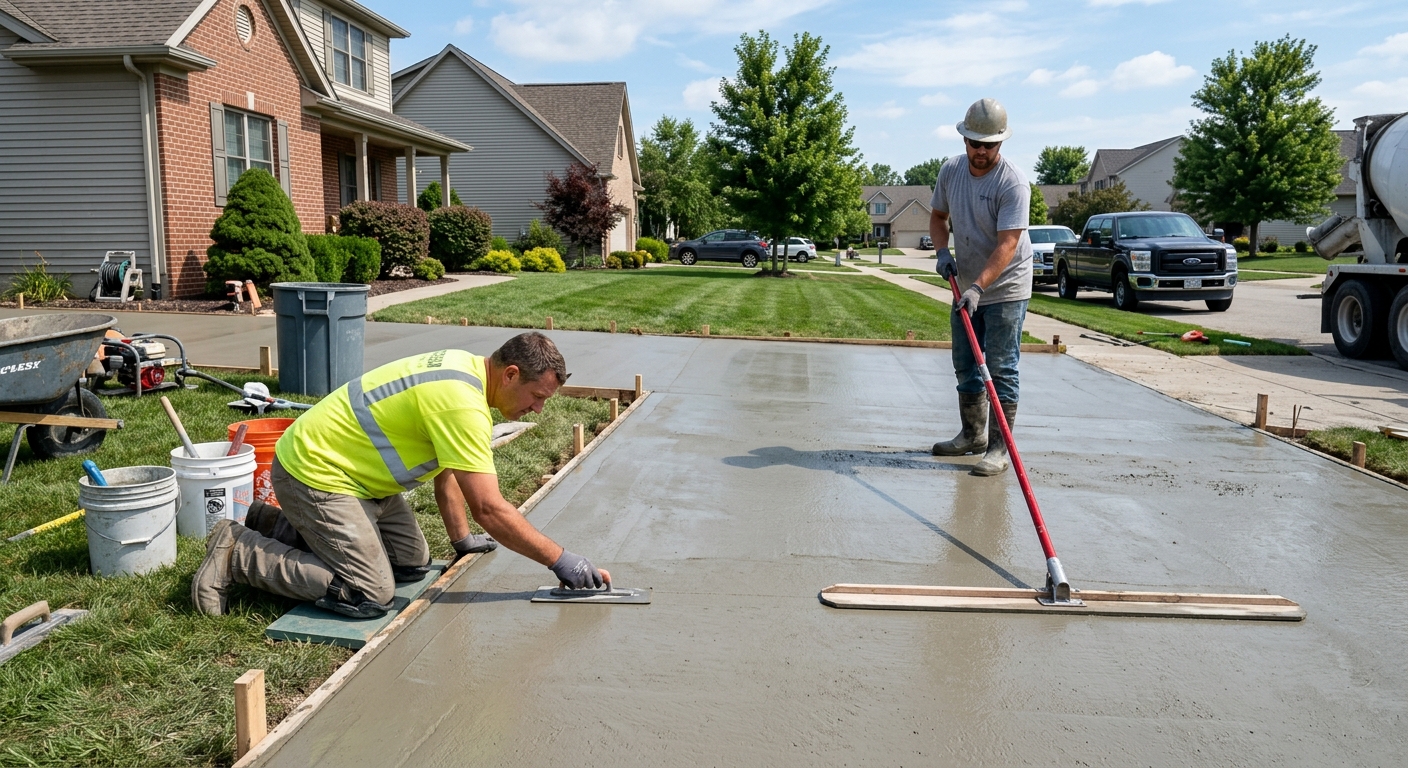
Concrete work options and costs in Downtown West End
In Downtown West End, Alberta, homeowners most often start with driveway, patio, and walkway concrete—because the area is built for practical, durable flatwork in a cold continental climate. With a small local population of 2,825 residents (Statistics Canada, 2021 Census), the market turns over through renovation and infill projects, and concrete trades stay busy when streets and back lanes need new slabs or foundation upgrades. That demand is especially noticeable around established pockets of older homes and laneway-access lots where excavation and re-grading are common, and where Calgary’s freeze–thaw cycles punish any weak base prep.
In Calgary and the surrounding region, costs are shaped by engineering realities: the design frost depth is about 1.2 m (roughly 4 ft), so footings and any frost-sensitive elements must bear on undisturbed soil below that depth. For exterior flatwork, we typically use air-entrained concrete and plan control joints to limit cracking and spalling as temperatures swing and de-icing salts are used. The practical pour season is shorter, so winter placements require winter-grade mixes, insulated blankets, and sometimes temporary heat—these add labour and equipment time.
Because contractors don’t all price the same scope (some include insulation blankets, granular base depth, or sealing; others don’t), the same “average” job can land at different ends of the pricing spectrum. Below is a practical comparison to help you line up expectations before you request itemised quotes.
| Application |
Typical Size |
Key Spec |
Finish Option |
Price Range |
| Concrete driveway (standard broom finish) |
24 ft x 10 ft (240 sq ft) |
Air-entrained mix, control joints, compacted granular base |
Broom finish + seal |
$12,000–$18,000 |
| Exposed aggregate driveway |
24 ft x 10 ft (240 sq ft) |
Air-entrained mix, proper curing to expose aggregate cleanly |
Exposed aggregate (surface retarder) |
$14,500–$21,500 |
| Stamped concrete driveway or patio |
20 ft x 12 ft (240 sq ft) |
Air-entrained mix, integral colour, release agent + curing care |
Stamped pattern with sealer |
$15,000–$26,000 |
| Plain concrete patio or walkway |
10 ft x 16 ft (160 sq ft) |
Air-entrained mix, thickened edges where needed |
Float + broom finish |
$5,000–$9,000 |
| Garage floor (interior slab) |
22 ft x 20 ft (440 sq ft) |
Vapour barrier, thickened perimeter, minimum fibre/rebar per spec |
Float finish + saw-cut joints |
$11,000–$18,000 |
| Foundation footings (structural, below frost) |
Typical house (engineered layout) |
Excavation to frost depth (~1.2 m), rebar cage, engineered thickness/steel |
Form + pour to plan (no decorative finish) |
$28,000–$45,000 |
Prices are estimates only and vary by project scope, site access and material selection.
What affects the price of concrete work in Downtown West End
In Downtown West End and across Calgary, it’s common to see quotes for the same concrete work vary by 30–50%. The difference usually isn’t “mystery pricing”—it’s scope and engineering details: whether the contractor includes excavation to the correct depth, the granular base thickness and compaction testing, the specified concrete mix (air-entrainment and strength), reinforcement requirements, and curing/blanketing for cold-weather pours. On exterior work, labour and equipment also swing depending on access for a concrete truck, the need for a pump, and the staging time to protect the slab from freezing before it reaches adequate strength.
Calgary’s climate drives much of the variance. With a design frost depth of about 1.2 m, footings and frost-sensitive components must be placed below that depth on undisturbed soil to prevent frost heave. Exterior slabs also require air-entrained concrete to survive freeze–thaw cycles, and de-icing salt exposure makes sealing more than just cosmetic—without it, surface scaling and spalling risks rise. The colder pour season is shorter, and winter-grade placement (insulating blankets, heated enclosures, or controlled curing) adds real cost. That’s why a standard driveway might fall in a band like $12,000–$18,000, while premium finishes can move into $15,000–$26,000 when stamps, integral colour, and more careful curing are included.
Two local examples: (1) a driveway built on soft, disturbed subgrade often needs deeper granular base—this can push the job toward the top of the slab band; (2) a late-season patio poured without temperature protection can lead to scaling that forces early repairs—cheaper quotes can turn expensive fast. In a market with lots of renovation work, foundations and footing scopes are also influenced by the original house age and the condition of existing soils and drainage, which directly affects excavation volume and reinforcement placement.
| Price Factor |
Why It Matters |
Cost Impact |
| Frost line depth — determines footing depth and form height |
Footings must bear below design frost depth to prevent movement |
Higher excavation can add thousands; deeper digs often push foundation work toward the top of the $28,000–$45,000 band |
| Site preparation — excavation, grading, compacted granular base |
Weak subgrade causes settlement and cracking |
Removal/haul and added base thickness can increase both labour and materials |
| Reinforcement — rebar or wire mesh requirement |
Controls cracking and improves structural capacity |
Additional steel and support chairs raise material + labour cost, especially for thicker or load-bearing slabs |
| Mix design — air-entrainment and compressive strength spec |
Freeze–thaw survival depends on air content and strength development |
Specialty mixes and stronger specs typically add incremental cost but reduce failure risk |
| Finish type — broom vs. stamped vs. exposed aggregate |
More steps require skilled labour and tighter curing control |
Premium finishes can move a driveway or patio into the $15,000–$26,000 range |
| Pour size and concrete truck access to site |
Pumping, access constraints, and re-tries affect placement time |
Pump/extended hose time can add major charges on smaller, tight lots |
| Cold-weather curing precautions — heating and blankets |
Concrete must cure without freezing to develop strength |
Insulation blankets, heat, and monitoring can noticeably raise exterior slab costs |
| Control joint pattern and sealing cost |
Joints manage cracking; sealing reduces salt-driven surface deterioration |
Skipping or under-specifying both is a common cause of early repairs |
Permits & regulations in Alberta
In Alberta, structural concrete work—such as foundation footings, foundation walls, and grade beams—typically requires a building permit and is usually based on engineered drawings that the municipality reviews. Concrete flatwork (patios, walkways, and driveways) often does not require a permit, unless it changes lot grading, affects impervious surface coverage limits, or ties into municipal right-of-way requirements (for example, work that impacts curb, sidewalk interface, or drainage flow). Always confirm requirements with the local authority before you excavate.
From a homeowner perspective in Downtown West End, your practical checks start before signing anything. Step one is contractor licensing and business eligibility: ask for the contractor’s registration details (and any applicable trade qualifications). Step two is insurance: request an up-to-date certificate of liability insurance listing you/your address as an additional insured where appropriate. Step three is workers’ compensation coverage—verify WSIB/WCB clearance where applicable for the contractor and subcontractors. Step four is documentation: ask for references from similar-scale concrete jobs and request photos of both the pour stage and the finished slab (including joints and edge details).
Then, before the crew mobilizes, ensure the quote clearly states whether permit pulls (when required), engineering requirements (for footings/walls), and haul-away/disposal are included. On structural work, missing permits or incomplete engineering can delay construction or force costly rework.
Getting concrete right in Downtown West End's freeze-thaw climate
Concrete failures in Downtown West End usually trace back to one of five issues: inadequate base preparation, wrong mix (especially air-entrainment), insufficient curing, poorly planned control joints, or sealing that happens too late or not at all. In Calgary’s freeze–thaw environment, you have rapid temperature swings and frequent de-icing salt use, so a slab that “looks fine” at pour time can scale or spall within a few winters if the concrete isn’t engineered correctly.
To spec the job properly: (1) base preparation should achieve a compacted granular sub-base at the correct depth for local soil and frost conditions—this is what limits settlement and prevents cracks from “opening” over time; (2) the mix design should be air-entrained, targeting about 5–7% air content for exterior flatwork, with a minimum 32 MPa compressive strength (or the engineered requirement for foundations); (3) control joints should be laid out with a consistent spacing plan to limit random cracking; (4) curing should be at least 7 days under proper conditions—especially when you’re close to colder weather where freezing at the surface can lock in damage; and (5) penetrating sealer is typically applied after cure (commonly at 28 days post-pour) to repel de-icing salts.
Here’s a real cost logic example: if a standard broom-finish driveway sits around $12,000–$18,000, spending toward a stamped or exposed finish may push you into $15,000–$26,000. That difference is justified only if the contractor also protects the curing process and uses the right air-entrained mix and joint/sealing plan—stamps don’t prevent failure; specs do. If you’re only choosing “appearance,” you risk paying extra without gaining durability.
Use your questions to target the most common failure: spalling from inadequate air-entrainment and rushed curing. Ask directly how they’re meeting air content, how they will keep the slab from freezing during early strength gain, and when sealing will be scheduled.
| Spec |
Why It Matters in Downtown West End |
What to Ask For |
Impact if Skipped |
| Compacted granular base (depth?) |
Controls settlement and reduces frost-related movement |
Confirm granular base thickness, compaction method, and frost-relevant excavation depth |
Cracking, uneven surfaces, and early spalling |
| Air-entrained concrete mix (target air %?) |
Freeze–thaw resistance depends on proper air bubbles |
Target 5–7% air content for exterior flatwork, and verify mix design on site |
Surface scaling and spalling over 1–3 winters |
| Compressive strength (MPa rating) |
Ensures strength gain before cold exposure |
Minimum 32 MPa for typical exterior work (or engineered requirement) |
Low durability, abrasion damage, and reduced structural capacity |
| Control joints (spacing per ACI guidelines) |
Limits random cracking patterns |
Joint spacing plan and saw-cut timing or contraction joint method |
Wide, uneven cracks that let water reach reinforcement |
| Minimum 7-day curing period |
Cold snaps can freeze weak surface paste and permanently weaken the slab |
How they’ll protect from freezing; curing temperature approach if late season |
Reduced strength, scaling, and premature deterioration |
| Penetrating sealer (when applied after cure) |
Repels melt water and de-icing salts that accelerate scaling |
Confirm sealer type and timing—typically after full cure (often 28 days) |
Faster salt damage and higher lifecycle repair costs |
How to choose a concrete work contractor in Downtown West End
Choosing the right concrete contractor in Downtown West End comes down to proof and clarity. Start by verifying Alberta licensing/eligibility for the contracting business (and the specific trade roles for the crew). Then check liability insurance: request a current certificate of insurance and confirm coverage limits are appropriate for the scope (excavation, forming, and truck access). Next, verify WSIB/WCB coverage and get a clearance letter or confirmation that applies to the contractor and any subcontractors. Don’t rely on verbal assurances—ask for documents.
For pricing, insist on 2–3 itemised written quotes. You want a breakdown that separates labour and materials (concrete volume, granular base, reinforcement, forms, joints, saw-cutting, hauling/disposal, and finishing/sealing). A true comparison also lists exclusions and allowances: what’s not included (curb cuts, permits, damage repairs, snow removal), whether permit pull is included when required for structural work, and whether disposal of excavated soil is covered.
Warranty matters in concrete because freeze–thaw failures can show up after the first winter. Ask for the workmanship warranty length, what’s covered (cracks due to shrinkage vs structural issues), and whether the warranty is transferable to a new homeowner if you sell. Payment schedule should be cautious: never pay more than 10–15% upfront, and hold back a reasonable amount until the job is complete and cleaned up properly. Finally, get the timeline in writing: a start date, pour day plan, curing protection approach, and estimated completion.
- Provide insurance documents (liability) before work begins
- Show WSIB/WCB clearance for the contractor and key subs
- Use itemised quotes with line items for excavation, base, reinforcement, concrete, and finishing
- Confirm air-entrained mix and minimum strength spec in the written scope
- Detail granular base depth and compaction approach
- State who handles permits when structural work requires them
- Include a joint and sealing plan (joint spacing + sealing timing)
- Explain cold-weather curing procedures if late season (blankets/heat/monitoring)
- Clarify concrete truck access (pump/hose fees vs included)
- Confirm disposal/haul-away is included if excavation is part of scope
- Provide a schedule showing curing protection and when saw-cut joints will be done
- List warranty terms in writing, including what triggers service calls
In Downtown West End, avoid contractors who (1) won’t put air content, curing time, and joint spacing in the quote, (2) skip sealing or treat it as optional without explaining salt exposure, (3) ask for heavy upfront payments beyond 10–15%, (4) lack insurance/WSIB/WCB documentation, or (5) dismiss Alberta frost depth requirements with “we’ve always done it shallow.”
Frequently asked questions — concrete work in Downtown West End
What is rebar and when is it required in Alberta?
Rebar (reinforcing steel) is steel bars added to concrete to help control cracking and improve load capacity. In Alberta, rebar is commonly required in structural elements like foundation footings, foundation walls, and grade beams based on engineered drawings and the concrete design—because these elements must handle soil pressures, movement, and, in Calgary’s case, frost-related loads. For exterior flatwork such as driveways and patios, reinforcement may be required depending on thickness, soil conditions, and loading (for example, heavy vehicles). In Downtown West End, I often see rebar or properly supported wire mesh specified when excavation and base compaction are challenging or when the slab is thicker than a basic walkway.
How long does a concrete project take in Downtown West End?
Timelines in Downtown West End usually depend on excavation, curing protection, and access for trucks. A small patio or walkway can be done in a few days once the sub-base is prepared, but the “clock” includes proper curing—exterior slabs should not be treated as fully ready immediately after the pour. Driveway work often includes more prep (base, forms, rebar if required) and can take about a week from start to finish when everything lines up, with curing affecting the usable timeline. Winter conditions can extend the schedule because contractors may need insulated blankets or heat to keep the slab from freezing too early. If you’re aiming for a broom-finish driveway in the $12,000–$18,000 range, plan for weather-driven scheduling, not just pour-day time.
What is a concrete overlay and is it suited to Downtown West End?
A concrete overlay is typically a cementitious topping or resurfacing system installed over an existing slab to improve appearance and smoothness, often without full demolition. In Downtown West End, overlays can be suitable when the existing concrete is structurally sound—meaning it’s not heaving, extensively broken, or draining poorly. However, overlays can fail if water is getting under the slab or if the original slab has movement from inadequate base prep or frost impacts. Calgary’s freeze–thaw cycles and de-icing salt exposure make proper assessment crucial: a contractor should check for voids, spalling, and joint performance before recommending an overlay. If your current driveway or patio is already scaling badly, full replacement may land closer to the standard slab band (for example, $12,000–$18,000) but can reduce the chance of repeated repairs.
How do I seal concrete to protect it in Downtown West End?
Sealing in Downtown West End is one of the most practical protections against freeze–thaw damage and salt-driven surface deterioration. The key rule is timing: most penetrating sealers are applied after the concrete has cured sufficiently—commonly about 28 days after the pour—so the slab is dry and stable. Before sealing, the surface must be cleaned (dust, salts, and debris can prevent proper penetration). Use a sealer designed for exterior concrete and discuss whether you need crack/joint maintenance first. Sealing helps repel melt water and slows salt penetration, but it’s not a substitute for correct mix design and air-entrainment. If you’re choosing finishes, remember that sealing is still recommended even on stamped or exposed aggregate surfaces to extend service life.
What is the difference between concrete and cement?
In everyday language, people often say “cement” when they mean the whole material, but technically they’re different. Cement is one ingredient inside concrete—typically Portland cement—combined with water, sand, and gravel (and sometimes admixtures like air-entrainment agents). Concrete is the finished construction material: it’s the mixture placed and cured into a solid slab. The difference matters because concrete properties—like air content for freeze–thaw resistance and compressive strength—are specified and measured for the concrete mix, not just the cement. In Calgary’s climate, that’s why your contractor should specify air-entrained exterior concrete and curing precautions, regardless of whether you refer to the product as “cement” or “concrete.”
How much does concrete work cost in Downtown West End?
Concrete costs in Downtown West End typically track Calgary market pricing and the realities of frost depth, excavation, and freeze–thaw engineering. As a planning reference, a standard broom-finish driveway is often estimated around $12,000–$18,000, while patios and walkways commonly land in the $5,000–$9,000 range depending on size and site access. Foundation/footings are more complex because they’re placed below frost depth and usually require engineered reinforcement—often estimated around $28,000–$45,000. Premium stamped concrete usually sits higher, commonly around $15,000–$26,000 due to additional labour steps and careful curing. If you want accurate pricing, ask each contractor for itemised quotes that include base preparation depth, mix specs, reinforcement, and sealing.