Concrete work options and costs in Bisset
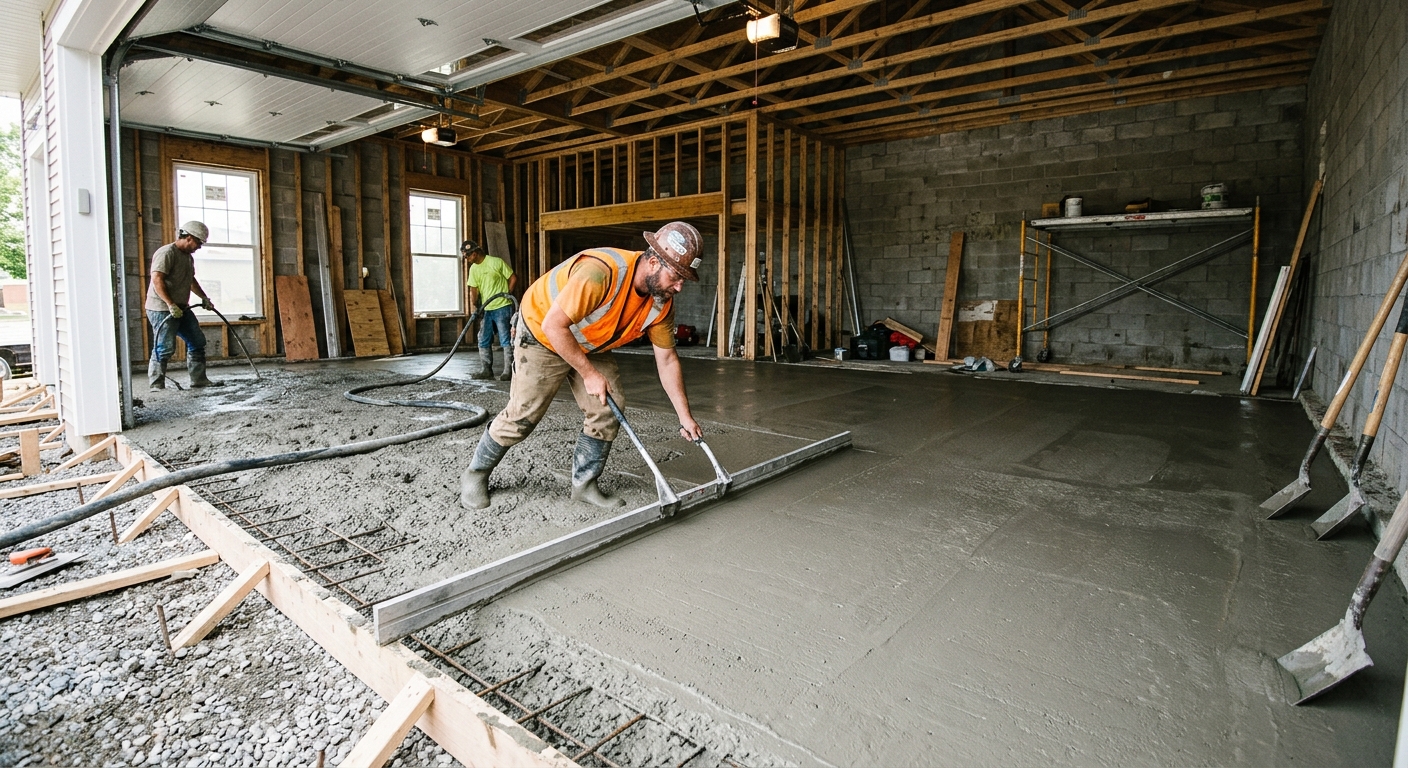
Bisset, Alberta is a small community (population 3,831 in 2021) and that directly shapes how concrete work gets scheduled and priced—crews and trucks often come in from the Calgary area, especially when multiple pours are happening at once. In this market, concrete flatwork is one of the most common upgrades homeowners plan alongside home improvements, particularly for single-detached homes that typically rely on driveways, patios and walkways for day-to-day access. With Alberta’s colder continental climate, Calgary-region projects are engineered around frost and frequent freeze–thaw cycles, which increases foundation and excavation scope and also pushes contractors toward air-entrained mixes and tighter curing controls.
In Bisset, you’ll feel these realities most clearly on exterior slabs. The design frost depth in this region is about 1.2 m (roughly 4 ft), so footing and any frost-susceptible construction must bear on undisturbed soil below that depth. For driveways and patios, that means deeper granular base prep, better compaction, and a curing approach that can’t be rushed—late fall or early spring pours in particular often require insulated blankets and sometimes temporary heat to achieve proper strength and reduce scaling. Demand is especially strong near newer developments and busier residential pockets around Bisset’s residential growth areas near local roads, where homeowners are regularly upgrading access and outdoor entertaining space.
Below is a practical comparison of common options you’ll see in Bisset, with realistic ranges you can use to sanity-check a quote before you ask for line-by-line details.
| Application |
Typical Size |
Key Spec |
Finish Option |
Price Range |
| Concrete driveway (standard broom finish) |
24 ft x 10 ft (240 sq. ft.) |
Air-entrained exterior mix, compacted base, control joints |
Broom finish, saw-cut joints |
$12,000–$18,000 |
| Exposed aggregate driveway |
24 ft x 10 ft (240 sq. ft.) |
Air-entrained exterior mix, polished/washed aggregate reveal, edged forms |
Exposed aggregate (weather-resistant texture) |
$15,000–$22,000 |
| Stamped concrete driveway or patio |
24 ft x 10 ft (240 sq. ft.) or patio 300 sq. ft. |
Base prep + reinforcement as needed, colour hardener + release agent |
Stamped pattern with sealed finish |
$15,000–$26,000 |
| Plain concrete patio or walkway |
200–300 sq. ft. (varies by layout) |
Air-entrained exterior mix, compaction, proper slope |
Float finish or broom edge |
$5,000–$9,000 |
| Garage floor (interior slab) |
22 ft x 22 ft (484 sq. ft.) |
Fibre or mesh as specified, vapour control + reinforced edges |
Steel trowel finish, optional densifier |
$9,500–$15,500 |
| Foundation footings (structural, below frost) |
Typical house perimeter/selected pads (site-dependent) |
Engineered footing size, rebar cage, below design frost depth |
Structural concrete, not decorative |
$28,000–$45,000 |
Prices are estimates only and vary by project scope, site access and material selection.
What affects the price of concrete work in Bisset
Even when two homeowners in the Calgary region are asking for the “same” concrete job, quotes can legitimately differ by 30–50%. That gap usually isn’t the concrete itself—it’s the engineering level, the depth and quality of excavation/granular base, the reinforcement spec, and whether the contractor is planning for freeze–thaw performance instead of treating cold-weather placement as optional.
In this climate, frost and freeze–thaw cycles drive the entire design conversation. Footings must extend below the design frost depth (about 1.2 m in this region) to prevent frost heave and seasonal movement. For exterior slabs—driveways, patios, walkways—contractors specify air-entrained concrete to handle repeated freezing, and they build in proper control joints to reduce random cracking. Calgary’s colder schedule also shortens the practical pour season. When you’re working near the edge of the season, cold-weather curing precautions (blankets, heaters, and protecting the slab after placement) add labour time and equipment costs. Finally, de-icing salt accelerates surface deterioration if the mix and curing aren’t right—sealing is often essential for long-term appearance.
Here’s how local conditions can raise or lower cost in Bisset: if your driveway ties into an existing driveway with limited access, trucking and forms can increase costs quickly; if your soil needs additional excavation to reach competent subgrade, you’ll see a larger “site prep” line. Conversely, a straightforward, flat backyard patio with easy truck access may land toward the lower end of the $5,000–$9,000 patio/walkway band. If you choose stamped concrete, the $15,000–$26,000 decorative band is often justified by added materials, labour and sealing, not just the pattern stamping.
If your home is on an older lot (or has older flatwork), removal can also drive cost: hauling, disposal, and subgrade restoration frequently add thousands compared to “new slab on ready base,” especially where previous slabs were underbuilt for frost performance.
| Price Factor |
Why It Matters |
Cost Impact |
| Frost line depth |
Determines footing depth and required form height |
Higher excavation volume increases total structural concrete and labour |
| Site preparation |
Excavation, grading, compacted granular base |
Poor or uncertain subgrade often adds trucking, granular, and re-compaction |
| Reinforcement |
Rebar or wire mesh requirement for load and frost performance |
More steel and labour to place properly increases price |
| Mix design |
Air-entrainment and compressive strength spec |
Exterior specs and winter-grade requirements can raise material costs |
| Finish type |
Broom vs. stamped vs. exposed aggregate |
Decorative finishes add specialized labour, tools, and sealing |
| Pour size and concrete truck access to site |
Placement efficiency and minimizing cold joints |
Limited access can force smaller pours, more labour, and extra scheduling |
| Cold-weather curing precautions |
Heating and blankets protect strength gain |
Equipment and labour to control temperatures adds cost in late season |
| Control joint pattern and sealing cost |
Limits random cracking and reduces salt scaling damage |
Joints require careful layout; sealing adds materials and application time |
Permits & regulations in Alberta
In Alberta, the key distinction is whether your concrete work is structural or whether it’s simply exterior flatwork. Structural concrete work—such as footings, foundation walls, and grade beams—typically requires a building permit and is commonly supported by engineered drawings that the municipality reviews. For concrete flatwork (driveways, patios, and walkways), a permit is usually not required unless the work affects lot grading, stormwater/lot drainage arrangements, impervious surface coverage rules, or municipal right-of-way concerns. Because rules can vary based on how the work changes surface runoff or encroaches on setback/servicing areas, confirm with the local authority before breaking ground.
For your contractor, don’t rely on verbal assurances—verify the paperwork. Step-by-step for a homeowner in Bisset: (1) confirm the contractor’s business details and eligibility through an online contractor registry or the relevant provincial listings they provide; (2) request a current Certificate of Insurance for liability insurance and ensure the coverage amount matches the job size; (3) ask for proof of WCB/WSIB coverage (workers’ compensation coverage in Alberta) and keep a copy for your records; (4) request clearance/confirmation letters where applicable and match the certificate to the legal business name on the contract; and (5) ask for references on similar-scale foundation or flatwork projects so you can verify both compliance and finish quality.
Getting concrete right in Bisset's freeze-thaw climate
Bisset’s freeze–thaw climate is where “good-looking concrete” often fails if it wasn’t spec’d for the environment. The common failure modes—scaling, spalling, and random cracking—usually trace back to a weak or poorly prepared base, inadequate air-entrainment, rushed curing, or control joints that weren’t planned for how the slab will move. To spec the job correctly here, start with base preparation: compacted granular sub-base to the required depth for local soil and frost conditions. Next, the mix design: for exterior flatwork, air-entrainment is critical (commonly targeting about 5–7% air content for freeze–thaw durability) and the concrete should be specified for at least 32 MPa compressive strength. Then plan control joints so the slab cracks in predictable locations, and don’t skip curing—minimum 7-day curing under the right conditions is a baseline, with cold-weather precautions when temperatures drop. Finally, apply a penetrating sealer after the slab has cured (often around 28 days post-pour) to help repel de-icing salts and reduce surface damage.
Ask the right technical questions. For example: “What air content are you targeting for the exterior mix?” If a contractor only talks about “standard concrete” and doesn’t discuss air-entrainment, you’re exposing the slab to the exact spalling risk that shows up in Calgary-region winters when salt and moisture cycle through the concrete surface.
Price-wise, some upgrades are worth it. If an exposed aggregate driveway costs more than broom-finish, that premium can be justified because it usually includes extra finishing steps and careful sealer application. But if someone prices stamped concrete without discussing curing and joint layout, the “decorative” premium isn’t protecting the structural performance. In Bisset, a driveway in the $12,000–$18,000 broom-finishing range can still last for years—if the spec is right—while a stamped driveway commonly sits in the $15,000–$26,000 decorative band because the added materials, labour and finishing control demand more precision.
| Spec |
Why It Matters in Bisset |
What to Ask For |
Impact if Skipped |
| Compacted granular base (depth?) |
Supports load and keeps frost-affected movement from reaching the slab |
Granular sub-base depth based on soil and frost performance plan |
Uneven settlement and cracking; faster deterioration at edges |
| Air-entrained concrete mix (target air %?) |
Enables freeze–thaw durability by providing space for ice expansion |
Exterior air-entrainment target (typically 5–7%) and winter mix plan if needed |
Spalling and scaling, especially with winter de-icing salt |
| Compressive strength (MPa rating) |
Determines how quickly the slab reaches structural capacity and long-term performance |
Minimum 32 MPa (as specified for the application) |
Surface wear, reduced durability, and higher risk of damage under traffic and salts |
| Control joints (spacing per ACI guidelines) |
Controls where cracking happens during movement and shrinkage |
Planned joint layout and spacing consistent with ACI guidance for slab thickness |
Random cracking, wider cracks, and more water intrusion |
| Minimum 7-day curing period |
Strength gain and surface quality depend on time and temperature protection |
Confirmation of curing duration and whether blankets/heaters are used in cold weather |
Reduced strength, scaling, and shortened service life |
| Penetrating sealer (when applied after cure) |
Reduces moisture and salt penetration through the concrete surface |
Penetrating sealer applied after cure (commonly around 28 days) |
Higher salt-related scaling and uneven discolouration |
How to choose a concrete work contractor in Bisset
Choosing the right concrete contractor in Bisset is mostly about proof: proof of coverage, proof of capability, and proof that the quote reflects the climate requirements of Calgary’s freeze–thaw season. Start by verifying Alberta coverage and compliance: ask for a current liability insurance certificate (confirm the legal name matches your contract), and request proof of WCB/WSIB coverage for their workers. Then check their status using available online registries or the documentation they provide—don’t accept expired certificates or generic summaries. If they can’t provide paperwork quickly, that’s your first warning sign.
Next, get 2–3 itemised written quotes. You want a breakdown that separates excavation/site prep, base material, reinforcement, concrete supply/mix type (including air-entrainment and winter provisions), forming, finishing, sealing, and disposal/haul-away. Avoid quotes that are only lump sums with no details; “cheap concrete” often ends up costing more after repair. Read the scope carefully: what’s excluded (uneven subgrade, soft spots, extra saw-cutting, tie-in removal, or disposal)? Is the permit pull included where needed for structural work? Is trucking and dump disposal included?
Warranty matters too. Ask for a workmanship warranty length and what it covers (surface scaling, cracking due to curing issues, joint performance). Clarify whether manufacturer product warranties are included and whether they’re transferable. Finally, payment scheduling should be realistic: never pay more than 10–15% upfront, and use a holdback until the job is complete and sealed (where included).
- Confirm liability insurance certificate is current and matches the contractor’s legal business name.
- Ask for WCB/WSIB coverage proof and keep a copy with your contract.
- Request an itemised quote (labour + materials) rather than a single lump sum.
- Ensure the exterior mix is described as air-entrained for freeze–thaw durability.
- Ask for the concrete strength target (minimum 32 MPa for typical exterior specs).
- Verify base depth and compaction plan for your soil conditions (not “one size fits all”).
- Check reinforcement details: rebar mesh placement and any dowels/edge bars where required.
- Confirm control joint layout and spacing approach to limit random cracking.
- Ask about curing time and cold-weather precautions (blankets/heaters if needed).
- Clarify if sealing is included, which product is used, and when it’s applied.
- Review disposal/haul-away for any removal and ask how excess concrete waste is handled.
- Get the start date and completion estimate in writing, including weather contingencies.
Concrete red flags in Bisset include: refusing to discuss air-entrainment or curing steps; quoting structural foundation work without engineered specs; vague promises like “we always broom it the same way” for exterior slabs; no clear reinforcement or joint plan in the scope; and requesting large upfront payments (well beyond 10–15%) before any prep work is done.
Frequently asked questions — concrete work in Bisset
How do I maintain concrete in Bisset's freeze-thaw climate?
In Bisset and the broader Calgary region, maintenance is mostly about controlling moisture and salt exposure. First, sweep regularly so sand and grit don’t grind the surface. For winter, use de-icing practices that don’t overdo salt—calcium chloride blends are often less harsh than rock salt for many surfaces, but avoid letting brine sit. If your driveway or walkway was sealed after cure (often around 28 days post-pour), you’ll generally get better resistance to salt-driven scaling. Also keep an eye on joints: if caulking or joint filler is failing, water can seep into cracks and speed up freeze–thaw damage. If you’re planning new work, ask your contractor about air-entrainment and a penetrating sealer schedule—this is a common reason a driveway can stay looking good longer even when it’s in the typical $12,000–$18,000 range.
What causes concrete to spall in Bisset winters?
Spalling in Bisset winters is usually a freeze–thaw durability problem. The most common causes are inadequate air-entrainment (too little protected air voids), poor curing in cold weather, and water/salt getting into the surface through cracks or poorly planned joints. When moisture repeatedly freezes, it expands and breaks down the top layer—so you’ll see flaking or pop-outs, especially near edges and in areas that get heavy de-icing. Another driver is rushing the schedule: if the slab is poured late in the season without blankets/heating to achieve proper strength gain, the surface can be weaker and more vulnerable. To prevent this, confirm the exterior mix is air-entrained and the job includes correct curing time (minimum 7 days under proper conditions) and a penetrating sealer after cure. For exterior flatwork, that technical spec is often more important than whether the finish is plain or decorative.
What is rebar and when is it required in Alberta?
Rebar is steel reinforcement bars used to help concrete resist tension and control cracking. In Alberta, whether you need rebar comes down to engineering and the slab’s design—concrete can be strong in compression but weak in tension, and the Calgary-region freeze–thaw movement increases the importance of reinforcement for many structural and load-bearing applications. For structural work like foundation footings and grade beams, reinforcement is typically required by engineered drawings and inspection requirements tied to the building permit process. For exterior slabs such as driveways, reinforcement may be specified based on thickness, subgrade quality, expected loading (cars, heavy vehicles), and how the base is prepared. Some contractors use wire mesh or fibres, but you should ask what’s specified in your quote: placement depth, chairing/tie-down details, and how reinforcement is supported so it sits in the correct zone. If a contractor can’t explain their reinforcement approach, that’s a cue to request the exact spec before signing.
How long does a concrete project take in Bisset?
In Bisset, timelines depend heavily on scope, removal needs, and weather. A typical exterior patio or walkway can often be scheduled and completed in days, but the concrete still needs proper curing before you remove protection and allow normal use. As a practical expectation: most small flatwork projects can have active work (excavation, forms, pour, finishing) over 1–3 days, with curing stretching beyond that. For cold-weather or late-season pours, contractors may add days to manage curing with insulated blankets or temporary heat to reach the target strength. For larger driveway projects, access planning and finishing sequencing can add time, particularly if you’re combining multiple pours or tying into existing concrete. Foundation work takes longer because of excavation and engineered steps, plus inspections. Regardless of the calendar, don’t let a contractor push you to use the slab early; minimum curing periods are part of durability in Alberta’s freeze–thaw climate.
What is a concrete overlay and is it suited to Bisset?
A concrete overlay is a new surface layer placed on top of existing concrete—often to improve appearance or to correct minor surface deterioration. In Bisset, overlays can be suitable when the existing slab is still structurally sound (no major heaving, widespread delamination, or failing base). If the original slab is moving due to poor base support or frost issues, an overlay usually won’t fix the underlying problem; it can crack or fail along with the movement beneath. Overlays are also sensitive to preparation: grinding, proper bonding methods, and ensuring drainage away from the slab are critical to prevent moisture from trapping under the new layer. If you’re dealing with surface scaling, a sealed overlay approach can help cosmetic wear, but if the concrete is actively spalling, removal and re-pour are typically the durable fix. If you’re comparing options, it may cost less than a full driveway replacement in some cases, but the right choice depends on inspection of the existing concrete and joints.
How do I seal concrete to protect it in Bisset?
Sealing concrete in Bisset is about repelling moisture and reducing salt penetration—especially important in Alberta’s freeze–thaw winters. The timing matters: most penetrating sealers are applied after the slab has cured thoroughly, commonly around 28 days post-pour, so the concrete has released enough moisture to accept the product. Before sealing, the surface should be clean and dry, and cracks or failing joints should be addressed first; sealing over active water pathways won’t stop freeze–thaw damage. For driveways and walkways, choose a penetrating sealer rather than a heavy film-former for better salt/moisture control. After installation, avoid heavy de-icing immediately in early winter, and keep traffic off until the sealer is fully cured. If you’re budgeting, sealing is often included in decorative or higher-end exterior scopes (for example, stamped options commonly fall in the $15,000–$26,000 band), but it can also be added to broom-finish projects—just confirm it’s included in the written quote.