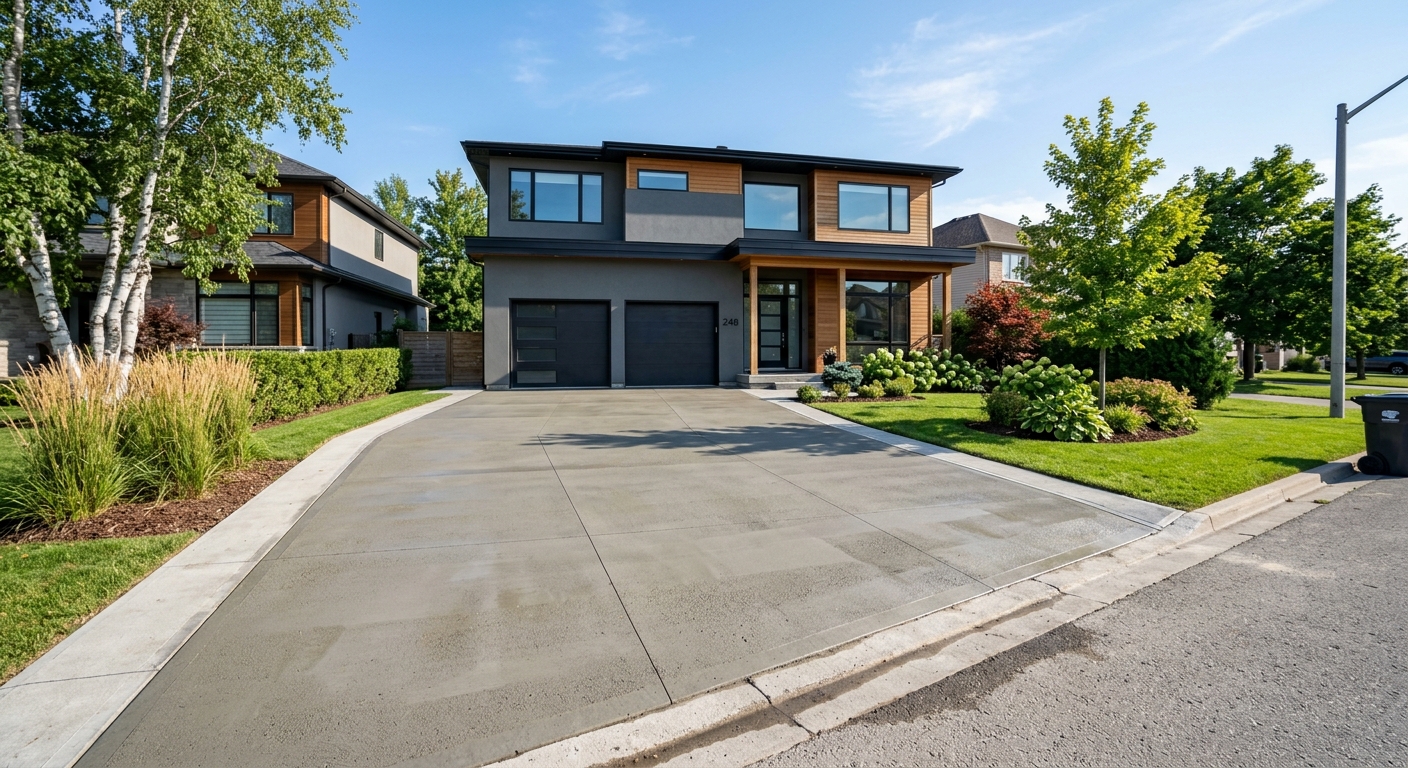
Concrete work options and costs in Belvedere
Belvedere, Alberta is a small community within the Calgary market, and concrete flatwork is one of the first exterior upgrades homeowners notice—especially when temperatures swing hard through the year. With a population of 5,018 (Statistics Canada, 2021 Census), the local housing base is tight-knit, and when a crew schedules a driveway or patio pour, you’ll often see them booked around the same neighbourhoods in the Calgary region. In practice, most concrete demand here is driven by single-family homeowners who want durable surfaces that can handle Alberta’s freeze–thaw cycles without heaving, scaling, or early cracking.
Cost is shaped less by “concrete being concrete” and more by what Calgary-area conditions demand. The regional design frost depth is about 1.2 m (roughly 4 ft), so structural work—footings and foundation elements—must be excavated and built on undisturbed soil below that depth. For exterior slabs, Calgary’s frequent freeze–thaw drives higher-spec air-entrained mixes, granular base preparation, and control joints to reduce spalling and random cracking. In colder months, the pour window tightens; winter-grade mix, insulated blankets, and sometimes temporary heat are often needed to get proper curing instead of surface damage.
In Belvedere, contractor demand tends to be strongest around established residential pockets with good truck access and straightforward site grades—where driveways, garage slabs, and backyard patios can be completed efficiently without rework. Below is a practical comparison of typical sizes, specs, finish options, and price ranges so you can line up like-for-like quotes for your project.
| Application |
Typical Size |
Key Spec |
Finish Option |
Price Range |
| Concrete driveway (standard broom finish) |
400–600 sq ft |
Air-entrained exterior mix; compacted granular base; control joints |
Broom finish |
$12,000–$18,000 |
| Exposed aggregate driveway |
400–600 sq ft |
Proper cure and surface wash timing; air-entrained exterior mix |
Exposed aggregate |
$13,500–$21,000 |
| Stamped concrete driveway or patio |
300–500 sq ft |
Durable stamp mats; integral color (often); air-entrained mix |
Stamped & colored |
$15,000–$26,000 |
| Plain concrete patio or walkway |
200–400 sq ft |
Compacted base; air-entrained exterior mix; joint layout |
Plain trowel/broom depending on slope |
$5,000–$9,000 |
| Garage floor (interior slab) |
400–600 sq ft |
Vapor barrier (as required); mesh or rebar as spec’d; 32 MPa class |
Broom finish |
$9,500–$15,500 |
| Foundation footings (structural, below frost) |
Typical single-detached footprint |
Excavate to undisturbed soil below design frost depth; engineered steel per plan |
Structural concrete (no decorative finish) |
$28,000–$45,000 |
Prices are estimates only and vary by project scope, site access and material selection.
What affects the price of concrete work in Belvedere
If you get two quotes for what sounds like the same job, it’s not unusual to see a 30–50% swing across the Calgary and Alberta market. The difference is usually in the “invisible” specs: how deep the excavation goes for the frost line, how much granular base is placed and compacted, whether reinforcement is actually included where it matters, and how the contractor plans cold-weather curing. Local labour rates also vary with timing and urgency—when the region tightens the pour window, crews charge more because scheduling and heating requirements rise.
In this climate, frost design drives everything. Footings must extend below the design frost depth (about 1.2 m in the Calgary area) to reduce the risk of frost heave and seasonal movement. Exterior slabs also need air-entrained concrete to survive freeze–thaw cycles; if that air-entrainment spec isn’t followed, you can see scaling and spalling sooner, which then forces costly repairs. Calgary’s shorter exterior pour season often means cold-weather precautions—insulated blankets and sometimes temporary heat—adding labour, equipment, and time. Finally, de-icing salt accelerates surface deterioration, so sealing later becomes a practical “must” rather than an upgrade.
Concrete examples from Belvedere: (1) if your driveway has poor drainage or a slope that pushes water toward the slab edge, base prep and grading work typically add cost; (2) if the contractor proposes “thin” excavation or insufficient compacted base, the initial price may look lower, but you’ll pay later when settlement or random cracking appears. If you’re comparing finish options, stamped concrete often moves you from the $12,000–$18,000 driveway band into the $15,000–$26,000 range because the labour and material steps are more involved (form detailing, stamp workflow, and colour handling). With older homes or late-winter thaw cycles, soil may be wetter and harder to manage, increasing excavation and haul-away costs—sometimes by thousands of dollars.
| Price Factor |
Why It Matters |
Cost Impact |
| Frost line depth |
Determines footing depth and form height, and protects against frost heave |
Higher excavation and concrete volume can add several thousand dollars |
| Site preparation |
Excavation, grading, and compacted granular base control settlement and cracking |
Poor access or extra haul-away raises labour and equipment time |
| Reinforcement |
Rebar or mesh helps control cracking and supports loads |
Steel cost plus install labour; omission usually lowers the quote but hurts longevity |
| Mix design |
Air-entrainment and strength specs govern freeze–thaw durability |
Correct mix increases material cost but reduces early scaling and repairs |
| Finish type |
Broom vs. stamped vs. exposed aggregate changes labour, workflow, and materials |
Stamped/exposed often increases cost by thousands versus standard broom |
| Pour size and concrete truck access |
Large pours need efficient batching/placement; narrow access increases time |
Extra labour and pump/extra equipment charges can apply |
| Cold-weather curing precautions |
Heating, blankets, and curing control protect strength gain |
Winter-grade work can noticeably increase the total due to time and equipment |
| Control joint pattern and sealing cost |
Proper jointing reduces random cracking; sealing helps with de-icing salts |
Increases line-item cost but often prevents premature surface damage |
Permits & regulations in Alberta
In Alberta, structural concrete work—such as footings, foundation walls, and grade beams—typically requires a building permit, and engineered drawings are often needed and reviewed through the municipal process. For concrete flatwork like driveways, patios, and walkways, permits are frequently not required by default, but you must check because permits can come into play if the work affects lot grading, drainage, setbacks, impervious surface coverage limits, or the municipal right-of-way. The safe approach is to confirm with the local authority before breaking ground, even if your neighbour’s job didn’t require a permit.
Before signing, verify the contractor carries liability insurance and has coverage for workers through WSIB/WCB (as applicable to the contractor’s operations). Then request references for similar-scope concrete in the Calgary area—especially exterior flatwork—so you’re not relying on only photos.
Step-by-step, for Belvedere homeowners: (1) ask for the contractor’s certificate of insurance—ensure it shows liability coverage and current dates; (2) request proof of WSIB/WCB clearance or coverage documentation; (3) confirm the contractor’s Alberta licensing details through the appropriate online registry for trades; and (4) keep copies of everything with your quote and contract so you can verify coverage again if issues arise. If a contractor refuses to provide documentation up front, that’s a major warning sign.
Getting concrete right in Belvedere's freeze-thaw climate
Concrete failures in Belvedere usually trace back to a few predictable causes: water management problems under the slab, inadequate base preparation, and mix specs that don’t match Alberta’s freeze–thaw demands. The correct way to spec the job is to build from the ground up. First, base preparation: use a compacted granular sub-base sized for local soil conditions and excavation depth that respects the design frost environment. Second, mix design: for exterior flatwork, require air-entrainment (commonly around 5–7% air) and a minimum compressive strength spec of 32 MPa. Third, control joints: plan joint locations and spacing to limit random cracking and give cracks a predictable path. Fourth, curing: aim for at least 7 days of proper curing conditions—cold weather requires extra attention with insulation blankets and, when needed, controlled temperature to ensure strength gain. Fifth, sealing: apply a penetrating sealer after the concrete has fully cured (often at around 28 days) to help repel de-icing salts and reduce surface damage.
When you ask for these items explicitly, you reduce the most common high-cost issue: spalling caused by inadequate air-entrainment and premature surface exposure to freeze–thaw and salt. For example, in Belvedere, a standard broom-finished driveway may land around $12,000–$18,000. If a quote tries to “save money” by reducing air-entrainment or skipping proper curing precautions, you might see a lower number today—but repairs, patching, or full replacement later can easily jump into the $15,000–$26,000 range of a more premium driveway because you’re redoing the work from a failed surface.
| Spec |
Why It Matters in Belvedere |
What to Ask For |
Impact if Skipped |
| Compacted granular base (depth?) |
Controls frost movement and limits settlement during freeze–thaw cycles |
State base depth/type and compaction method; include grading/drainage plan |
Settlement and cracking; edges can heave or debond |
| Air-entrained concrete mix (target air %?) |
Provides durability against freeze–thaw damage in Alberta winters |
Target air content of about 5–7% for exterior flatwork |
Higher risk of scaling and spalling on the surface |
| Compressive strength (MPa rating) |
Ensures required strength gain for structural and surface performance |
Minimum 32 MPa (confirm at time of placement/cure per spec) |
Lower strength leads to brittle behaviour and premature wear |
| Control joints (spacing per ACI guidelines) |
Limits random cracking that can admit water and accelerate freeze–thaw cycles |
Joint spacing plan tied to slab dimensions and panel layout |
Random cracks; increased water infiltration and freeze-related damage |
| Minimum 7-day curing period |
Cold weather affects strength gain and surface durability |
Confirm curing approach and protection method if temperatures drop |
Surface scaling, weaker slab, and possible long-term durability issues |
| Penetrating sealer (when applied after cure) |
Repels de-icing salts and reduces moisture uptake |
Apply penetrating sealer after cure (commonly around 28 days post-pour) |
Faster salt damage and more staining/roughening of the surface |
How to choose a concrete work contractor in Belvedere
Choosing the right concrete contractor in Belvedere starts with documentation and detail. In Alberta, confirm the contractor is properly licensed for their trade scope (where applicable) and that they carry liability insurance. Ask for a current certificate of insurance and ensure the coverage dates are valid for your project period. Next, confirm WSIB/WCB coverage: request proof of clearance or coverage documentation before work begins—don’t rely on verbal assurance.
Then focus on the quote itself. Get 2–3 itemised written quotes that break out labour, excavation/base prep, rebar/mesh, concrete supply, finishing, joints, and any sealing. Avoid “lump sum” quotes without line items, especially for exterior slabs where base depth, reinforcement placement, and curing precautions can swing costs dramatically. Read the scope carefully for exclusions: is site access included? Is disposal of excess soil included? Are permit-related tasks included (where required for structural concrete)? What temperature limitations trigger extra curing charges?
Warranty matters: ask for the workmanship warranty length and whether it’s specific to cracking/spalling issues or only general workmanship. Also ask about the product/manufacturer warranty for any sealers or speciality materials and whether it transfers to the homeowner.
Payment schedule should be conservative: never pay more than about 10–15% upfront, and hold back a portion until completion and cleanup are verified. Timeline expectations should be written—start date, curing/protection plan, and estimated completion date—so you know how they will manage the cold-weather curing window in the Calgary region.
- Request proof of current liability insurance (certificate with your job dates).
- Ask for WSIB/WCB clearance or coverage documentation before scheduling.
- Confirm licensing details relevant to the work being performed (in Alberta).
- Get 2–3 itemised quotes with labour and materials broken out.
- Verify base prep depth, granular type, and compaction method in writing.
- Confirm concrete mix spec: air-entrainment and minimum 32 MPa rating.
- Require joint layout and sealing plan to be included (or priced separately).
- Ask how they handle cold-weather curing (blankets/heating) and when charges apply.
- Confirm reinforcement (rebar/mesh) type and placement, not just “included.”
- Clarify truck access: whether a pump is needed, and who pays for it.
- Review warranty terms for workmanship and any product/sealer warranties.
- Set payment terms: 10–15% max upfront; holdback until final walk-through.
Red flags I see in Belvedere concrete jobs include contractors who won’t discuss air-entrainment specs, quotes that omit base depth/compaction details, no clear curing plan for cold nights, “cheap” joints or no joint layout, and requests for large upfront payments without a written schedule and scope.
Frequently asked questions — concrete work in Belvedere
How long does a concrete project take in Belvedere?
In Belvedere, the timeline depends mainly on pour size, site prep, and weather. A typical broom-finished driveway often takes a day for excavation/base prep and a day for forming and the pour, with curing and protection afterwards. If you add sealed curing blankets for cold evenings, expect longer total calendar time even though the active work is short. Patios and walkways are usually quicker because the slab is smaller and access is simpler. For projects tied to structural work, like foundation footings, schedule can stretch because inspections and engineered steps affect start/hold points. Plan around the Calgary region’s shorter exterior pour season—late fall or early spring can add time due to winter-grade mix and extra curing measures. For homeowners, the practical question is: when can the surface be trafficked safely, and when will it be ready for de-icing season use?
What is a concrete overlay and is it suited to Belvedere?
A concrete overlay is a new cementitious layer placed over an existing slab to restore appearance and reduce minor surface issues. It can be suited to Belvedere if—and this is the key—the existing concrete is still structurally sound, with no major sub-base settlement or widespread cracking. Overlays do not “fix” frost movement problems caused by poor base prep; if the slab beneath has started to move, the overlay can crack and fail along with it. In Alberta’s freeze–thaw cycle and with de-icing salts, overlay success depends heavily on surface preparation (profiling/cleaning), bond quality, proper mix, and curing. If your driveway is merely worn but stable, an overlay may cost less than full replacement. If you’re looking at replacement pricing, many driveways land around $12,000–$18,000, while stamped systems go higher; overlays can be an option only after a contractor evaluates slab movement and drainage.
How do I seal concrete to protect it in Belvedere?
Sealing in Belvedere is about managing moisture and de-icing salt exposure. Use a penetrating sealer designed for concrete (not just a cosmetic film), and apply it after the concrete has fully cured—commonly around 28 days after the pour. Before sealing, the surface should be clean, dry, and free of dust or construction residue; applying sealer too early can trap moisture and reduce performance. Choose a product appropriate for exterior freeze–thaw exposure, and follow the manufacturer’s temperature and dryness requirements for application. After sealing, continue to use de-icers carefully: avoid excessive salt and prefer non-corrosive options when possible. Sealing won’t prevent cracking caused by frost heave, but it helps slow surface scaling and spalling where water and salts get into the pores. If your quote includes sealing, ask what product is being used and whether the contractor covers application timing during cold snaps.
What is the difference between concrete and cement?
Concrete is the final construction material you pour—typically a mixture of cement, water, sand (fine aggregate), gravel or crushed stone (coarse aggregate), and sometimes admixtures. Cement is only one ingredient: the binding material that reacts with water to create the paste that holds everything together. Contractors specify performance through concrete parameters like air-entrainment and compressive strength, because those govern durability in Alberta’s freeze–thaw climate. When you hear “32 MPa” or an air content target, that’s about the concrete mix design, not just the cement itself. In Belvedere, the practical difference shows up in durability: exterior concrete needs air-entrainment (commonly about 5–7% for flatwork) so freeze–thaw doesn’t destroy the surface. So when comparing quotes, focus on the concrete specs (mix design, curing, joints), not only brand names of cement.
How much does concrete work cost in Belvedere?
Concrete costs in Belvedere are driven by the same Calgary-area factors: frost depth excavation, base preparation, air-entrained mix, reinforcement, and the winter curing precautions needed to protect the slab. For reference, a concrete driveway (standard broom finish) commonly lands around $12,000–$18,000. A plain patio or walkway is often in the $5,000–$9,000 range depending on size and site conditions. Stamped concrete tends to be higher, commonly in the $15,000–$26,000 band because of labour-intensive forming, stamping, and colouring steps. Foundation footings (structural, below frost) are a separate cost category and often land around $28,000–$45,000 in typical scopes. Always compare itemised quotes—if the base depth, air-entrainment spec, or curing plan changes, the price difference is usually justified.
How deep must footings be for Belvedere's frost line?
For Belvedere in the Calgary region, the design frost depth used in engineering practice is about 1.2 m (roughly 4 ft). In plain terms, that means footings and structural concrete elements like foundation components must bear on undisturbed soil below the design frost environment to reduce the risk of frost heave and seasonal movement. The exact depth for your specific home depends on your geotechnical conditions, building design, and what the engineered drawings call for—so you shouldn’t pick a depth from a generic guide without the plan. For homeowners, the check is simple: confirm the excavation reaches the engineered frost bearing level and that the contractor doesn’t “value engineer” the excavation depth. Ask to see how their footing scope aligns to the frost-depth design and whether they’re following engineered steel placement requirements. This is especially important because Calgary-area freeze–thaw cycles punish small construction shortcuts over time.