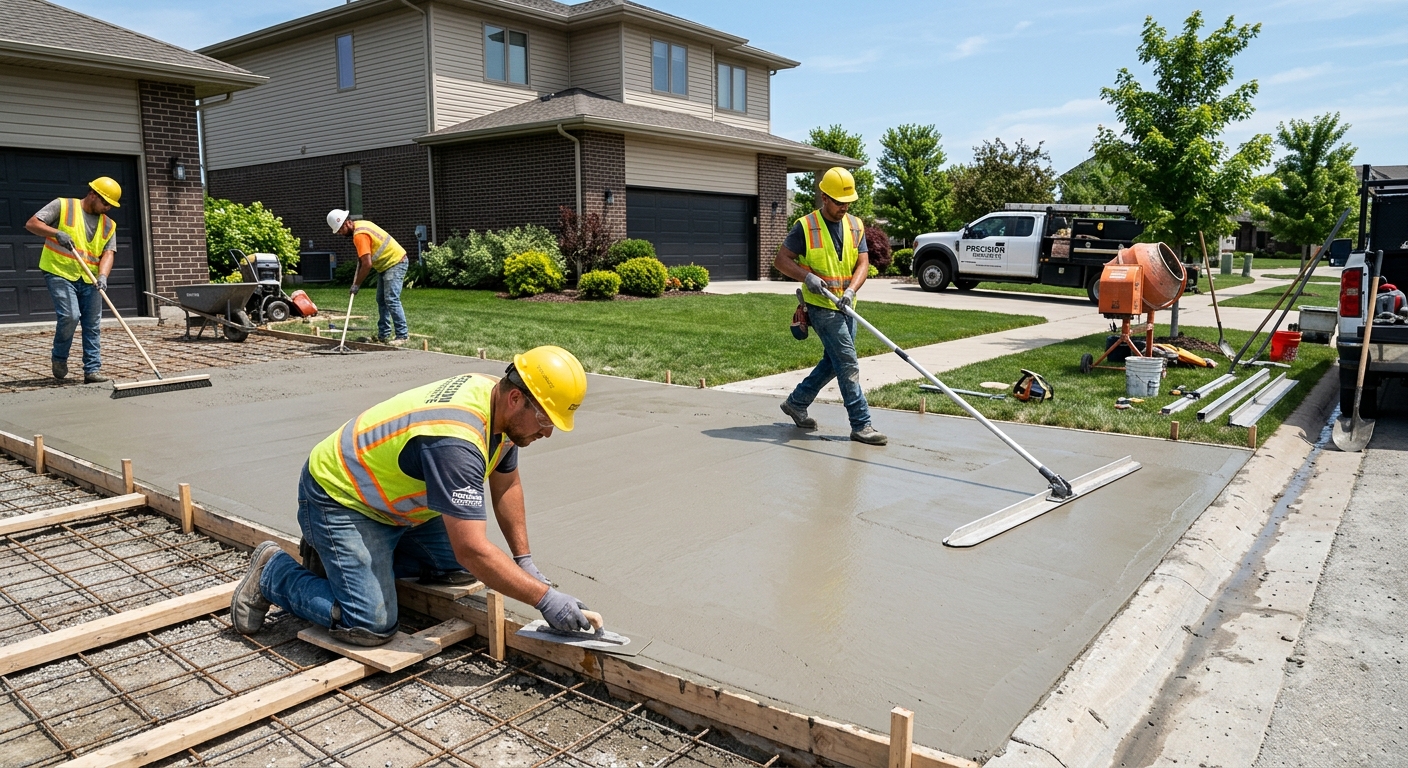
Concrete work options and costs in Grovenor
Grovenor, Alberta is a small community (2,347 people based on the Statistics Canada, 2021 Census), but it sits in the Calgary region’s demanding freeze–thaw reality, so concrete isn’t “one spec fits all.” In practice, most concrete flatwork demand tracks closely with the local housing stock—many homeowners upgrade driveways, patios and walkways as part of exterior maintenance and landscaping. Calgary-area contractors are also busiest around established residential areas where access and staging are predictable, and in Grovenor that demand is often strongest near the more developed residential pockets where long driveway approaches and established grades are common.
Pricing in Grovenor is shaped by the region’s engineered frost depth and the amount of excavation required. With design frost depths of about 1.2 m (roughly 4 ft) for typical house and accessory footings, contractors must excavate to undisturbed soil below the frost line—then add granular base and proper compaction. On top of that, repeated freeze–thaw cycles mean exterior slabs should be built with air-entrained concrete and a control-joint plan. That adds both material and labour, and it’s why the same driveway can land 30–50% apart depending on thickness, base prep and finish.
Finally, the practical pour season is shorter than in milder provinces, so cold-weather placement (insulated blankets, winter-grade mix, sometimes temporary heat) can be necessary to cure correctly. If you’re comparing options, use the ranges below as a starting point: standard broom-finished slabs typically align with the region’s backbone driveway costs, while stamped and decorative work follows a higher, finish-driven band.
| Application |
Typical Size |
Key Spec |
Finish Option |
Price Range |
| Concrete driveway (standard broom finish) |
24 ft x 10 ft (240 sq. ft.) |
Air-entrained mix, compacted granular base |
Broom finish + seal |
$12,000–$18,000 |
| Exposed aggregate driveway |
24 ft x 10 ft (240 sq. ft.) |
Air-entrained mix, proper retarder timing |
Exposed aggregate finish |
$15,000–$22,000 |
| Stamped concrete driveway or patio |
20 ft x 12 ft (240 sq. ft.) |
Air-entrained mix, release agent + curing plan |
Stamped patterns with colour hardener |
$15,000–$26,000 |
| Plain concrete patio or walkway |
12 ft x 12 ft (144 sq. ft.) |
Reinforcement as required, compacted base |
Float + broom or light broom |
$5,000–$9,000 |
| Garage floor (interior slab) |
24 ft x 22 ft (528 sq. ft.) |
Vapour barrier where needed, proper thickness |
Steel trowel or broom finish |
$8,500–$15,500 |
| Foundation footings (structural, below frost) |
Per house/engineered scope |
Concrete designed to local frost depth |
Structural concrete/formed footings |
$28,000–$45,000 |
Prices are estimates only and vary by project scope, site access and material selection.
What affects the price of concrete work in Grovenor
In Grovenor and the wider Calgary area, quotes for the “same” concrete job can differ by 30–50% because the drivers aren’t just the concrete itself—they’re what’s under it (excavation, compaction, reinforcement) and how it’s protected during a tough curing window. Cold-weather placement, short effective pour season, and freeze–thaw exposure all push contractors toward higher-spec mixes, engineered base prep and careful scheduling. The result is that two contractors may quote different thickness, different base depth, or different mix/air content, and that shifts cost quickly.
Frost line depth is the biggest technical reason. Calgary-region practice uses a design frost depth of about 1.2 m (roughly 4 ft) for typical residential work, so footings and any structural foundation elements must bear on undisturbed soil below that depth to limit frost heave. Exterior slabs also need robust granular base prep to resist pumping and movement. Add repeated freeze–thaw cycles across the region, and exterior concrete should use air-entrained mixes designed to survive those conditions. If temperatures drop during placement, cold-weather curing precautions—insulating blankets and sometimes heated enclosures—add labour and rental costs.
De-icing salt is another cost factor. Salt accelerates surface scaling if the slab is under-specified or poorly finished, so sealing becomes a practical “insurance” step. For context, a broom-finished driveway often lands in the $12,000–$18,000 band, while stamped/decorative work commonly tracks the higher $15,000–$26,000 band because of formwork, extra finish steps, and more labour-intensive curing and detailing.
Two Grovenor-specific examples: (1) a thicker slab over weak subgrade can add thousands because base reconstruction and re-compaction are required; (2) easy truck access (short reach from street, no tight turns) reduces pump/placement time and can keep a walkway nearer the $5,000–$9,000 band. Also, older neighbourhood grading around existing landscaping sometimes forces extra excavation and re-build of compacted base, which shows up directly in the quote.
| Price Factor |
Why It Matters |
Cost Impact |
| Frost line depth |
Determines footing depth and form height |
More excavation and concrete; can move foundation scope toward the higher end of $28,000–$45,000 |
| Site preparation |
Excavation, grading, compacted granular base |
Additional hauling/compaction can increase flatwork pricing by thousands |
| Reinforcement |
Rebar or wire mesh requirement |
Material and labour time; omission can shorten slab life in freeze–thaw cycles |
| Mix design |
Air-entrainment and compressive strength spec |
Winter-grade or higher-spec air content raises material cost but improves durability |
| Finish type |
Broom vs. stamped vs. exposed aggregate |
More labour, timing and tools; stamped/decorative typically aligns with $15,000–$26,000 |
| Pour size and concrete truck access to site |
Placement speed and logistics |
Long staging distances or tight access can require pump/extra crews |
| Cold-weather curing precautions |
Heating and blankets |
Rental and labour add-ons; critical to prevent scaling |
| Control joint pattern and sealing cost |
Controls cracking; reduces salt damage |
More detailing and a sealer step; typically modest cost compared with repairs |
Permits & regulations in Alberta
In Alberta, concrete work is split between structural items that typically need permits and flatwork that often doesn’t—unless it changes drainage, grade, or site conditions. Structural concrete work such as footings, foundation walls, grade beams and foundation-related structural elements generally requires a building permit, and engineered drawings are commonly reviewed before approval. For exterior concrete flatwork like patios, walkways and driveways, a permit is usually not required by default, but you should expect checks if your project affects lot grading, stormwater flow, or the municipality’s limits around impervious surfaces, or if you’re working close to a municipal right-of-way. Confirm with the local authority before you dig—especially if you’re lowering/raising grades or tying into existing drainage features.
Before you hire anyone in Grovenor, also verify: (1) the contractor carries liability insurance; (2) they have the correct WSIB or applicable WCB
- Check Alberta licensing details via the appropriate provincial/registry sources listed on the contractor’s website or business profile.
- Ask for a Certificate of Insurance showing liability coverage effective dates and project/contractor name.
- Request proof of WSIB/WCB clearance (a clearance letter or account evidence).
- Confirm insurance covers concrete placement activities (not just general contracting).
- Verify references on similar-scale projects (driveway vs. footing is not the same work).
If you can’t get these documents quickly, it’s a real red flag.
Getting concrete right in Grovenor's freeze-thaw climate
Concrete failure in Grovenor usually comes down to one of four things: weak base preparation, incorrect mix design (especially air-entrainment), poor control-joint detailing, or rushed curing. In Calgary’s cold continental climate, freeze–thaw cycles repeatedly expand and contract water inside concrete pores. If the concrete mix doesn’t have enough air content and proper durability specs, water damage shows up as surface scaling (spalling) and faster deterioration. That’s why the “best” job is engineered from the ground up.
To spec the job correctly, start with base preparation. Your slab needs a compacted granular sub-base to the right depth for local soil and frost considerations, not just “some gravel.” Next, mix design: for exterior flatwork, air-entrainment is typically targeted around 5–7% air content and you should expect minimum compressive strength of 32 MPa depending on the engineered spec. Control joints should be placed to encourage cracking where it’s acceptable, limiting random cracking through the field. Curing matters as much as placement: in cold snaps, you need at least 7 days of proper curing conditions, which may include insulated blankets and/or temporary heat to prevent early freezing.
Finally, sealing is where homeowners can actively protect their investment. A penetrating sealer applied about 28 days post-pour helps repel de-icing salts—important because salt accelerates surface damage on older or under-sealed slabs.
Dollar example: if one quote offers standard broom finish at the $12,000–$18,000 driveway band but skips proper base thickness and air-entrained mix verification, you may save upfront yet face earlier repairs. In Grovenor, that’s false economy—rebuilding a driveway after premature scaling often costs far more than the incremental specification and curing steps.
| Spec |
Why It Matters in Grovenor |
What to Ask For |
Impact if Skipped |
| Compacted granular base (depth?) |
Limits movement during freeze–thaw and prevents pumping |
Base depth plan based on soil + engineered frost considerations |
Settlement, cracking and premature surface failure |
| Air-entrained concrete mix (target air %?) |
Reduces freeze–thaw damage to paste and surfaces |
Confirm air content target, typical 5–7% for exterior flatwork |
Spalling/scaling risk increases significantly |
| Compressive strength (MPa rating) |
Supports structural integrity and durability |
Minimum 32 MPa (or project spec if engineered) |
Weak concrete can crack and erode sooner |
| Control joints (spacing per ACI guidelines) |
Controls where cracks occur under thermal movement |
Joint spacing and layout drawing for the slab dimensions |
Random cracking across visible slab areas |
| Minimum 7-day curing period |
Achieves strength and reduces early freezing damage |
Curing method (blankets/heat if needed) and timeline |
Surface weakness, scaling and long-term durability issues |
| Penetrating sealer (when applied after cure) |
Repels salt and reduces moisture ingress |
Penetrating sealer applied about 28 days after pour |
Faster salt-related deterioration and staining |
How to choose a concrete work contractor in Grovenor
Choosing the right concrete contractor in Grovenor starts with verifying credentials and matching the quote to the climate realities. In Alberta, confirm the contractor’s licensing (if applicable to their work), then require proof of liability insurance and WSIB/WCB coverage. To check each: look for an online business profile/registry entry where required, ask for a current Certificate of Insurance (effective dates and coverage limits), and request a WSIB clearance letter or equivalent WCB proof showing the account is in good standing for the period covering your project.
Next, get 2–3 itemised written quotes with a labour-and-materials breakdown. A real comparison includes: excavation/haul-off, formwork, base supply and compaction, reinforcement (wire mesh vs. rebar where used), concrete thickness and mix spec, finishing method, curing/blankets, joint cutting pattern, and sealing. Also read the exclusions: will permit pulling be included if it applies to engineered structural work? Is disposal of unsuitable soils included? Are there fees for pump access or extra mobilization if trucks can’t get close?
Warranty should be in writing. Ask for the workmanship warranty length, whether the product/manufacturer warranty applies to your materials, and if it’s transferable if you sell your home. Payment schedule matters too: never accept more than about 10–15% upfront, and hold back until key completion milestones are met. Finally, get a start date and completion estimate in writing so winter-risk scheduling is transparent.
- Insurance certificate includes your project’s work scope (placement/finishing) and valid dates.
- WSIB/WCB clearance proof provided before work begins.
- Quotes list slab thickness, base depth and compaction assumptions—not just “concrete supply.”
- Concrete mix is specified as air-entrained for exterior exposure.
- Reinforcement approach is stated (mesh/rebar where required) with dimensions/plan notes.
- Control joint layout is included with approximate spacing and finishing sequence.
- Curing plan is described for cold snaps (blankets/heat if required).
- Sealing is specified as penetrating sealer and timing (about 28 days post-pour).
- Traffic management and site cleanup/disposal are clearly itemised.
- Access constraints (truck reach/pump) are addressed in writing.
- Workmanship warranty is written and not just “verbal assurance.”
- Payment terms align with milestone-based progress, with a holdback.
Red flags in Grovenor: vague quotes with no thickness or base specs, “we’ve never had issues” claims that ignore freeze–thaw performance, refusal to provide insurance/WSIB proof, pressure for large upfront payments, and finish promises (like “no joints needed”) that contradict basic control-joint practice for exterior slabs.
Frequently asked questions — concrete work in Grovenor
How long does a concrete driveway last?
In Grovenor and the Calgary-area climate, a well-built driveway often lasts 20–30 years, sometimes longer, but only if the slab is engineered for freeze–thaw. The key drivers are excavation depth and base compaction, correct air-entrained mix for exterior exposure, a proper control-joint pattern, and curing that avoids early damage. Driveways that are poured with under-specified air content or rushed curing frequently show scaling sooner, especially after winters with de-icing salt. If your driveway is built to the same quality standard that supports the local $12,000–$18,000 driveway band (including proper prep and finish), you’re giving it the best odds. For patios and walkways, similar durability logic applies, just at smaller scale.
What is air-entrained concrete and why does it matter here?
Air-entrained concrete is designed with tiny, evenly distributed air bubbles in the mix. Those bubbles provide space for water to expand when it freezes, reducing internal pressure that causes surface scaling and spalling. In Grovenor’s freeze–thaw conditions, air-entrainment is not optional—it’s one of the most important specs for exterior flatwork. It’s also why you’ll hear contractors emphasize correct mix design and curing timing during colder months. If a quote doesn’t clearly state that the concrete is air-entrained for exterior exposure, treat it as incomplete. Compared with a basic mix, air-entrainment and correct placement/cure can move the project slightly within the expected ranges—typically still consistent with the region’s backbone pricing for driveways and slabs, but it protects the finish you’re paying for.
How do I prepare the base for a concrete slab?
For any exterior slab in Grovenor—driveways, patios or walkways—base preparation is usually the difference between long service life and early cracking. Contractors typically excavate to the required depth, remove unsuitable soils, then install a compacted granular base in lifts with proper moisture conditioning and density testing/verification. The frost depth requirement in the region affects how deep foundations go, and for exterior slabs it drives how contractors approach granular depth and compaction to prevent movement during freeze–thaw. Ask your contractor to specify the granular base depth, compaction method, and whether reinforcement is included where required. A credible quote should also explain drainage and grading so water doesn’t pool near the slab edges, because that accelerates deterioration.
How do I compare concrete quotes?
Compare quotes like-for-like, not just total price. Ask each contractor to provide itemised line items: excavation and haul-off, base depth and compaction, reinforcement type, slab thickness, concrete mix details (including air-entrainment for exterior work), finishing method, joint layout, curing plan, and sealing. Make sure they specify whether winter-grade precautions (blankets/heating) are included if the schedule is tight. If one quote lands in the $12,000–$18,000 driveway band but another is much higher, check whether the lower bid is skipping base depth, using a different finish approach, or omitting curing/sealing steps. If a quote includes decorative stamped work, expect it to align more with the $15,000–$26,000 range because it’s labour-intensive and requires tighter control during placement and curing.
Can concrete be poured in cold weather in Grovenor?
Yes, concrete can be poured in cold weather in Grovenor, but it must be handled correctly to protect curing. When temperatures drop, contractors may use winter-grade mixes, insulating blankets and, in some cases, temporary heat to keep concrete from freezing too early. The curing window is critical here because early freezing increases the risk of weak surface, scaling, and long-term durability issues. The best approach is to plan pours around temperature and schedule constraints, then specify cold-weather protection in writing. Ask your contractor to describe the curing method, how long they’ll insulate, and how they’ll monitor conditions. A “we’ll pour whenever you want” approach without a documented curing plan is a risk, especially for exterior slabs exposed to freeze–thaw and de-icing salt.
How do I maintain concrete in Grovenor's freeze-thaw climate?
Maintenance in Grovenor is mostly about moisture and salt control. First, apply a penetrating sealer after proper curing—typically around 28 days post-pour—because it helps repel de-icing salts and reduces moisture ingress that leads to scaling. Second, use de-icing products carefully: avoid over-salting and choose products that are appropriate for concrete surfaces. Third, keep water draining away from slab edges by addressing grading and downspout discharge. Fourth, inspect the driveway or patio annually for small cracks or joint failures; address them early with the right joint sealing approach rather than waiting for spalling to expand. If you keep the slab sealed and manage water/salt exposure, you protect the freeze–thaw performance the original air-entrained mix was designed to handle.