Concrete work options and costs in York
York, Alberta is small, but it sits right in the Calgary market, so concrete pricing and scheduling are shaped by the same contractors, crews, and winter-readiness requirements you’d see around Calgary. With a 2021 population of 3,836 (Statistics Canada, 2021 Census), most driveways, patios, and walkways in the York area are tied to owner-occupied homes and garages on typical suburban lots—work that’s in steady demand. In practice, the biggest cost swings come from Calgary’s cold continental climate: the engineered frost depth is about 1.2 m (roughly 4 ft), so footing and base volumes are higher than in milder regions. Combine that with frequent freeze–thaw cycles and you get stricter specs—air-entrained concrete, granular base prep, and proper control joints—especially for exterior slabs.
Contractors are also careful about the pour calendar. In late fall and early spring, cold-weather placement may require winter-grade mixes, insulated curing blankets, and sometimes temporary heat to protect the slab while it gains strength. That reduces downtime risk, but it adds line items that can move a quote up or down.
Concrete work is particularly busy around newer residential pockets like the Rosedale Estates area, where homeowners often upgrade driveways and add patios once landscaping is installed. Below are common applications and what you can typically expect to pay in York, based on the local Calgary price bands.
| Application |
Typical Size |
Key Spec |
Finish Option |
Price Range |
| Concrete driveway (standard broom finish) |
400–600 sq. ft. |
Air-entrained mix; compacted granular base; control joints |
Broomed, light broom texture |
$12,000–$18,000 |
| Exposed aggregate driveway |
400–650 sq. ft. |
Air-entrained mix; binder/cure method; reinforced as needed |
Exposed aggregate finish |
$14,500–$21,500 |
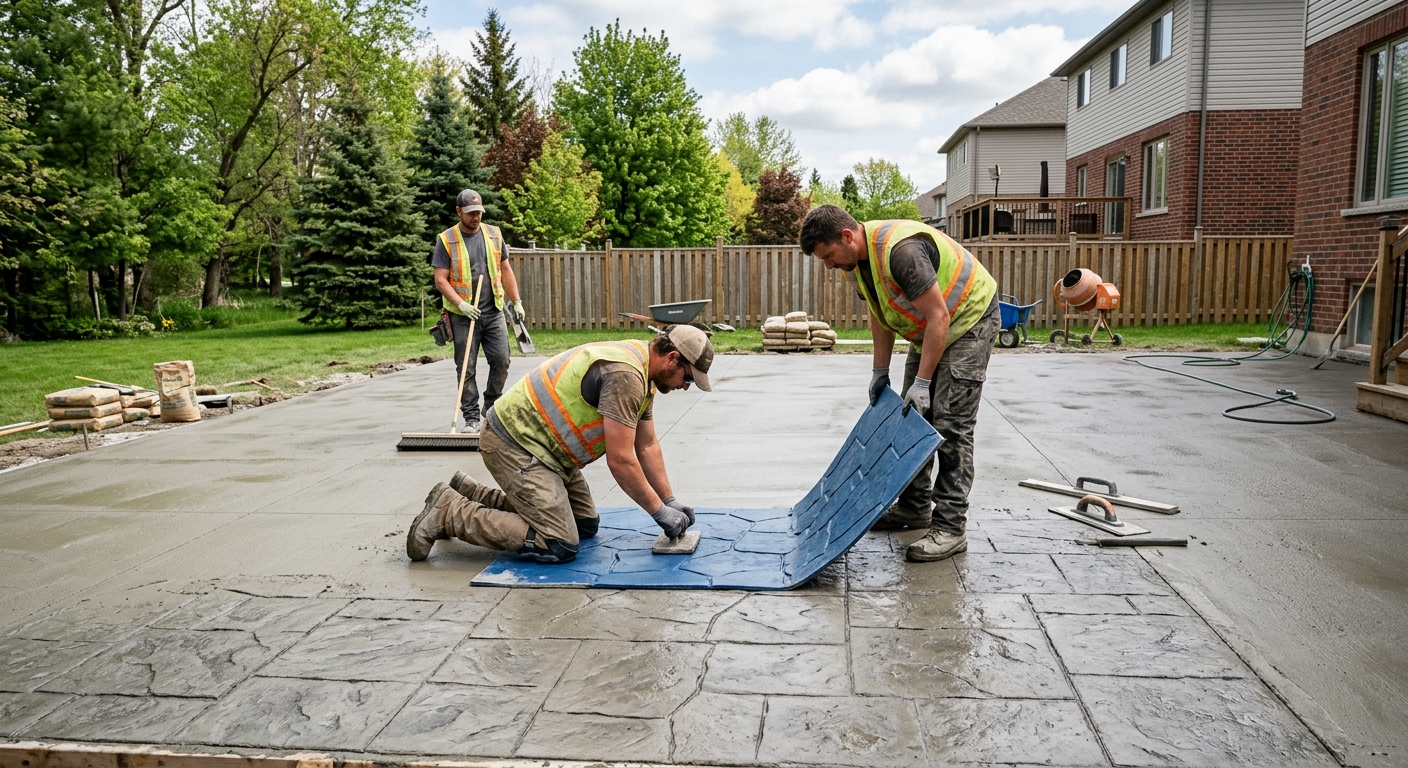
| Stamped concrete driveway or patio |
300–600 sq. ft. |
Air-entrained mix; color hardener/antiquing (where specified) |
Stamped pattern with sealant |
$15,000–$26,000 |
| Plain concrete patio or walkway |
150–400 sq. ft. |
Air-entrained mix; proper base and jointing |
Float/smooth or light broom |
$5,000–$9,000 |
| Garage floor (interior slab) |
300–500 sq. ft. |
Vapour barrier (as needed); fibre or mesh; thickness per design |
Smooth trowel or broom finish |
$6,000–$12,000 |
| Foundation footings (structural, below frost) |
Typical house perimeter + piers |
Excavate to undisturbed soil below ~1.2 m frost depth; rebar as engineered |
Structural concrete, formed/finished for grade |
$28,000–$45,000 |
Prices are estimates only and vary by project scope, site access and material selection.
What affects the price of concrete work in York
In York, Alberta, it’s common to see quotes for the “same” concrete job vary by 30–50% because the real drivers are under the surface: how deep the excavation goes, how much granular base is hauled and compacted, what reinforcement is required, and whether the contractor is engineering for freeze–thaw longevity. Even when two quotes both say “concrete driveway,” one may be designed for proper base depth and air-entrainment, while the other is closer to a minimal install. In Calgary’s market, the difference can show up quickly—especially on slabs that get salted.
Three specifications are non-negotiable in our cold continental climate. First, frost depth matters: exterior footings and structural supports must bear below the local design frost depth (about 1.2 m in this region) to prevent frost heave and seasonal movement. Second, freeze–thaw performance depends on air-entrained concrete; for exterior flatwork, contractors typically target about 5–7% air to resist spalling. Third, the shorter exterior pour season means winter-grade mixes and cold-weather curing precautions—like insulating blankets or temporary heat—can add cost when work happens in late fall or early spring.
Local conditions can also raise or lower the price. Steeper yards or lots that need significant regrading can push excavation and formwork costs up, while easy access (wide driveway, minimal tree removal) can keep a driveway closer to the $12,000–$18,000 band. For example, a simple broom-finished driveway with straightforward access may land near the lower end, while a stamped driveway or patio with colour and a more involved finishing crew usually sits in the $15,000–$26,000 range—often worth it when you want impact and curb appeal. The age and layout of nearby homes also matter: older properties may have more demolition and debris hauling before you can build the required granular base.
| Price Factor |
Why It Matters |
Cost Impact |
| Frost line depth — determines footing depth and form height |
Footings must extend below the design frost depth to prevent heave and seasonal movement. |
Major: deeper excavation increases concrete, rebar, and forming labour. |
| Site preparation — excavation, grading, compacted granular base |
Proper base reduces settling and helps drainage through freeze–thaw cycles. |
Moderate to major: haul and compaction time can swing the quote. |
| Reinforcement — rebar or wire mesh requirement |
Controls cracking and supports load transfer, especially at edges and thicker slabs. |
Moderate: material and additional labour for placement and chairs. |
| Mix design — air-entrainment and compressive strength spec |
Air entrainment protects against spalling in winter; strength supports long-term performance. |
Moderate: winter-grade specs and stricter mix requirements can add cost. |
| Finish type — broom vs. stamped vs. exposed aggregate |
Finishes require different labour time and materials (colour hardener, release agents, sealing). |
Low to major depending on finish complexity. |
| Pour size and concrete truck access to site |
Access affects how many truck loads and how fast the crew can place and finish. |
Moderate: tight access may require smaller batch scheduling or extra equipment. |
| Cold-weather curing precautions — heating and blankets |
Curing must be protected so the concrete gains strength without surface scaling. |
Moderate to major in late fall/early spring. |
| Control joint pattern and sealing cost |
Joint layout manages cracking; sealing helps repel de-icing salts. |
Low to moderate: small materials cost, labour and timing matter. |
Permits & regulations in Alberta
In Alberta, structural concrete work typically needs a building permit and often engineered drawings reviewed through the municipality. That includes foundation work such as footings, foundation walls, and grade beams—basically any structural concrete that supports the building and is affected by frost protection requirements. For concrete flatwork like patios, walkways, and driveways, permits are usually not required as standalone work unless the project affects lot grading, impervious surface coverage limits, or the municipal right-of-way. Even then, the requirement depends on how the work ties into drainage and surface runoff. Before any excavation, confirm with your local authority so you don’t lose time or have to redo work.
For your contractor in York, Alberta, also verify basic compliance up front. Step-by-step: (1) Ask for their Alberta business details and check they’re eligible to perform the work you’re hiring for; (2) Request a certificate of liability insurance that matches the job value and effective dates; (3) Confirm they carry WSIB/WCB coverage (ask for clearance documentation or a current account verification letter, depending on their setup). Then, check references on similar-scale projects—driveways with proper base prep and exterior jointing are a good real-world proxy for how they’ll handle your freeze–thaw durability specs.
Getting concrete right in York's freeze-thaw climate
Concrete failure in York, Alberta is usually not “bad concrete”—it’s the wrong spec for the climate or shortcuts in base prep and curing. The two most common issues are spalling from inadequate air-entrainment and cracking that starts at edges because granular base and jointing weren’t engineered for freeze–thaw movement. To spec the job correctly, start with base preparation: excavate to the proper depth for local soil conditions and compact a granular sub-base. Next, mix design: exterior flatwork should use air-entrained concrete, typically targeting 5–7% air content, with a minimum compressive strength of 32 MPa. Third, control joints: plan joint spacing so shrinkage and thermal movement produce cracks at joints instead of randomly.
Curing is critical here. You generally want a minimum 7-day curing period under proper conditions, and in cold weather you may need insulating blankets and careful temperature management so the slab gains strength rather than scaling. Finally, sealing: apply a penetrating sealer after the cure window (commonly 28 days post-pour) so de-icing salts don’t accelerate deterioration at the surface.
A quick price reality check: if you’re choosing between a plain patio in the $5,000–$9,000 band and a stamped patio that lands more in the $15,000–$26,000 range, the difference is justified when you’re also upgrading overall prep quality, joint layout, and sealing. If a quote for stamped work is cheaper than expected but skips air-entrainment or compromises base depth, you’re basically paying for appearance while risking early winter damage.
| Spec |
Why It Matters in York |
What to Ask For |
Impact if Skipped |
| Compacted granular base (depth?) |
Reduces settling and supports drainage through repeated freeze–thaw cycles. |
Exact base depth, soil class assumptions, and compaction method. |
Uneven settlement, cracking, and premature joint failure. |
| Air-entrained concrete mix (target air %?) |
Protects against freeze–thaw spalling and surface scaling. |
Air content target (commonly 5–7% for exterior flatwork) on the pour ticket or spec sheet. |
Spalling and flaking in winter, especially where de-icing salt is used. |
| Compressive strength (MPa rating) |
Ensures durability and structural capacity for the long term. |
Minimum 32 MPa stated and included in mix design. |
Reduced strength gain and higher risk of scaling or early cracking. |
| Control joints (spacing per ACI guidelines) |
Controls where cracks form from shrinkage and thermal movement. |
Joint spacing plan for your slab size and thickness. |
Random cracking across the slab and more difficult repairs. |
| Minimum 7-day curing period |
Gives concrete time to reach handling strength and resist early damage. |
Specified cure time and what happens if temps drop. |
Surface weakness, scaling, and compromised long-term performance. |
| Penetrating sealer (when applied after cure) |
Repels water and reduces how salts work into the surface. |
Confirm seal type and timing (commonly after 28 days). |
Faster deterioration from salt exposure and wetting cycles. |
How to choose a concrete work contractor in York
Choosing the right concrete contractor in York, Alberta starts with compliance and proof—not promises. First, ask whether they carry liability insurance and confirm the policy is active and valid for your project dates. Next, verify WSIB/WCB coverage: request a current clearance letter or equivalent account verification that matches their coverage status. For Alberta work, it’s also reasonable to ask for their business credentials and how subcontractors are handled—then confirm they’ll remain responsible for workmanship if they use crews through the season.
Second, get 2–3 itemised written quotes. You want labour and materials clearly separated (concrete supply, reinforcement, forms, base prep, disposal, sealing). Avoid quotes that are purely lump-sum with broad wording like “concrete and finish,” because that hides whether frost-safe base prep and proper mix specs are included. Ask what’s excluded: permit pull responsibilities, tree removal, demolition/disposal, and any tie-ins to existing concrete or grading/drainage.
Third, read the warranty details. A solid workmanship warranty should be stated in writing, and you should know whether it’s transferable if you sell the home. Finally, manage payment: don’t pay more than 10–15% upfront; use a holdback until the job is complete and clean-up is done.
Timeline matters in this climate. Ask for a start date and a completion estimate in writing, plus what cold-weather curing steps they’ll use if temperatures drop.
- Confirm liability insurance and request the certificate before signing.
- Confirm WSIB/WCB coverage with a clearance letter or account verification.
- Ask for 2–3 local references from Calgary-area projects with similar slab type.
- Require an itemised quote (labour, concrete, rebar/mesh, base, formwork, disposal, sealing).
- Check whether frost-safe excavation and proper granular base compaction are explicitly included.
- Ask for the air-entrainment and minimum strength spec (commonly 32 MPa and ~5–7% air for exterior).
- Verify control joint layout and finish curing plan are part of the scope.
- Clarify cold-weather curing: blankets/heating plan if temps drop.
- Confirm whether sealing is included (and when it will be applied—after cure).
- Ask about truck access and whether the quote assumes lane closures or equipment.
- Avoid paying large sums upfront; keep a holdback until acceptance.
- Get start date, completion date, and weather contingencies in writing.
Concrete red flags I see in York: (1) no mention of air-entrained mix or curing steps; (2) “we’ll pour when we can” without a winter cure plan; (3) missing base depth details or vague wording on excavation to frost-safe depth; (4) no clear joint spacing plan; and (5) warranties that only cover “materials” but not workmanship.
Frequently asked questions — concrete work in York
Can concrete be poured in cold weather in York?
Yes, concrete can often be poured in York, Alberta during cold weather, but it has to be engineered for it. The main risk is early freezing before the concrete reaches adequate strength, which can lead to surface scaling and weaker durability through freeze–thaw cycles. Reputable crews use cold-weather practices such as winter-grade mixes, heated enclosures or temporary heat (when needed), and insulated curing blankets to maintain proper temperature and curing conditions. Plan for a tighter schedule because the exterior pour season is shorter here. If your driveway or patio is being placed near late fall/early spring, ask the contractor to explain their curing plan and what they’ll do if temperatures drop overnight.
How do I maintain concrete in York's freeze-thaw climate?
Maintenance in York is about protecting the slab surface from water and de-icing salt. Keep the surface clean and minimize salt overuse—salt accelerates spalling where the concrete is weak or poorly air-entrained. If you have exterior flatwork, sealing helps repel moisture; a penetrating sealer is commonly applied after the full cure window (often around 28 days post-pour). Sweep off sand and grit (to reduce abrasion), and avoid heavy impact from plows straight onto the slab edges. If you see early surface pitting or scaling, catch it quickly—repairs made early usually cost far less than letting it spread. Finally, don’t ignore drainage: if water pools near the slab, it will cycle through freezing and warming more intensely than the rest of the yard.
What causes concrete to spall in York winters?
In York winters, spalling is most commonly linked to freeze–thaw damage—especially when air-entrainment isn’t correct or curing was rushed. Without adequate air content, internal water can expand as temperatures fall, and the surface paste can break down and flake off. Salt exposure makes it worse because it increases moisture movement at the surface. The second frequent cause is poor base prep or drainage, where water saturates the slab edges and joints; then each cold snap intensifies deterioration. A contractor quote that lands low (for example, trying to stay near the $5,000–$9,000 patio band while skipping air-entrainment details) can be a warning sign. Ask for the air-entrainment target and the minimum strength spec, and ensure control joints and sealing are included as part of a freeze–thaw-ready system.
What is rebar and when is it required in Alberta?
Rebar (reinforcing steel) is used to strengthen concrete so it can carry tensile forces and control cracking under load and temperature movement. In Alberta, rebar requirements depend on the design and the application. Structural concrete—especially foundation footings, foundation walls, and grade beams—typically involves engineered reinforcement and is often reviewed as part of the building design. For exterior flatwork like driveways and patios, some slabs may use welded wire mesh or rebar depending on thickness, soil conditions, and whether heavy vehicles will drive on the slab. In York, it’s not enough to ask “do you use rebar?”—you should ask what the slab thickness is, what reinforcement is specified, and where it’s placed (including chairs/spacers) so the steel sits in the correct concrete cover.
How long does a concrete project take in York?
Timelines vary by scope, access, and weather, but most residential projects in York follow a predictable sequence: excavation/base prep, reinforcement setup (if required), formwork, pour, curing protection, then finishing and clean-up. For a typical driveway in the $12,000–$18,000 range, you might see about a 1–3 day site window for prep and pour, with curing/handling steps extending the overall completion timeline. Patios and walkways are often faster—frequently in the $5,000–$9,000 band depending on size and finish—though stamping can add extra crew time. If cold weather hits, cold-weather curing precautions can extend calendar time even if the pour day is quick. Ask your contractor to provide a written start date, an estimated completion date, and the “if temps drop” plan.
What is a concrete overlay and is it suited to York?
A concrete overlay is a new layer placed over an existing slab to improve appearance and add surface wear resistance—sometimes including grinding/prep, crack repair, and a bonding system before the overlay pour. In York, overlays can be suited when the existing concrete is mostly stable (not heavily cracked, heaving, or failed at the sub-base), because overlays can’t fully correct structural problems underneath. You’ll still need proper base and drainage management, correct joint treatment, and appropriate freeze–thaw durability for the new surface. Overlay costs can be less than a full replacement, but they’re only a good value if adhesion and substrate condition are verified. If your current slab is already spalling badly or rocking due to frost movement, removal and rebuild is usually the more durable long-term fix—even though it may move you into the higher driveway or foundation price bands.