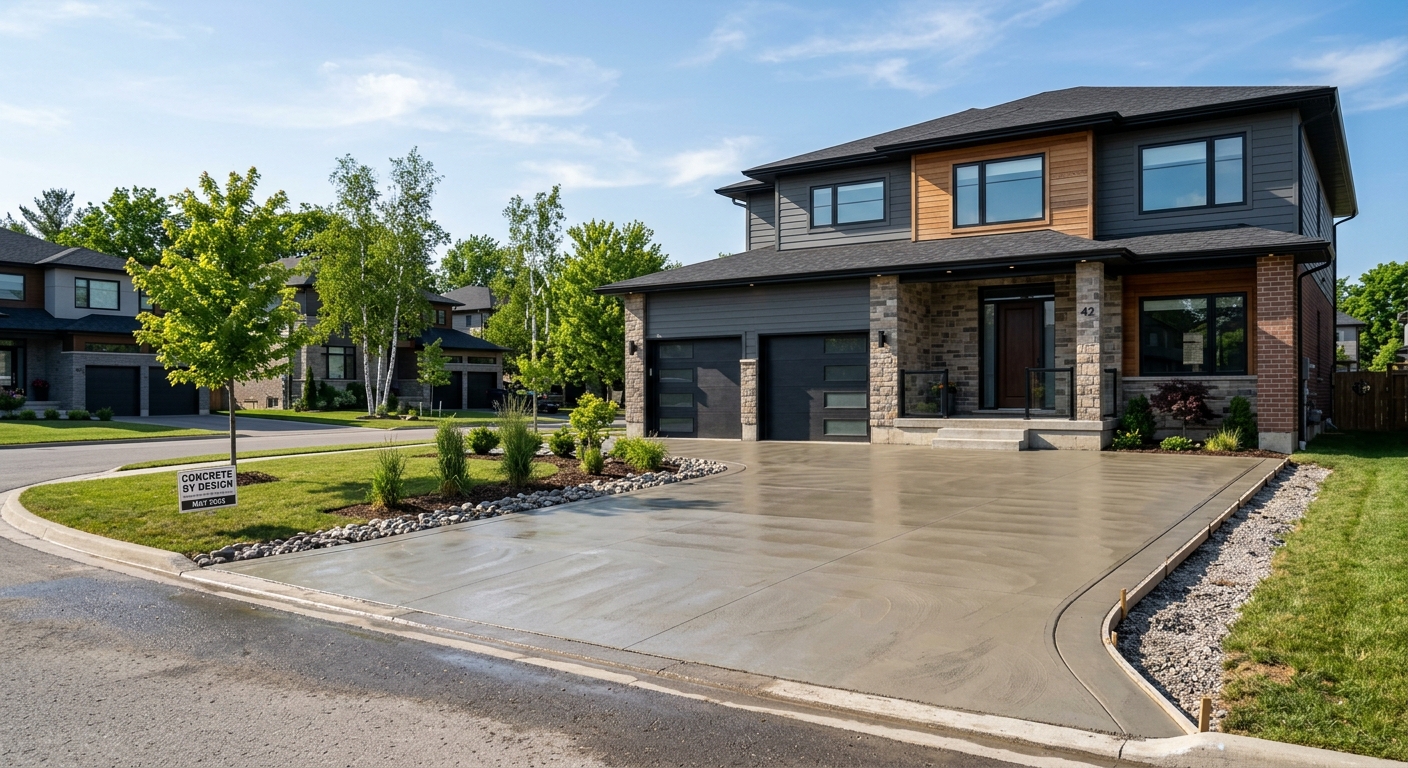
Concrete work options and costs in Somerset
Somerset, Alberta is a great place to build—and concrete flatwork is a big part of day-to-day life there. With a population of 8,320 in 2021 (Statistics Canada, 2021 Census), the area draws steady residential building and upgrades, especially around established pockets like the Calgary edge communities where driveways and backyard patios are frequently replaced as homes are updated. In practice, most of the concrete demand in Somerset ties to one thing: homeowners want durable exterior surfaces that can handle Calgary-area freeze–thaw cycles and winter de-icing.
Calgary’s cold continental climate engineers concrete choices around frost and movement. Footings for houses, garages, decks and retaining structures must be designed to bear below the local design frost depth—about 1.2 m (roughly 4 ft)—so seasonal heave doesn’t lift the structure. For exterior slabs and driveways, contractors typically use air-entrained mixes, staged granular base prep, well-spaced control joints, and a curing plan that protects concrete during shorter pour seasons. That’s why “same size” projects can still land at different totals: a patio poured too late in the season or with thin base prep is a recipe for surface scaling and premature cracking.
Below is a Somerset-focused comparison of common concrete options and realistic price ranges, so you can match finishes to budget and long-term performance. Use it as a starting point before you request itemised quotes.
| Application |
Typical Size |
Key Spec |
Finish Option |
Price Range |
| Concrete driveway (standard broom finish) |
400–650 sq. ft. |
Air-entrained mix, compacted granular base, joints |
Broom finish |
$12,000–$18,000 |
| Exposed aggregate driveway |
400–650 sq. ft. |
Air-entrained mix, base prep, proper curing |
Exposed aggregate |
$14,500–$22,000 |
| Stamped concrete driveway or patio |
300–650 sq. ft. |
Air-entrained mix, reinforced slab design, colour hardener |
Stamped patterns |
$15,000–$26,000 |
| Plain concrete patio or walkway |
150–350 sq. ft. |
Proper base, joints, drainage slope |
Floated/smooth or broom |
$5,000–$9,000 |
| Garage floor (interior slab) |
400–600 sq. ft. |
Vapour control where needed, reinforcement, flatness |
Float finish (often trowelled edges) |
$10,500–$17,000 |
| Foundation footings (structural, below frost) |
Typical single-family home |
Engineered reinforcement, excavation to undisturbed soil |
Structural concrete |
$28,000–$45,000 |
Prices are estimates only and vary by project scope, site access and material selection.
What affects the price of concrete work in Somerset
In the Calgary economic region around Somerset, it’s common to see quotes for the “same” concrete job swing by 30–50%. The driver isn’t just concrete cost—it’s how each contractor designs for Alberta’s deep frost depth, freeze–thaw cycling, and the practical realities of excavation and scheduling. In this market, foundations and exterior flatwork aren’t plug-and-play: with a design frost depth of about 1.2 m, excavation is deeper and footing volumes are higher than many homeowners expect. That pushes foundation and earthwork costs up, which is exactly why local foundation budgets often land in the $28,000–$45,000 band.
For exterior slabs like driveways and patios, Calgary-area freeze–thaw cycles mean every spec matters. Exterior concrete should be air-entrained to survive repeated wetting and freezing; poor air content is one of the quickest ways to get scaling and surface spalling. The pour season is also shorter, so cold-weather curing precautions—insulated blankets and sometimes temporary heat—can add cost when weather shifts late in the year. De-icing salt in winter accelerates surface wear, so sealing becomes a practical “must-do” in many Somerset driveways and walkways.
Concrete examples: (1) If one contractor excavates to properly compacted granular base depth and the other “minimizes” base, you’ll often see a meaningful price gap on a patio, including staying within the $5,000–$9,000 range versus falling into costly rework later. (2) A stamped driveway isn’t just stamps—colouring, release agents, and extra finishing time typically push it into the $15,000–$26,000 band compared with broom finish. (3) If your existing driveway has poor drainage or heavy frost heave already started, the foundation of the slab repair can require additional subdrain and deeper excavation.
| Price Factor |
Why It Matters |
Cost Impact |
| Frost line depth — determines footing depth and form height |
Footings must bear below ~1.2 m (design frost depth) to reduce frost heave |
Higher excavation and concrete volume; commonly a major driver on foundations |
| Site preparation — excavation, grading, compacted granular base |
Proper sub-base thickness and compaction prevent settlement and cracking |
Removes variability; poor prep increases both risk and labour time |
| Reinforcement — rebar or wire mesh requirement |
Controls crack widths and improves slab performance under loads |
Material and placement labour can noticeably change totals |
| Mix design — air-entrainment and compressive strength spec |
Freeze–thaw durability and long-term strength depend on mix design |
Air-entrained, winter-grade scheduling can add cost in shoulder season |
| Finish type — broom vs. stamped vs. exposed aggregate |
Finishing steps affect labour time, materials, and curing handling |
Stamped/exposed typically costs more than standard broom finish |
| Pour size and concrete truck access to site |
Access affects pump vs. chute, labour, and pour sequencing |
Limited access can add equipment and additional crew hours |
| Cold-weather curing precautions — heating and blankets |
Concrete must achieve proper cure without freezing at early ages |
Blankets/heat can add several thousand dollars on exterior pours |
| Control joint pattern and sealing cost |
Joints direct cracking; sealing helps resist salt scaling |
Increases material line-items but often reduces long-term failure risk |
Permits & regulations in Alberta
In Alberta, structural concrete work typically requires a building permit, and it often depends on engineered drawings that are reviewed as part of the permit process. For Somerset homeowners, that usually means work like foundation footings, foundation walls, and grade beams are handled through the municipal building permit pathway. Because this is load-bearing structural work below grade (and it’s tied to design frost depth), it generally cannot be “assumed” without proper approvals.
On the other hand, concrete flatwork—driveways, patios, and walkways—often does not require a permit by default. Common exceptions are when the work changes lot grading, affects impervious surface coverage rules, or impacts a municipal right-of-way (for example, work that ties into a boulevard, sidewalk, or driveway approach where municipal approvals may be required). Always confirm with the local authority before digging.
Before you hire in Somerset, verify the contractor is properly insured and licensed for the work. Step-by-step:
- Check the Alberta online registry for the contractor’s business standing and any required trade/contractor registration for the scope.
- Ask for a certificate of liability insurance and confirm it matches the project value and dates.
- Ask for proof of WSIB/WCB coverage for workers who will be on site.
- Request references from similar-scale footing or flatwork jobs completed within the last 2–3 years.
- Confirm whether the permit process (when required) is included in their scope and who is responsible for pulling it.
Getting concrete right in Somerset's freeze-thaw climate
Somerset’s freeze–thaw climate doesn’t forgive shortcuts; concrete fails when it can’t stay durable through repeated wetting, freezing, and thawing. The most common issues I see are spalling (surface scaling) from inadequate air-entrainment, cracking from weak base prep, and movement related to foundations bearing too shallow. To spec correctly for Calgary-area conditions, focus on five items.
(1) Base preparation: Your slab or driveway needs a compacted granular sub-base to the correct depth for your soil and frost conditions, plus proper grading for drainage. (2) Mix design: Exterior flatwork typically targets 5–7% air depending on exposure and the contractor’s design, with minimum 32 MPa compressive strength for the specified placement. (3) Control joints: They’re not optional. They limit random cracking by giving concrete a planned path to crack as it shrinks. (4) Curing: Plan for a minimum 7-day cure under conditions that don’t allow early freezing—this is where late-fall and early-spring pours can require insulated blankets and sometimes temporary heat. (5) Sealing: A penetrating sealer applied 28 days after the pour helps repel de-icing salt and reduces surface deterioration.
A specific dollar example: if you’re deciding between a plain broom-finish patio (often near $5,000–$9,000) and a stamped option, the stamped finish may move you toward $15,000–$26,000. That cost can be justified for appearance and added finishing steps—but only if the base, mix design, joints, curing plan and sealing are done to the same durability standard. Otherwise, the decorative surface just fails faster.
| Spec |
Why It Matters in Somerset |
What to Ask For |
Impact if Skipped |
| Compacted granular base (depth?) |
Prevents settlement and reduces stress during freeze–thaw |
Confirm base depth, compaction method and drainage slope |
Cracking, uneven surface, and premature failure |
| Air-entrained concrete mix (target air %?) |
Improves freeze–thaw durability and reduces scaling/spalling |
Ask for the target air content (commonly 5–7% for exterior) |
Surface deterioration, scaling and spalling in winter |
| Compressive strength (MPa rating) |
Supports structural and wear performance over time |
Confirm minimum 32 MPa rating (or higher if engineered) |
Lower durability and higher risk of cracking under load |
| Control joints (spacing per ACI guidelines) |
Directs shrinkage cracking away from random locations |
Ask for joint spacing and saw-cut timing |
Random cracking and water infiltration into sub-base |
| Minimum 7-day curing period |
Ensures strength gain before exposure to cold and loading |
Confirm curing method; ask how they protect against freezing |
Reduced strength, increased scaling and early surface failure |
| Penetrating sealer (when applied after cure) |
Helps repel de-icing salts in Calgary winters |
Confirm sealer type and application timing (about 28 days) |
Faster salt damage and higher maintenance needs |
How to choose a concrete work contractor in Somerset
Choosing the right concrete contractor in Somerset is mostly about verifying three things: competence for cold-weather concrete, proper coverage, and detailed quoting. Start with Alberta requirements and insurance. First, confirm their business standing and registration for the scope you’re hiring for—then ask for a current certificate of liability insurance and confirm it covers the work at your address and for the project dates. Next, request proof of WSIB/WCB coverage for workers who will be on site; a crew without coverage can put you in a tough position if there’s an injury.
Then get 2–3 itemised written quotes rather than a single lump sum. Itemisation should show labour and materials for excavation/base prep, reinforcement, concrete supply, finishing, joints, sealing (if included), and any cold-weather curing measures. Read the scope for exclusions: disposal of excess soil, saw-cut timing, protection of landscaping, and whether permits are included when required for structural work.
Warranty matters too. Ask for a clear workmanship warranty length (what it covers and for how long) and whether there is a product/manufacturer warranty for sealers or admixtures. For payment, don’t let contracts drift upward—generally keep upfront payments to 10–15% and hold back until the job is complete and you’ve confirmed curing protection, jointing, and final grade.
- Written start date and completion estimate
- Concrete placement plan for cold snaps (blankets/heating if needed)
- Proof of liability insurance (certificate) and WSIB/WCB coverage
- Itemised scope (base prep, reinforcement, concrete, finishing, joints)
- Clear inclusions/exclusions for disposal and site cleanup
- Details on concrete spec (air content, MPa, reinforcement type)
- Joint spacing and when they’ll be cut
- Sealing included or clearly excluded (and when it’s applied)
- Inspections at key stages (base compaction, reinforcement placement)
- Schedule aligned to weather—no rushing early curing
- References for similar Somerset-area freeze–thaw exposure
- Warranty terms in writing and not only “verbal”
Concrete red flags in Somerset: crews who won’t explain air-entrainment targets, quotes that treat “driveway size” without discussing excavation/base depth, missing proof of WSIB/WCB or insurance, no written curing/sealing plan for winter durability, and contracts asking for large upfront payments before any base prep or materials are on site.
Frequently asked questions — concrete work in Somerset
Why does concrete crack in Somerset and how is it prevented?
In Somerset and across the Calgary area, concrete cracking usually comes from movement: shrinkage as concrete cures, settlement from inadequate base prep, and thermal stress during freeze–thaw cycles. The big prevention steps are a properly compacted granular base to the right depth, air-entrained concrete for durability, and a joint pattern designed to control where cracks form. Control joints need correct spacing and should be cut at the right time so the slab cracks where it’s intended—not randomly. Curing also matters: if concrete freezes too early, strength gain suffers and surface defects increase. Finally, sealing after cure helps protect against salt-driven surface wear, which can worsen deterioration that leads to wider cracking over time. If your slab is exposed to heavy salt use, make sure sealing is in the plan, not an afterthought.
Stamped vs broom-finish concrete — cost difference?
Stamped concrete costs more primarily because of extra materials and finishing labour: colour hardener or integral colouring, stamp application, release agents, texture finishing, and more careful curing and cleanup. In Somerset, a standard broom-finish driveway often sits around $12,000–$18,000, while stamped concrete driveways or patios commonly fall into $15,000–$26,000 depending on size and complexity. The key point is that you shouldn’t pay for “looks” while sacrificing durability. Ask whether the contractor is using air-entrained concrete, proper base prep, proper jointing, and a cold-weather curing approach. If all those items are the same, the price gap is easier to justify. If they aren’t, the cheaper finish can end up costing more through repairs.
When is the best time to pour concrete in Somerset?
For exterior work in Somerset, the best time is typically late spring through early fall—when temperatures are stable enough for consistent curing. Calgary’s freeze–thaw pattern means you want to avoid pouring when overnight temperatures are likely to drop and freeze the concrete early. If you’re considering a driveway or patio near the end of the season, ask your contractor how they plan for cold-weather curing (insulated blankets, temporary heating, and protection of the slab during the first days). Even with winter-grade approaches, rushing curing is where scaling risk rises. For homeowners, the practical move is to book your pour window with weather in mind and confirm the curing plan in writing. That’s especially important for slabs designed to resist salt exposure on roads and sidewalks.
How long does concrete take to cure?
Concrete curing has two “clocks”: how fast it gains usable strength and how long it needs to be protected to perform well long-term. In Somerset, for exterior flatwork, the workmanship standard I recommend is a minimum of 7 days curing with proper protection so the concrete doesn’t freeze early and doesn’t dry out before strength develops. Full performance continues beyond that—especially for durability against winter conditions. That’s also why sealing is typically scheduled later; many penetrating sealers are applied about 28 days after the pour, once the concrete has fully cured enough to accept the treatment. Your contractor should explain what cure protection they’ll use (blankets/heating if needed) and how they’ll keep surface conditions stable during that critical first week.
Do I need a permit for concrete work in Alberta?
In Alberta, structural concrete work generally requires a building permit—think foundation items like footings, foundation walls, and grade beams. Concrete flatwork like driveways, patios and walkways often does not require a permit, unless it affects lot grading, impervious surface limits, or a municipal right-of-way (for example, work that impacts a driveway approach tied to boulevard or sidewalk areas). For Somerset homeowners, the best approach is to confirm with the local authority before excavation, especially if your project involves changes to drainage, regrading, or anything near property boundaries and municipal features. Regardless of permit requirements, ensure your contractor provides proof of liability insurance and WSIB/WCB coverage and that the job scope clearly states who is responsible for permit pulling if one is needed.
Concrete vs pavers for a patio in Somerset?
Concrete and pavers can both work well, but in Somerset’s freeze–thaw climate they’re valued differently. Concrete patios—when built with proper base prep, air-entrained mix, correct jointing, and curing—tend to deliver consistent performance and fewer shifting points over time. A plain concrete patio or walkway commonly lands in the $5,000–$9,000 band depending on size and site access. Pavers can be visually attractive and offer easier localized repairs if a section fails, but paver systems depend heavily on bedding and drainage; if the base isn’t done correctly, freeze–thaw can lead to lifting, rocking, and weed growth. If your goal is a clean, low-maintenance surface that handles de-icing salt, properly specified concrete (plus sealing after cure) is often the better fit—especially when you want predictable longevity.