Concrete work options and costs in Charleswood
In Charleswood, Alberta, homeowners typically call us for concrete flatwork that can stand up to deep frost and repeated freeze–thaw cycles—most often driveways, patios, walkways, and garage floors. Charleswood is a smaller community within the Calgary area (population 3,595 in 2021) (Statistics Canada, 2021 Census), so demand is concentrated around established pockets like the newer infill near the residential streets west of McKnight Boulevard, where lots have been tighter and grading is more common. At the same time, many homeowners are working with older housing stock and post-and-beam style additions that change drainage patterns, so base prep and proper drainage are as important as the pour itself.
Calgary’s cold continental climate affects concrete costs directly: the frost depth used in local design practices is about 1.2 m (roughly 4 ft), meaning footings for houses, garages, decks, and retaining structures need to bear on undisturbed soil below that depth. Exterior slabs also require air-entrained concrete and well-spaced control joints to reduce freeze–thaw cracking and spalling. Because the pour season is shorter, late pours often need winter-grade materials, insulated blankets, or temporary heat to reach proper curing temperatures—those steps add labour and equipment time.
Below are realistic cost ranges for common options in Charleswood, from straightforward broom-finished driveways to stamped finishes and structural foundation footings. Use these as a baseline when you compare quotes and scope details in the table that follows.
| Application |
Typical Size |
Key Spec |
Finish Option |
Price Range |
| Concrete driveway (standard broom finish) |
24 ft x 10 ft (240 sq. ft.) |
Air-entrained exterior mix, compacted granular base, joints |
Broom finish + edge control joints |
$12,000–$18,000 |
| Exposed aggregate driveway |
24 ft x 10 ft (240 sq. ft.) |
Air-entrained mix, proper curing for wash exposure, joints |
Exposed aggregate (light brush wash) |
$14,500–$21,500 |
| Stamped concrete driveway or patio |
20 ft x 20 ft (400 sq. ft.) |
Air-entrained mix, integral colour, sawcut pattern |
Stamped pattern + release agent + seal |
$15,000–$26,000 |
| Plain concrete patio or walkway |
10 ft x 16 ft (160 sq. ft.) |
Air-entrained mix, compacted base, joints as needed |
Float/strike-off + broom or light trowel |
$5,000–$9,000 |
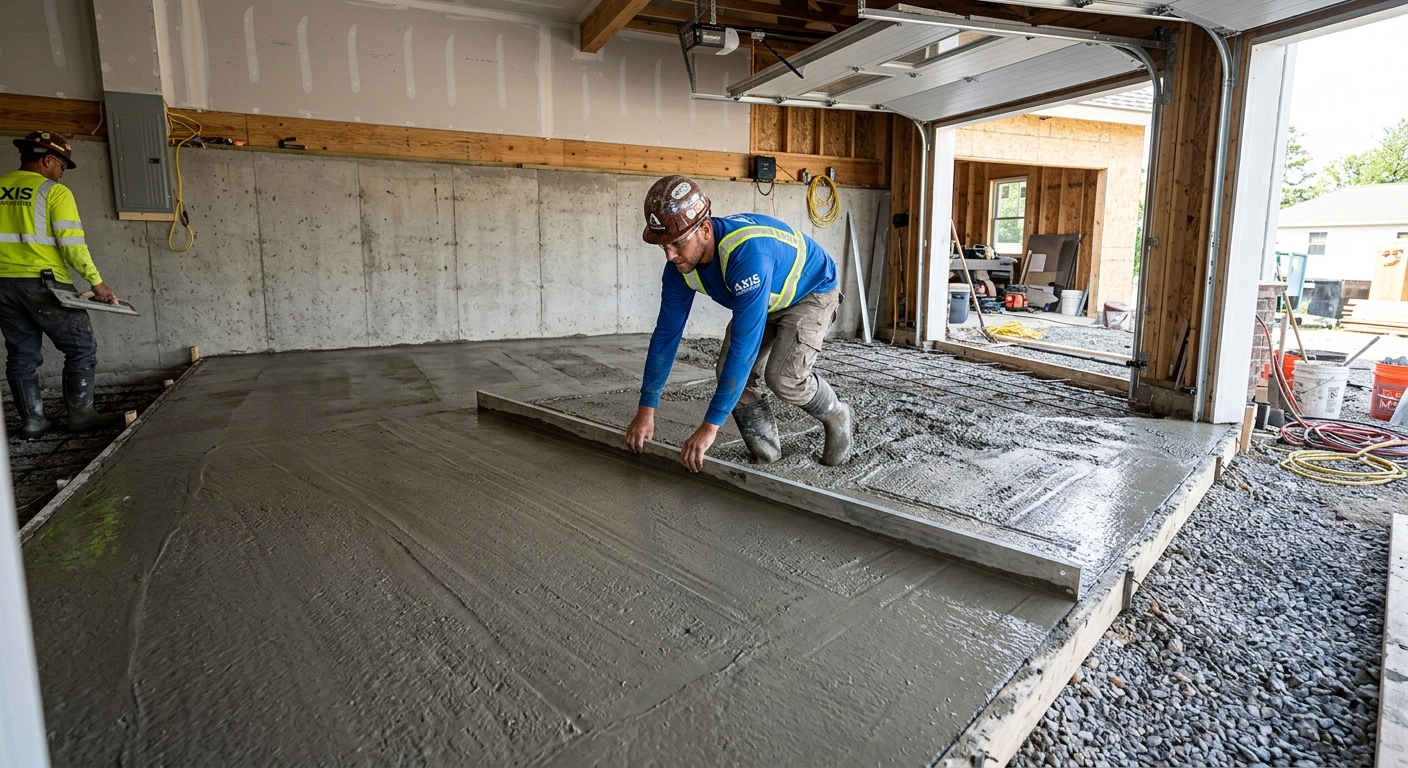
| Garage floor (interior slab) |
22 ft x 24 ft (528 sq. ft.) |
Minimum 32 MPa, vapour control, mesh or fibres |
Flat finish + optional burnished/coat ready |
$9,000–$15,500 |
| Foundation footings (structural, below frost) |
Typical house footprint (varies by design) |
Excavation to design frost depth, engineered reinforcement |
Structural concrete (no aesthetic finish) |
$28,000–$45,000 |
Prices are estimates only and vary by project scope, site access and material selection.
What affects the price of concrete work in Charleswood
In the Calgary region—including Charleswood—two contractors can quote the “same” concrete job and still land 30–50% apart because the price is driven less by the pour day and more by the hidden work: excavation, granular base design, reinforcement placement, mix specifications, finishing labour, and cold-weather curing. If one quote assumes easy access and the other includes haul distance, tight-yard logistics, dewatering, or more extensive base depth, you’ll feel that gap quickly.
Frost line depth and freeze–thaw cycles dictate nearly every spec here. Local practice is engineered around a design frost depth of about 1.2 m (roughly 4 ft), so exterior footings and many structural supports must extend below that depth to prevent frost heave. Likewise, exterior slabs need air-entrained concrete to survive repeated freeze–thaw exposure. When temperatures drop, contractors may need cold-weather placement precautions—insulated blankets, thawing methods, or temporary heat—so concrete reaches proper curing conditions. That curing window matters: rushing it increases scaling risk and can lead to surface deterioration that shows up in a few winters, not five years later. Finally, de-icing salt accelerates surface spalling, so sealing (and sometimes surface treatment selection) is a practical add-on.
Local examples in Charleswood that raise cost include: clayey or variable soils requiring deeper granular replacement; drainage lines or mature trees limiting equipment access; and longer driveways needing additional sawcut planning and reinforcement. Costs can be lower when the grade is already stable and truck access is straightforward. As a practical benchmark, a standard broom driveway tends to fall into the $12,000–$18,000 range, while stamped options that include colouring, pattern mats, and extra labour often land closer to $15,000–$26,000.
| Price Factor |
Why It Matters |
Cost Impact |
| Frost line depth — determines footing depth and form height |
Footings must bear on undisturbed soil below design frost to prevent heave |
Higher excavation and concrete volume; can significantly increase foundation line items |
| Site preparation — excavation, grading, compacted granular base |
Proper base thickness and compaction reduce settlement and premature cracking |
Extra trucks, labour hours, and engineered base depth adjustments |
| Reinforcement — rebar or wire mesh requirement |
Controls cracking and improves load transfer on slabs and footings |
Material + placement time; fibre vs mesh choices affect cost |
| Mix design — air-entrainment and compressive strength spec |
Air-entrainment is critical for freeze–thaw durability in exterior work |
Higher-spec mix and sometimes winter-grade admixtures increase concrete cost |
| Finish type — broom vs. stamped vs. exposed aggregate |
Finishing labour and materials differ widely by finish method |
Stamped/exposed typically add labour, tools, and colour/sealer steps |
| Pour size and concrete truck access to site |
Smaller, staged pours and pumping or extended carry increase labour and risk |
May add pump/mobilization costs or surcharge fees |
| Cold-weather curing precautions — heating and blankets |
Concrete must cure in a controlled temperature range to reduce scaling |
Blankets, heaters, monitoring and increased material wastage |
| Control joint pattern and sealing cost |
Joints manage crack locations; sealing protects from salt and moisture |
Sawcut timing, spacing layout, and added sealer/material cost |
Permits & regulations in Alberta
In Alberta, many homeowners assume “concrete is just concrete,” but the permit requirement depends on what you’re building. Structural concrete work—such as foundation footings, foundation walls, grade beams, and similar load-bearing elements—normally requires a building permit. In practice, engineered drawings are often part of the permit package, and the municipality’s plan review focuses on structural adequacy and frost considerations. For concrete flatwork like patios, walkways, and driveways, permits are typically not required unless the work affects lot grading, drainage, or impervious surface coverage limits, or it involves municipal right-of-way or culverts. Always confirm with the local authority before breaking ground.
On top of permits, protect yourself by verifying the contractor is properly insured and set up to work. Step-by-step in Charleswood: (1) ask for proof of liability insurance—your contractor’s certificate of insurance should show you as a named “additional insured” where applicable; (2) confirm WSIB/WCB coverage documentation (or the contractor’s exemption/registration status if they are not required); (3) request the contractor’s legal business information, then cross-check it through the appropriate online business registry tools; and (4) get clearance letters where provided and compare them to the certificate dates.
Finally, ask for references on similar-scale Alberta projects, particularly winter-placed exterior work, and confirm the scope includes protection during cold weather curing when temperatures drop.
Getting concrete right in Charleswood's freeze-thaw climate
Concrete failures in Charleswood are usually climate-driven and spec-driven. Freeze–thaw cycles bring water in and out of the slab and surface pores; if there isn’t enough air entrainment or if the base isn’t built correctly, you’ll see early scaling, spalling, and random cracking. To spec the job correctly, start with the base: use a compacted granular sub-base built to the required depth for your soil and frost conditions, with proper grading and drainage so water doesn’t pond. Next, require an air-entrained concrete mix designed for exterior exposure—commonly 5%–7% air content for durable freeze–thaw performance on exterior flatwork. Pair that with a minimum 32 MPa compressive strength requirement so the slab reaches design performance.
Control joints are what prevent cracks from becoming “pretty” failures. In practice, you want sawcut or formed joints set to a spacing plan that limits random cracking across long runs and large panels. Curing is non-negotiable in Calgary-area winters: even if the pour day looks workable, cold weather can slow strength gain and increase surface damage. Plan for a minimum 7-day curing period under appropriate conditions, and protect with insulated blankets or temporary heat when temperatures warrant. Then seal: use a penetrating sealer applied after the cure window (commonly around 28 days post-pour) to reduce salt and moisture penetration.
Here’s where the money makes sense: if a broom-finish patio is $5,000–$9,000, you shouldn’t find “cheap” quotes that cut base depth or skip air-entrainment. Those savings often turn into repeat repairs after 1–3 winters, especially where de-icing salt is used.
| Spec |
Why It Matters in Charleswood |
What to Ask For |
Impact if Skipped |
| Compacted granular base (depth?) |
Stable base reduces settlement and keeps slab movements uniform under frost action |
Granular base depth and compaction method to match your soil and design |
Uneven cracking, rocking slabs, and accelerated deterioration |
| Air-entrained concrete mix (target air %?) |
Freeze–thaw durability depends on properly entrained air void structure |
Target air content (typically 5%–7% for exterior flatwork) |
Spalling and scaling within a few seasons |
| Compressive strength (MPa rating) |
Adequate strength supports long-term durability and load capacity |
Minimum 32 MPa specified for the slab/flatwork |
Surface wear, deeper cracking, reduced resistance to scaling |
| Control joints (spacing per ACI guidelines) |
Joints provide planned crack locations under thermal movement and drying |
Proposed joint layout and spacing plan matched to the slab dimensions |
Random, wider cracks and loss of surface integrity |
| Minimum 7-day curing period |
Cold weather slows hydration; proper curing limits weakness and surface damage |
Curing plan for temperatures at pour date (blankets/heating if needed) |
Reduced strength gain and higher risk of scaling/spalling |
| Penetrating sealer (when applied after cure) |
Repels moisture and salt exposure at the surface |
Penetrating sealer applied after cure (commonly around 28 days post-pour) |
Faster salt-driven surface deterioration and staining |
How to choose a concrete work contractor in Charleswood
Choosing the right concrete contractor in Charleswood is mostly about verification and clarity. First, confirm Alberta compliance and protection: request their liability insurance certificate (make sure it’s current and covers the scope), then confirm WSIB/WCB coverage (or the proper exemption/registration documentation if applicable). If they won’t provide paperwork promptly, that’s a red flag. Next, get 2–3 itemised written quotes—not a single lump-sum number. You want labour + materials broken out so you can compare base depth, reinforcement, mix design, access methods, finishing level, and whether cold-weather measures are included.
Read the scope carefully for exclusions: is permit pulling included where required for structural work? Is excavation spoil disposal included? Are sawcut joints and sealing part of the plan? Does the quote specify an air-entrained mix and minimum 32 MPa strength for exterior pours? Warranty matters too—ask for workmanship warranty length and whether the product/manufacturer warranty is documented. Also ask if the warranty is transferable if you sell your home.
For payment schedule, don’t pay the majority up front. A common homeowner-safe approach is no more than 10–15% upfront, then hold back until the work is complete and any deficiency list is corrected. Finally, request a start date and completion estimate in writing so you can plan around the short Calgary exterior pour window.
- Ask for proof of current liability insurance with policy dates
- Confirm WSIB/WCB coverage documentation before signing
- Get an itemised quote (labour, forms, rebar/mesh, concrete supply, base prep, sawcuts, sealer)
- Verify the quote includes air-entrained concrete for exterior flatwork
- Confirm minimum compressive strength (typically 32 MPa) is stated
- Require a written joint layout plan (spacing and where joints go)
- Ask how they handle cold weather curing (blankets/heating/temperature monitoring)
- Check whether base depth and compaction are specified, not just “excavate and pour”
- Confirm truck access plan (distance, pumping vs. carry, protection for landscaping)
- Make sure sealing timing is included if you’re in a salt-exposed driveway or walkway area
- Ask for disposal and hauling details for excavated material
- Request a clear warranty statement and what it covers/doesn’t cover
Concrete red flags I see in Charleswood: quotes that don’t mention air-entrainment for exterior slabs; “blanket cure” or cold-weather plans that are left vague; insufficient or no joint layout/sawcut schedule; very low pricing that omits base depth or reinforcement; and payment requests that exceed about 10–15% upfront without a detailed contract schedule.
Frequently asked questions — concrete work in Charleswood
What is the difference between concrete and cement?
Concrete is the final building material—cement plus water plus aggregates (sand and gravel) and often admixtures. Cement is only one ingredient that acts like a binder; it reacts with water and helps the mix harden. In Charleswood and across Alberta’s Calgary region, the “real” performance questions are about what’s added to the concrete for freeze–thaw durability: for exterior patios, walkways, and driveways, contractors should specify an air-entrained mix so the slab can withstand repeated cycles. That’s why two “concrete” quotes can differ even when the thickness looks similar—the mix design (air content and strength) and curing practices are what change durability in our climate. When you review a quote, ask what the air content target and compressive strength are—not just the slab dimensions.
How much does concrete work cost in Charleswood?
For a typical Charleswood homeowner, pricing follows the regional backbone ranges driven by frost depth, granular base prep, and winter curing needs. For example, a concrete driveway in the $12,000–$18,000 band usually includes proper base prep and a broom finish, while stamped concrete driveways or patios often fall into the $15,000–$26,000 range because of added labour for colouring and patterning. Plain patios and walkways commonly sit around $5,000–$9,000 depending on size and access. Foundation footings (structural, below frost) typically run $28,000–$45,000 for many common residential scopes, but exact quantities depend on engineered design and excavation conditions. Your final number can shift 30–50% when base depth, reinforcement, truck access, and cold-weather curing are handled differently.
How deep must footings be for Charleswood's frost line?
In the Calgary area climate used for design practice, the frost depth is about 1.2 m (roughly 4 ft). That means house and accessory structure footings need to extend below this design frost depth to bear on undisturbed soil, helping prevent frost heave and seasonal movement. In Alberta, the exact footing depth and reinforcement details should come from engineered drawings or the approved foundation design for your specific soil conditions—some sites require deeper excavation or more extensive granular replacement. When reviewing a foundation quote, make sure the contractor states excavation depth “to design frost depth” and ties it to the engineered plan. If you’re told it’s “about a foot down,” ask for the engineering basis; under-excavation is one of the fastest paths to future cracking or uneven settlement in freeze–thaw regions like Charleswood.
Why does concrete crack in Charleswood and how is it prevented?
Concrete cracking is common in Charleswood because slabs move with temperature changes and moisture variation, and our freeze–thaw cycles amplify those stresses. Cracks can also result from a weak or uneven base, poor drainage, or insufficient joint planning. The prevention strategy is a combination: proper sub-base preparation and compaction, an exterior air-entrained mix, and a control joint plan that limits where cracks can form. In exterior flatwork, contractors should use joint spacing that follows recognized engineering/ACI-style guidance and sawcut on the correct timeline so cracks occur at joints instead of randomly. Sealing helps protect the surface from de-icing salt and moisture intrusion, which reduces freeze–thaw-driven spalling. If a contractor skips air-entrainment or doesn’t specify joint layout, you often see wider cracking and surface breakdown after winters rather than right away.
Stamped vs broom-finish concrete — cost difference?
Stamped concrete costs more than broom-finish because it requires extra materials and labour: integral colour, stamp mats, release agents, finishing coordination, and usually careful timing to get crisp edges and consistent texture. In Charleswood, a broom-finished driveway commonly sits in the $12,000–$18,000 range, while stamped driveway or patio projects often land in the $15,000–$26,000 range depending on size and complexity. The price difference is justified when the homeowner wants both durability and appearance, and when the contractor is using exterior-grade air-entrained mix plus a compatible sealing system for salt exposure. What’s not justified is paying for “stamped” without a proper air-entrainment and curing plan—those shortcuts can lead to premature surface scaling even if the pattern looks good for a season or two.
When is the best time to pour concrete in Charleswood?
In Charleswood and the wider Calgary area, the best time is typically when daytime temperatures support normal curing—commonly late spring through early fall—because Calgary’s cold snaps can arrive quickly. The reason is curing performance: concrete needs proper hydration and temperature control to build strength. If you pour close to freezing, contractors may need cold-weather curing precautions such as insulated blankets, temporary heating, and monitoring to reduce the risk of surface scaling and weakness. That extra equipment and labour is part of what makes cold-season concrete more expensive and more logistically demanding. If you’re scheduling a driveway or patio, ask your contractor what temperature thresholds they use and whether the quote includes winter-grade mix and curing protection. For foundational work, the schedule often depends on excavation and engineered requirements, so it’s best planned early with your builder.