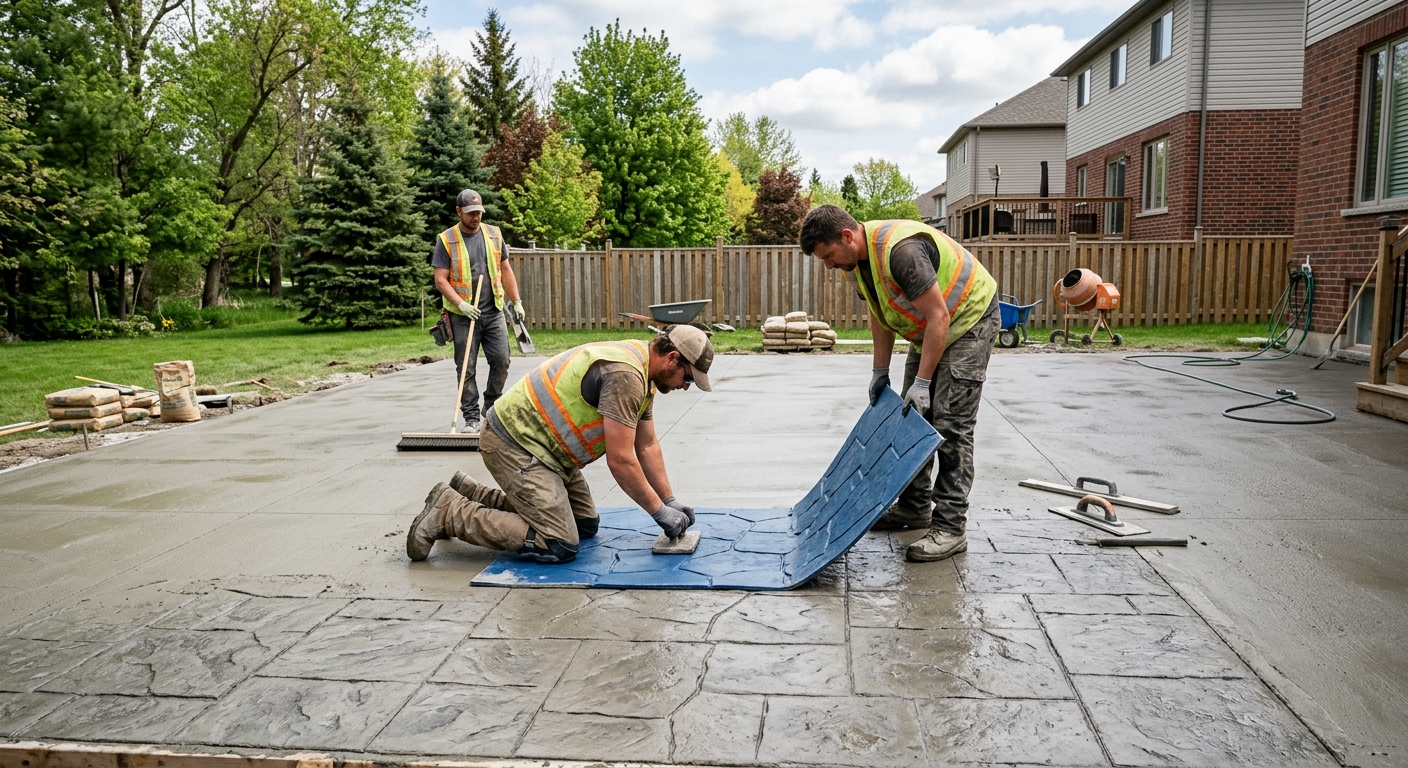
Concrete work options and costs in Queen Mary Park
Concrete work in Queen Mary Park is heavily influenced by local soil conditions and Calgary’s cold continental weather, where freeze–thaw cycles are a daily reality in winter. In a community of 7,365 residents (Statistics Canada, 2021 Census), most homeowners are planning work around typical single-detached home lots and driveways—exactly the kind of flatwork where concrete pricing becomes a comparison game. The neighbourhood where I see the most recurring demand is the Queen Mary Park area itself, particularly the busier residential pockets near schools and main residential streets, because access and snow-storage patterns affect excavation and scheduling.
When you get bids for the “same” driveway or patio, the total cost often shifts because Alberta’s frost depth requires footings to bear below the design frost line. That doesn’t just apply to foundations; it also drives how thick and well-supported exterior slabs must be, including granular base prep and air-entrained mixes. Calgary-area contractors also work around a shorter exterior pour season and, when the temperature drops, they may need insulated blankets or temporary heat to protect curing. Those winter-grade curing precautions protect against surface scaling and long-term durability issues—especially when residents salt sidewalks and driveways.
To help you budget quickly, below are realistic scope-based price bands for common concrete projects in Queen Mary Park, plus the key specs that typically move a quote up or down. Use this as a baseline, then we’ll refine it with site measurements and finish selection in the next sections.
| Application |
Typical Size |
Key Spec |
Finish Option |
Price Range |
| Concrete driveway (standard broom finish) |
400–600 sq. ft. |
Air-entrained mix, compacted base, 4–5 in. slab |
Broom finish + seal (optional) |
$12,000–$18,000 |
| Exposed aggregate driveway |
400–600 sq. ft. |
Air-entrained mix, proper surface retard/cleaning |
Exposed aggregate (medium-chips) |
$15,000–$22,000 |
| Stamped concrete driveway or patio |
300–500 sq. ft. |
Air-entrained mix, integral color, release agent |
Stamp pattern + color hardener |
$15,000–$26,000 |
| Plain concrete patio or walkway |
150–350 sq. ft. |
4 in. slab, compacted granular sub-base |
Plain float/trowel + light broom |
$5,000–$9,000 |
| Garage floor (interior slab) |
500–700 sq. ft. |
Vapour barrier (as required), typical 4 in. slab |
Steel trowel (burnished) + curing |
$14,000–$22,000 |
| Foundation footings (structural, below frost) |
Varies by house plan |
Engineered depth/steel, frost-bearing excavation |
Structural concrete only (no decorative finish) |
$28,000–$45,000 |
Prices are estimates only and vary by project scope, site access and material selection.
What affects the price of concrete work in Queen Mary Park
In Queen Mary Park and across the Calgary region, quotes for the same concrete job can swing by 30–50% because concrete isn’t just “slab thickness.” The biggest drivers are engineered frost protection, excavation volume, base preparation quality, and the mix/curing controls needed to survive freeze–thaw. Two contractors can both say “4-inch concrete,” yet one may be placing it on a properly compacted granular base with an air-entrained mix and proper control joints, while the other cuts corners on haul, disposal, or curing—differences that show up in durability and eventually in repairs.
Here’s the climate reality that shapes nearly every exterior spec. The design frost depth in Alberta is deep, and footings must extend below the design frost depth (often up to around 2.4 m in Alberta) to prevent frost heave and seasonal movement. Exterior slabs are also engineered for freeze–thaw survival through air-entrained concrete and good drainage. Calgary’s pour season is shorter, and colder placement requires cold-weather curing precautions—insulated blankets, heated enclosures, or winter-grade admixtures—to reach proper strength without surface scaling.
In practical terms, if you’re choosing between a standard driveway and stamped concrete, the stamp work isn’t just labour—it also includes integral colour and extra surface operations, so it often moves you from the typical driveway band of $12,000–$18,000 toward the $15,000–$26,000 range depending on area and complexity. Another cost lever is de-icing salt: Calgary homeowners commonly salt in winter, so sealing and a durable finish strategy become more important, especially on broom-finished and exposed-aggregate surfaces.
Even the age of a home matters. Older neighbourhood properties in the Calgary area may have older grading that directs meltwater toward the slab edge; that means more base excavation, tighter slope work, and more granular build-up—costs you won’t see in a “flat” suburban lot with good drainage.
| Price Factor |
Why It Matters |
Cost Impact |
| Frost line depth |
Determines footing depth and form height |
Higher excavation and concrete volume can add major cost; drives foundation/footing pricing |
| Site preparation |
Excavation, grading, compacted granular base |
Poor access, rock, or poor drainage increases haul/disposal and granular supply cost |
| Reinforcement |
Rebar or wire mesh requirement |
Steel procurement, placement labour, and chairs/spacers can add mid-to-high costs |
| Mix design |
Air-entrainment and compressive strength spec |
Exterior air-entrainment is essential in cold climates; cold-weather mix and controls can increase material costs |
| Finish type |
Broom vs. stamped vs. exposed aggregate |
Stamped and exposed aggregate require extra labour steps and materials; standard broom is typically lowest |
| Pour size and concrete truck access to site |
Impacts pumping needs, truck scheduling, and labour time |
Limited access can require smaller loads, pumping, or extended labour for placement |
| Cold-weather curing precautions |
Heating and blankets |
Temporary heat/blankets and tighter scheduling often add cost, especially late fall/early spring |
| Control joint pattern and sealing cost |
Reduces random cracking; protects from salt exposure |
Joint layout labour is small, but proper sealing adds a noticeable line item and can extend service life |
Permits & regulations in Alberta
In Alberta, structural concrete work generally needs a building permit and is often tied to engineered drawings reviewed as part of the municipal process. That includes footings and foundations such as foundation walls, grade beams, and other structural elements below grade. For Queen Mary Park homeowners, the key is to separate “structural” from “cosmetic flatwork.” Concrete flatwork like patios, walkways, and most driveways typically does not require a permit unless it affects lot grading, impacts municipal right-of-way, or changes impervious surface coverage rules.
Before breaking ground, confirm with your local authority about your specific scope (especially if you’re changing drainage patterns, raising elevations, or working near the curb/sidewalk). Also verify your contractor carries liability insurance and has the required workplace coverage (WSIB/WCB, depending on the contractor’s situation).
Step-by-step, here’s how homeowners can verify a concrete contractor in Alberta for work in Queen Mary Park:
- Ask for the contractor’s liability insurance certificate and confirm it names the correct legal entity and includes sufficient coverage.
- Request evidence of WSIB/WCB clearance (or appropriate coverage documentation) and confirm it’s current.
- Check the provincial registry or the applicable licensing/registration entry for the contractor/company if they perform regulated construction activity in the province.
- Ask for references on similar Calgary-area cold-weather pours (driveways with control joints, exterior curing practices, etc.).
- Make sure the permit responsibility is clear in the contract scope (who pulls it, and what’s included).
Getting concrete right in Queen Mary Park's freeze-thaw climate
Concrete failure in Queen Mary Park’s winters usually comes down to three things: water entry, freeze–thaw movement, and a mix design that isn’t properly engineered for exterior exposure. When slabs aren’t built on a well-compacted granular base, water migrates under or into the slab edge. When there aren’t enough air voids, the freeze–thaw cycle can create internal pressure that spalls the surface. And when curing is rushed—common if a pour starts late in the season—weak early-age strength can lead to scaling and premature wear.
To spec the job correctly for Calgary’s climate, insist on a written plan for:
(1) Base preparation: compacted granular sub-base to the required depth for local soil and frost-bearing needs, with attention to drainage and slope. (2) Mix design: exterior air-entrained concrete with 5–7% air content and minimum 32 MPa compressive strength suitable for cold exposure. (3) Control joints: a spacing plan that limits random cracking and helps cracks stay tight and predictable. (4) Curing: protect the concrete so it reaches strength—minimum 7 days under proper conditions—and in colder weather use insulating blankets or temporary heat when required. (5) Sealing: apply a penetrating sealer about 28 days post-pour to repel de-icing salts and reduce surface water absorption.
Here’s a clear budget example. A standard driveway at $12,000–$18,000 may cost less upfront, but if the contractor skips proper air-entrainment and curing controls, you can be looking at costly patching within a few winters. Upgrading to a more durable exterior finish system—sometimes modestly higher within the driveway band—can be a better long-term value than paying later. Stamped concrete can raise the upfront number toward $15,000–$26,000, and it’s worth it when the base, joints, and curing are done right first.
When you ask questions with these points, you’ll avoid the most common spalling cause in Alberta: inadequate air-entrainment combined with salt exposure and freeze–thaw.
| Spec |
Why It Matters in Queen Mary Park |
What to Ask For |
Impact if Skipped |
| Compacted granular base (depth?) |
Supports the slab and manages frost-related movement and drainage |
Base depth and compaction test/verification method |
Settling, cracking, and accelerated edge deterioration |
| Air-entrained concrete mix (target air %?) |
Air voids relieve freeze–thaw pressure during winter cycles |
Target 5–7% air for exterior flatwork and mix documentation |
Surface scaling/spalling in a few winters, especially with salt |
| Compressive strength (MPa rating) |
Strength gain affects durability and resistance to abrasion and freeze–thaw |
Minimum 32 MPa and curing approach to reach it |
Weak surface, dusting, and premature cracking |
| Control joints (spacing per ACI guidelines) |
Controls where cracks form so they don’t become random |
Joint spacing plan and saw-cut timing |
Random cracking, wider joints, water infiltration |
| Minimum 7-day curing period |
Ensures early-age strength before winter stresses |
Curing protection method, especially if pouring cold |
Scaling and long-term strength loss |
| Penetrating sealer (when applied after cure) |
Reduces salt and water absorption into the surface |
Sealer type and timing (about 28 days post-pour) |
Higher water/salt penetration leading to faster spalling |
How to choose a concrete work contractor in Queen Mary Park
Choosing the right concrete contractor in Queen Mary Park starts with verification, not just price. In Alberta, you should confirm the contractor’s liability insurance is current (ask for the certificate of insurance and ensure it covers the correct legal entity and adequate limits). Next, verify WSIB/WCB coverage documentation appropriate to the contractor’s business structure—request a clearance letter or proof of active coverage before work begins. Don’t wait for delivery day; do this at quote stage.
Then get 2–3 itemised written quotes, not just one lump-sum number. The best quotes break down labour and materials clearly (excavation/grading, granular base, forms, reinforcement, concrete supply, saw cuts, and finishing). Ask whether disposal is included, whether permit pulling is included (where required for structural work), and what the timeline looks like.
Warranty matters in concrete because exterior slabs are exposed to freeze–thaw and salt. Ask for workmanship warranty length and what it covers (often cracking control vs structural issues). Also ask if the manufacturer warranty for products like sealer or special admixtures is included and whether it’s transferable to you.
On payment schedule, never agree to more than about 10–15% upfront. Hold back a portion until key milestones are complete—typically base inspection, rebar verification, and final finish/cleanup.
Quick checklist:
- Confirm liability insurance certificate (current date, correct company, sufficient coverage).
- Verify WSIB/WCB clearance/proof of coverage before scheduling.
- Ask for at least two recent references on similar Calgary-area exterior concrete.
- Request itemised quote (materials + labour) and confirm all inclusions/exclusions.
- Clarify permit responsibility for structural work; confirm typical flatwork needs no permit unless grading/right-of-way is impacted.
- Check whether granular base depth and compaction method are specified.
- Ask about air-entrained mix and cold-weather curing plan (blankets/heating when needed).
- Confirm reinforcement approach (mesh vs rebar) based on thickness and use.
- Confirm control joint spacing and saw-cut timing.
- Ask when sealing is applied (about 28 days post-pour) and whether sealer is included.
- Discuss concrete truck access and whether pumping is required.
- Get a written start date and completion estimate, plus weather-delay communication plan.
Concrete red flags I see in Queen Mary Park include: “we pour and fix later” promises without addressing air-entrainment or curing, quotes that ignore base excavation and disposal, unclear joint plans, refusal to provide insurance/WSIB documentation, and vague warranties that don’t specify what will be repaired or replaced.
Frequently asked questions — concrete work in Queen Mary Park
How do I compare concrete quotes?
Start by making each quote comparable, not just the total price. Ask for an itemised breakdown showing excavation/grading, granular base depth and compaction, reinforcement type, concrete mix details (including air-entrainment for exterior work), finishing, joints, and whether sealing is included. In Queen Mary Park, freeze–thaw protection is a major cost driver, so quotes that skip or vaguely describe curing, air content, or joint spacing should raise concern. For budgeting, use the local bands as a reality check: a standard driveway often lands around $12,000–$18,000, while stamped options frequently trend higher toward $15,000–$26,000. Finally, confirm disposal and access assumptions—limited truck access can add labour and pump costs.
Can concrete be poured in cold weather in Queen Mary Park?
Yes, concrete can be poured in cold weather in Queen Mary Park, but it must be engineered and protected properly. The big risk in Alberta is that early-age curing gets disrupted, which increases surface scaling and durability problems over time. A contractor should use winter-grade practices such as heated enclosures or insulated blankets, protect against freezing during the critical first stage, and use a cold-weather mix approach consistent with the job requirements. Ask specifically what temperature range triggers extra protection and how they will maintain curing long enough to reach adequate early strength. If a quote simply says “we’ll pour whenever,” without a curing plan, that’s a problem—especially because Calgary’s freeze–thaw cycles and salt use can be unforgiving on poorly cured exterior slabs.
How do I maintain concrete in Queen Mary Park's freeze-thaw climate?
Maintenance in Queen Mary Park is mostly about keeping water and salt from getting into the surface and protecting joints. After the slab has cured (typically allow about 28 days before sealing), apply a penetrating sealer if it isn’t included in your scope. Use de-icing practices carefully: avoid aggressive rock salt piling right against the concrete and try to keep the surface cleared so salt isn’t sitting wet for days. Keep an eye on edges and joints—small issues tend to start there. If you notice spalling around joints or hairline cracking, seal promptly to reduce water entry. In Alberta’s winter conditions, even well-constructed slabs benefit from this routine because freeze–thaw plus meltwater can work into micro-spaces over time.
What causes concrete to spall in Queen Mary Park winters?
Spalling is usually caused by water entering the concrete and expanding during freeze–thaw, combined with inadequate air-entrainment or poor curing. In Queen Mary Park, homeowners often use de-icing salt, which increases the chemical exposure at the surface and makes durability problems appear sooner if the concrete mix isn’t properly designed. If air content is low (or the contractor doesn’t confirm air-entrainment), freeze–thaw pressure can rupture the paste at the surface, leading to scaling and spalling. Another contributor is a slab on insufficient base prep, where settlement creates micro-pockets that hold water. Finally, rushing cure—such as placing in colder conditions without blankets/heat—reduces early strength and makes the surface more vulnerable to abrasion and winter stress.
What is rebar and when is it required in Alberta?
Rebar is reinforcing steel placed in concrete to increase tensile capacity and control cracking, especially in structural elements and in slabs designed for heavier loads or thinner sections. In Alberta, whether rebar is required depends on the specific engineering and design—driveways and patios may use wire mesh or rebar depending on thickness, soil conditions, and usage loads, while foundations and footings are typically engineered for reinforcement and frost-bearing excavation. For structural work, expect engineered drawings and a permit process that confirm reinforcement placement. When you’re comparing quotes in Queen Mary Park, ask what reinforcement they’re using (mesh versus rebar), the spacing, and whether supports/chairs are included to keep steel properly embedded. This is one of the easiest ways to spot a “cheap” quote that may skip durability.
How long does a concrete project take in Queen Mary Park?
Timelines depend on project size, access, curing conditions, and weather. For a typical exterior flatwork job, you might see excavation and base work during one to two days, placement and finishing in a day, then protection and curing over the following days. In Calgary’s cold winters, curing can require additional time and protection (insulated blankets/heat), which can extend the overall schedule. Interior garage slabs can proceed faster once the site is ready, but you still need curing time before you load or finish other trades. Your contractor should provide a written start date and a realistic completion estimate, including weather-delay contingencies. As a budgeting cue, don’t assume weekends can be “cut in”—durability depends on proper curing, not speed.