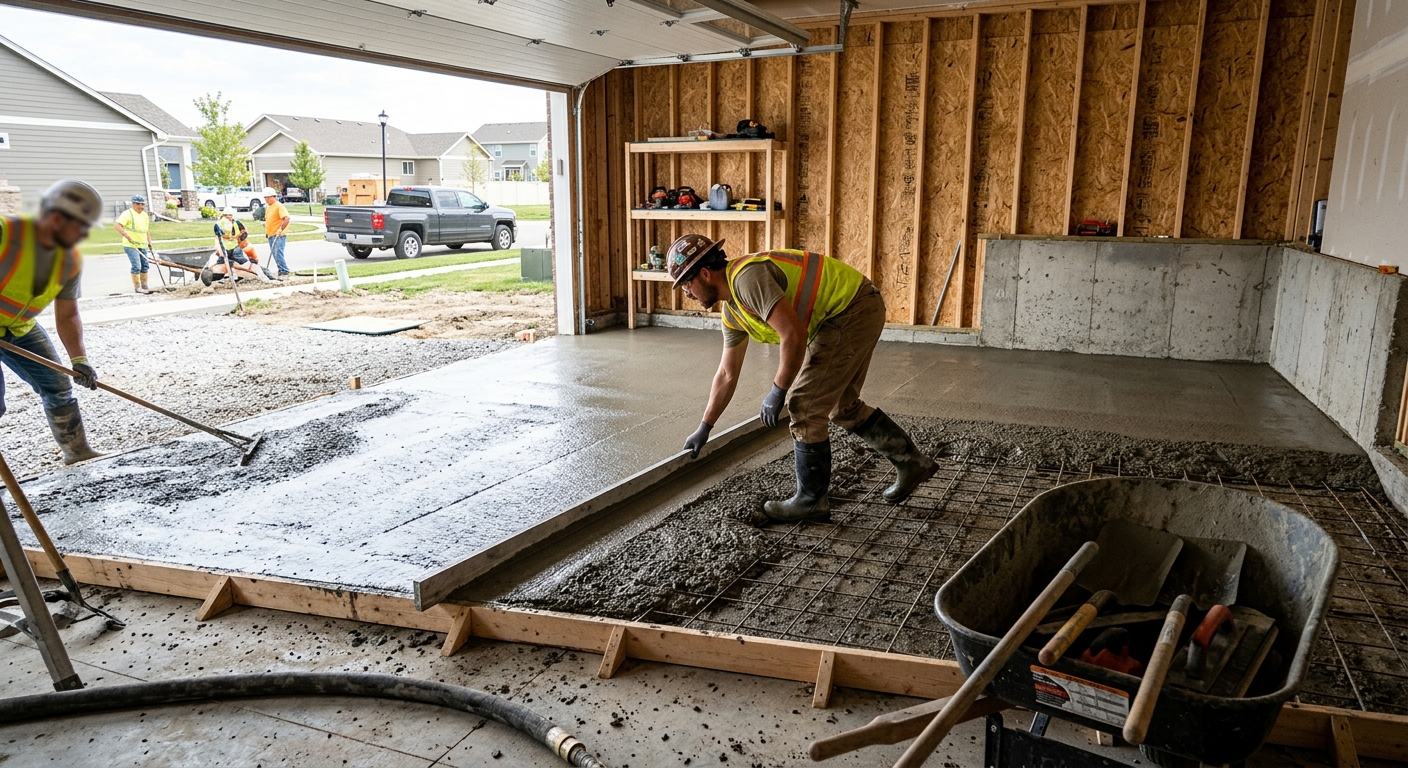
Concrete work options and costs in Terra Losa
Terra Losa, Alberta is a small community, and in our area the demand for concrete flatwork often follows the pace of home building and upgrades. The surrounding Calgary housing market is heavily driven by single-detached homes—those “main streets” driveways, patios, and walkways—and the broader economic base matters too: Terra Losa’s population was 2,188 in the 2021 Census (Statistics Canada, 2021 Census). That small-town scale can mean fewer crews locally, so pricing depends on how fast contractors can schedule site visits and pours.
Concrete pricing in the Calgary region is engineered around frost and freeze–thaw. With a design frost depth of about 1.2 m (roughly 4 ft), footings for houses, garages, decks, and retaining work must sit on undisturbed soil below that depth to prevent frost heave and seasonal movement. Exterior slabs also need air-entrained mixes, and the practical pour season can be shorter—especially when cold weather curing precautions (insulation blankets, sometimes heat) are required.
In Terra Losa, you tend to see extra attention to drainage and base prep when driveways connect to older grades or when people add a new entrance off existing approaches. Around the newer subdivisions near the south edge (where lots are often being finished and landscaping is added right after construction), demand for driveway and patio work is especially steady because homeowners want “finished curb appeal” before winter.
Below is a realistic comparison of the most common concrete scopes in Terra Losa to help you line up apples-to-apples quotes—then you can confirm specs like air content, base depth, and curing with your contractor.
| Application |
Typical Size |
Key Spec |
Finish Option |
Price Range |
| Concrete driveway (standard broom finish) |
20 ft x 12 ft (240 sq. ft.) |
Reinforced, air-entrained exterior mix |
Broom finish + control joints |
$12,000–$18,000 |
| Exposed aggregate driveway |
20 ft x 12 ft (240 sq. ft.) |
Reinforced, air-entrained exterior mix |
Exposed aggregate with sealant system |
$15,000–$21,000 |
| Stamped concrete driveway or patio |
12 ft x 24 ft (288 sq. ft.) |
Reinforced, air-entrained exterior mix |
Stamp pattern + release powder + seal |
$15,000–$26,000 |
| Plain concrete patio or walkway |
10 ft x 18 ft (180 sq. ft.) |
Reinforced where required, air-entrained |
Light broom or trowel-float |
$5,000–$9,000 |
| Garage floor (interior slab) |
20 ft x 22 ft (440 sq. ft.) |
Interior mix, vapour barrier and base |
Steel trowel finish + optional densifier |
$9,500–$15,500 |
| Foundation footings (structural, below frost) |
Typical house foundation |
Engineered rebar + concrete below design frost |
Structural grade placement |
$28,000–$45,000 |
Prices are estimates only and vary by project scope, site access and material selection.
What affects the price of concrete work in Terra Losa
In Terra Losa and the Calgary region, quotes for the “same” concrete job can easily swing by 30–50% because the differences are usually hidden in the specs: what depth is actually required, what’s under the concrete (excavation and compacted base), and how the crew will protect the pour during cold or windy weather. Labour availability also matters—small communities often require crews to mobilize from the wider Calgary area, so schedule windows can push costs up or down.
The biggest driver is frost and freeze–thaw. Local engineering practice uses a design frost depth of about 1.2 m, so footings and below-grade structural elements must extend under that depth. That means excavation and footing volumes are higher than in warmer climates, and the formwork and concrete placement time follow suit. For exterior slabs—driveways, patios, and walkways—air-entrained mixes are non-negotiable to handle freeze–thaw cycling and reduce surface damage. Calgary’s cold-weather placement window is shorter, which can force winter-grade mix options, curing blankets, and sometimes temporary heat. On top of that, de-icing salt is common; without a proper sealing plan, you’ll see accelerated spalling and scaling. Sealing doesn’t eliminate cracking, but it helps protect the surface where salt sits.
Two examples from Terra Losa: (1) a driveway over poorly compacted soil or topsoil often requires deeper granular replacement—raising costs even if the slab size stays the same; (2) a stamped patio looks similar from the yard, but the extra labour for stamps, colour hardeners/release, and finishing typically moves it into the $15,000–$26,000 band, while a plain patio can stay closer to the $5,000–$9,000 range when the base prep and reinforcement are straightforward. If your home is older and the grade has settled over the years, the “demo and regrade” portion can add thousands before the first truck arrives.
| Price Factor |
Why It Matters |
Cost Impact |
| Frost line depth — determines footing depth and form height |
Footings must bear below the design frost depth to limit frost heave and seasonal movement. |
Higher excavation and concrete volume can add several thousand dollars on foundations. |
| Site preparation — excavation, grading, compacted granular base |
Concrete longevity depends on the foundation/sub-base being level, properly drained, and compacted. |
Bad soil/topsoil removal can shift the job into the higher end of slab price bands. |
| Reinforcement — rebar or wire mesh requirement |
Slab reinforcement affects crack control and load capacity for driveways and some patios. |
Material + labour increases, especially for larger or vehicular slabs. |
| Mix design — air-entrainment and compressive strength spec |
Exterior slabs need air-entrained concrete to survive freeze–thaw cycles. |
Winter/engineered mix can raise material costs, but reduces long-term failure risk. |
| Finish type — broom vs. stamped vs. exposed aggregate |
Stamps and exposed aggregate require extra labour and careful curing and washing. |
Typically increases cost; stamped work aligns with the $15,000–$26,000 band. |
| Pour size and concrete truck access to site |
Limited access may require pumping, more labour, and extra time managing logistics. |
Pumping and longer placement time can move costs upward quickly. |
| Cold-weather curing precautions — heating and blankets |
Achieving proper early strength is critical to avoid scaling and structural issues. |
Temporary heat/blankets can add to the bill—especially outside the pour season. |
| Control joint pattern and sealing cost |
Joints manage where cracks happen; sealing protects against salt exposure and surface damage. |
Proper jointing plus sealant system is usually a worthwhile upsell. |
Permits & regulations in Alberta
In Alberta, structural concrete work—think footings, foundation walls, grade beams, and other engineered foundation components—typically requires a building permit. Many projects also involve engineered drawings that the municipality reviews as part of the permitting process. Concrete flatwork (driveways, patios, walkways) usually does not require a permit by itself, unless it changes lot grading, affects drainage, triggers impervious surface coverage limits, or involves work within a municipal right-of-way. Because rules can vary by the site and municipality requirements, always confirm with the local authority before breaking ground in Terra Losa.
Before you sign, verify the contractor is set up for Alberta work. Step-by-step, you can do this:
- Confirm licensing/registration: use the appropriate Alberta government online registry for the contractor’s status (and check matching business name).
- Ask for a certificate of insurance: request proof of liability insurance with adequate coverage limits and ensure it lists your project address.
- Verify WSIB/WCB coverage: ask for the coverage clearance letter or proof of coverage (as applicable to the contractor’s business structure).
- Match documents to the quote: ensure the contractor who provides the permit (if required) is the same entity quoting and performing the work.
- Check references: request 2–3 recent jobs similar in scale (e.g., driveways or foundation work) and confirm workmanship warranty terms.
If the contractor can’t provide current insurance/coverage documentation, or tries to avoid detailing who pulls permits when needed, treat it as a major red flag.
Getting concrete right in Terra Losa's freeze-thaw climate
Concrete can fail fast in Terra Losa when the job is spec’d for milder climates. The most common issues we see in the Calgary region are surface scaling, spalling, and wider-than-expected random cracking—most often tied to inadequate air-entrainment, shallow or poorly prepared base, and rushed curing when temperatures drop. To get it right, you need a checklist-driven approach that matches the local freeze–thaw reality.
1) Base preparation: your sub-base should be excavated to the right depth and compacted to support the slab without settlement. With a design frost depth of about 1.2 m for below-grade work, the whole foundation approach matters—especially where slopes and drainage aren’t ideal. 2) Mix design: specify air-entrainment for exterior flatwork (typically 5–7% air for many exterior applications) and a minimum 32 MPa compressive strength, with proper slump and admixtures based on temperature. 3) Control joints: joints should be planned to limit random cracking—don’t “wing it.” 4) Curing: plan for at least 7 days under proper conditions, and in cold weather use insulated blankets and/or heat so the concrete reaches early strength before it gets hammered by freeze nights. 5) Sealing: apply a penetrating sealer after the recommended cure period (often 28 days) so de-icing salt exposure is reduced.
A specific example: upgrading from a plain broom-finished driveway to a stamped finish can add roughly $3,000–$8,000 depending on size and pattern complexity. That premium is justified when you’re paying for proper stamp system, extra finishing time, and correct sealing—not when it’s only “colour and texture.” If the base and air-entrainment are wrong, even the most expensive stamped work won’t last through Calgary winters.
| Spec |
Why It Matters in Terra Losa |
What to Ask For |
Impact if Skipped |
| Compacted granular base (depth?) |
Reduces settlement and supports the slab through freeze–thaw cycles and loading. |
Base thickness and compaction requirements based on soil and site grade. |
Settlement, uneven cracking, and premature surface failure. |
| Air-entrained concrete mix (target air %?) |
Air voids give freeze–thaw protection and reduce scaling/spalling risk. |
Target air content (commonly 5–7% for exterior flatwork) and mix confirmation. |
Scaling and spalling accelerated by winter salt and repeated freeze cycles. |
| Compressive strength (MPa rating) |
Affects early strength gain and long-term durability. |
Minimum 32 MPa (or higher if engineered) and documentation of mix. |
Lower durability, increased cracking risk under freeze–thaw stress. |
| Control joints (spacing per ACI guidelines) |
Controls where cracking happens so it doesn’t become random and wide. |
Planned joint spacing, sawcut timing, and joint layout drawing. |
Random cracking, trip hazards, and water intrusion. |
| Minimum 7-day curing period |
Early strength development is essential before cold nights and rapid temperature swings. |
Minimum curing duration and how curing will be managed in cold weather. |
Surface scaling, weak zones, and long-term durability loss. |
| Penetrating sealer (when applied after cure) |
Repels water and helps protect surface exposure to de-icing salts. |
Schedule and product type; confirm application after cure (often 28 days). |
Faster salt scaling/spalling and more frequent maintenance. |
How to choose a concrete work contractor in Terra Losa
Choosing the right contractor matters as much as the concrete mix. Start with Alberta compliance: request proof of liability insurance (certificate of insurance) and confirm WSIB/WCB coverage with a clearance letter or documented proof. Then verify licensing/registration using the proper Alberta online registry and ensure the business name on the quote matches the insured/licensed entity. If a contractor won’t provide documentation or provides expired paperwork, walk away.
Next, don’t accept “one number” quotes that hide the details. Get 2–3 itemised written quotes that show labour and materials separately where possible—especially excavation, base prep/compaction, reinforcement (rebar or mesh), concrete supply/mix design, finishing, and sealing. Clarify what’s included in the scope: disposal of removed material, permit pull (if required), temporary heat/blankets for cold weather, sawcutting and joint sealing, and cleanup. If the quote is silent on these, assume costs can change later.
Ask about warranty: confirm workmanship warranty length and what it covers (cracks, spalling, settlement), plus whether product/manufacturer warranties apply and if they’re transferable to you. For payment schedule, never pay more than 10–15% upfront. Hold back a portion until the final finish and protective steps (including any sealant) are complete. Finally, get a start date and completion estimate in writing—especially in late fall or early spring when curing needs can change.
- Ask for air-entrainment and compressive strength specs in writing for exterior concrete.
- Confirm base thickness, compaction method, and how drainage will be handled.
- Require a joint layout plan (spacing and sawcut timing).
- Ask how they’ll protect the pour in cold weather (blankets/heating) if temps drop.
- Check whether reinforcement is included for driveways/garage floors (not just “it depends”).
- Verify liability insurance and WSIB/WCB clearance before work begins.
- Confirm who pulls permits for foundations and engineered items (when required).
- Request disposal and debris cleanup inclusion—no guessing.
- Ensure the quote states concrete finish method (broom vs stamped vs exposed aggregate).
- Confirm curing and sealing steps, including timing (e.g., sealer after full cure).
- Get start/completion dates and pour-day contingency plan.
- Review warranties in plain language: coverage, exclusions, and claim process.
Concrete contractor red flags in Terra Losa: they promise “no cracks ever,” won’t discuss air-entrainment specs, provide a quote that skips base prep details, ask for large upfront payments, or can’t show insurance/WSIB/WCB paperwork before scheduling your pour.
Frequently asked questions — concrete work in Terra Losa
How do I seal concrete to protect it in Terra Losa?
In Terra Losa (and across Alberta’s freeze–thaw winters), sealing is mainly about protecting the surface from water and de-icing salts. For exterior flatwork, the key is timing: let the concrete cure properly first—often about 28 days—then apply a penetrating sealer designed for concrete. A good contractor should explain product type and application method (spray/roll) and confirm the surface is clean and dry before coating. If you seal too early, you can trap moisture and reduce effectiveness, which is when scaling can show up faster in our cold cycles. For reference, even a straightforward broom-finished driveway commonly falls in the $12,000–$18,000 band; sealing is usually positioned as a surface protection step that supports that investment.
What is the difference between concrete and cement?
Homeowners in Terra Losa often hear “cement” and “concrete” used interchangeably, but they’re not the same thing. Cement is one ingredient—typically Portland cement—that reacts with water to help bind materials. Concrete is the full engineered mix: cement plus water, sand (fine aggregate), gravel or crushed stone (coarse aggregate), and often admixtures for performance—especially air-entrainment for exterior slabs in Alberta’s freeze–thaw climate. That air-entrainment is critical; without it, surface scaling and spalling risk increases when salt and repeated freezing temperatures attack the surface. When you ask for specs in your quote, focus on the complete concrete mix requirements (air content and compressive strength), not just the word “cement.”
How much does concrete work cost in Terra Losa?
Concrete cost in Terra Losa depends heavily on scope and climate-driven specs like base preparation, reinforcement, and cold-weather curing. For quick planning: a typical concrete driveway (standard broom finish) often lands around the $12,000–$18,000 range, while plain patios and walkways are commonly around $5,000–$9,000. Foundations/footings are a different category because they’re engineered below the design frost depth; those commonly run $28,000–$45,000 depending on the size and excavation conditions. If you choose decorative work—stamped concrete driveway or patio—you should expect premium finishing labour and materials, commonly in the $15,000–$26,000 band. Quotes can vary 30–50% when excavation depth, soil conditions, and winter placement measures change.
How deep must footings be for Terra Losa's frost line?
For Terra Losa, the critical concept is that footings must extend below the design frost depth to reduce frost heave and seasonal movement. Calgary-region engineering practice uses a design frost depth of about 1.2 m (roughly 4 ft). That means foundation footings for houses, garages, decks, and retaining work are typically designed to bear on undisturbed soil below that depth. The exact required depth can vary based on engineered drawings, soil conditions, and the foundation type, but the frost depth principle is what drives excavation and footing volume. Because the frost line is deeper in colder regions, you often pay more than homeowners expect—more digging, more concrete, and more formwork—compared to milder climates.
Why does concrete crack in Terra Losa and how is it prevented?
Concrete cracks are common in Terra Losa—not because “bad concrete” was poured, but because concrete shrinks as it cures and expands/contracts with temperature, and freeze–thaw cycles add stress. What you want is controlled cracking: cracks that happen at joints and are limited in width. Prevention starts with proper granular base prep and correct air-entrained mix for exterior work. Next, you need the right control joint pattern and proper sawcut timing so the slab is “asked” to crack where it should. Curing also matters: rushing curing or pouring in cold conditions without adequate blankets/heat can increase vulnerability. Sealing after full cure helps protect the surface against de-icing salt exposure. A properly detailed driveway or patio may still crack slightly, but it should be predictable and manageable rather than random and damaging.
Stamped vs broom-finish concrete — cost difference?
Stamped concrete costs more than broom-finish because of extra labour and materials. Broom-finished concrete is primarily about correct base prep, reinforcement (if required), finishing for traction, and reliable curing—cost often aligns with the $12,000–$18,000 driveway band for typical scopes. Stamped work adds a more complex finishing process (stamp mats, release powder/colour system, careful finishing to avoid defects, and usually a dedicated sealing plan). In this region, decorative driveway or patio projects commonly land in the $15,000–$26,000 range depending on size, pattern complexity, and accessibility for crews and finishing tools. If your base prep is weak, stamped concrete won’t solve performance issues—so the best value comes from paying for the right engineering specs first, then choosing the finish.