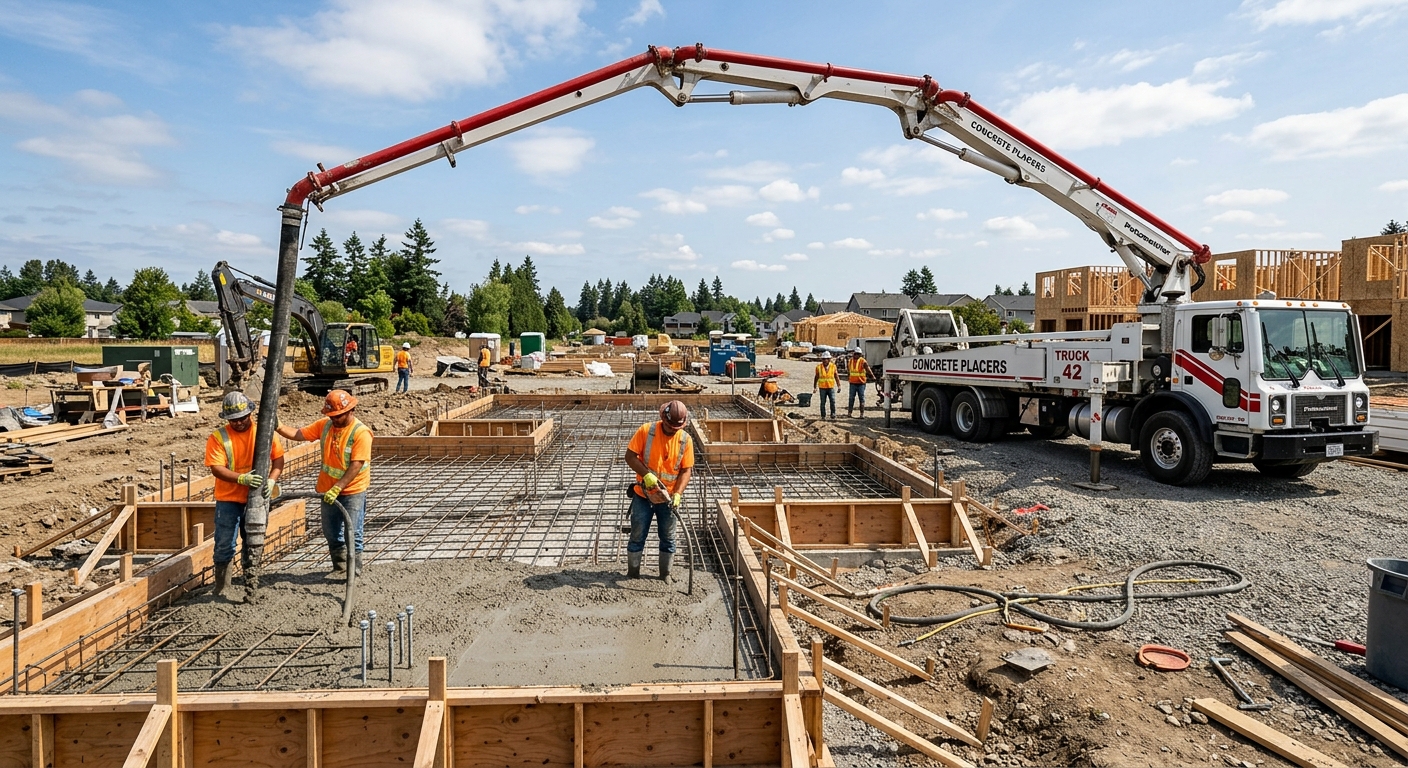
Concrete work options and costs in Blairmore
Concrete work in Blairmore usually centers on durable flatwork for busy drive lanes, back patios, and practical walkways. In a town of 1,522 residents (Statistics Canada, 2021 Census), demand is steady year-round because most properties are single-detached homes that need recurring maintenance for exterior surfaces. That matters when you’re comparing quotes: the same square footage can end up with different excavation volumes, reinforcement, and finishing effort depending on your soil, access, and how your slab ties into existing grade.
Calgary’s cold continental climate changes the math. With a design frost depth of about 1.2 m (roughly 4 ft), exterior slabs and structural footings have to be engineered to resist frost heave through freeze–thaw cycles. That typically means deeper excavation and more granular base, and it drives up foundation pricing compared with milder regions. On top of that, the shorter exterior pour season in the Calgary area pushes contractors to use cold-weather placement methods (insulated blankets and, in some cases, temporary heat) to protect curing concrete.
In Blairmore, trade interest is often highest around established residential areas where driveways and walkways are due for rework—especially in the older built-up pockets with mature landscaping and limited truck access. For many homeowners, the decision becomes: choose standard broom finish for budget certainty, or pay for exposed aggregate or stamped finishes where appearance and curb appeal matter most. The table below gives realistic starting ranges so you can compare options apples-to-apples.
| Application |
Typical Size |
Key Spec |
Finish Option |
Price Range |
| Concrete driveway (standard broom finish) |
24 ft x 10 ft (240 sq ft) |
Air-entrained mix, compacted base, control joints |
Broom finish, light sealer |
$12,000–$18,000 |
| Exposed aggregate driveway |
24 ft x 10 ft (240 sq ft) |
Air-entrained mix, washing process, reinforced edges |
Exposed aggregate |
$15,500–$23,500 |
| Stamped concrete driveway or patio |
18 ft x 12 ft (216 sq ft) |
Air-entrained mix, integral colour, joints per design |
Stamp pattern + sealer |
$15,000–$26,000 |
| Plain concrete patio or walkway |
12 ft x 16 ft (192 sq ft) or 4 ft x 30 ft (120 sq ft) |
Air-entrained mix, compacted base, broom finish |
Plain (broom) |
$5,000–$9,000 |
| Garage floor (interior slab) |
22 ft x 22 ft (484 sq ft) |
Vapour barrier, insulation as needed, reinforcement |
Power-trowel/smooth finish |
$10,500–$16,500 |
| Foundation footings (structural, below frost) |
Typical single-detached footprint; varies by plan |
Engineered design; below design frost depth; rebar |
Structural concrete |
$28,000–$45,000 |
Prices are estimates only and vary by project scope, site access and material selection.
What affects the price of concrete work in Blairmore
In Blairmore and the wider Calgary region, it’s common to see the same general project come back with a 30–50% difference between quotes. The biggest drivers are often hidden in the site conditions and engineering decisions: excavation and base depth, reinforcement quantity, truck access, and how contractors plan for cold-weather curing. Even when two bids both mention “concrete,” one may include a deeper, properly compacted granular base and engineered frost-compliant footings, while another assumes easier conditions—those differences show up immediately in cost.
Calgary-area freeze–thaw cycles dictate the specs. Footings and structural concrete must bear below the design frost depth (about 1.2 m in this region) to prevent frost heave and seasonal movement. For exterior flatwork—driveways, patios, and walkways—air-entrained concrete is essential to survive repeated expansion and contraction. Because the pour season is shorter and concrete must be properly cured, contractors may use insulated blankets and temperature control—especially if you’re scheduling in late fall or early spring—adding labour and equipment costs. De-icing salts also accelerate surface scaling when the mix and sealing aren’t specified correctly, so sealing is not a “nice-to-have” here.
Local examples that raise cost in Blairmore: removing oversized landscaping materials and hauling spoils when your driveway ties into mature gardens; needing additional rebar or thicker slab due to vehicle loads; and adding temporary heat to keep curing on schedule. Costs can be lower when access is straightforward and soil conditions are consistent, allowing contractors to follow the planned footing and base sections without surprises. That’s why a driveway can land anywhere from the $12,000–$18,000 band for standard broom-finished work to the $15,000–$26,000 band when stamping, integral colour, and extra finishing steps are included.
| Price Factor |
Why It Matters |
Cost Impact |
| Frost line depth — determines footing depth and form height |
Footings must sit below design frost depth to avoid heave and movement |
Higher excavation and concrete volume; typically a large portion of foundation budgets |
| Site preparation — excavation, grading, compacted granular base |
Proper base prevents settling and supports freeze–thaw durability |
More haul-away and compaction time can push labour and equipment costs up |
| Reinforcement — rebar or wire mesh requirement |
Controls cracking and increases load capacity |
Material and labour increases; required for thicker slabs and structural work |
| Mix design — air-entrainment and compressive strength spec |
Air-entrainment helps resist freeze–thaw damage; strength supports long-term performance |
Cold-weather specs and correct air content can raise material cost |
| Finish type — broom vs. stamped vs. exposed aggregate |
Finish impacts labour, cure timing, and sealing approach |
Stamped and exposed aggregate typically add finishing and product costs |
| Pour size and concrete truck access to site |
Access affects pour logistics and whether pumps/extra handling are needed |
Limited access can require smaller loads, longer setups, or pumping |
| Cold-weather curing precautions — heating and blankets |
Protects cement hydration when temperatures drop |
Heaters, blankets, and additional monitoring can add noticeable cost |
| Control joint pattern and sealing cost |
Joints manage cracking; sealing improves surface durability against salts |
Skipping or underspecifying can lower upfront cost but increases long-term failure risk |
Permits & regulations in Alberta
In Alberta, the permit and review pathway is mainly about whether the work affects a building’s structure or site servicing. Structural concrete—think foundation footings, foundation walls, and grade beams—generally requires a building permit, and engineered drawings are commonly part of the process so the municipality can confirm the design meets code requirements. For Blairmore homeowners, that usually means your contractor or design team provides the engineered details, and you (or the contractor on your behalf) ensures the permit is in place before excavation or placement.
Concrete flatwork such as patios, walkways, and driveways typically does not require a permit unless it affects lot grading, impervious surface coverage limits, drainage and stormwater flow, or municipal right-of-way requirements. If your slab changes the way water sheds or alters existing grades near sidewalks/servicing, the local authority may expect approvals before breaking ground.
Step-by-step, here’s how to verify your contractor in Alberta before work starts. First, confirm the contractor’s general business details and check that they have the correct licensing/registration for their scope (ask them what they’re registered for and who the accountable contractor is). Second, ask for a current certificate of insurance showing liability coverage; verify the dates are valid and the coverage amount is appropriate for concrete construction. Third, request WSIB/WCB coverage documentation (clearance letter or equivalent proof) so you know workers are covered if something goes wrong. Finally, ask for references from similar-scale Blairmore projects—especially ones involving frost-depth excavation or close-access driveway removals.
Getting concrete right in Blairmore's freeze-thaw climate
Concrete failures in Blairmore are usually a “system” problem: weak base prep, the wrong mix, poor jointing, or curing that’s rushed when temperatures drop. In this Calgary-region cold continental climate, freeze–thaw cycles drive expansion and contraction. If air-entrainment is missing or too low, water can freeze inside the paste, creating internal pressure that leads to spalling and surface scaling. If footings or exterior slabs don’t support properly on well-compacted granular base, seasonal movement can show up as settlement cracks or uneven slabs.
Spec the job like an Alberta frost-resistance project. Start with base preparation: excavate to the right depth for your soil and frost considerations, then place and compact granular sub-base properly (not “just enough” to level). Next, require an air-entrained concrete mix with a target air content of about 5–7% for exterior flatwork, along with a minimum 32 MPa compressive strength. Add control joints to create predetermined crack locations instead of random cracking. For curing, require minimum 7 days of curing under appropriate conditions; in colder weather, ask if they’ll use insulated blankets and/or temperature control so hydration isn’t interrupted. Finally, plan for sealing: a penetrating sealer applied after the slab has cured (commonly around 28 days) helps repel de-icing salts and slows surface breakdown.
Ask direct questions: “What’s your air content target?” “How deep is the granular base?” and “What curing plan do you use if night temperatures fall?” A practical cost example: if you’re choosing between plain broom-finish versus stamped, you might pay the higher $15,000–$26,000 band for stamped work. That price is justified when the scope includes correct mix, control joints, and proper sealing—not when a contractor tries to cut corners on base depth or curing. In Blairmore, those shortcuts are what turn a pretty finish into an expensive repair.
| Spec |
Why It Matters in Blairmore |
What to Ask For |
Impact if Skipped |
| Compacted granular base (depth?) |
Supports the slab and reduces frost-related movement during freeze–thaw cycles |
“Confirm excavation depth, granular type, and compacted lift specs based on my soil” |
Settlement, uneven surfaces, and early cracking |
| Air-entrained concrete mix (target air %?) |
Resists freeze–thaw damage in exterior slabs exposed to Alberta winters and salts |
“What air content target do you use for exterior flatwork (5–7%)?” |
Surface spalling and scaling that worsens each winter |
| Compressive strength (MPa rating) |
Ensures the concrete develops the strength needed for load and durability |
“Specify minimum 32 MPa and show the mix design/strength class” |
Premature wear, brittle behaviour, and reduced service life |
| Control joints (spacing per ACI guidelines) |
Controls where cracks form to reduce random damage |
“What joint spacing and saw-cut schedule will you use for my slab size?” |
Uncontrolled cracking and more expensive patch/replace work |
| Minimum 7-day curing period |
Proper hydration is critical when Blairmore temperatures can drop quickly |
“How will you protect curing concrete at night (blankets/heaters if needed)?” |
Weak surface, increased scaling risk, durability problems |
| Penetrating sealer (when applied after cure) |
Improves resistance to de-icing salts and reduces moisture ingress |
“Will you apply penetrating sealer around 28 days after pour, and what’s the product type?” |
Faster surface deterioration and higher chance of spalling |
How to choose a concrete work contractor in Blairmore
Choosing the right concrete contractor in Blairmore is mostly about documentation and clarity, not just price. In Alberta, you want proof of liability insurance and valid WSIB/WCB coverage, plus confirmation that the contractor is accountable for the scope they’re selling you. Start by asking for a current certificate of insurance—check the coverage is active and the project is within the listed scope. Then request WSIB/WCB proof (often in the form of a clearance letter or equivalent documentation). If they can’t provide both quickly, treat it as a serious warning.
Get 2–3 itemised written quotes instead of one lump-sum number. A solid quote breaks out excavation and base prep, concrete supply, reinforcement, forms, finishing, cutting joints, disposal, and sealing. Make sure it states whether any permits are included (for structural foundation work), whether snow removal and site protection are accounted for, and whether waste disposal and hauling are included in the price. For payment, avoid large upfront payments—never pay more than 10–15% upfront, and hold back a portion until the job is complete, cleaned up, and cured as planned.
Warranty matters in freeze–thaw zones. Ask for a workmanship warranty length and whether the warranty is tied to proper curing and sealing recommendations. Also ask if the manufacturer warranty for materials is transferable. Finally, insist on a written timeline: start date, pour date window, curing protection plan, and the estimated completion time.
- Request proof of liability insurance (active dates, appropriate coverage limits)
- Confirm WSIB/WCB clearance/coverage for workers
- Ask for similar Blairmore or Calgary-area projects with comparable access constraints
- Get quotes itemised (base prep, reinforcement, concrete, finishing, sealing)
- Ensure the scope lists removal/disposal of existing concrete (if applicable)
- Confirm control joint layout and who performs saw cuts
- Ask for the mix spec: air-entrainment target and minimum compressive strength
- Verify curing plan for cold nights (blankets/heating if needed)
- Check whether sealer is included and when it will be applied
- Clarify who provides any permit/engineering review for structural foundation work
- Review payment schedule; keep a holdback until complete and cleaned
- Confirm warranty terms for workmanship and how claims are handled
Concrete contractor red flags in Blairmore: quotes that don’t mention air-entrainment or curing protection; “too cheap to be true” base prep with no granular depth details; no written scope for joints and sealing; reluctance to provide insurance/WSIB/WCB proof; and vague timelines that ignore cold-weather risk during the Calgary season.
Frequently asked questions — concrete work in Blairmore
How do I seal concrete to protect it in Blairmore?
In Blairmore’s Alberta winters, sealing helps slow moisture and de-icing salt intrusion, which is a key reason exterior slabs hold up better over multiple freeze–thaw cycles. The typical approach is a penetrating sealer applied after the concrete has fully cured—often around 28 days after the pour—so the surface is dry and capable of absorbing the product correctly. Ask your contractor what product type they’re using (penetrating vs film-forming) and confirm surface preparation: any laitance or dust needs to be removed. If your driveway or patio is in a high-salt zone (near sidewalks or where you park and shovel), sealing is especially important. If you’re budgeting, sealing may be included with higher-finish work—think stamped at the $15,000–$26,000 band—or added as an upgrade for standard work.
What is the difference between concrete and cement?
Concrete is the full construction material: it’s cement plus water plus aggregates (like sand and gravel), and often admixtures such as air-entrainers for freeze–thaw durability. Cement is only one ingredient in the mix—typically Portland cement—that acts as the binder when it hydrates. In Alberta’s cold continental climate, the “cement/what’s in the mix” discussion is really about the overall concrete design: whether it’s air-entrained for exterior exposure, the minimum compressive strength (commonly 32 MPa for many flatwork specs), and how it will be cured. A contractor can use the same “cement” language, but what matters to you is the mix performance: air content, curing protections, and whether the spec is correct for exterior slabs in the Calgary market.
How much does concrete work cost in Blairmore?
Concrete pricing in Blairmore generally follows the same cost structure as the Calgary region: excavation depth for frost considerations, base preparation, reinforcement, and the amount of finishing and curing protection required. For homeowners, a standard exterior driveway can land in the $12,000–$18,000 range for broom-finished work (site access and removal/disposal can shift the number). Patios and walkways often fall in the $5,000–$9,000 band for typical sizes, depending on thickness, base depth, and whether it includes sealing. If you want stamped finishes, decorative work commonly pushes into the $15,000–$26,000 range because labour time and finishing steps increase. For foundations, structural footings below frost depth often drive the higher $28,000–$45,000 band.
How deep must footings be for Blairmore's frost line?
For Blairmore and the broader Calgary area, the practical rule for structural concrete is to bear below the design frost depth—about 1.2 m (roughly 4 ft) in the local frost depth guidance used for engineering. That depth isn’t something you should estimate from neighbour experiences; engineered drawings typically confirm the exact footing size, thickness, and depth based on your soil conditions and foundation design. The reason is frost heave: if footings don’t rest on undisturbed soil below the frost line, freeze–thaw cycles can create seasonal movement that leads to cracks and settlement. If you’re pricing foundation work, the excavation and concrete volume created by frost-compliant depth is a major reason foundation costs commonly sit in the $28,000–$45,000 range in this region.
Why does concrete crack in Blairmore and how is it prevented?
Concrete cracks in Blairmore primarily because concrete shrinks as it cures and because the slab experiences movement from freeze–thaw cycles and temperature swings. In this Calgary-area climate, inadequate base preparation or the wrong mix increases the risk, but the most preventable cracking factor is joint strategy. Control joints create planned crack locations—so the slab cracks neatly at the joints rather than randomly. Proper compaction of a compacted granular base also reduces differential movement. Mix design matters too: for exterior slabs, air-entrainment helps prevent freeze–thaw damage that turns micro-cracking into surface spalling. Prevention is a package: correct mix, correct base, correct reinforcement for load, proper joint spacing, and curing protection. When sealing is added after cure, it helps protect cracked microscopic pores from salt-driven deterioration.
Stamped vs broom-finish concrete — cost difference?
Stamped concrete costs more than broom-finish because it’s labour-intensive and requires additional materials and careful timing. Broom-finished driveways are generally straightforward: a properly placed air-entrained mix over a compacted base, then finishing with a broom and adding control joints. Stamped work adds integral colour (or other colouring methods), stamp mats, release agents, and more detailed surface finishing and cleanup—plus sealing as part of the expected finish system for exterior durability. In Blairmore, that’s why standard broom driveways often sit around the $12,000–$18,000 range, while stamped driveways or patios commonly land in the $15,000–$26,000 band. The best value comes when the higher-finish choice still includes correct frost and freeze–thaw specs—especially air-entrainment and curing protection—rather than just decorative surface work.