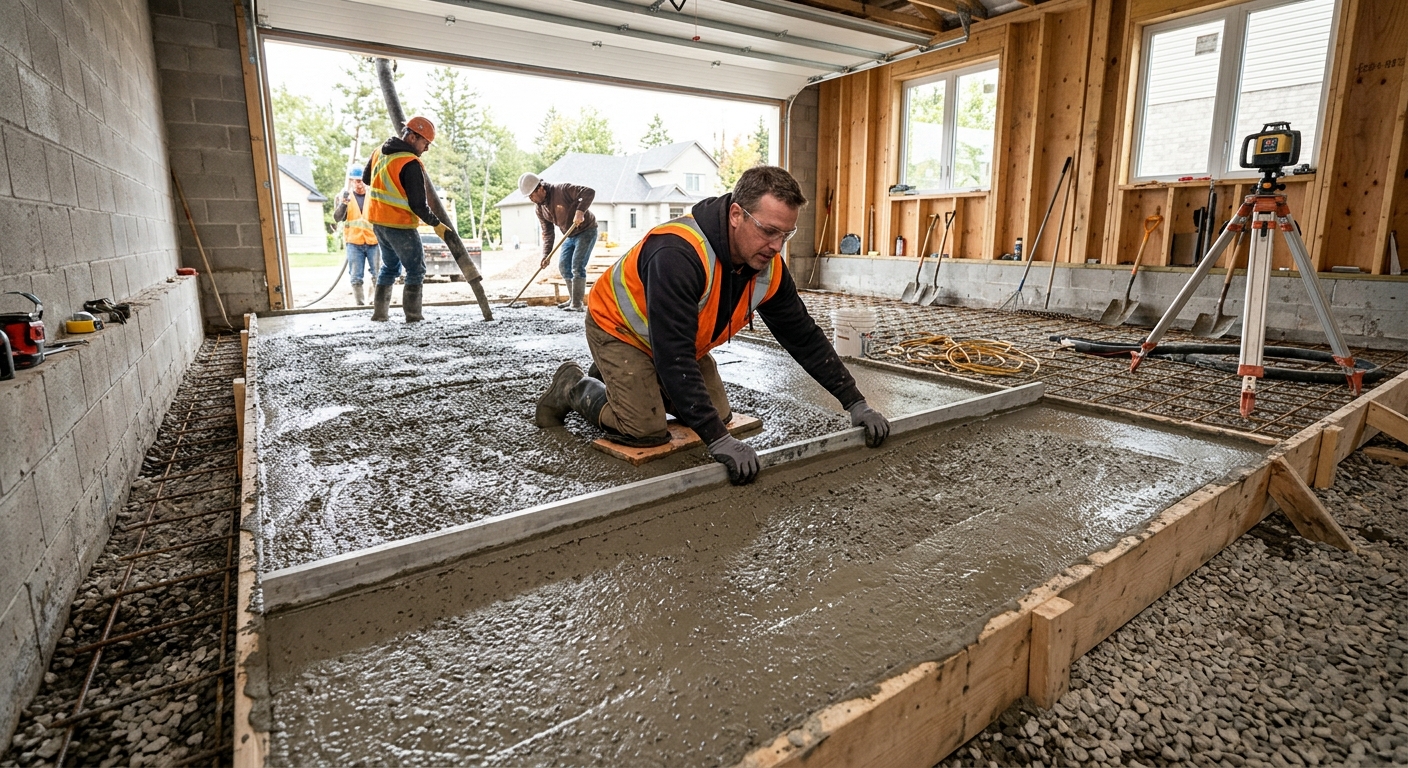
Concrete work options and costs in Mayland Heights
Mayland Heights, Alberta is where homeowners usually start thinking about concrete as soon as they notice foot traffic, rain puddling, or the early signs of freeze–thaw wear. With a population of 5,925 residents (Statistics Canada, 2021 Census), the local housing market supports ongoing demand for driveways, patios, walkways, and foundations tied to typical single-detached neighbourhood development patterns. In the Calgary economic region, that steady demand means pricing tends to be consistent—until weather tightens the pour schedule.
Calgary’s cold continental climate is the biggest driver of cost. The design frost depth is engineered at about 1.2 m (roughly 4 ft), so exterior footings and structural foundation elements generally require excavation down to undisturbed soil below that depth. On top of that, frequent freeze–thaw cycles require air-entrained mixes, granular base preparation, and control joints to reduce surface scaling and cracking. Late fall and early spring placements often cost more because contractors may need cold-weather curing practices (insulating blankets and, in some cases, temporary heat) to achieve proper strength gain and durability.
Labour and access matter too—Mayland Heights homes with tight side gates, landscaping, or mature trees often need extra prep time, which shows up in quotes. Demand is especially high for exterior upgrades around family-friendly areas such as near the newer residential pockets and infill streets, where homeowners are extending driveways and adding patios for backyard living.
Here’s a practical comparison of common concrete options and realistic budget ranges so you can line up quotes before you choose a finish or scope.
| Application |
Typical Size |
Key Spec |
Finish Option |
Price Range |
| Concrete driveway (standard broom finish) |
400–600 sq. ft. |
Air-entrained mix for exterior, compacted base |
Broom finish |
$12,000–$18,000 |
| Exposed aggregate driveway |
400–600 sq. ft. |
Exposed stone mix, cured and processed to achieve texture |
Exposed aggregate |
$14,500–$21,500 |
| Stamped concrete driveway or patio |
300–500 sq. ft. |
Air-entrained exterior mix, release agent and stamp pattern |
Stamped patterns |
$15,000–$26,000 |
| Plain concrete patio or walkway |
200–400 sq. ft. |
Exterior grade, controlled joints |
Broom or light trowel |
$5,000–$9,000 |
| Garage floor (interior slab) |
420–600 sq. ft. |
Vapour control considerations, mesh/rebar as specified |
Steel trowel or light broom |
$10,500–$16,500 |
| Foundation footings (structural, below frost) |
Typical house + footing system |
Excavate to undisturbed soil; designed bearing depth below frost |
Formwork + structural concrete |
$28,000–$45,000 |
Prices are estimates only and vary by project scope, site access and material selection.
What affects the price of concrete work in Mayland Heights
In Mayland Heights (and across Calgary), you can see 30–50% quote swings for what looks like the “same” concrete job. The difference isn’t usually the concrete itself—it’s the engineering depth, the base prep, the reinforcement strategy, and how the contractor protects concrete during cold weather curing. In a city where the design frost depth is engineered at about 1.2 m (roughly 4 ft), excavation and form height are a major cost driver, and that’s why foundation and footing work tends to land in the $28,000–$45,000 band more often than homeowners expect.
Freeze–thaw cycles also dictate key specs. Exterior slabs need air-entrained concrete mixes to resist scaling and spalling, plus a properly compacted granular base. Because the practical pour season for exterior work is shorter, winter-grade placement may require insulating blankets and/or temporary heat to keep the slab curing long enough to reach strength. On top of that, Calgary-area de-icing salts are hard on unsealed surfaces—so sealing is a real durability investment, not an upsell.
Two examples from local projects that commonly push costs up or down in Mayland Heights: (1) If your driveway ties into an existing slab or has utility offsets, saw-cutting, removal, and regrading can add hours—often shifting a standard driveway budget within the $12,000–$18,000 band toward the higher end. (2) Stamped finishes look similar on paper, but labour time is higher; when stamps, borders, and colour hardener are included, budgets commonly move into the $15,000–$26,000 range.
Even housing age plays a role. Older properties may have settlement issues, deeper frost-susceptible soils, or drainage patterns that force more base rebuild and subdrain consideration—so the same 20 ft by 10 ft patio can cost meaningfully more if the contractor has to correct underlying site conditions.
| Price Factor |
Why It Matters |
Cost Impact |
| Frost line depth |
Footings must extend below the design frost depth to prevent frost heave |
Higher excavation and formwork for structural work; drives footing pricing |
| Site preparation |
Proper grading and compacted granular base reduces voids and future settlement |
More haul-off, regrading, and compaction raises costs |
| Reinforcement |
Rebar or mesh controls cracking from shrinkage and loads |
Labour and materials add cost, especially for driveways and garage slabs |
| Mix design |
Air-entrainment and strength spec improve freeze–thaw durability |
Exterior mixes and engineering requirements increase per-cubic-yard costs |
| Finish type |
Broom vs. stamped vs. exposed aggregate changes labour time and materials |
Stamped/exposed typically cost more than standard broom |
| Pour size and concrete truck access to site |
Smaller or harder-to-access pours can require more handling |
Additional mobilization and labour; possible extra dispatch charges |
| Cold-weather curing precautions |
Heating/blankets protect strength gain when temperatures drop |
Can add significant day-to-day costs in shoulder seasons |
| Control joint pattern and sealing cost |
Joints guide cracking; sealing helps repel de-icing salts |
Better long-term performance, but adds materials and crew time |
Permits & regulations in Alberta
In Alberta, structural concrete work typically needs a building permit, and it’s often tied to engineered drawings. That includes footings, foundation walls, grade beams, and other structural foundation elements designed to carry loads and resist frost-related movement. Concrete flatwork like driveways, patios, and walkways usually does not require a permit on its own—however, it can trigger permitting if it affects lot grading, stormwater flow, or impervious surface/coverage rules that municipalities enforce. If your project changes drainage, ties into a retaining structure, or alters how runoff leaves your property, confirm with the local authority before breaking ground.
For Mayland Heights homeowners, the practical step-by-step verification is straightforward. First, ask for the contractor’s proof of Alberta liability insurance (certificate of insurance). Second, verify the contractor has WSIB/WCB coverage for their workers. You can check documentation by requesting the insurer’s certificate showing the coverage is current and matches your project type. Third, confirm licensing details for the contractor/business through the provincial registry resources that list regulated construction trades where applicable. If they can’t provide current insurance/coverage or references that match the scale of your work, take that as a red flag.
Finally, ask whether permit pull responsibilities are included in the proposal (especially for structural work) and confirm who will handle any required inspections. A solid contractor will answer clearly—no guessing.
Getting concrete right in Mayland Heights's freeze-thaw climate
Concrete can fail in Mayland Heights mainly through freeze–thaw damage, poor base support, and surface deterioration from de-icing salts. The two biggest technical levers are base preparation and mix durability. If the compacted granular sub-base isn’t built to the right depth and density for local soil and frost conditions, the slab can lose uniform support and crack. If the mix isn’t properly air-entrained, water can freeze in the paste, expanding and causing surface scaling and spalling—one of the most common driveway and walkway problems we see here.
To spec the job correctly for the Calgary-area climate, insist on five things: (1) base prep built on compacted granular material to the required depth for the frost-engineered design, (2) an exterior air-entrained mix with target air content commonly in the 5–7% range, (3) compressive strength meeting the structural/engineering requirement—commonly at least 32 MPa for exterior slabs, (4) control joints installed to manage where cracking happens, and (5) curing protected with proper temperature/time—minimum 7-day curing under suitable conditions, with cold-weather precautions when pours happen near or below seasonal thresholds.
Sealing also matters: apply a penetrating sealer after the slab has fully cured (commonly around 28 days post-pour) so water and salt are less able to penetrate at the surface.
Here’s a realistic value comparison: a standard broom-finished driveway might land in the $12,000–$18,000 band, while stamped options can move to $15,000–$26,000. The price difference is justified when the contractor also includes correct base build, proper air-entrainment, reliable jointing, and curing protection—not just the stamp and colour.
| Spec |
Why It Matters in Mayland Heights |
What to Ask For |
Impact if Skipped |
| Compacted granular base (depth?) |
Mayland Heights freeze–thaw pushes slabs if voids or weak sub-base exist |
Documented sub-base depth and compaction method; confirm fit to frost-engineered design |
Settlement, uneven wear, and early cracking |
| Air-entrained concrete mix (target air %?) |
Calgary-area cycles require durable paste to resist scaling/spalling |
Target exterior air content typically 5–7% for flatwork |
Surface scaling, pop-outs, and freeze–thaw deterioration |
| Compressive strength (MPa rating) |
Strength gain affects long-term durability and load resistance |
Minimum 32 MPa (or engineered requirement for the slab/footings) |
Soft surface, increased cracking, and reduced service life |
| Control joints (spacing per ACI guidelines) |
Joints control shrinkage cracking in freeze–thaw exposure |
Joint layout and spacing consistent with ACI guidance for the slab thickness and exposure |
Random cracking that admits water and accelerates freeze–thaw damage |
| Minimum 7-day curing period |
Cold snaps slow curing; poor curing increases surface weakness |
Minimum 7 days curing under proper conditions; winter precautions if required |
Reduced strength, scaling, and premature surface wear |
| Penetrating sealer (when applied after cure) |
De-icing salts and moisture attack unsealed surfaces |
Penetrating sealer applied about 28 days after pour (after full cure) |
Faster salt penetration, spalling risk, and higher maintenance |
How to choose a concrete work contractor in Mayland Heights
Choosing the right contractor in Mayland Heights starts with proof and paper, not promises. First, verify the contractor’s Alberta liability insurance—ask for a current certificate of insurance showing appropriate coverage for your project type. Second, confirm WSIB/WCB coverage for their workers; request documentation rather than accepting “we’re covered.” Third, check licensing/registration for regulated trades where applicable, and verify the business is active and in good standing.
Then, get 2–3 itemised written quotes. You want a breakdown that separates labour, concrete supply, forms, base preparation, reinforcement, saw cutting, disposal, and finish materials. A lump-sum number without quantities and inclusions is hard to compare. Read the scope carefully: what’s excluded for example—existing concrete removal, soil hauling, permit pulls (if applicable), backfill and grading, drainage ties, or patching around adjacent landscaping and fences.
Warranty is another differentiator. Ask for the workmanship warranty length (and what it covers), plus any product/manufacturer warranty on sealers or decorative systems. Also ask whether the warranty is transferable if you sell your home—especially relevant for new stamped finishes.
For payment, never pay more than 10–15% upfront. Hold back a portion until completion and final grading/sealing steps are done. Get a start date and completion estimate in writing, and confirm how weather risk will be managed in a cold-weather placement window.
- Provide Alberta liability insurance certificate (current dates and project coverage).
- Provide WSIB/WCB clearance documents for workers.
- List past jobs in the Calgary region with similar scope (driveways, patios, footings).
- Use itemised quotes: labour, concrete volume, base prep, rebar/mesh, finishing, saw cuts.
- Clarify what’s included for removal, hauling, and disposal of existing materials.
- Confirm compaction spec and base depth approach before any concrete is ordered.
- Ask for mix specifications: air-entrainment for exterior flatwork and strength rating.
- Ask about control joint layout and whether joints are installed before the slab sets.
- Confirm curing plan for cold weather (blankets/heaters if required).
- Confirm sealing inclusion if you want salt-resistance (penetrating sealer after cure).
- Use a written schedule: pour day(s), cure protection days, and final cleanup.
- Set payment milestones tied to workmanship checks, not just “progress.”
Concrete red flags in Mayland Heights include: quoting without discussing air-entrainment for exterior work, skipping documented base depth/compaction details, starting pours late in the season without a cold-weather curing plan, refusing to provide insurance/WSIB/WCB proof, and giving a vague finish promise (especially for stamped/exposed aggregate) without a clear scope.
Frequently asked questions — concrete work in Mayland Heights
What is a concrete overlay and is it suited to Mayland Heights?
A concrete overlay is a thin cement-based layer installed over an existing slab to improve surface appearance and restore a smoother riding surface. In Mayland Heights and the wider Calgary area, overlays can be suited to patios and some driveways when the underlying slab is structurally sound and properly prepared. The key is evaluation: if the old slab has significant movement, heaving, or widespread cracking/spalling, an overlay can hide defects temporarily but the problem often returns through the new surface after freeze–thaw cycles.
Overlay pricing varies by thickness and prep, and it should be compared against full replacement. If your current driveway is failing and base support is compromised, replacement often ends up closer to the typical driveway range of $12,000–$18,000 rather than repeatedly paying for cosmetic fixes. Ask the contractor to assess bond-readiness, moisture conditions, and surface profile, then confirm how they’ll manage joints to reduce reflective cracking.
How do I seal concrete to protect it in Mayland Heights?
In Mayland Heights, sealing is about repelling moisture and de-icing salt from penetrating the concrete surface during Alberta’s freeze–thaw cycles. The most common approach is a penetrating sealer applied after the slab has fully cured—typically around 28 days after the pour. Before sealing, the concrete should be clean and dry, with any stains removed and the surface allowed to return to a stable moisture condition.
Use the right product for exterior concrete: ask specifically for a penetrating sealer (not just a film-forming coating) and confirm the application instructions for temperature and humidity. If you seal too early, moisture can get trapped, which can reduce performance. For driveways and walkways where salts splash, sealing can reduce surface deterioration and help maintain traction.
If you’re budgeting, sealing is often a smaller add-on compared to upgrading finish type; it doesn’t usually move a job out of the standard $5,000–$9,000 patio/walkway band or the $12,000–$18,000 driveway band, but it’s one of the best durability steps for Calgary-region concrete.
What is the difference between concrete and cement?
Concrete is the final structural material you see on your driveway or foundation. Cement is one ingredient inside concrete. Portland cement (often called cement) binds the mix together, but concrete also includes aggregates (sand and gravel) and water, plus admixtures that control performance—like air-entrainment for freeze–thaw durability.
In Mayland Heights, the practical takeaway is that homeowners should ask about the concrete mix design, not just “cement brand.” Exterior flatwork needs appropriate air-entrainment and a strength specification that matches local engineering and exposure conditions. For example, the typical exterior slab expectation includes at least 32 MPa compressive strength, and exterior mixes commonly use air content in the 5–7% range to protect against scaling and spalling.
When comparing quotes, focus on: the stated mix specs, base prep, reinforcement (if needed), curing precautions, and whether the contractor documents how the air-entrainment is ensured. Those details affect durability in Calgary’s cold winters more than the cement label alone.
How much does concrete work cost in Mayland Heights?
Concrete costs in Mayland Heights generally align with Calgary-area price bands because materials, labour availability, and winter scheduling are shared across the region. For a standard exterior driveway, budgets often fall into the $12,000–$18,000 range, with higher costs when you add features like expanded removal/regrading, thicker reinforcement, or premium finishes. For decorative work such as stamped concrete driveways or patios, typical budgets commonly sit in the $15,000–$26,000 band due to additional labour and finishing materials.
For patios and walkways, plain concrete is commonly budgeted at $5,000–$9,000 depending on size, access, and jointing/sealing requirements. Foundation footings are a different category because excavation must reach undisturbed soil below the design frost depth (about 1.2 m in this region). That structural work often lands in the $28,000–$45,000 range when you include forms, reinforcing, and engineered requirements.
If you’re seeing a quote well outside these bands, it’s worth asking what’s different: base depth, reinforcement, cold-weather curing plan, disposal, or whether the scope includes sealing and joint sealing.
How deep must footings be for Mayland Heights's frost line?
For Mayland Heights in the Calgary area, concrete foundation footings are typically designed to bear below the design frost depth—about 1.2 m (roughly 4 ft) in local engineering practice. The exact depth for your specific foundation depends on your engineered drawings and site conditions, including soil type and bearing capacity. The goal is to place concrete where it won’t lift seasonally due to frost heave, which is why contractors often excavate deeper and replace unsuitable material.
When reviewing a quote, don’t accept a vague statement like “to frost” without context. Ask how they’ll confirm bearing conditions and how excavation depth is established on your lot. Also ask whether they’re addressing drainage and removal of poor soils, since weak or saturated soils can increase frost risk even if the nominal depth seems correct.
Because this excavation is more intensive than in milder regions, footing work commonly falls into the $28,000–$45,000 band. A reputable contractor will align your footing depth with the engineered foundation plan and explain the steps clearly.
Why does concrete crack in Mayland Heights and how is it prevented?
Concrete cracks in Mayland Heights mainly due to shrinkage, temperature changes, and freeze–thaw cycling where water can enter. Even well-made concrete will shrink as it cures, and then it contracts/expands with winter and summer temperature swings. If cracks happen randomly, they can open up pathways for moisture and salts—leading to deterioration over time.
Prevention comes from planning: properly prepared and compacted granular base support, an exterior air-entrained mix, and correctly spaced control joints that guide where cracking occurs. Control joints should be installed early enough and spaced according to standard guidelines for slab thickness and exposure. For cold-weather placements, proper curing (often with insulating blankets or temporary heat when needed) helps the slab gain strength instead of finishing too soft.
Finally, sealing after cure helps limit moisture and de-icer penetration at the surface. If you’re comparing driveway options, this is why standard broom-finished concrete can cost in the $12,000–$18,000 range, while decorative stamped work is higher—yet both still rely on correct mix, joints, and curing to survive Calgary freeze–thaw cycles.