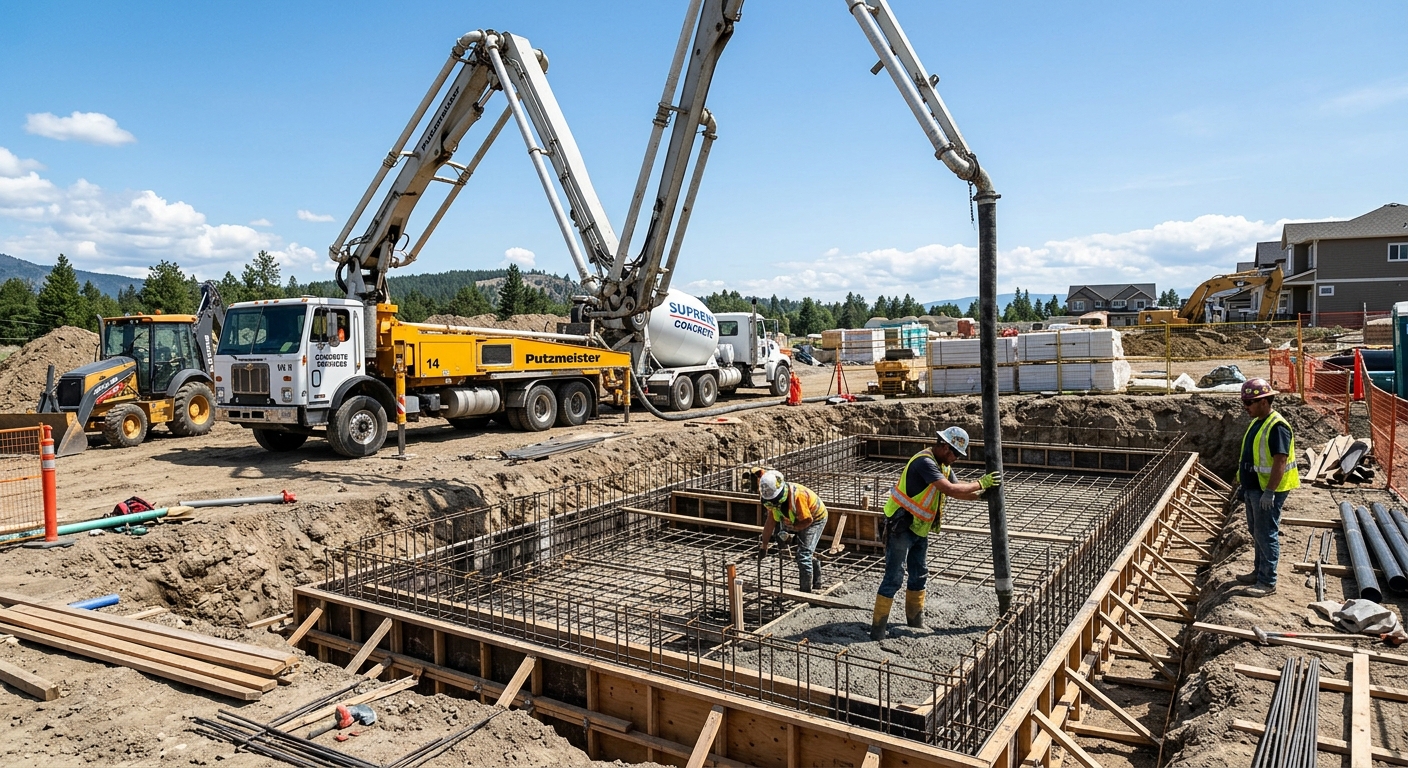
Concrete work options and costs in Elbow Park
Elbow Park, Alberta is a mature, established neighbourhood in Calgary, and that matters because most concrete flatwork here sits on older driveways, mature landscaping, and soils that have seen decades of freeze–thaw movement. According to the Statistics Canada 2021 Census, Elbow Park has a population of 3,285. The housing profile is dominated by single-detached homes, which is why driveways, patios and walkways are among the most requested upgrades in the area. In 2021, the city’s long-run residential demand kept crews busy, and in turn that affects availability and scheduling for concrete contractors.
Pricing in Calgary is engineered around a cold continental climate. The region’s design frost depth is about 1.2 m (roughly 4 ft), so foundation-related excavation and thicker, frost-protected bearing for exterior slabs are common. Frequent freeze–thaw cycles also drive spec decisions like air-entrained mixes, a properly compacted granular base, and control joints spaced to reduce random cracking and future spalling. Late-season weather can compress the pour window, which is why winter-grade placement practices (insulated blankets, sometimes heated enclosures for sensitive schedules) can show up as a line-item cost—especially for exterior work.
In Elbow Park, concrete work is particularly in demand along busy corridors where homeowners often want a cleaner, durable driveway and smooth walk transitions—those paths between front steps, garages and laneways take a beating every winter. Use the comparison below to anchor your expectations before you ask for a site-specific quote.
| Application |
Typical Size |
Key Spec |
Finish Option |
Price Range |
| Concrete driveway (standard broom finish) |
480–650 sq. ft. |
Frost-depth excavation, compacted granular base, air-entrained concrete, control joints |
Broom finish, standard forms |
$12,000–$18,000 |
| Exposed aggregate driveway |
480–650 sq. ft. |
Air-entrained mix, correct curing timing, aggregate exposure plan |
Exposed aggregate (scoured/surface retarder-controlled finish) |
$14,000–$22,000 |
| Stamped concrete driveway or patio |
300–650 sq. ft. |
Reinforcement as required, integral colour (often), proper stamping timing |
Stamped pattern with release agent and sealer |
$15,000–$26,000 |
| Plain concrete patio or walkway |
200–450 sq. ft. |
Air-entrained mix, compacted base, joints and drainage plan |
Broom or light trowel finish |
$5,000–$9,000 |
| Garage floor (interior slab) |
400–600 sq. ft. |
Vapour control as needed, reinforcement, proper subgrade compaction |
Float and light broom (standard) |
$6,500–$12,500 |
| Foundation footings (structural, below frost) |
Typical single-detached footing perimeter |
Engineered depth and bearing; rebar, forms, and concrete volume below design frost depth |
Structural concrete work (no decorative finish) |
$28,000–$45,000 |
Prices are estimates only and vary by project scope, site access and material selection.
What affects the price of concrete work in Elbow Park
In Elbow Park and across the Calgary region, two homeowners can receive quotes for what sounds like the same concrete job and see differences of 30–50%. That gap usually comes down to engineering depth requirements, how much excavation the contractor must do, and the “quality control” items that make concrete last through Alberta winters. In our market, contractors aren’t all pricing the same spec—some include air-entrainment and proper base prep, while others cut corners to win a quicker schedule.
First, the frost line depth drives the foundation and slab economics. In Alberta, footings and exterior bearing typically need to sit below the design frost depth (about 1.2 m or 4 ft here) to prevent frost heave. When excavation gets deeper and granular replacement increases, you pay for more labour, more trucking, and more concrete. Second, freeze–thaw cycles across Calgary push contractors to use air-entrained concrete mixes for exterior work; without it, you often get spalling and surface scaling over time. Third, Calgary’s cold-weather realities shorten the practical exterior pour season, so some projects require winter-grade mixes, insulated blankets and sometimes temporary heat to achieve a reliable curing window.
Here are a few Elbow Park scenarios that raise or lower cost: if your existing driveway must be fully removed to reach compactable subgrade, the “demo + hauling” portion increases costs quickly within the $12,000–$18,000 driveway band; if you choose a plain patio in the $5,000–$9,000 range and keep access straightforward (no tight turns for trucks), you’ll usually see fewer extra charges than decorative finishes. Finally, housing-stock age matters—many older properties have less uniform subgrade and more buried services, so contractors spend more time locating utilities and stabilizing the base. As a reference point, it’s common to see stamped upgrades add thousands because crews need more labour for formwork, finishing, and colour/sealing steps—often pushing projects toward the $15,000–$26,000 decorative range.
| Price Factor |
Why It Matters |
Cost Impact |
| Frost line depth |
Determines footing depth and form height below frost to prevent heave |
More excavation and concrete volume; can add thousands on structural scopes |
| Site preparation |
Excavation, grading, and compacted granular base determine stability |
Extra demo, regrading, and base material/compaction increase price |
| Reinforcement |
Rebar or wire mesh controls cracking and supports loads |
Material plus labour; often more on larger drives and garage floors |
| Mix design |
Air-entrainment and compressive strength spec for Alberta freeze–thaw |
Higher-grade concrete and stricter QA can shift costs upward |
| Finish type |
Broom vs. stamped vs. exposed aggregate changes labour and timing |
Decorative finishes typically cost more than plain flatwork |
| Pour size and concrete truck access |
Access affects placement rate, pumping needs, and labour planning |
Tight access may require smaller loads or additional handling |
| Cold-weather curing precautions |
Heating, blankets, and temperature control protect early strength gain |
Can add line-items in late fall/early spring and during cold snaps |
| Control joint pattern and sealing cost |
Proper joints reduce random cracking; sealing helps repel de-icing salts |
Additional saw-cut/finishing time and a post-cure sealer step |
Permits & regulations in Alberta
In Alberta, the permitting and review expectations depend on the type of concrete work you’re doing. Structural concrete work—like foundation footings, foundation walls, and grade beams—typically requires a building permit, and engineered drawings are often reviewed through municipal processes. For flatwork such as patios, walkways and driveways, a permit is usually not required by default, unless the project affects lot grading, interferes with drainage, impacts impervious surface coverage limits, or touches the municipal right-of-way. Before you break ground in Elbow Park, confirm details with your local authority and your property’s development rules.
From a homeowner-safety perspective, also verify the contractor is properly insured. Ask for liability insurance and proof of coverage for workers (WSIB/WCB coverage as applicable) before work starts. Then, request references for similar-scale residential projects—especially ones that involved comparable access and exterior freeze–thaw exposure.
Step-by-step verification you can do:
- Check the contractor’s Alberta business/registration details through the appropriate public online registry.
- Ask for a current certificate of insurance for liability—ensure coverage matches the scope and dates.
- Request proof of WSIB/WCB clearance or equivalent documentation for workers involved in the project.
- Confirm the company names on the quote and insurance documents match (avoid “subcontractor-only” paperwork).
- Get the permit responsibility in writing: who pulls it, who provides drawings if required, and what happens if plans change.
Getting concrete right in Elbow Park's freeze-thaw climate
In Elbow Park, concrete doesn’t fail because it’s “bad concrete”—it fails when the build-up can’t survive Alberta’s freeze–thaw cycles. Most problems I see start with base prep that wasn’t compacted to a stable, frost-resistant condition, or with a mix that wasn’t engineered for exposure to de-icing salts and winter moisture. To spec the job correctly, focus on five items.
(1) Base preparation: the granular sub-base must be compacted to the right depth and profile for local soil and the design frost requirement (about 1.2 m here for frost-protected bearing). (2) Mix design: exterior slabs should use air-entrained concrete; a target of about 5%–7% air content is typical for durable outdoor performance, along with a minimum 32 MPa compressive strength. (3) Control joints: spacing should be set to limit random cracking; cracking isn’t always preventable, but it can be controlled. (4) Curing: plan for at least 7 days of curing under proper conditions—cold-weather placement needs insulated blankets and sometimes heat so the surface doesn’t scale. (5) Sealing: apply a penetrating sealer after the cure period (commonly around 28 days post-pour) to help repel de-icing salts.
Here’s an example of where specs are worth paying for: a plain broom-finished patio in the $5,000–$9,000 band can look great initially, but if the contractor skips air-entrainment or uses an under-specified base, you may end up resurfacing or patching in a few winters. Spending toward a properly engineered exterior spec is usually cheaper long-term than mid-cycle repairs, even when decorative options are tempting. Stamped concrete may run closer to the $15,000–$26,000 decorative range, but the same durability fundamentals—air, base, joints and curing—still determine how it performs.
| Spec |
Why It Matters in Elbow Park |
What to Ask For |
Impact if Skipped |
| Compacted granular base (depth?) |
Stable support reduces settlement and helps prevent frost-related movement |
Confirm excavation depth and granular lift compaction method |
Uneven settling, increased cracking, and edge deterioration |
| Air-entrained concrete mix (target air %?) |
Freeze–thaw durability depends on correct air void system |
Request specified air content (commonly 5%–7% for exterior flatwork) |
Scaling and spalling, especially where salt and melt water sit |
| Compressive strength (MPa rating) |
Strength gain supports long-term load and surface hardness |
Minimum 32 MPa rating for exterior scopes |
Surface wear, early failure, and reduced resistance to damage |
| Control joints (spacing per ACI guidelines) |
Joints guide where cracks form, limiting random tearing |
Ask for joint layout and sawing timing plan |
Wider, uncontrolled cracks that trap water and salts |
| Minimum 7-day curing period |
Cold nights can slow strength gain and increase surface scaling risk |
Clarify curing method; winter work may require blankets/heating |
Reduced strength, surface failure, and compromised durability |
| Penetrating sealer (when applied after cure) |
Salt exposure is constant in Alberta driveways |
Apply after cure (commonly around 28 days post-pour) |
Faster salt-induced deterioration and more frequent patching |
How to choose a concrete work contractor in Elbow Park
Choosing the right contractor in Elbow Park starts with verifying credentials and then proving the quote matches the technical spec. In Alberta, confirm the contractor’s licensing/registration details through public online resources, and ask for proof of liability insurance with current coverage dates. For worker protection, request WSIB/WCB clearance or equivalent documentation—don’t accept “we don’t sub out” as a substitute. If the contractor is vague, you should assume corner-cutting risk.
Next, get 2–3 itemised written quotes. Look for labour and materials separated so you can see what’s included: base depth and type, reinforcement, concrete mix details, saw-cut timing, disposal, and whether sealing is included. A lump sum is okay only if the scope is extremely clear. Also confirm permit pull responsibility: who applies, who pays, and what happens if drawings or conditions change. In structural jobs, that’s especially important.
Warranty matters, too. Ask for the workmanship warranty length (how long they stand behind labour), product/manufacturer warranties on any specialty items (like sealer systems), and whether the warranty is transferable if you sell your home. For payments, never pay more than about 10%–15% upfront; keep a holdback until completion and final cleanup. Finally, insist on a start date and a completion estimate in writing—Calgary’s cold snaps and shorter exterior pour season can impact timelines.
- Confirm their Alberta coverage documents before signing.
- Ask how they protect early curing in cold weather (blankets/heating plan).
- Request written base prep details: excavation depth and compaction method.
- Verify air-entrainment and minimum compressive strength in the quote.
- See their proposed control joint layout and saw-cut timing.
- Ask whether reinforcement (mesh/rebar) is included and where.
- Confirm disposal, hauling, and site restoration are included.
- Clarify truck access and placement plan for your lot layout.
- Make sure sealing is specified (penetrating sealer and timing after cure).
- Check if they’re providing curing blankets and concrete temperature monitoring (winter work).
- Require a detailed scope with exclusions (what’s not included).
- Review references with comparable sizes and exterior exposure.
Elbow Park red flags include: quotes that omit air-entrainment or curing procedures, “standard” driveway work that doesn’t address frost-depth base expectations, vague joint/finishing schedules, promises to pour late into winter without any heating/blanket plan, and payment requests that exceed 10%–15% upfront with no clear holdback.
Frequently asked questions — concrete work in Elbow Park
When is the best time to pour concrete in Elbow Park?
The best time for exterior concrete in Elbow Park is typically late spring through early fall, when daytime temperatures help concrete place and cure reliably. In Calgary’s cold continental climate, late-season pours (especially when nights drop quickly) can require winter-grade mixes, insulated curing blankets and sometimes temporary heat to keep early strength gain on track. That matters because cold-weather curing mistakes increase the chance of surface scaling and long-term durability issues, particularly for driveways and patios exposed to melt water and de-icing salts. If you’re planning a project around a limited pour window, ask your contractor for their cold-weather plan and whether they’ll monitor conditions. Pricing can also move with scheduling—exterior scopes like patios often fit well inside the $5,000–$9,000 band when timing and access are straightforward.
How long does concrete take to cure?
Concrete has two timelines: initial set and practical curing. While concrete may be walkable sooner, homeowners should expect at least 7 days of curing under proper conditions for many exterior applications, and more stringent curing procedures in cold weather. For durability-focused steps like sealing, a common practice is applying penetrating sealer after the cure period—often around 28 days post-pour—so the concrete has developed enough moisture stability to accept the treatment and repel de-icing salts. If your patio or walkway is scheduled in late fall, confirm the contractor’s temperature control approach (blankets/heating) so curing isn’t compromised by Alberta freeze–thaw cycles. A well-cured slab protects your investment, whether you’re aiming for a plain finish in the $5,000–$9,000 range or upgrading to a decorative driveway.
Do I need a permit for concrete work in Alberta?
In Alberta, structural concrete work—like foundation footings, foundation walls, and grade beams—typically requires a building permit and often engineered drawings reviewed through the municipal process. For concrete flatwork (driveways, patios and walkways), a permit is usually not required unless the project affects lot grading, drainage, impervious surface coverage limits, or touches municipal right-of-way considerations. Even when a permit isn’t required, it’s smart to confirm with your local authority before breaking ground, because Elbow Park properties can have site constraints, older utilities, and drainage sensitivities that change what’s allowed. Also, require your contractor to carry liability insurance and proper WSIB/WCB coverage and provide proof on request. Clear permits and documentation reduce delays and keep the work aligned with Alberta expectations.
Concrete vs pavers for a patio in Elbow Park?
Concrete usually wins on cost-efficiency and longevity for Alberta winters when the base is engineered and joints are placed correctly. A plain broom-finished patio or walkway commonly lands in the $5,000–$9,000 range, and the durability comes from air-entrained mix, compacted granular base, and proper curing. Pavers can offer visual flexibility and easier spot repairs, but they often involve more ongoing maintenance if the bedding and drainage aren’t correct, and freeze–thaw movement can lift or shift units over time. In Elbow Park, where freeze–thaw and salt exposure are consistent, the choice really depends on your desired look and how complex your base prep will be. If your quote for concrete includes air-entrainment, a granular base to the right depth, and a control-joint plan, concrete is often the more predictable path.
How long does a concrete driveway last?
A well-built concrete driveway in Elbow Park commonly lasts many decades because it’s designed for Alberta freeze–thaw cycles—when the spec is right. The biggest durability drivers are frost-protected bearing (about 1.2 m design frost depth expectations), an air-entrained mix, correct base compaction, and a control-joint pattern that manages cracking. Sealing after cure (often around 28 days) helps repel de-icing salts that accelerate surface deterioration. If a driveway is poured without proper air content, rushed curing in cold weather, or poorly compacted base, you can see scaling or spalling much earlier. Budget-wise, most standard driveways fall into the $12,000–$18,000 range; that cost should reflect the engineering and finishing steps needed for long-term performance, not just the final appearance.
What is air-entrained concrete and why does it matter here?
Air-entrained concrete is mixed with tiny, evenly distributed air bubbles that create space for freeze–thaw expansion. In Elbow Park and the broader Calgary area, concrete is repeatedly exposed to freeze–thaw cycles and moisture from snowmelt and spring thaws. That’s why air-entrainment is a core durability spec for exterior flatwork—without it, water can damage the paste as it freezes, leading to scaling and spalling over time. Ask your contractor to include air-entrained concrete with a target air content (often 5%–7% for exterior flatwork) and a minimum compressive strength (commonly 32 MPa for exterior applications). Pair that with proper base prep, control joints and adequate curing, and your driveway or patio is far more likely to survive winters without early repairs.