Concrete work options and costs in Wembley
In Wembley, concrete work is a major part of keeping homes and lots functioning well year-round—especially on properties where driveways and walkways have to handle deep frost, relentless freeze–thaw cycles, and winter salt. With most Wembley dwellings being single-detached homes (80.0% of the housing stock), homeowners typically plan concrete flatwork at the same time as landscaping, regrading, or after older walkways and drive approaches start to crack and heave. That matters because nearly half the homes in town were built before 1981, so many projects involve tie-ins to existing foundations, patching, and upgrades to drainage.
In the Athabasca–Grande Prairie–Peace River region, costs are shaped less by cement prices and more by logistics and curing requirements. Frost lines here often run deep, so footings and any exterior slab work need robust base preparation and, for outdoor slabs, air-entrained concrete to resist scaling. The shorter reliable pour season also means crews and equipment can be in higher demand in the window when weather is workable. In practice, that’s why the same job can land at different price points depending on access, excavation depth, and whether cold-weather curing precautions (blankets/heating and extended curing time) are needed.
Concrete demand is especially strong in residential areas like the central Wembley neighbourhoods near main roads and the busier service corridors, where homeowners are often replacing worn driveway approaches and adding garages or widening parking pads.
Below is a practical comparison of typical options homeowners ask for before we talk site-specific details and produce a tighter estimate.
| Application |
Typical Size |
Key Spec |
Finish Option |
Price Range |
| Concrete driveway (standard broom finish) |
24 ft x 10 ft (240 sq. ft.) |
Air-entrained exterior mix, compacted granular base |
Broom finish, edges sealed |
$3,400 – $4,900 |
| Exposed aggregate driveway |
24 ft x 12 ft (288 sq. ft.) |
Air-entrained mix, proper finishing timing |
Exposed aggregate with sealed surface |
$4,500 – $6,500 |
| Stamped concrete driveway or patio |
20 ft x 16 ft (320 sq. ft.) |
Air-entrained exterior mix, release agent + coloring |
Stamp pattern, integral color or stains |
$6,500 – $10,500 |
| Plain concrete patio or walkway |
12 ft x 8 ft (96 sq. ft.) |
Air-entrained exterior mix, control joints |
Float + light broom, saw-cut joints |
$1,200 – $2,000 |
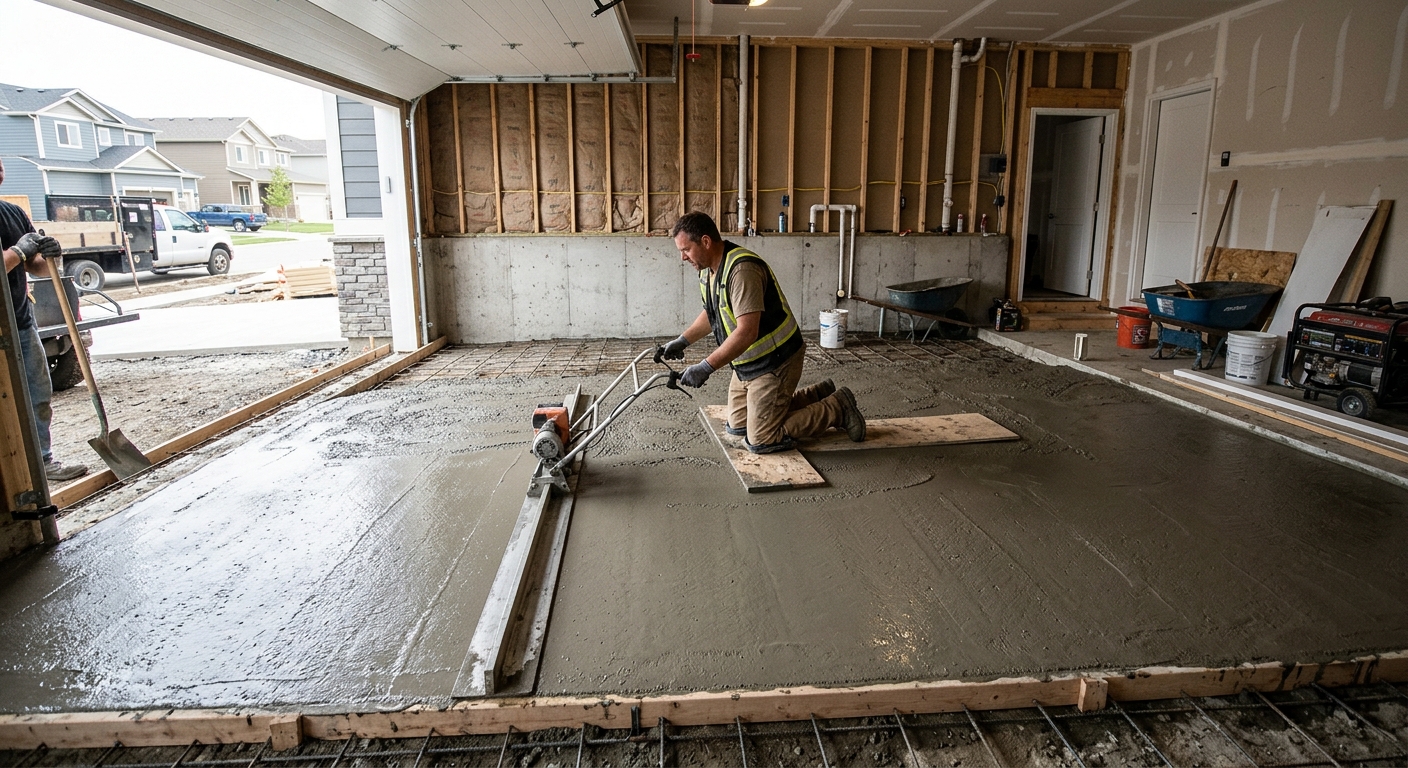
| Garage floor (interior slab) |
22 ft x 20 ft (440 sq. ft.) |
Vapour barrier, fibres or mesh as required |
Power trowel, light broom pass |
$7,200 – $10,800 |
| Foundation footings (structural, below frost) |
Typical 24 ft x 32 ft home perimeter |
Excavation, formwork, rebar cage, below-frost placement |
Structural concrete (not decorative) |
$18,000 – $28,000 |
Prices are estimates only and vary by project scope, site access and material selection.
What affects the price of concrete work in Wembley
In Wembley and the wider Athabasca–Grande Prairie–Peace River region, it’s common to see quotes for the “same” concrete scope swing by 30–50%. The differences usually come from how contractors handle frost-depth excavation, base preparation, and cold-weather curing—not from the concrete itself. In Alberta, longer mobilizations and tighter crews during the short workable pour season can also push labour and equipment costs up, particularly when we’re travelling or waiting on weather windows.
Frost line depth is the big driver. Exterior work must be built below the design frost depth to prevent frost heave; in Alberta this can reach up to about 2.4 m depending on conditions and local design assumptions. Combine that with repeated freeze–thaw cycles, and you get a project that needs air-entrained concrete plus a well-drained, well-compacted granular base. If the mix spec and drainage details are missed, you often don’t see the failure until the second or third winter, when scaling and spalling show up.
Pour timing also matters. A warm-day pour might be straightforward, but if the temperature drops into the “cold-weather” range, curing practices change: insulated blankets, heated enclosures, and longer curing time can add cost. Finally, de-icing salt accelerates surface wear; in practice, sealing is often the difference between a driveway that looks good for years versus one that starts to pit sooner.
Here are a few local examples. Replacing a simple walkway can land closer to the $12 – $18/sq. ft band when access is easy and excavation is shallow. But widening a driveway where the subgrade needs deeper granular rebuild can push pricing toward the upper flatwork range—plus foundation tie-ins can quickly move the budget into foundation/footings territory (typically $45 – $70 per ft of footing equivalent, depending on depth and reinforcement needs).
| Price Factor |
Why It Matters |
Cost Impact |
| Frost line depth — determines footing depth and form height |
Deeper excavation and taller forms if frost depth assumptions are conservative |
Can add thousands due to excavation, disposal, and rebar cage complexity |
| Site preparation — excavation, grading, compacted granular base |
Correct base thickness prevents settlement and minimizes heave |
Usually the largest swing factor on any exterior slab |
| Reinforcement — rebar or wire mesh requirement |
Control and structural capacity for loads and crack resistance |
Costs rise with steel tonnage and placement labour |
| Mix design — air-entrainment and compressive strength spec |
Exterior survival through freeze–thaw relies on air content and strength |
Higher-spec air-entrained mixes can add per-yard cost |
| Finish type — broom vs. stamped vs. exposed aggregate |
Decorative finishes require extra labour, timing, and materials |
Stamped and exposed aggregate typically cost more than plain broom |
| Pour size and concrete truck access to site |
Long hauls or limited access can require more labour or pump costs |
Shorter access routes generally reduce total labour time |
| Cold-weather curing precautions — heating and blankets |
Ensures strength gain and prevents early-age damage |
Adds crew handling time and equipment rental |
| Control joint pattern and sealing cost |
Joints control cracking; sealing helps resist salt-driven surface damage |
More precise joint layout and sealer add line-item cost but extend service life |
Permits & regulations in Alberta
In Alberta, the permitting and paperwork side depends heavily on what you’re building. Structural concrete work—think foundation walls, grade beams, and footings that support the foundation—requires a building permit and often engineered drawings that the municipality reviews. For Wembley homeowners, that typically means any change that affects the structural system must be approved before concrete goes in. Examples that DO generally require a permit include new foundation footings, foundation wall pours, and any structural grade beam work, plus major structural repairs or underpinning.
Concrete flatwork (driveways, patios, and walkways) usually does not require a permit, as long as it doesn’t change lot grading in a way that affects drainage, doesn’t violate impervious surface coverage rules, and doesn’t encroach into the municipal right-of-way. Still, it’s smart to confirm before you break ground, especially if you’re altering slope away from the house or moving drainage discharge points.
Also verify the contractor’s coverage. At a minimum, ask for liability insurance and evidence of WSIB/WCB coverage (or the appropriate exemption paperwork, if applicable). Then check in a practical order: (1) request their current insurance certificate and confirm your project address is covered, (2) confirm their Alberta WCB/WSIB coverage documentation, and (3) verify they’re properly registered to do the work by checking the relevant online registry and matching the name on the paperwork to the quote and invoice.
Getting concrete right in Wembley's freeze-thaw climate
Concrete failure in Wembley usually comes down to three things: weak base preparation, poor mix design for freeze–thaw, and inadequate early-age curing. We spec work differently here because the Athabasca–Grande Prairie–Peace River region is built around deep frost and winter salt exposure. If the base isn’t compacted to the right depth and drainage isn’t handled correctly, the slab can settle or heave, and cracks can open up pathways for water. Then freeze–thaw cycles do what they do best—expand and break down the surface.
To spec the job correctly, start with base preparation: a compacted granular sub-base built to the required depth for local soil and frost conditions. Next is mix design: exterior flatwork should use air-entrained concrete (typically 5%–7% target air content for durability in freeze–thaw exposure) and a minimum 32 MPa compressive strength. Then control joints: saw-cut or formed joints spaced to limit random cracking, so the concrete cracks where it’s supposed to. Curing matters, especially in shoulder seasons: plan for minimum 7-day curing under proper conditions. Finally, sealing: apply a penetrating sealer after the concrete has cured (commonly around 28 days post-pour) to help repel de-icing salts.
Ask these technical questions to avoid the most common winter issue—spalling from inadequate air-entrainment and poor protection during cold weather. For example, if a decorative patio quote feels “too low” and skips air-entrainment or reduces curing time, it may seem to save money upfront (often within the patio band of $12 – $18/sq. ft), but repairs after a hard winter can erase that savings quickly. Conversely, paying for a proper base rebuild can be worth more than adding a decorative finish, because durability protects your surface investment.
| Spec |
Why It Matters in Wembley |
What to Ask For |
Impact if Skipped |
| Compacted granular base (depth?) |
Prevents settlement and reduces freeze-related movement in deep-frost conditions |
Base thickness by design, compacted in lifts; proof of grading and drainage |
Heaving, rocking, cracking, and early edge failures |
| Air-entrained concrete mix (target air %?) |
Freeze–thaw durability relies on microscopic air voids to relieve internal pressure |
Target air content of 5%–7% for exterior flatwork; confirm mix with supplier |
Spalling/scaling within 1–3 winters, especially with salt use |
| Compressive strength (MPa rating) |
Strength gain supports load capacity and long-term performance |
Minimum 32 MPa compressive strength at specified curing age |
Surface wear, cracking, and reduced durability under vehicle loads |
| Control joints (spacing per ACI guidelines) |
Controls where cracking occurs to limit random cracks and water intrusion |
Proposed joint spacing and saw-cut timing plan |
Random cracking and faster deterioration from trapped moisture |
| Minimum 7-day curing period |
Cold spells and wind can stop or slow strength development early |
Curing method plan; protection steps if night temps drop |
Weaker concrete and higher risk of scaling or surface damage |
| Penetrating sealer (when applied after cure) |
Helps repel de-icing salts that accelerate surface breakdown |
Specify sealer type and confirm application after cure (often around 28 days) |
Faster pitting/spalling, more frequent maintenance |
How to choose a concrete work contractor in Wembley
Choosing a contractor in Wembley is about more than price—concrete is a “spec” trade, and the details decide whether your driveway lasts 15 years or 5. Start by verifying Alberta coverage. Ask the contractor for their certificate of liability insurance and proof of WSIB/WCB coverage for the workers on your site. Then verify their Alberta registration/status using the appropriate online registry search and confirm the name matches the quote and invoice. If they can’t provide current documents quickly, that’s a red flag in a small community where accountability matters.
Next, get 2–3 itemised written quotes. You want labour and materials broken out (excavation, base materials, rebar/wire mesh, concrete supply, forming, finishing, sealing) rather than a single lump-sum number. Read the scope for exclusions: is concrete disposal included? Is permit handling included (when required)? Are approach transitions and tie-ins included or priced separately? Make sure the quote describes the finish and curing plan in plain language.
Warranty should be clear. Ask for the workmanship warranty length and what it covers, plus whether there’s any product/manufacturer warranty (for sealers or admixtures). Confirm whether warranties are transferable if you sell the home. For payment, don’t let the schedule drift into “pay most up front.” A typical safe approach is 10%–15% upfront, then hold back until the job is complete and properly cured. Also insist on a written timeline with an expected start date and completion estimate—Wembley pours depend on weather windows.
- Ask whether the mix is air-entrained and request the target air content for exterior work.
- Confirm base thickness and compacted lift plan (not just “we’ll prep the base”).
- Require a joint layout plan: where joints go and how they’ll be cut.
- Check whether curing blankets/heating are included if temperatures fall near cold-weather thresholds.
- Make sure drainage and tie-ins to existing surfaces are addressed in writing.
- Get dimensions, thickness, and quantities for concrete (sq. ft and slab thickness).
- Confirm reinforcement details: rebar grade/size and spacing, or mesh specs if used.
- Verify disposal/loading for excavation is included (spoils haul can surprise budgets).
- Ask what finish is included: broom pass level, edges, and sealer scope.
- Request a warranty in writing and whether it covers spalling/scaling related to mix or curing choices.
- Clarify payment schedule and retainage/holdback terms.
- Ensure site access plan is explained (truck access, hoses/pumps, and rebar handling).
Red flags I see in Wembley: (1) quotes that omit air-entrainment or curing precautions, (2) “no need for joints” or vague joint descriptions, (3) payment terms asking for more than 15% upfront without detailed scheduling, (4) no written scope for drainage/tie-ins, and (5) no ability or willingness to provide insurance/WSIB/WCB documentation before starting.
Frequently asked questions — concrete work in Wembley
Can concrete be poured in cold weather in Wembley?
Yes, but not “as usual.” In Wembley, cold-weather pours are only reliable when the contractor controls early-age conditions—usually with insulated blankets, heating, and careful protection so the concrete reaches strength safely before freezing. Many Alberta crews have a shorter reliable pour season, so schedules can tighten, and that can affect labour availability and pricing. A good contractor will ask for the forecast, check concrete temperature, and outline a curing plan in writing. For flatwork like driveways or patios, the risk isn’t just immediate freezing; it’s also slowed strength gain that can lead to weak surfaces and early scaling when freeze–thaw cycles hit. If you’re budgeting, a properly managed cold-weather plan may cost more than a standard summer pour, but it’s typically cheaper than repairs later—especially when winter salt is involved.
How do I maintain concrete in Wembley's freeze-thaw climate?
Maintenance starts with sealing and drainage. After your concrete cures fully (commonly around 28 days), a penetrating sealer helps repel de-icing salt and reduces surface pitting—important in Wembley winters when salt is used to keep sidewalks and driveways safe. Keep water from ponding by ensuring grades slope away from the foundation and that downspouts aren’t discharging onto slabs. For snow removal, use plastic shovels or carefully positioned blades to avoid gouging the surface, which can accelerate freeze–thaw damage. If you’re comparing options, a basic broom-finish driveway is usually in the driveway flatwork pricing bands, but you’ll often get better long-term value by adding sealing and a correct joint pattern rather than just choosing an upgraded finish. Also, don’t “ignore” minor hairline cracking—monitor and address it early so water doesn’t get underneath.
What causes concrete to spall in Wembley winters?
Spalling is most commonly caused by inadequate air-entrainment, poor curing, or water getting into the surface through poorly planned joints and cracks. In freeze–thaw conditions, water trapped in the concrete expands as it freezes, and without sufficient microscopic air voids it breaks apart the surface. Salt accelerates this process by increasing deterioration at the top layer. In Wembley, we also see spalling worsen when the base prep is weak or drainage isn’t handled, because the slab can move slightly and open up micro-cracks. That’s why a contractor should spec an air-entrained mix for exterior work and follow a proper curing routine, not just “pour and broom.” If you’re replacing a driveway and a quote is unusually low compared to typical bands like $14–$20 for a concrete driveway, ask specifically what mix design and curing steps are included.
What is rebar and when is it required in Alberta?
Rebar (reinforcing steel) is used to strengthen concrete and help control cracking, especially for slabs and structural foundation elements. In Alberta, whether rebar is required depends on the design loads, slab thickness, soil conditions, and whether the pour is structural or flatwork. For example, foundation footings and grade beams are typically structural and commonly require engineered reinforcement placement. For exterior slabs like driveways and garage floors, rebar or mesh may be recommended based on thickness and support conditions—particularly if you’re placing heavy loads or if the base requires extra structural assistance. A proper contractor will not guess; they’ll provide thickness, spacing, and reinforcement specs in the quote or align with engineer drawings when required. If you’re unsure, ask to see the reinforcement plan and how it ties back to the foundation or slab design.
How long does a concrete project take in Wembley?
Timing depends on the scope, weather window, and curing requirements—especially in the Athabasca–Grande Prairie–Peace River region where the pour season can be short. A small walkway can often be scheduled within a few days, but that doesn’t mean concrete “sets and you’re done.” Typically, the pour day is one step, then finishing and curing protection follow. Minimum 7-day curing is a common baseline before expecting full performance, and longer protection may be needed in colder swings. Larger projects like driveways may involve excavation and base preparation first, which can take the better part of a day to multiple days depending on depth (frost considerations and any granular rebuild). Decorative work (stamped/exposed aggregate) adds time for placement, patterning, and wash/exposure steps. If the contractor can’t provide a written start and completion estimate, expect delays—Wembley schedules need to align with forecast temperatures.
What is a concrete overlay and is it suited to Wembley?
A concrete overlay is a new concrete layer placed on top of an existing slab after it’s prepped—usually grinding, patching spalls, and ensuring bonding. Overlays can be suited to Wembley when the existing concrete is generally stable (not severely heaved, badly broken, or with widespread base failure). In freeze–thaw climates, the key risk is locking in the problems: if the original slab is moving due to drainage or soil/frost movement, an overlay may crack or fail sooner. Overlays can also be a cost-effective option compared to full replacement, but they rely on proper prep and bonding steps. If you’re comparing against a standard replacement driveway budget that often falls into the $14–$20 range, overlays might look appealing—however, only a site inspection can confirm whether your current base is sound. If you have older pre-1981 concrete, cracking and localized settlement are common, so inspection and moisture/drainage assessment matter.