Concrete work options and costs in Red Deer
Concrete work in Red Deer is popular because a large share of local housing stock is well-suited to fresh flatwork upgrades—about 53.1% of dwellings are single-detached homes (Statistics Canada, 2021 Census), and the area has a deep need for driveways, patios, sidewalks, and garage slabs that can handle long freeze-thaw seasons. In Red Deer, contractor availability and pricing also reflect the relatively short construction season on the prairies, plus the extra care required to prevent frost heave and surface damage. Many homeowners in older neighbourhoods—where 34.1% of homes were built before 1981 (Statistics Canada, 2021 Census)—are replacing cracked driveways and adding drainage solutions to keep water from undermining the base.
Weather drives the details: exterior slabs need air-entrained concrete, proper compaction of a granular base, and properly placed control joints. When conditions are cold or wet, crews often add scheduling time for setup and curing protection (insulating blankets or temporary heating) to reduce the risk of early freezing. That’s why two “same-size” projects can price very differently depending on access (truck approach, backyard paths), thickness, reinforcement, and whether sealing is included for de-icing salt. In Red Deer, demand is especially consistent in areas like Riverside Meadows and Timberstone, where many properties have similar lot grades and people routinely upgrade aging driveways and add walkway connections.
Below are realistic, current budget ranges to help you compare options before you request a detailed quote.
| Application |
Typical Size |
Key Spec |
Finish Option |
Price Range |
| Concrete driveway (standard broom finish) |
400–600 sq. ft. |
Air-entrained, compacted granular base, control joints |
Broom finish |
$4,000–$10,800 |
| Exposed aggregate driveway |
400–600 sq. ft. |
Air-entrained, correct curing then wash/expose |
Exposed aggregate |
$7,200–$13,500 |
| Stamped concrete driveway or patio |
250–500 sq. ft. |
Air-entrained, integral colour/texture, sealed surface |
Stamped & coloured |
$5,000–$14,000 |
| Plain concrete patio or walkway |
150–300 sq. ft. |
Air-entrained, base prep, edge forms, joints |
Plain slab |
$1,200–$4,800 |
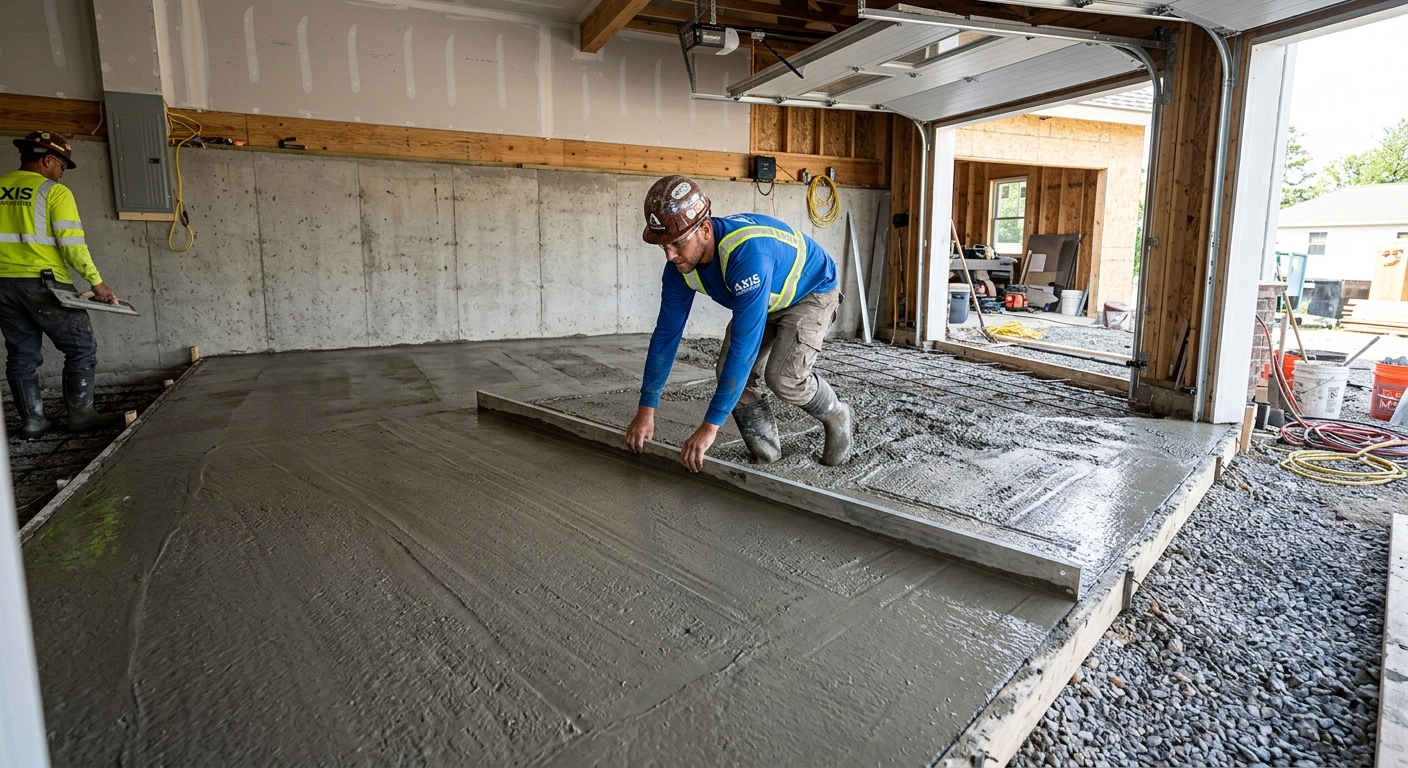
| Garage floor (interior slab) |
300–600 sq. ft. |
Vapour control as needed, thickness per load, joints as required |
Plain finish (trowel/broom blend) |
$3,900–$9,500 |
| Foundation footings (structural, below frost) |
Varies by house plan |
Engineered structural spec, rebar, below frost depth excavation |
Structural concrete |
$12,000–$38,000 |
Prices are estimates only and vary by project scope, site access and material selection.
What affects the price of concrete work in Red Deer
In Red Deer, it’s common to see quote differences of 30–50% for the “same” concrete job. The pricing spread usually isn’t about concrete being dramatically different—it’s about the foundation of the job: excavation depth, base preparation, reinforcement, access, and the weather protection required to keep concrete durable through freeze-thaw cycling. Even when the driveway or slab square footage is similar, one site may need deeper frost-safe excavation, additional drainage, or more careful forming because the lot grade is uneven or water has historically pooled.
Frost line depth is the big driver for foundations and exterior work because footings must extend below the local design frost depth to prevent frost heave and settlement. In Alberta, that typically means deeper excavation than in many southern regions, along with more material handling. Exterior slabs also require air-entrained concrete mixes to survive the freeze-thaw cycle, and cold weather extends setup and finishing time. Cold-weather curing precautions (temporary heating or insulated blankets) can add labour and equipment costs—particularly in late fall or early spring when crews have to protect the pour while it gains strength. De-icing salt accelerates surface wear and spalling on under-specified mixes, which is why sealing is often treated as “part of the durability package,” not an optional add-on.
Here are a few Red Deer examples of how costs move up or down: replacing a straight, well-accessed 400 sq. ft. broom-finished driveway usually lands near the $10–$18 per sq. ft. backbone, while switching to stamped looks often increases the finish cost into the $16–$28 per sq. ft. range because of additional labour for colour, texturing, and sealing. If your home is older (34.1% built before 1981), the existing base may be inconsistent—extra digging and re-compaction are frequently required, which can add cost even when the new slab dimensions stay the same. Lastly, if truck access is difficult (tight gates, long path to grade), concrete placement time increases and that can change the total quote significantly.
| Price Factor |
Why It Matters |
Cost Impact |
| Frost line depth |
Determines footing depth and form height to resist heave |
High: deeper excavation and more concrete/rebar |
| Site preparation |
Excavation, grading, and compacted granular base control settlement |
High: adds labour, hauling, and materials |
| Reinforcement |
Rebar or mesh helps control cracking under load |
Moderate to High depending on thickness/load |
| Mix design |
Air-entrainment and specified compressive strength for freeze-thaw durability |
Moderate: specialty materials but better longevity |
| Finish type |
Broom vs. stamped vs. exposed aggregate changes labour and cure/finishing steps |
Moderate to High: stamped/exposed typically more |
| Pour size and concrete truck access to site |
Smaller/awkward access pours increase placement time and labour |
Moderate: access can swing total quote |
| Cold-weather curing precautions |
Heating/blankets protect strength gain during cold, wet conditions |
Moderate to High: equipment and schedule changes |
| Control joint pattern and sealing cost |
Joints guide cracking; sealing helps resist de-icing salts and surface wear |
Low to Moderate: small scope cost, big durability benefit |
Permits & regulations in Alberta
In Alberta, structural concrete work—such as footings, foundation walls, and grade beams—typically requires a building permit, and engineered drawings are often reviewed as part of the permit process. For homeowners in Red Deer, that means jobs tied to the structural system (anything below grade that carries loads) should be discussed with your contractor and your municipality before excavation begins. Concrete flatwork like patios, walkways, and driveways usually does not require a permit, unless the project changes lot grading, affects drainage/impervious surface limits, or involves work within or near municipal right-of-way rules. Even when a permit isn’t required for the slab itself, base/drainage changes can still trigger review—so don’t assume.
Step-by-step, here’s how to verify a contractor in Alberta:
- Confirm they carry liability insurance: ask for a current Certificate of Insurance naming you and/or providing the coverage details (limits and effective dates).
- Check WSIB/WCB coverage: request proof of WCB coverage (or clearance details) before work starts.
- Ask for references on similar-scale jobs in the Red Deer area (driveways, slabs, or foundation work depending on the scope).
- For permit-required structural work, ask who is pulling the permit and provide the permit/engineering reference numbers once issued.
- Verify contractor contact information and ensure the quote includes clear exclusions (demo, hauling, disposal, rebar supply, and curing protection if cold-weather work is scheduled).
If a contractor won’t provide insurance/WCB details or refuses to spell out who handles permits for structural scope, that’s a warning sign in any Alberta city.
Getting concrete right in Red Deer's freeze-thaw climate
Concrete fails in Red Deer mainly due to water and freezing getting into the slab system. If the base isn’t built to the right depth and properly compacted, groundwater can find its way under the concrete and expand during freezing, causing settlement or heave. Another common failure is spalling: the surface flakes when water freezes inside the slab pores without enough air-entrainment, or when the mix doesn’t meet the local durability requirements. The fix isn’t “more concrete”—it’s the right spec and execution.
To spec the job correctly for Red Deer’s freeze-thaw climate, focus on five things. First, base preparation: use a compacted granular sub-base to the required depth for frost protection, and ensure proper grading so water drains away from the slab. Second, mix design: exterior flatwork should use air-entrained concrete (commonly 5–7% air content) and minimum 32 MPa compressive strength for durability under weather and de-icing exposure. Third, control joints: create a planned crack pattern with appropriate spacing so the concrete cracks where it’s designed to crack. Fourth, curing: plan for at least 7 days under proper conditions—especially if temperatures drop—because strength gain slows when it’s cold. Fifth, sealing: apply a penetrating sealer after the slab has properly cured (typically around 28 days post-pour) to repel moisture and help manage salt exposure.
Ask the contractor why they’re using air-entrainment and what curing protection they’ll use if the forecast turns cold. For a concrete patio, the difference between plain and decorative can be justified: a basic patio might land in the $8–$16 per sq. ft. band, while stamped work is typically $16–$28 per sq. ft. The extra cost is mainly labour and finishing time—worth it when you’re also getting the durability specs right, not when you’re just paying for appearance over performance.
| Spec |
Why It Matters in Red Deer |
What to Ask For |
Impact if Skipped |
| Compacted granular base (depth?) |
Red Deer freeze-thaw needs frost-safe support to prevent heave and settlement |
Base depth for your soil/grade, compacted to spec |
Uneven settling, cracking, water intrusion |
| Air-entrained concrete mix (target air %?) |
Freeze-thaw durability depends on controlled air voids |
Air content 5–7% for exterior flatwork |
Higher risk of spalling and surface scaling |
| Compressive strength (MPa rating) |
Strength affects wear resistance and long-term performance under load |
Minimum 32 MPa compressive strength |
Faster deterioration and weaker surface |
| Control joints (spacing per ACI guidelines) |
Controls where cracking occurs during shrinkage |
Joint spacing and layout plan before pour |
Random cracking and spalling at uncontrolled cracks |
| Minimum 7-day curing period |
Cold snaps extend cure time; early freezing can reduce strength gain |
How they protect the slab in cold/wet weather |
Reduced strength, higher long-term cracking risk |
| Penetrating sealer (when applied after cure) |
Helps manage moisture and de-icing salt exposure |
Application timing after cure (often ~28 days) |
More salt/surface wear and increased scaling over seasons |
How to choose a concrete work contractor in Red Deer
Choosing the right concrete contractor in Red Deer is mostly about protecting yourself from shortcuts that show up later as cracking, spalling, or settlement. Start by verifying Alberta coverage and compliance. Ask for:
- Liability insurance: request a current Certificate of Insurance with coverage limits and effective dates.
- WSIB/WCB coverage: ask for proof of workers’ compensation coverage (or a clearance status letter if applicable) before work begins.
- Written scope and references: get references on similar work locally (not just photos from jobs in other cities).
Next, get 2–3 itemised written quotes. A good quote separates labour and materials, and it clearly lists what’s included: demo, excavation, disposal, granular base, reinforcement, vapour barrier (if needed for garage slabs), concrete supply, finishing, curing protection in cold weather, and sealing (if you choose it). Avoid a quote that only provides a lump sum without thickness, joint pattern, or base spec.
Warranty matters too. Ask for the workmanship warranty length, whether it covers labour only or materials too, and whether it transfers if you sell your home. For payment, don’t pay more than about 10–15% upfront. Hold back the remainder until the work is complete and cleanup is done. Finally, require a written timeline: a start date and an estimated completion window, including contingencies for weather.
- Confirm insurance and WCB/WSIB documentation before signing.
- Insist on slab thickness and reinforcement details in the quote.
- Ask about base depth and compaction testing/approach.
- Request the control joint layout plan (not just “we’ll do joints”).
- Verify air-entrainment is included for exterior work.
- Ask how they’ll cure in cold or wet conditions.
- Clarify disposal/hauling inclusion for demo and over-excavation.
- Confirm truck access/placement method and included labour for forms/edges.
- Read what’s excluded (e.g., landscaping reinstatement, sealing, minor grade changes).
- Ask whether sealing is offered as a product included in the scope.
- Check warranty terms in writing and what triggers warranty service.
- Ensure payment schedule is staged with holdback until final walkthrough.
Concrete red flags in Red Deer include: quotes that omit air-entrainment details for exterior slabs, no mention of control joints or sealing, curing protection “only if the weather is nice,” unclear base depth/compaction specs, and contractors who pressure you for large upfront payments or won’t provide proof of liability insurance and WCB coverage.
Frequently asked questions — concrete work in Red Deer
Why does concrete crack in Red Deer and how is it prevented?
In Red Deer and across Alberta, cracking is usually about shrinkage plus freeze-thaw pressure from moisture movement—not “bad concrete” by itself. If water gets under the slab because the granular base wasn’t built to spec or compaction was rushed, seasonal expansion and contraction can lift and stress the concrete. Cracking also happens naturally as concrete cures, so control joints are critical: they create a planned weak point so the slab cracks where the design expects it to. For exterior flatwork, air-entrained mixes (with the right air content) help reduce spalling from freezing moisture in the surface pores. Prevention starts with excavation depth for frost safety, proper grading/drainage, correct joint spacing, and curing time under protection when temperatures drop. A well-built driveway often still shows hairline cracks at joints, but it should not random-crack everywhere or scale badly after a few winters.
Stamped vs broom-finish concrete — cost difference?
Stamped concrete costs more in Red Deer mainly because it takes more labour and finishing steps: integral colour, texture application, careful curing, and then sealing for durability against de-icing salt. As a budget guide, your driveway or patio typically lines up with the general rate bands—standard broom-finish work is often closer to the $10–$18 per sq. ft. backbone, while stamped & decorative concrete commonly runs $16–$28 per sq. ft. That difference can look big on paper, but it’s usually justified when you’re comparing like-for-like specs (proper base prep, air-entrainment, and control joints). If a quote for stamped concrete is only slightly higher than broom finish yet omits air-entrainment, joint layout, or curing protection, that’s where homeowners get burned. Ask the contractor to itemise thickness, base depth, reinforcement, and whether sealing is included and when it’s applied.
When is the best time to pour concrete in Red Deer?
The best time is during the window when temperatures allow consistent curing and finishing without excessive cold-weather protection. In Red Deer, that usually means late spring through early fall when you can finish promptly and cure properly. If you must pour earlier or later in the season, the contractor should plan for cold-weather curing precautions—insulating blankets and, in some cases, temporary heating—to keep the slab from freezing before it gains adequate early strength. A cold, wet day can extend setup and finishing time, which affects the schedule and cost, too. Also consider site prep: if the base is wet or frozen, achieving proper compaction is harder, and that can lead to settlement later. For homeowners, the simplest approach is to coordinate the pour date with drainage and base preparation done well in advance so you’re not rushing to compact under bad conditions.
How long does concrete take to cure?
Concrete cures in phases. It starts gaining strength immediately, but for practical durability in Red Deer’s freeze-thaw climate, plan around a minimum 7-day curing period under proper conditions before treating it as fully serviceable for many normal loads. Full strength gain continues beyond that, and surface treatments matter: penetrating sealers are commonly applied about 28 days after the pour when the concrete is sufficiently cured and dry. Cold weather can slow strength gain, so the contractor should provide a curing plan if temperatures drop—blankets, protection from moisture loss, and monitoring. If you seal too early, moisture can get trapped and reduce the sealer’s effectiveness. For driveways and patios, patience pays off: rushing the timeline is one of the biggest causes of early scaling and premature wear, especially with de-icing salt in Alberta winters.
Do I need a permit for concrete work in Alberta?
It depends on the type of concrete work in Alberta. Structural concrete such as footings, foundation walls, and grade beams typically requires a building permit and often engineered drawings that the municipality reviews as part of the process. Concrete flatwork—patios, walkways, and driveways—usually does not require a permit, unless it affects lot grading, drainage, impervious surface coverage limits, or work is near municipal right-of-way requirements. For a Red Deer homeowner, the safest step is to ask your contractor whether a permit is required for your specific scope and, when applicable, confirm whether the contractor is pulling it. Regardless of permit needs, ensure the contractor carries liability insurance and has WSIB/WCB coverage in place before work begins.
Concrete vs pavers for a patio in Red Deer?
Concrete and pavers can both work well in Red Deer, but concrete is often chosen when homeowners want a seamless surface with fewer interlock components to shift over time. With proper base prep and air-entrained concrete, a patio slab can perform very well through Alberta freeze-thaw cycles. Pavers can be excellent aesthetically and offer easier localized repairs if a section fails, but they still require a correctly built base, proper edging, and drainage. On cost, plain concrete patios typically align with the $8–$16 per sq. ft. band, while stamped/decorative lifts the price into the $16–$28 per sq. ft. range—paver projects can vary widely depending on unit cost, labour, and base/edging requirements. The deciding factor is usually maintenance and durability: if you want fewer future moving parts and a clean long-term surface, quality concrete with control joints and sealing is a strong fit. If you want maximum visual variety and easier spot repair, pavers may be better.