Concrete work options and costs in Marlborough
Marlborough, Alberta is a practical place to invest in concrete flatwork because the homes and garages here are built for real winter use—driveways need to handle ploughing, and patios/walkways must survive frequent freeze–thaw cycles. In a community of about 8,910 residents (Statistics Canada, 2021 Census), the surrounding Calgary market brings steady demand for concrete contractors, particularly around established residential pockets where homeowners are upgrading entry slabs, backyard patios, and garage floors. Calgary’s cold continental climate forces every design detail to account for frost depth (roughly 1.2 m, about 4 ft) and to resist cracking and scaling during repeated thawing and refreezing. That engineering reality shows up in foundation and slab pricing, along with labour availability during the short exterior pour season.
In Marlborough, a major driver of concrete cost is that excavation and footing volumes are higher when footings must bear on undisturbed soil below the design frost depth. For exterior slabs, the granular base prep, air-entrained concrete mix, and control joint pattern are also non-negotiable to reduce spalling and long-term surface deterioration from de-icing salts. When you compare options, the “cheap” choice often costs more later if it skips air content targets, proper curing, or sealing—especially on driveways and walkways.
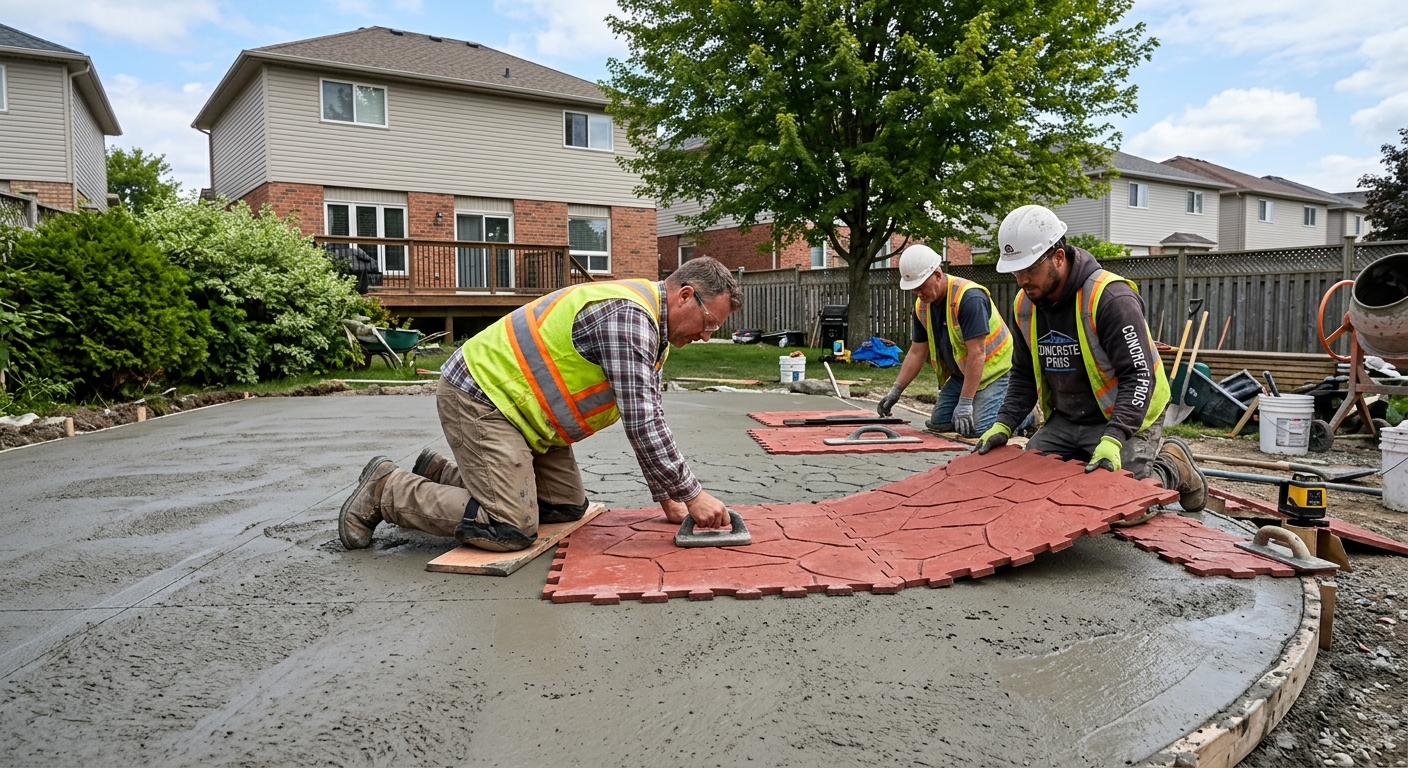
As a rule of thumb for Marlborough homeowners: standard driveways land in the $12,000–$18,000 range, while more decorative work (stamped finishes) commonly moves into the $15,000–$26,000 band depending on area and complexity. Garage floors and interior slabs typically price differently from exterior slabs because site prep and freeze-thaw exposure change the specs and finishing requirements. See how the main options compare below.
| Application |
Typical Size |
Key Spec |
Finish Option |
Price Range |
| Concrete driveway (standard broom finish) |
24 ft x 10 ft (240 sq. ft.) |
Air-entrained mix, granular base, control joints |
Broom finish |
$12,000 – $18,000 |
| Exposed aggregate driveway |
24 ft x 10 ft (240 sq. ft.) |
Air-entrained mix, proper curing to control texture |
Exposed aggregate |
$15,500 – $22,500 |
| Stamped concrete driveway or patio |
20 ft x 12 ft (240 sq. ft.) |
Engineered mix + finish care, joints planned for shrinkage |
Stamp pattern + release + color hardener (varies) |
$15,000 – $26,000 |
| Plain concrete patio or walkway |
12 ft x 16 ft (192 sq. ft.) |
Air-entrained mix, compacted sub-base, edging |
Wood float/light broom (cleanable surface) |
$5,000 – $9,000 |
| Garage floor (interior slab) |
22 ft x 20 ft (440 sq. ft.) |
Interior mix, vapour considerations (as needed), joints |
Broom finish, optional seal |
$9,500 – $16,000 |
| Foundation footings (structural, below frost) |
Typical house footprint (varies by plan) |
Structural concrete + rebar, excavation to frost depth bearing |
Structural finish level (engineered) |
$28,000 – $45,000 |
Prices are estimates only and vary by project scope, site access and material selection.
What affects the price of concrete work in Marlborough
In Marlborough and across the Calgary economic region, it’s common to see bids for the “same” concrete project vary by 30–50%. The reason usually isn’t the concrete itself—it’s the engineered reality behind the work: how deep excavations go, what base prep is specified, how much reinforcement is required, and how the contractor protects curing in a cold continental climate. When crews price differently, it often reflects different assumptions about frost-protection excavation, granular thickness, and whether they’re allocating time for proper curing (blankets/temperature control) and joint layout.
Frost depth and freeze–thaw cycles dictate every spec here. Footings must extend below the design frost depth (about 1.2 m in this region, roughly 4 ft) to avoid frost heave. Exterior slabs require air-entrained mixes to survive repeated thawing and freezing, and they need control joints spaced to limit random cracking. Calgary’s colder pour window is shorter, so late-fall or early-spring placements frequently trigger cold-weather curing precautions like heated enclosures or insulated blankets—cost that doesn’t show up in milder regions.
Two practical Marlborough examples: (1) a driveway that needs deeper removal of topsoil/organic material can move from the $12,000–$18,000 band toward the upper end because granular base and excavation increase. (2) a stamped patio may cost more (within the $15,000–$26,000 band) when the contractor includes a more controlled prep and finishing schedule—often the difference between crisp edges that last and a “muddy” stamp that fails prematurely.
Also, some newer housing-adjacent lots and older serviced areas have tighter access or more irregular grades, which can add truck setup time and hauling/disposal costs. With concrete, time is money, and in freeze–thaw season, protecting the curing window is where quality is actually “bought.”
| Price Factor |
Why It Matters |
Cost Impact |
| Frost line depth — determines footing depth and form height |
Footings must bear on undisturbed soil below design frost depth to limit heave |
Higher excavation/structural volume often moves pricing toward the upper foundation band |
| Site preparation — excavation, grading, compacted granular base |
Base thickness and compaction determine settlement and cracking risk |
Extra haul-away and granular layers can add thousands to the project |
| Reinforcement — rebar or wire mesh requirement |
Controls cracking and improves load performance, especially for driveways and footings |
Material + labour cost; omission can reduce bid price but increases failure risk |
| Mix design — air-entrainment and compressive strength spec |
Exterior freeze–thaw durability depends on air content and strength targets |
Correct mix spec typically raises cost modestly; wrong mix can cause costly repairs |
| Finish type — broom vs. stamped vs. exposed aggregate |
Decorative finishes need more labour time and tighter process control |
Stamped/exposed aggregate commonly increases cost within driveway/patio bands |
| Pour size and concrete truck access to site |
Access affects how long crews wait and whether pumps/extra equipment are needed |
Restricted access can add labour hours and equipment charges |
| Cold-weather curing precautions — heating and blankets |
Maintains hydration and prevents surface scaling/spalling |
Increases labour/materials; often required in late fall/early spring pours |
| Control joint pattern and sealing cost |
Joints manage shrinkage cracking; sealing helps with de-icing salt exposure |
Proper joint layout and sealer add line items but reduce long-term deterioration |
Permits & regulations in Alberta
In Alberta, structural concrete work—footings, foundation walls, grade beams and other load-bearing components—generally requires a building permit and often engineered drawings submitted for municipal review. Concrete flatwork (patios, walkways and driveways) typically does not require a permit by default, but it can trigger permit involvement if it affects lot grading, drainage, or impervious surface coverage rules, or if work encroaches into the municipal right-of-way. Because outcomes vary by lot and by how the slab ties into the rest of the site, your safest move is to confirm with the local authority before breaking ground.
For a Marlborough homeowner, verify your contractor in a straightforward sequence:
- Building permit path (if structural): ask the contractor who pulls the permit and whether engineered drawings are included.
- Contractor licence/registration: check the contractor’s business information and any trade qualifications listed in provincial directories where applicable (your contractor should provide a licence/registration reference number on request).
- Liability insurance certificate: request a current Certificate of Insurance (COI) naming you and/or the appropriate parties as required, showing coverage effective dates and claim limits.
- Workers’ compensation: confirm coverage for workers via WSIB/WCB documentation—your contractor should provide proof, not just “verbal confirmation.”
- References: request recent photos and references for similar-scale projects (driveways/patios/foundation work in similar weather exposure).
- Clearance/letters (if applicable): ask whether any required clearance letters are provided for the permit or inspections.
Then, ask for the scope in writing so it’s clear what requires inspection and what doesn’t.
Getting concrete right in Marlborough's freeze-thaw climate
The most common concrete failures in Marlborough happen when freeze–thaw durability details are skipped or rushed. In Calgary’s cold continental climate, concrete expands and contracts with temperature swings, water migrates through micro-cracks, and de-icing salts can accelerate surface scaling. The fix is not a “better finish”—it’s base prep, correct mix, and curing you can prove on paper.
Start with (1) base preparation: the compacted granular sub-base needs to be installed to the proper depth for local soil and to stay structurally stable below the active frost zone. (2) mix design: for exterior flatwork, specify air-entrainment around 5–7% air content and a minimum 32 MPa compressive strength at placement/curing conditions appropriate for the pour schedule. (3) control joints: joints should be planned to limit random cracking—especially on larger driveways and patios—by controlling where shrinkage cracks will form. (4) curing: allow at least 7 days under proper conditions; in cold weather, contractors may need temporary heating or insulated blankets to keep hydration on track. (5) sealing: apply a penetrating sealer about 28 days post-pour after cure to repel de-icing salt exposure and reduce surface damage over time.
If you’re comparing options on price, it’s important to understand where the premium is justified. For example, a standard broom-finish driveway in Marlborough often falls within the $12,000–$18,000 band. Choosing stamped concrete might move into the $15,000–$26,000 band, but that extra cost can be worth it when the quote includes stricter prep, controlled finishing timing, and proper joint planning. If the contractor can’t explain their joint spacing, air content target, and curing method, the “savings” rarely last.
Ask targeted questions like: “What air content target are you using for the mix?”, “How deep is your compacted base?”, “What is your curing plan if temperatures drop at night?”, and “Where exactly will the control joints be placed?” Those answers are the difference between durable concrete and a driveway that needs early repairs.
| Spec |
Why It Matters in Marlborough |
What to Ask For |
Impact if Skipped |
| Compacted granular base (depth?) |
Stable support reduces settlement and cracking during freeze–thaw cycles |
Confirm granular thickness, compaction method, and bearing depth relative to site conditions |
Higher risk of dips, cracking, and premature edge failure |
| Air-entrained concrete mix (target air %?) |
Exterior durability depends on resistance to freeze–thaw damage |
Ask for air content target around 5–7% for exterior flatwork |
Spalling and scaling are much more likely, especially with de-icing salts |
| Compressive strength (MPa rating) |
Strength at cure time affects long-term performance and surface durability |
Specify minimum 32 MPa compressive strength (project-specific) |
Surface wear and structural issues can appear early |
| Control joints (spacing per ACI guidelines) |
Manages shrinkage cracking in cold-weather drying |
Ask for joint spacing plan and joint finishing details before the pour |
Random cracks reduce appearance and allow moisture ingress |
| Minimum 7-day curing period |
Hydration must continue long enough to build strength safely |
Confirm cure protection and whether cold-weather methods are used |
Reduced strength and higher risk of surface scaling/spalling |
| Penetrating sealer (when applied after cure) |
Helps repel salt and moisture from freeze–thaw cycles |
Ask for penetrating sealer application about 28 days after cure |
Faster surface deterioration and more frequent re-sealing cycles |
How to choose a concrete work contractor in Marlborough
Choosing the right concrete contractor in Marlborough is mostly about verification and clarity—because freeze–thaw durability depends on details. Start with Alberta coverage and compliance: ask for a current Certificate of Insurance (liability) and confirm it matches your project period. For worker protection, require proof of WSIB/WCB coverage for anyone working on your site (a COI alone doesn’t prove it). Next, confirm any applicable registration/licensing for the contractor’s business and trade activities—your contractor should be able to provide references, business details and relevant documentation on request.
Then get 2–3 itemised written quotes instead of one lump-sum number. A good quote breaks down labour and materials (excavation/grading, granular base, rebar/mesh, concrete supply, finishing labour, joints, and sealing if included). Carefully read exclusions: is disposal included? Are forms, saw-cutting, tie-ins, and protection measures included? Who is responsible for any required permit paperwork for structural work?
Warranty matters too. Ask for a workmanship warranty length (and what it covers), the product/manufacturer warranty terms, and whether warranties transfer if you sell the home. Finally, keep the payment schedule controlled: never pay more than 10–15% upfront; hold back an appropriate portion until completion items (clean-up, joint finishing, sealing if included, and any punch-list work) are done. Get a start date and completion estimate in writing so the schedule accounts for cold-weather conditions in the Calgary area.
- Provide proof of liability insurance with effective dates and coverage limits
- Provide proof of WSIB/WCB coverage for workers
- Show recent references for driveways/patios/foundation work in the Calgary freeze–thaw climate
- Quote includes excavation depth, base thickness and compaction method
- Spec air-entrainment target and minimum strength (not just “concrete”)
- Includes control joint locations and finish method
- Defines cold-weather curing plan (blankets/heating) if temperatures drop
- Breaks down materials vs labour (no vague line items)
- Clarifies disposal/hauling and restoration of sod/landscaping
- States whether sealing is included and when it will be applied
- Provides warranty details in writing (workmanship + manufacturer terms)
- Payment schedule respects holdback until punch list is complete
Concrete contractor red flags in Marlborough: pressure for full payment upfront; quotes that don’t specify air-entrainment or curing plan; vague scope language like “standard base prep” without depth/compaction; skipping rebar/mesh details for exterior slabs; and promises of “no cracks” or “no maintenance” warranties—durable concrete is engineered, not guaranteed by hype.
Frequently asked questions — concrete work in Marlborough
Why does concrete crack in Marlborough and how is it prevented?
Concrete in Marlborough cracks mainly due to shrinkage, temperature changes, and movement through freeze–thaw cycles. When the slab dries unevenly or sits on an inconsistent granular base, shrinkage cracks can form where they’re least expected. In Calgary’s colder climate, water migration plus de-icing salt exposure can widen those micro-cracks over time. Prevention is about engineering control: proper base preparation with compacted granular support, air-entrained concrete for exterior exposure, and a planned control joint pattern so shrinkage cracks occur at intended locations. A competent contractor also protects curing—minimum 7 days under suitable conditions—because rushing hydration increases early cracking risk. If your driveway is in the $12,000–$18,000 range, ensure that quote includes base depth, joints, and curing notes; those details reduce cracking far more than finish “extras.” (Statistics Canada, 2021 Census)
Stamped vs broom-finish concrete — cost difference?
Stamped concrete costs more than broom-finish because it requires additional labour time, tighter finishing timing, and often colour hardener/release materials depending on the design. In Marlborough, broom-finished driveways commonly fit the $12,000–$18,000 band for typical areas, while stamped driveway or patio projects often land in the $15,000–$26,000 band depending on square footage, pattern complexity, and whether colour/extra edging is included. The important part is what’s behind the price: if a stamped quote doesn’t discuss joints, air-entrainment, curing blankets (if needed), and sealing, you’re paying for appearance without the durability that freeze–thaw demands in Alberta. Ask for the same technical specs in both options, then compare only the finishing scope. That way, the premium you pay buys the decorative look plus correct installation—not “cheap concrete with stamps.”
When is the best time to pour concrete in Marlborough?
In Alberta, the best time to pour exterior concrete in Marlborough is typically during the warmer part of the season—when daytime temperatures are consistently above freezing and nights can be managed with the right curing protection if needed. The Calgary market often has a shorter pour season for outdoor slabs because late-fall and early-spring temperatures can drop and interfere with hydration. If you must pour during colder weather, reputable contractors plan cold-weather curing: insulated blankets, temporary heating where practical, and monitoring to ensure the concrete achieves proper early strength. That’s exactly why two bids for the same driveway can differ: the crew that budgets for curing protection will cost more but deliver better long-term performance. For planning, aim for scheduling that avoids the worst cold snaps, and ask how they handle temperatures on pour day and for the first several days afterward.
How long does concrete take to cure?
Concrete curing is a staged process. For exterior flatwork in Marlborough, you should plan for at least a 7-day curing period under appropriate conditions to reach adequate early strength for typical handling and reduced risk of surface damage. In cold weather, curing may need protection (heating/blankets) to ensure hydration continues at the right pace. Full design strength continues to develop over time, and the timeline matters for durability in freeze–thaw conditions. If you’re sealing for salt resistance, penetrating sealer is generally applied after cure—often around 28 days post-pour once the slab has dried appropriately. Ask your contractor to specify curing methods in the schedule, especially for late-season work in the Calgary economic region. A good contractor won’t just say “we’ll cure it”; they’ll tell you what they’re doing and for how long.
Do I need a permit for concrete work in Alberta?
In Alberta, structural concrete work like footings, foundation walls and grade beams generally requires a building permit and often engineered drawings reviewed through the municipal process. Concrete flatwork—patios, walkways and driveways—usually does not require a permit by default, but it can if it affects lot grading, drainage, impervious surface coverage limits, or the municipal right-of-way. In Marlborough specifically, your lot’s drainage and how the slab ties into existing grades matters, so don’t assume “no permit” without checking. Your homeowner checklist: ask the contractor which items are considered structural vs non-structural, confirm who pulls the permit (if needed), and verify the contractor’s insurance and WSIB/WCB coverage before work starts. When in doubt, call your local authority to confirm requirements before excavation begins.
Concrete vs pavers for a patio in Marlborough?
Concrete and pavers both work well for patios in Marlborough, but they fail differently in Alberta’s freeze–thaw climate. Concrete is a monolithic surface: if it’s built correctly with air-entrained mix, proper base prep, control joints, and curing, it can be very durable and easier to maintain. Pavers are modular and can settle unevenly if the base isn’t compacted properly; once weeds and movement start, repairs become more frequent. Cost-wise, a plain concrete patio often fits the $5,000–$9,000 range for typical sizes, while stamped decorative concrete can go higher (up into the $15,000–$26,000 band) depending on details. Pavers can be comparable or higher once you include excavation, base materials, edging, and reset labour. If you want the smoother, salt-resistant long-term option, concrete—installed with the right specs—is usually the most predictable choice. If you want design flexibility and are comfortable with potential long-term re-leveling, pavers may suit better.