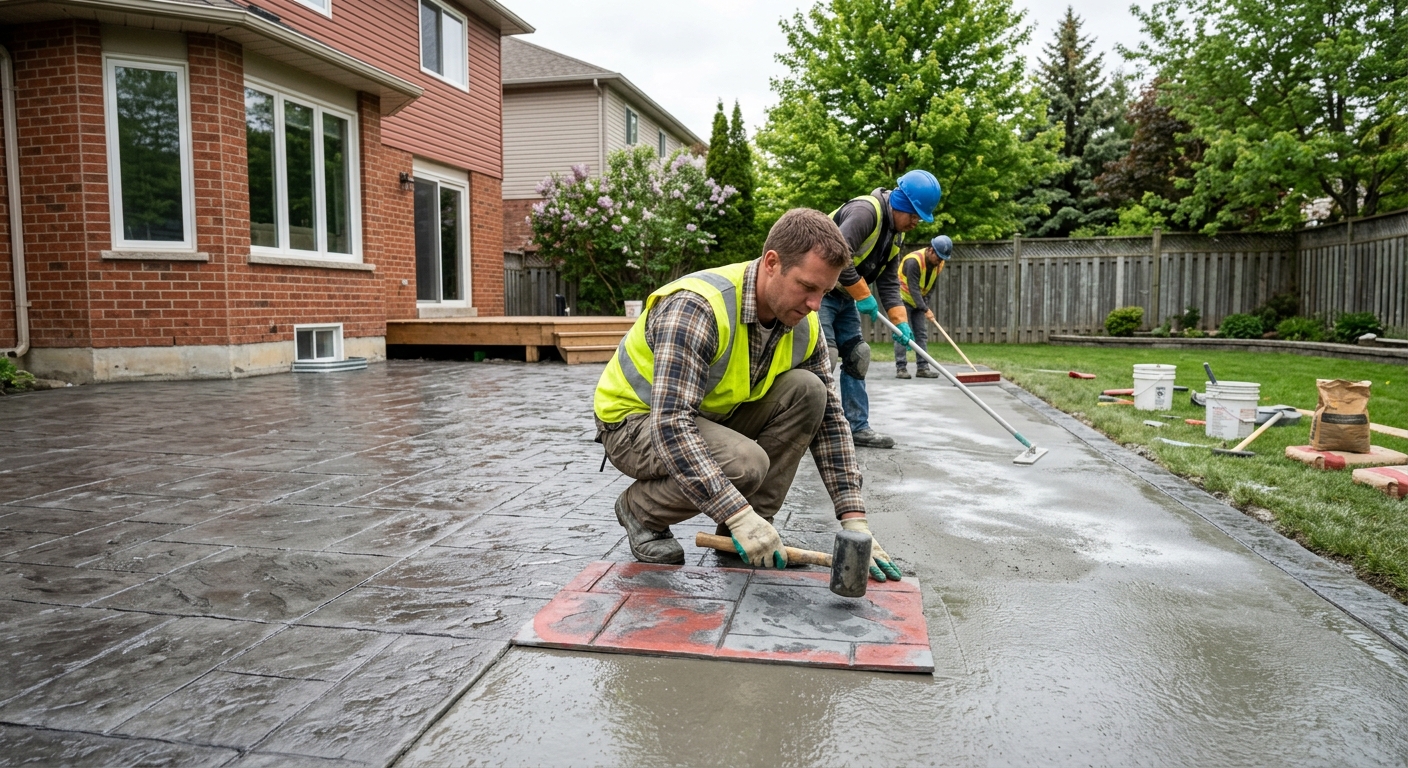
Concrete work options and costs in Glendale
Concrete work in Glendale is a practical, long-term investment for homeowners—especially for driveways, patios, walkways, garage floors, and structural foundation elements. With Glendale’s population at 2,715 (Statistics Canada, 2021 Census), you’ll typically feel strong contractor demand during the short Calgary-region pour season, and schedules can tighten quickly around spring thaw and early fall. Glendale’s housing mix is dominated by single-detached style development typical of the Calgary economic region, which drives steady demand for exterior flatwork that’s engineered for frost and freeze–thaw.
In this cold continental climate, costs are shaped less by “just concrete” and more by engineering the whole system: excavating down to undisturbed soil below the design frost depth (about 1.2 m or roughly 4 ft for many house components), building a properly compacted granular base, and using air-entrained mixes. Frequent freeze–thaw cycles also mean contractors plan control joints carefully and often schedule cold-weather curing measures (insulated blankets or temporary heat) to protect concrete during set and early curing. On top of that, de-icing salts can accelerate surface wear, so sealing is commonly recommended. For Glendale-area homeowners, neighbourhoods near popular commuter corridors—such as the Highway 22 / south Calgary access side—tend to see brisk activity for new driveways and garage slabs when additions and renovations pick up.
Below is a comparison of common options you’ll see quoted in Glendale, Alberta.
| Application |
Typical Size |
Key Spec |
Finish Option |
Price Range |
| Concrete driveway (standard broom finish) |
20 ft x 10 ft (200 sq ft) |
Air-entrained mix, control joints |
Broom finish, darkening/cleaning as needed |
$12,000–$18,000 |
| Exposed aggregate driveway |
20 ft x 10 ft (200 sq ft) |
Exposed stone, sealed surface system |
Exposed aggregate (wash/retarder) |
$14,500–$21,500 |
| Stamped concrete driveway or patio |
18 ft x 12 ft (216 sq ft) |
Air-entrained mix, release agent, joints |
Stamped patterns (brick/stone/wood looks) |
$15,000–$26,000 |
| Plain concrete patio or walkway |
12 ft x 10 ft (120 sq ft) |
Reinforcement as required by span |
Float finish or light broom |
$5,000–$9,000 |
| Garage floor (interior slab) |
22 ft x 20 ft (440 sq ft) |
Vapour barrier, fibre or mesh, proper base |
Broom finish / light burnish options |
$10,000–$16,500 |
| Foundation footings (structural, below frost) |
Typical house footprint (engineered) |
Excavation to undisturbed soil, rebar, drainage |
Engineered concrete with waterproofing interface |
$28,000–$45,000 |
Prices are estimates only and vary by project scope, site access and material selection.
What affects the price of concrete work in Glendale
Homeowners in Glendale, Alberta can see quotes for what looks like the “same job” vary by 30–50% across the Calgary region because concrete pricing is really a bundle of excavation, engineering, logistics, and weather protection—not just the cement. In a cold continental climate, the design frost depth and freeze–thaw cycles dictate that exterior footings and structural elements must extend below the design frost depth to resist frost heave. That means more excavation, more formwork height, and larger footing volumes than in milder areas. For exterior slabs, the mix must also include proper air entrainment so the paste survives repeated freezing and thawing without spalling.
Cold weather placement adds cost, too. In Calgary-area conditions, the pour season for exterior flatwork is shorter, and late fall/early spring pours may require winter-grade mixes, insulating blankets, or temporary heat to achieve proper curing. Once concrete is in service, de-icing salt can worsen surface scaling if the wrong mix and finish were used—so sealing becomes part of the “whole system” conversation.
In Glendale, two common examples explain the spread in pricing. First, a driveway rebuild with a deeper removal down to stable granular base often lands near the top of the $12,000–$18,000 range when excavation and trucking are heavy. Second, a stamped patio that includes quality base prep and winter-cure protection may sit closer to $15,000–$26,000 because labour time increases with forms, stamping, and colour/curing control. If you’re working around older homes where the existing soil has compacted unevenly over decades, that site variability can add thousands because base correction is never optional.
| Price Factor |
Why It Matters |
Cost Impact |
| Frost line depth |
Determines footing depth and required form height to reach undisturbed soil below frost |
Higher excavation and concrete volume; can push structural work toward the upper range |
| Site preparation |
Excavation, grading, and compaction of granular base to prevent settlement and frost movement |
Undercut, hauling, and thicker granular lifts add labour and equipment time |
| Reinforcement |
Rebar or mesh requirements depend on slab span, thickness, and engineering loads |
Material and tying time can increase costs substantially for driveways and slabs |
| Mix design |
Air-entrainment and compressive strength targets are essential for freeze–thaw durability |
Winter-grade mixes and tighter spec compliance raise material cost |
| Finish type |
Broom finish is simpler; stamped and exposed aggregate require more labour and careful timing |
Stamped/exposed work often adds design, labour, and longer crew time |
| Pour size and concrete truck access to site |
Large pours need faster placement; access affects equipment choice and delay costs |
Restricted access can mean extra labour for pumping/handling and waiting time |
| Cold-weather curing precautions |
Heating, insulated blankets, and curing control protect against early strength loss and scaling |
Often adds a noticeable line-item cost in late season projects |
| Control joint pattern and sealing cost |
Proper joint spacing reduces random cracking; sealing improves resistance to de-icing salt wear |
More layout time plus sealer material and application labour |
Permits & regulations in Alberta
In Alberta, structural concrete work generally requires a building permit, and many projects also need engineered drawings reviewed through the municipal process. That typically includes foundations and structural elements such as footings, foundation walls, and grade beams—because they carry load and are tied to design requirements for frost and structural performance. For concrete flatwork like patios, walkways, and driveways, a permit is often not required as long as the work doesn’t significantly affect lot grading, drainage direction, or impervious surface coverage rules. However, the practical reality in Glendale is that any work impacting how surface water is handled can trigger additional municipal requirements, so you should confirm before breaking ground.
Step-by-step, here’s how a Glendale homeowner can verify a contractor’s Alberta compliance:
1) Ask for the contractor’s business details and current certificate of insurance; ensure the liability policy lists your project address (or has sufficient coverage). 2) Verify WSIB/WCB coverage status (request a clearance letter or proof of account coverage). 3) Confirm licensing/registration as required for the scope of work (ask the contractor what category applies to their work and provide their registration details). 4) Request references on similar-scale projects—particularly exterior concrete built for Calgary-area freeze–thaw conditions. 5) Ensure the written contract states inclusions like base prep depth, reinforcement details, and whether disposal and winter-cure protection are included.
If you’re unsure whether your specific driveway/grade change needs review, call the local permitting office first—doing it upfront prevents delays once concrete is scheduled.
Getting concrete right in Glendale's freeze-thaw climate
In Glendale and across the Calgary region, concrete most often fails due to freeze–thaw damage, poor base support, and inadequate curing—especially when de-icing salt and early seasonal cold hit a surface that wasn’t protected. To spec the job correctly, start with base preparation: the granular sub-base needs to be compacted to the right depth for local soil conditions and built to support the slab below frost-affected movement zones. Next, get the mix design right. Exterior concrete should be air-entrained (typically targeting about 5% to 7% air content) and carry a minimum compressive strength (commonly 32 MPa for many exterior flatwork specs, depending on engineering and design). Without air entrainment, freeze–thaw cycling increases the chance of spalling and surface scaling.
Control joints are another key system piece. Proper joint spacing and a consistent pattern help cracks form where you can manage them, rather than allowing random cracking across the driveway or patio. Curing also matters: you want a minimum 7-day curing period under proper conditions, and in cold weather that often means insulating blankets or temporary heat so the concrete achieves strength development before temperatures drop. Finally, sealing should be planned after the concrete has cured—often around 28 days post-pour—so it can better repel de-icing salt-related wear.
Here’s where pricing is justified. A standard broom-finished driveway might land in the $12,000–$18,000 band, while a stamped option rises to $15,000–$26,000 because labour time increases for forms, stamping, and colour/curing control. If the contractor is also upgrading base prep, reinforcement, and winter curing to protect durability, that added cost is not just cosmetic—it’s risk reduction.
| Spec |
Why It Matters in Glendale |
What to Ask For |
Impact if Skipped |
| Compacted granular base (depth?) |
Prevents settlement and reduces frost-driven movement at slab edges and low spots |
Confirmed granular lift thickness and compaction testing/verification |
Uneven settling, premature cracking, and drainage issues |
| Air-entrained concrete mix (target air %?) |
Helps the concrete tolerate freeze–thaw cycling without scaling/spalling |
Target air content (typically 5%–7% for exterior flatwork) stated on the mix ticket/spec |
Surface scaling, flaking, and early spalling in winter conditions |
| Compressive strength (MPa rating) |
Strength development supports durability and load capacity through Alberta winters |
Minimum MPa rating (commonly 32 MPa for exterior flatwork unless engineered otherwise) |
Reduced wear resistance and increased cracking risk |
| Control joints (spacing per ACI guidelines) |
Limits random cracking by guiding crack locations |
Joint spacing plan and saw-cut timing |
Random cracking and higher chance of water intrusion into joints |
| Minimum 7-day curing period |
Early strength is critical in cold snaps to prevent scaling and strength loss |
Curing method in cold weather (blankets/heating if needed) |
Surface weakness, scaling, and reduced long-term performance |
| Penetrating sealer (when applied after cure) |
Improves resistance to de-icing salt and moisture-driven wear |
Sealer type and timing (often around 28 days post-pour) |
Faster deterioration and more frequent maintenance |
How to choose a concrete work contractor in Glendale
Choosing the right contractor in Glendale starts with verifying Alberta compliance and proof you can trust. First, ask for evidence of liability insurance and confirm it covers concrete work for projects like yours. Next, request WSIB/WCB clearance or coverage documentation so you know the contractor can legally manage workplace coverage. For licensing/registration, ask the contractor to provide their current registration details and explain what category applies to their scope (especially for structural work like foundations and footings).
Then get 2–3 itemised written quotes. A good quote breaks down labour and materials (excavation, granular base, forms, reinforcement, concrete supply, finishing, sealing, and disposal) rather than a single lump sum. Read the scope carefully for exclusions: is permit pulling included where required, who pays for concrete washout/disposal, and what’s included in removal and re-compaction? Ask for a clear start date and a completion estimate in writing, and confirm how weather impacts scheduling—particularly for cold-weather curing and finishing.
Warranty is also non-negotiable. Look for a workmanship warranty length and confirm whether the manufacturer’s product warranties (e.g., sealer or admixtures) apply and whether they’re transferable to you. Payment should be staged; never pay more than 10–15% upfront. Hold back the final payment until the job is complete, cleaned up, and any punch list items are addressed.
- Ask for local references on Calgary-area exterior flatwork built for freeze–thaw durability.
- Confirm liability insurance limits and request a COI before work begins.
- Request WSIB/WCB clearance/coverage proof for each contractor or crew member (as applicable).
- Get an itemised quote showing excavation and granular base scope, not just “concrete.”
- Confirm footing/foundation depth statements in structural scopes match frost requirements.
- Verify air-entrainment and the stated compressive strength on the mix spec.
- Ask for reinforcement details (mesh vs rebar, and placement) for driveways and slabs.
- Confirm joint spacing plan and when saw cuts will be performed.
- Discuss cold-weather plan: blankets, heating, and curing procedure if temperatures drop.
- Ask whether sealing is included and when it will be applied after cure.
- Ensure disposal and site cleanup are explicitly included.
- Use a written payment schedule with a final holdback until completion.
Concrete contractor red flags in Glendale include: quotes that omit granular base prep depth, no mention of air-entrained mix for exterior work, “we’ll pour whenever” without cold-weather curing measures, vague joint spacing details, and contracts that require large upfront payments with no retention or clear completion criteria.
Frequently asked questions — concrete work in Glendale
What is a concrete overlay and is it suited to Glendale?
A concrete overlay is a new layer of concrete (or sometimes a polymer-modified topping system) placed over an existing slab after surface preparation. In Glendale, it can be a good option when the original driveway is generally sound—meaning there’s no widespread settlement, major structural cracking, or pumping water issues—because a proper overlay depends on a stable base. Since Calgary-area freeze–thaw cycles and de-icing salts can expose weak joints and edges, overlays only perform well if the prep is thorough (shot blasting/grinding, crack assessment, and proper bonding). Cost-wise, an overlay can sometimes sit below full replacement, but if the slab is already failing, replacement may protect your long-term investment better. If you’re comparing options, ask how the overlay thickness, crack treatment, and sealing plan will be engineered for exterior exposure.
How do I seal concrete to protect it in Glendale?
Sealing is one of the most effective ways to reduce moisture and de-icing salt impact on exterior concrete in Glendale. The typical approach is to wait until the concrete has cured properly—often around 28 days post-pour—then apply a penetrating sealer designed for freeze–thaw climates. Prep matters: the slab should be clean and dry, and any coatings/contaminants must be removed so the sealer can penetrate. Ask your contractor which sealer they use and whether it’s meant for concrete exposed to salts (not just general water repellency). Sealing works best when paired with the right air-entrained mix, control joint spacing, and sound base prep; otherwise, water can still enter through cracks and joints.
What is the difference between concrete and cement?
In everyday terms, people often say “cement” when they mean concrete. Cement is one component—usually Portland cement—that acts as the binding material. Concrete is the complete mixture: cement plus water, aggregates (sand and gravel/crushed stone), and sometimes admixtures (like air-entraining agents). In Glendale’s freeze–thaw environment, the difference becomes important because specifications typically reference the concrete mix design—especially air entrainment for exterior flatwork. So when you’re reviewing quotes, ask for the concrete mix ticket details (air content and compressive strength), not just the fact that “cement is included.” That’s where the real durability decisions are made.
How much does concrete work cost in Glendale?
Concrete costs in Glendale generally follow the Calgary-region price bands, but your final number depends on excavation depth, reinforcement, access, finish complexity, and whether cold-weather curing is required. For example, a standard concrete driveway often lands in the $12,000–$18,000 range for a typical residential size. Plain patios and walkways commonly fall around $5,000–$9,000, while stamped concrete driveways or patios frequently range from $15,000–$26,000 because stamping, timing, and material handling take more labour. Foundation footings (structural, below frost) are commonly quoted in the $28,000–$45,000 band, depending on engineered scope and excavation requirements.
How deep must footings be for Glendale's frost line?
For the Calgary region, concrete footings are engineered around the design frost depth, which is about 1.2 m (roughly 4 ft) for many residential applications. The key point for Glendale homeowners is that footings must bear on undisturbed soil below the design frost depth to reduce frost heave and seasonal movement. In practice, the exact depth can vary with soil conditions, drainage, and engineering requirements, so your engineer/contractor should specify the footing elevations and bearing depth. Because frost depth is deeper in Alberta than in warmer provinces, excavation is more intensive, which is one reason foundation costs can run higher than some homeowners expect from other regions.
Why does concrete crack in Glendale and how is it prevented?
Concrete cracks in Glendale mainly because concrete shrinks as it cures and because freeze–thaw cycles plus seasonal moisture movement can stress the slab—especially at edges, near joints, and where base support is inconsistent. The good news is that cracking is manageable when the job is designed correctly: a properly compacted granular base, correctly air-entrained exterior concrete, and well-planned control joint spacing guide cracking to predictable locations. Equally important is curing—minimum 7 days under proper conditions—and, in cold snaps, insulating blankets or temporary heat to ensure strength development. Finally, sealing after cure helps reduce de-icing salt and moisture exposure. If a contractor skips air entrainment or joint planning, spalling and uncontrolled cracking are more likely over time.