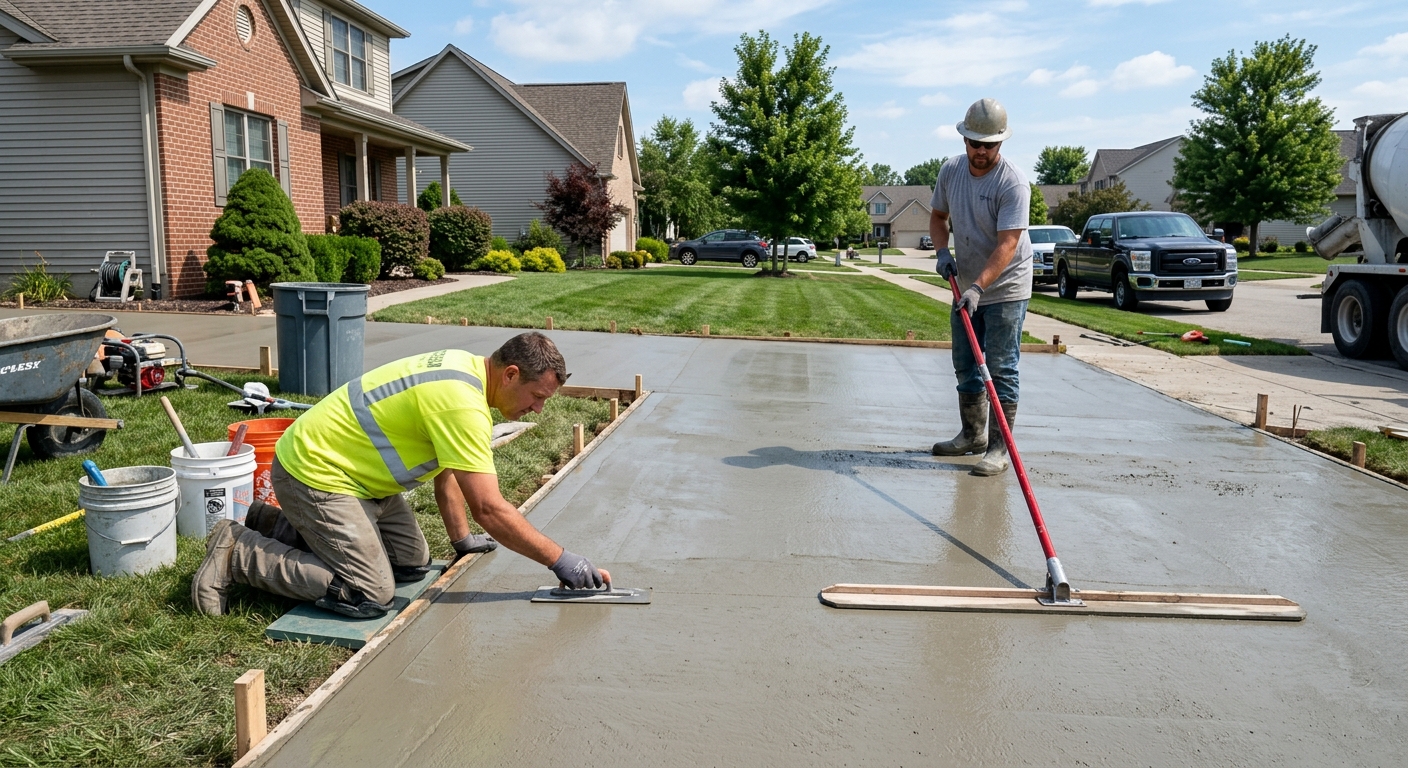
Concrete work options and costs in Sexsmith
Concrete work in Sexsmith is mostly about getting the build right for local frost and freeze–thaw, not just pouring “a slab.” In a town of 2,427 people (Statistics Canada, 2021 Census), the housing stock is strongly oriented toward single-detached homes—83.0% of dwellings—which drives steady demand for driveways, patios, walkways and garage slabs. About 655 households own their homes (77.1%), so homeowners are the biggest repeat customer group for flatwork repairs, re-pours, and upgrades like exposed aggregate or stamped finishes.
In the Athabasca–Grande Prairie–Peace River region, frost lines and repeated freeze–thaw cycles can be unforgiving. Footings must be placed well below frost to prevent heave, and exterior flatwork needs air-entrained concrete to resist scaling and surface breakdown. You also feel the logistics side: the reliable pour season is shorter, and crews often juggle travel across the Peace region and equipment availability. That can tighten scheduling and affect labour productivity, especially when access is limited or the site requires more excavation and thicker base preparation.
In Sexsmith, concrete crews are especially busy around older residential areas where homes built before 1981 are more common (32.4%), because that’s where existing driveways, steps and small porch slabs typically need replacement or major patching. To help you compare the common options, here are realistic price bands for typical residential work in Sexsmith.
| Application |
Typical Size |
Key Spec |
Finish Option |
Price Range |
| Concrete driveway (standard broom finish) |
400–600 sq. ft. |
Air-entrained mix, compacted base, control joints |
Broom finish |
$5,800–$12,000 |
| Exposed aggregate driveway |
400–600 sq. ft. |
Air-entrained mix, proper curing, thicker build-up |
Exposed aggregate (broom/topset variation) |
$9,000–$16,000 |
| Stamped concrete driveway or patio |
300–500 sq. ft. |
Air-entrained mix, colour hardeners, integral seal ready |
Stamped (mould patterns) |
$8,000–$14,500 |
| Plain concrete patio or walkway |
120–300 sq. ft. |
Compacted base, joints, air-entrained exterior mix |
Float + broom / trowel edges |
$1,600–$5,300 |
| Garage floor (interior slab) |
24’ x 24’ (576 sq. ft.) |
Interior mix, vapour barrier, joints as planned |
Broom finish (light/medium duty) |
$9,000–$18,000 |
| Foundation footings (structural, below frost) |
Per house footprint |
Engineered layout, below-frost depth, reinforced concrete |
Structural concrete only |
$20,000–$45,000 |
Prices are estimates only and vary by project scope, site access and material selection.
What affects the price of concrete work in Sexsmith
In Sexsmith and across the Athabasca–Grande Prairie–Peace River economic region, it’s common to see quotes for the same “size” of concrete come in 30–50% apart. The big drivers aren’t just cement prices—they’re what the job requires to survive local freeze–thaw, how much excavation is needed for reliable base prep, and how fast a crew can place and finish the concrete during a shorter workable pour window. When labour and equipment are in peak demand, even the same concrete driveway can cost more if truck access is tight or if extra thaw/heating/blankets are required for the pour date.
Frost line depth dictates every spec: exterior footings must extend below the design frost depth to prevent frost heave. Alberta projects also require air-entrained concrete for exterior slabs so the mix can tolerate repeated freezing and thawing. Cold-weather curing precautions—insulating blankets, heaters, and longer curing timelines—add handling time and materials. De-icing salts (common on driveways and steps) can accelerate surface wear and spalling if the surface isn’t sealed; sealing isn’t “luxury” here, it’s a durability step.
Two practical examples in Sexsmith: (1) Replacing a driveway on poor subgrade often pushes excavation and granular base thickness, which moves the project toward the higher end of driveway pricing (for example, concrete driveway / slab often lands around $14–$20 per sq. ft.). (2) Upgrading from plain concrete to stamped or decorative finishes increases material complexity and labour, typically aligning with stamped & decorative concrete pricing of $22–$35 per sq. ft. in this tier. In older neighbourhoods (and especially where homes built before 1981 are common), existing settlement and poor drainage can mean more demo, more hauling, and more base rebuild—often the difference between a mid-range re-pour and a higher-end replacement.
| Price Factor |
Why It Matters |
Cost Impact |
| Frost line depth — determines footing depth and form height |
Controls excavation volume and concrete placement below frost for stability |
Can swing total structural cost by tens of thousands on footing-heavy jobs |
| Site preparation — excavation, grading, compacted granular base |
Ensures load support and reduces settlement/cracking |
Higher excavation or weak soils typically add labour, base rock and hauling |
| Reinforcement — rebar or wire mesh requirement |
Improves crack control for slabs subjected to vehicle loads or movement |
Adds material + tying/labour time; sometimes reduces thickness requirements |
| Mix design — air-entrainment and compressive strength spec |
Air void system reduces freeze–thaw scaling; strength must meet design |
May increase per-yard concrete cost and affect scheduling/curing approach |
| Finish type — broom vs. stamped vs. exposed aggregate |
Finish complexity affects labour, materials and curing/processing steps |
Stamped/exposed options generally cost more than plain broom-finish work |
| Pour size and concrete truck access to site |
Impacts production rate, number of loads, and placement logistics |
Restricted access can force smaller pours, extra labour and additional equipment |
| Cold-weather curing precautions — heating and blankets |
Prevents strength loss and surface damage in cold, wet conditions |
Adds time, blankets/heaters, and staff attention during curing |
| Control joint pattern and sealing cost |
Manages where cracks form; sealing helps against de-icing salt wear |
More joints or quality sealing increases cost but reduces recurring repairs |
Permits & regulations in Alberta
In Alberta, the permitting line is mostly about structural impact. Structural concrete work—such as footings, foundation walls, grade beams and other elements that support a building—generally requires a building permit and often engineered drawings reviewed by the municipality. Concrete flatwork (patios, walkways and typical driveways) usually does not require a permit unless it affects lot grading, drainage, or impervious surface coverage rules, or encroaches near a municipal right-of-way. Always confirm with the City/County planning or development office before breaking ground, especially if you’re changing elevations or redirecting surface water.
For compliance, start by verifying that your contractor carries liability insurance and Workers’ Compensation coverage (WSIB/WCB). Then ask for references on similar-scale concrete projects in Alberta weather conditions—driveways, steps, and foundation-related work. Step-by-step for Sexsmith homeowners:
- Ask for the contractor’s business address and project references (similar pour season and exterior exposure).
- Request a certificate of liability insurance naming you/your property correctly (if applicable) and confirm the coverage is current.
- Confirm WSIB/WCB status with the documentation the contractor provides (or via the provider clearance approach they use).
- For structural work, confirm the contractor will coordinate the engineering/permit documents before the pour.
- If permits are triggered, ensure the permit is pulled before excavation and placement—not after.
If you’re ever unsure, it’s worth asking directly: “Is my scope flatwork only, or does it include structural concrete elements that require a permit?”
Getting concrete right in Sexsmith's freeze-thaw climate
Concrete tends to fail in Sexsmith when the foundation and slab system are built for the “nice weather” scenario instead of for freeze–thaw cycles, moisture movement and de-icing salt. The most common problems I see are scaling and surface spalling on exterior flatwork, settlement-driven cracking, and random cracks that appear early because the base and joint plan weren’t matched to the load and exposure. In the Athabasca–Grande Prairie–Peace River region, the solution is to spec the whole system: base, mix, joints, curing and sealing.
(1) Base preparation: place and compact granular sub-base to the correct depth and grade for local soil and frost conditions. If water can move beneath a slab, freeze–thaw can lift the edge and break the finish. (2) Mix design: specify air-entrainment and exterior durability. A common target is 5–7% air content for exterior flatwork and a minimum 32 MPa compressive strength (as specified/engineered for the use). (3) Control joints: design the joint spacing so cracks start where you want them, not randomly. (4) Curing: plan for minimum 7 days of proper curing conditions; in cold weather, curing may require heated enclosures and insulated blankets to reach strength safely. (5) Sealing: apply a penetrating sealer after the slab has cured—typically at 28 days—to repel water and de-icing salt intrusion.
Here’s where the price difference is (and isn’t) justified: upgrading from plain broom-finish concrete ($14–$20 per sq. ft. tier for driveways/slabs) to stamped concrete ($22–$35 per sq. ft.) isn’t only about looks—stamped work benefits from better curing discipline and careful finish timing. But if the contractor is cutting corners on air-entrainment or base prep, you can’t “buy your way out” of spalling risk later.
When you quote the work, ask technical questions about air entrainment, joint plan, curing method and the exact base depth—because those are the levers that stop exterior concrete from deteriorating through Sexsmith winters.
| Spec |
Why It Matters in Sexsmith |
What to Ask For |
Impact if Skipped |
| Compacted granular base (depth?) |
Supports the slab and limits water movement before freeze–thaw |
Base depth (inches/cm) and compaction test/verification method |
Settlement, edge heave, cracking and premature failure |
| Air-entrained concrete mix (target air %?) |
Protects against scaling/spalling from repeated freezing and thawing |
Documented air content target (commonly 5–7% for exterior flatwork) |
Surface scaling and spalling within winters |
| Compressive strength (MPa rating) |
Strength gain matters for durability under vehicle loads and freeze cycles |
Minimum 32 MPa (or engineered spec) and test/quality plan |
Soft or under-strength concrete wears faster and can crack early |
| Control joints (spacing per ACI guidelines) |
Controls where cracks form as the slab shrinks and moves |
Planned joint spacing and saw-cut timing |
Random cracking, uneven slab appearance, accelerated water ingress |
| Minimum 7-day curing period |
Cold/wet conditions can slow strength development |
How curing will be handled; blankets/heating if needed |
Reduced strength, surface dusting and durability problems |
| Penetrating sealer (when applied after cure) |
Helps limit water and salt exposure that drives surface breakdown |
Sealer type and application timing (commonly around 28 days post-pour) |
Faster salt wear, staining, and scaling in subsequent seasons |
How to choose a concrete work contractor in Sexsmith
Choosing the right contractor in Sexsmith comes down to proof and clarity. In Alberta, confirm licensing and coverage before you sign anything. First, request the contractor’s Alberta business details and ask whether they’re eligible to carry out the scope you’re bidding (flatwork versus structural work). Then verify liability insurance by asking for a current certificate of liability insurance—it should show dates, coverage limits and the correct legal entity. For workers, ask for WSIB/WCB documentation or clearance evidence so you know the crew is properly covered.
Next, get 2–3 written, itemised quotes rather than a single lump sum. You want a breakdown that shows labour, materials (concrete, rebar/mesh, base rock), excavation and disposal, forming, finishing, joints, sealing and any cold-weather curing allowances. Read the exclusions: is removal and hauling included? Is the base depth specified? Is disposal handled at a licensed site? Does the price include permits if structural concrete is involved?
Warranty matters too. Ask for a workmanship warranty length and what it covers (for example, scaling, settlement, joint failure). Also ask whether product warranties are transferable if you sell your home. Finally, be cautious with payment terms: never pay more than 10–15% upfront, and use a holdback until the job is complete, cleaned and verified. Get the timeline in writing, including start date and completion estimate—short pour seasons can affect scheduling, so you need commitments, not guesses.
- Use a written quote with itemised labour/material lines, not “allowances” everywhere.
- Ask for the base depth and whether compaction is verified.
- Confirm the concrete mix is air-entrained for exterior flatwork.
- Require a joint plan: spacing and saw-cut timing.
- Ask how cold weather curing will be handled (blankets/heaters, minimum cure time).
- Confirm reinforcement plan (wire mesh vs rebar, thickness and placement).
- Check that sealing is included or clearly excluded (and when it will be applied).
- Verify liability insurance certificate is current and matches the contractor entity.
- Confirm WSIB/WCB coverage documentation before work starts.
- Ensure equipment and access constraints are addressed (truck reach, extra labour for placement).
- Clarify disposal/hauling and whether contaminated soil gets handled properly.
- Get a workmanship warranty in writing, plus what “defect” means for repairs.
Concrete contractor red flags in Sexsmith: vague quotes that omit base depth and joint spacing; claiming “we always use air-entrained concrete” without specifying it for the exterior scope; skipping insulated curing plans when temperatures drop; offering deep discounts with minimal insurance documentation; or asking for large upfront payments before any materials are staged.
Frequently asked questions — concrete work in Sexsmith
What causes concrete to spall in Sexsmith winters?
Spalling in Sexsmith typically comes from moisture getting into the concrete and then freezing repeatedly. If the exterior slab or walkway doesn’t have proper air entrainment (and the right curing), water can expand and break the surface paste. Poor drainage and weak base prep can also trap water at slab edges, which accelerates freeze–thaw damage. De-icing salt makes the situation worse because it increases salt exposure at the surface; over time, that drives scaling and flaking. If your slab was poured with a low-quality mix, insufficient air content, or rushed curing in cold weather, you can see early surface breakdown even if the concrete looks fine when first poured. In practical terms, ask your contractor what air content target they’re using and whether the job includes curing blankets/heating when it’s cold.
What is rebar and when is it required in Alberta?
Rebar is steel reinforcement used inside concrete to help control cracking and increase strength, especially where slabs or structural elements experience tension. In Alberta, whether rebar is required depends on the design and load conditions—driveways for heavier vehicles, thickened edges, and interior/exterior slabs that carry stress may call for wire mesh or rebar. For structural concrete like footings and foundation elements below frost, reinforcement requirements are typically determined by engineered drawings and the structural design. For homeowners in Sexsmith, the key is to ask your contractor whether your specific scope calls for mesh or rebar, and to see how it’s placed (not just that it “exists”). For footings below frost, it’s common that reinforcement is specified for the structural system rather than “optional.”
How long does a concrete project take in Sexsmith?
Timelines in Sexsmith depend on weather, site access and curing conditions. For many exterior flatwork jobs—say a small patio or walkway—excavation and forming may take a day or two, placing and finishing is usually one day, and curing time affects when you can use it. Even though a slab gains handling strength quickly, the durability expectations align with proper curing; many contractors plan at least 7 days before normal use, and sealing is often targeted around 28 days post-pour for best results. Driveway replacements can take longer due to heavier excavation, base preparation and proper joint layout. In colder periods, cold-weather curing precautions (insulation blankets/heating) can add time and labour. If you’re comparing quotes, ask for a start date, completion estimate, and how curing will be managed given the pour day forecast.
What is a concrete overlay and is it suited to Sexsmith?
A concrete overlay is a new concrete layer placed over an existing slab (after prep), meant to restore appearance and levelness without full removal. In Sexsmith, overlays can be suitable if the existing concrete is still structurally sound—no significant slab movement, minimal deterioration, and a surface that can be properly prepared for bonding. However, overlays can fail if the original slab has heave, settlement, or moisture issues because the new layer can crack or debond in step with the old problem. That’s why thorough assessment matters: check for spalling, drainage issues, and joint failure. If your driveway is already scaling from freeze–thaw, sometimes removal and re-pour is the better long-term option. As a budgeting reference, plain concrete patio/walkway work often sits around the lower bands (for example, the $12–$18 per sq. ft. tier for patios/walkways), while overlays may not always deliver proportional savings if prep is extensive.
How do I seal concrete to protect it in Sexsmith?
Sealing helps in Sexsmith because it reduces how quickly water and de-icing salts penetrate the surface, which slows scaling and surface wear in freeze–thaw cycles. The important part is timing: apply penetrating sealer after the slab has cured sufficiently—often around 28 days post-pour—so you don’t trap moisture inside. Before sealing, the concrete should be clean, dry, and free of contaminants; contractors typically pressure wash and allow drying time. For exterior driveways and steps, choose a penetrating sealer designed for salt exposure rather than a simple decorative coating. Ask what product is used and whether the contractor tests moisture or waits for weather conditions suitable for sealing. If your scope includes sealing, make sure it’s specified in the contract—some driveway quotes focus on the pour only, and sealing can be a meaningful add-on.
What is the difference between concrete and cement?
Cement is one component of concrete. Concrete is the complete engineered mix: cement (which acts as a binder) plus aggregates (sand and gravel), water, and—when required for exterior exposure—admixtures like air-entrainment. In Sexsmith, the distinction matters because “using cement” is not the same as specifying the correct exterior concrete performance. For example, exterior flatwork needs air entrainment and curing discipline to handle freeze–thaw. The broader durability spec is about the full concrete mixture and placement method, not just the brand of cement. When you get a quote, ask what the mix design targets (air content for exterior, compressive strength such as 32 MPa, and curing approach). This is also why two driveways with similar sizes can vary by 30–50%: the contractor isn’t only changing material brand—they’re changing mix design, base thickness, and cold-weather handling to match Athabasca–Grande Prairie–Peace River conditions.