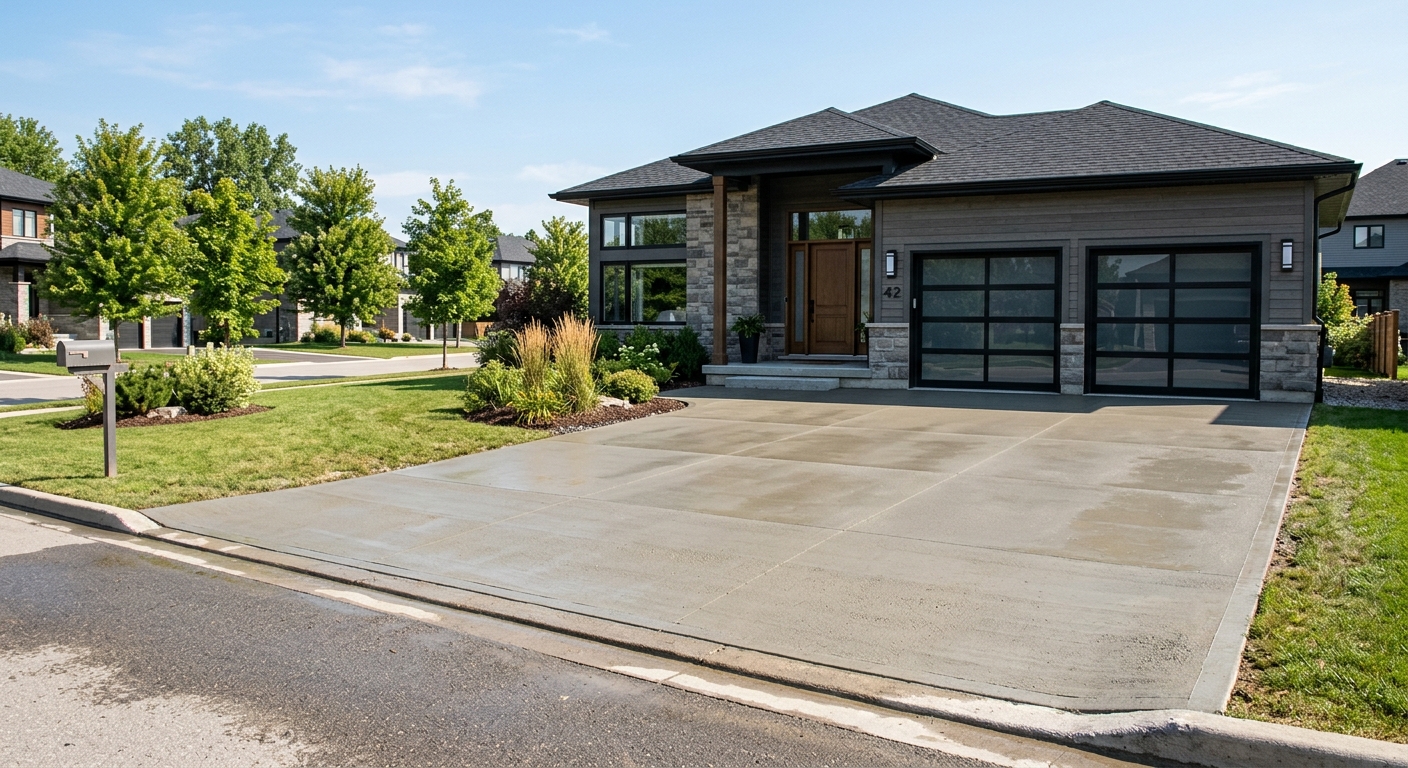
Concrete work options and costs in Taber
Taber homeowners typically choose concrete flatwork because it performs well when it’s detailed for southern Alberta’s freeze–thaw swings. In Taber, where single-detached homes make up 92.6% of dwellings (Statistics Canada, 2021 Census), concrete driveways, patios and walkways are the most common upgrades that get poured as part of home maintenance and curb-appeal projects. The market is also shaped by the fact that 77.4% of households are homeowners (Statistics Canada, 2021 Census), which means many projects are done during warmer seasons when access and curing are easier.
In the Lethbridge–Medicine Hat economic region, concrete pricing is heavily driven by deep frost depth and aggressive freeze–thaw cycles. For structural work, footings are taken below frost—often around the 5–6 ft range—so excavation and forming rise compared with milder climates. Exterior slabs also need air-entrained concrete, tight control-joint layouts, and quality granular base prep to manage water movement and internal expansion. On top of that, exterior pours are often clustered into the warm months, and colder shoulder-season work may require blankets, heaters, or accelerators—costs that aren’t needed in regions with longer pour seasons.
If you’re near new growth or established pockets like the south end of Taber (common for driveway widening and backyard patio retrofits), you’ll notice crews booking earlier because truck availability and forming materials are in higher demand. Below is a practical comparison of typical sizes, specifications, and pricing ranges for the most-requested concrete options in Taber, followed by what typically drives those numbers.
| Application |
Typical Size |
Key Spec |
Finish Option |
Price Range |
| Concrete driveway (standard broom finish) |
24 ft x 10 ft (240 sq. ft.) |
Air-entrained mix, compacted base, control joints |
Broom finish |
$14,400–$22,000 |
| Exposed aggregate driveway |
24 ft x 10 ft (240 sq. ft.) |
Air-entrained mix, proper grading and jointing |
Exposed aggregate top finish |
$18,000–$27,000 |
| Stamped concrete driveway or patio |
20 ft x 12 ft (240 sq. ft.) |
Air-entrained mix, integral colour, base prep |
Stamp + colour + seal |
$20,000–$34,000 |
| Plain concrete patio or walkway |
12 ft x 12 ft (144 sq. ft.) |
Air-entrained mix, compacted granular sub-base |
Float and broom/steel trowel (as specified) |
$2,400–$5,000 |
| Garage floor (interior slab) |
24 ft x 22 ft (528 sq. ft.) |
Vapour barrier (as required), fibre/rebar option |
Broom or smooth finish (light trowel) |
$6,000–$12,000 |
| Foundation footings (structural, below frost) |
Typical two-bay footprint (site-dependent) |
Below-frost excavation, reinforced concrete |
Structural formwork (not decorative) |
$18,000–$35,000 |
Prices are estimates only and vary by project scope, site access and material selection.
What affects the price of concrete work in Taber
In the Lethbridge–Medicine Hat region, two quotes for what looks like the “same” concrete job can vary by 30–50% because the real cost drivers aren’t just the cubic yards—they’re frost protection details, base prep, reinforcement decisions, finish complexity, and winter readiness. Alberta’s deeper frost requirements mean excavation, forming and concrete volume often rise for exterior structural elements, while freeze–thaw cycles force air-entrained mixes and disciplined joint spacing for slabs.
For structural work and anything tied to foundations, footings must extend below the design frost depth to prevent frost heave. That requirement alone is a major reason foundation and footings pricing sits higher than decorative flatwork. For exterior slabs and driveways, air-entrained concrete is essential so the mix can safely manage freezing water inside the paste. When temperatures drop into shoulder seasons, contractors often need cold-weather curing precautions—blankets, heaters, and/or accelerators—which adds labour and materials. Even de-icing salts can contribute to surface scaling if the slab isn’t protected; that’s where sealing becomes part of the “real performance” cost.
In Taber, a typical example: a standard broom-finish driveway can land near the lower end of the driveway band, while stamped work commonly shifts you into the higher decorative band because the finish system (forms, texture mats, integral colour and sealing) takes more time and care. Another example is base depth: if your soil is wetter/softer or the grade needs correction, granular base and compaction can add cost, pushing a patio project upward within the $12–$20 per-sq.-ft. style range for patios/walkways.
| Price Factor |
Why It Matters |
Cost Impact |
| Frost line depth — determines footing depth and form height |
Deeper, below-frost excavation prevents heave and structural movement |
Higher excavation + forming; can move structural jobs up significantly |
| Site preparation — excavation, grading, compacted granular base |
Fixes drainage and provides the support slab needs under freeze–thaw |
Additional granular material, compaction passes, and regrading labour |
| Reinforcement — rebar or wire mesh requirement |
Controls cracking and supports heavier loads (especially slabs) |
Steel material + cutting/tie-in labour |
| Mix design — air-entrainment and compressive strength spec |
Air voids protect against freeze–thaw damage and spalling |
Premium mix + tighter batching/QA practices |
| Finish type — broom vs. stamped vs. exposed aggregate |
Texture complexity affects crew time and finishing labour |
Stamped/exposed generally adds form-and-finish labour and sealer |
| Pour size and concrete truck access to site |
Access affects pump vs. wheelbarrow handling, and pour efficiency |
Long carry distances and access constraints add labour and sometimes pump fees |
| Cold-weather curing precautions — heating and blankets |
Ensures concrete reaches usable strength in Taber’s shoulder seasons |
Extra labour, heaters/blankets, and possibly accelerators |
| Control joint pattern and sealing cost |
Jointing manages shrinkage cracking; sealing protects against de-icing salts |
More layout/work + sealer material applied after cure |
Permits & regulations in Alberta
In Alberta, structural concrete work typically needs a building permit—especially for footings, foundation walls, grade beams, and any scope that affects structural support. In many cases, engineered drawings are required and reviewed by the municipality before excavation starts. Concrete flatwork such as patios, walkways, and driveways often does not require a permit by default, unless the project changes lot grading, impacts drainage/side-yard runoff, or touches municipal right-of-way requirements.
For a Taber homeowner, the practical approach is to verify two things: (1) whether the specific scope triggers a permit, and (2) whether the contractor is properly insured and compliant. Step-by-step, start by asking the contractor to clearly list what they’re building and confirm whether permits are included in the quote. Then, confirm the Alberta contractor licensing information using the appropriate provincial registry resources (contractor licence verification) and request a current certificate of insurance showing liability coverage. Also ask for proof of WSIB/WCB coverage (or the applicable clearance documentation) so you’re not exposed to worker-related liabilities if anything goes wrong on your property.
Finally, request references from similar-size concrete projects and ask what cold-weather measures they use when pours happen near the shoulder seasons. If they can’t explain the freeze–thaw detailing or they won’t talk about insurance and job documentation, that’s a red flag before you sign.
Getting concrete right in Taber's freeze-thaw climate
Concrete failure in Taber’s freeze–thaw climate usually comes down to three weaknesses: poor base prep, a mix that isn’t properly air-entrained, and inadequate curing/jointing. Water gets into the slab and, when it freezes repeatedly, it expands—leading to scaling/spalling, surface deterioration, and sometimes deeper cracking. That’s why the “spec” matters as much as the pour day. For base preparation, we build a compacted granular sub-base to the right depth for local soils and frost protection. For the mix design, exterior flatwork should target about 5–7% air content (air-entrained) and meet a minimum 32 MPa compressive strength specification, so the paste can accommodate freeze–thaw stress. Control joints also need the right spacing so shrinkage and movement crack predictably instead of randomly.
Curing is another big one. In Taber, even though we’re drier than coastal areas, cold snaps slow strength gain. A minimum 7-day curing period under proper conditions is a practical minimum, and in colder weather we use protection—blankets/heaters—to keep the concrete from freezing before it’s strong enough. After the slab has cured, we recommend a penetrating sealer applied at around 28 days post-pour to help repel de-icing salt impacts. If you want the questions to ask: “What air content are you delivering, what’s the compressive strength spec, how deep is the granular base, what’s your control joint spacing plan, and what cold-weather curing steps do you use?”
On price: going from plain broom finish to stamped concrete can add roughly $6,000–$12,000 on a typical driveway/patio once you account for integral colour, tooling and added finishing time, and that’s justified when you also keep the same proper air-entrained mix, base prep and jointing. If the contractor cuts those corners, any finish upgrade won’t hold up through Alberta winters.
| Spec |
Why It Matters in Taber |
What to Ask For |
Impact if Skipped |
| Compacted granular base (depth?) |
Provides stable support and helps drainage so water doesn’t sit under slab |
State granular base depth and compaction method (proof/notes if available) |
Settling, rocking slabs, faster cracking under freeze–thaw movement |
| Air-entrained concrete mix (target air %?) |
Air voids relieve internal pressure during repeated freezing cycles |
Confirm target air content for exterior flatwork (typically 5–7%); show mix spec |
Spalling/scaling risk increases significantly, especially with salt exposure |
| Compressive strength (MPa rating) |
Strength gain supports durability and loading after cold nights |
Ask for minimum 32 MPa (or project-engineered strength) and curing approach |
Surface wear, reduced long-term performance, possible early damage |
| Control joints (spacing per ACI guidelines) |
Manages shrinkage and movement so cracks occur at planned joints |
Get spacing plan and timing (saw-cut or form-joint approach) |
Random cracking, wider cracks, water infiltration into slab edges |
| Minimum 7-day curing period |
Strength develops slower in colder weather common in southern Alberta |
Minimum curing time and temperature/protection plan if nights are cool |
Reduced strength at early age, increased cracking and surface breakdown |
| Penetrating sealer (when applied after cure) |
Helps repel de-icing salts that can accelerate surface scaling in Alberta |
When it will be applied (around 28 days post-pour) and which product type |
Faster surface deterioration and more frequent maintenance |
How to choose a concrete work contractor in Taber
Start with compliance checks. In Alberta, verify the contractor’s licensing status (where applicable to their trade scope) and request proof of liability insurance before work begins. For workers on site, confirm WSIB/WCB coverage (or clearance documentation) so you’re protected if an injury occurs. Ask for the certificate of insurance and ensure coverage is current; don’t accept “we’re insured” without documents.
Next, get 2–3 itemised written quotes instead of a lump sum. You want a labour + materials breakdown that clearly shows excavation, granular base prep, reinforcement, concrete supply/mix, finish labour, saw-cutting/jointing, curing/protection, and disposal of concrete spoils. Make sure the scope states whether permits are included (when required), whether removal/replacement of existing concrete is included, and what’s excluded (soft landscaping, drainage tie-ins, asphalt cutbacks, snow clearing for access).
Warranty matters too. Confirm the workmanship warranty length, what it covers (cracks below a certain width, spalling exceptions, sealer responsibilities), and whether any product/manufacturer warranty is transferable to you. Then check the payment schedule: never pay more than about 10–15% upfront. Hold back a portion until the job is complete, cleaned up, and you’ve had time to review finished grades and joints.
Finally, get a start date and a completion estimate in writing. In Taber, weather can compress schedules—good contractors plan around frost/temperature windows and will tell you early if cold-weather curing equipment is needed.
- They provide a written, itemised scope (not just “supply and install concrete”).
- They specify the mix design: air-entrainment and compressive strength.
- They document granular base thickness and compaction expectations.
- They explain control-joint spacing and show where saw cuts will land.
- They state curing duration and cold-weather protection steps.
- They include sealing expectations if you’re using de-icing salts.
- They list reinforcement (wire mesh vs. rebar) by area and load needs.
- They confirm truck access and pour plan (pump vs. wheelbarrow handling).
- They disclose disposal responsibilities for excavated materials.
- Payment schedule is conservative (10–15% max upfront).
- They provide insurance certificates and WSIB/WCB clearance paperwork.
- They can show similar Taber residential concrete projects and references.
Concrete contractor red flags in Taber: vague scopes with no mix/joint/curing details; refusing to provide insurance/WSIB/WCB documentation; pricing that’s unusually low compared to the local driveway band of about $14–$22 (per-sq.-ft.-style expectations) without explaining base depth or reinforcement changes; no mention of air-entrainment for exterior work; and no plan for sealing or for cold-weather protection during shoulder-season pours.
Frequently asked questions — concrete work in Taber
Stamped vs broom-finish concrete — cost difference?
In Taber and the Lethbridge–Medicine Hat region, stamped concrete costs more because it adds integral colour, stamp/texture tooling, extra finishing labour, and typically sealing to lock in performance. A standard broom-finish driveway is usually priced within the general concrete driveway band (about $14–$22), while stamped driveway or patio work typically lands higher—often aligning with the stamped/decorative band (about $20–$32). The price gap is usually justified only if the contractor also maintains the same exterior specs that keep slabs durable here: air-entrained concrete for freeze–thaw, solid granular base prep, and correct control joint spacing. If a quote looks “stamped-priced” but doesn’t address air content, curing protection, and jointing, ask questions before you accept it.
When is the best time to pour concrete in Taber?
The best time to pour concrete in Taber is during the warmest stretches of late spring through summer, when nights are less likely to drop low enough to slow curing or threaten freezing. Because southern Alberta has a short practical pour season and freeze–thaw cycles, many projects are scheduled in the warm months so we can rely on normal curing timelines. If you’re pouring in shoulder season, contractors should plan cold-weather curing precautions—often insulating blankets, heaters, and mix adjustments—so the concrete doesn’t freeze before it reaches sufficient early strength. A good contractor will discuss your forecast window and build extra curing/protection time into the schedule, rather than rushing backfilling or early use. That’s where “season timing” becomes a real cost driver in Alberta.
How long does concrete take to cure?
Concrete curing depends on temperature and exposure, but for exterior work in Taber, we usually treat curing as a minimum 7-day period for practical strength gain, with proper protection when weather is cool. Full strength development continues beyond that, and that’s why we typically recommend waiting about 28 days before applying penetrating sealer—especially when de-icing salts are used. If the contractor schedules backfilling or heavy loads too early, you can end up with surface wear, early cracking, or poor durability through freeze–thaw. Ask your contractor what their curing temperature targets are, whether they use blankets/heaters in cool weather, and how they protect the slab during the first week. Those details are often included in better-quality quotes.
Do I need a permit for concrete work in Alberta?
In Alberta, permits usually apply to structural concrete work—such as footings, foundation walls, and grade beams—because those elements affect building stability and require municipal review, often with engineered drawings. Concrete flatwork like patios, walkways, and many driveways typically does not require a permit unless the work affects lot grading, drainage, or impervious surface rules, or if it involves municipal right-of-way concerns. For a Taber homeowner, the safest approach is to ask your contractor to confirm whether your exact scope triggers a permit and whether they include permit coordination in the quote. Before breaking ground, verify the contractor’s insurance and WSIB/WCB coverage as well—insurance documentation matters even if the job itself doesn’t require a permit.
Concrete vs pavers for a patio in Taber?
Concrete and pavers can both look great, but concrete is often the better long-term value when detailed for freeze–thaw. In Taber, pavers can shift if base compaction or drainage isn’t right, which can be harder to correct once installed. Concrete patios—properly air-entrained, with compacted granular base, controlled joints, and sealing—tend to be more straightforward to maintain over Alberta winters. Cost-wise, plain concrete patio/work typically fits the local patio/walkway band (about $12–$20), while stamped/decorative options rise into the higher decorative band (about $20–$32). Pavers can be competitive on small areas, but for larger patios, the sub-base and edge restraints become crucial—ask for the base spec either way.
How long does a concrete driveway last?
A well-built concrete driveway in Taber can last decades, but lifespan depends on how it’s detailed for freeze–thaw and how it’s maintained with de-icing salt. The biggest durability factors are air-entrainment, correct granular base prep, control joint layout, and curing/protection during cold snaps. Sealing after cure (around 28 days) helps repel salt and moisture that can drive surface scaling. In terms of rough budgeting, a standard broom-finish driveway commonly falls within the local driveway band (about $14–$22 per-sq.-ft. style expectations). You’re not just buying concrete—you’re buying the spec. If you keep water off the edges, respect joint performance, and reseal when needed, the driveway typically performs much better than slabs poured with minimal base or without proper air-entrainment.