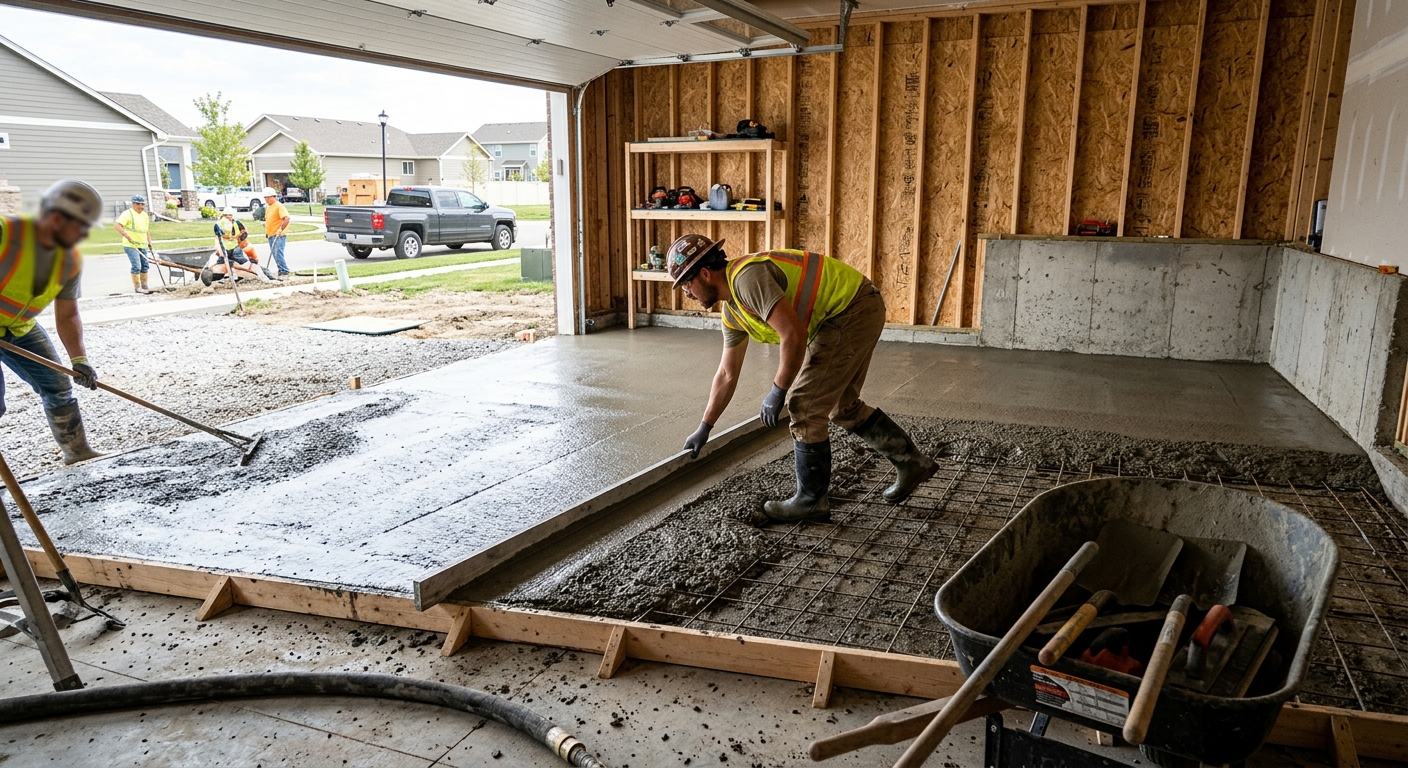
Concrete work options and costs in Cumberland
Cumberland, Alberta is a smaller community within the Calgary economic region, and that’s good news for homeowners shopping concrete flatwork: local contractors often know the typical soil conditions and the practical limits of truck access in established neighbourhoods. In Cumberland, many households are in single-detached homes (Statistics Canada, 2021 Census), which is exactly where you’ll see recurring demand for driveways, patios and walkways that can handle long winter freeze–thaw cycles.
Calgary-area pricing is shaped by engineered frost depth requirements and short exterior pour seasons. In cold continental climates, footings and many structural elements must bear on undisturbed soil below the design frost depth of about 1.2 m (roughly 4 ft). That pushes excavation, formwork height, and concrete volume higher than in milder provinces. On the flatwork side, frequent freeze–thaw means exterior slabs need air-entrained mixes, proper granular base prep, and well-planned control joints to reduce cracking and spalling. Late fall and early spring pours also require cold-weather curing precautions—insulated blankets, sometimes temporary heat—which adds labour and equipment costs.
In Cumberland, driveways and backyard patios are especially in demand around the residential pockets near 17 Avenue / 126 Street corridor and other established lanes where access and grading are often tight. Below are realistic “typical” ranges you’ll see in bids, so you can compare apples to apples before selecting an option.
| Application |
Typical Size |
Key Spec |
Finish Option |
Price Range |
| Concrete driveway (standard broom finish) |
10 m x 3 m (30 m²) |
Air-entrained mix; compacted granular base; control joints |
Broom finish |
$12,000–$18,000 |
| Exposed aggregate driveway |
10 m x 3 m (30 m²) |
Air-entrained mix; consistent wash timing; proper curing |
Exposed aggregate (two-step) |
$15,000–$22,000 |
| Stamped concrete driveway or patio |
10 m x 3 m (30 m²) driveway or 6 m x 3 m (18 m²) patio |
Air-entrained mix; release agent; joint layout |
Stamped patterns + integral colour |
$15,000–$26,000 |
| Plain concrete patio or walkway |
6 m x 3 m (18 m²) patio or 1.2 m x 6 m (7.2 m²) walkway |
Air-entrained mix; compacted base; edge forms |
Broom or smooth-trowel finish (as requested) |
$5,000–$9,000 |
| Garage floor (interior slab) |
6 m x 7 m (42 m²) |
Minimum thickness; vapour considerations; properly cured concrete |
Power trowel + optional colour/hardener |
$10,500–$16,500 |
| Foundation footings (structural, below frost) |
Typical detached house footprint varies |
Engineered footing size; rebar cage; excavation to design frost depth |
Structural formwork + waterproofing coordination |
$28,000–$45,000 |
Prices are estimates only and vary by project scope, site access and material selection.
What affects the price of concrete work in Cumberland
In the Calgary region around Cumberland, it’s not unusual to see quotes for the same concrete type vary by 30–50%. The reason isn’t just brand differences—it’s whether the contractor fully accounts for frost depth excavation, granular base design, reinforcement needs, and cold-weather curing. When crews miss one of those items, the “low” price can quickly become a change order once excavation is deeper than expected or when the curing plan needs heaters and blankets to protect the slab.
Frost depth and freeze–thaw cycles dictate the entire approach in Alberta. Footings and below-grade structural work must extend to undisturbed soil below the design frost depth of about 1.2 m (roughly 4 ft) to prevent frost heave. Exterior slabs also require air-entrained concrete so the mix can withstand repeated freezing and thawing without losing surface integrity. Calgary’s shorter exterior pour season pushes contractors to use winter-grade practices—heating, insulated blankets, and careful temperature control—especially in late fall or early spring, which adds labour and equipment cost. Finally, de-icing salt accelerates surface scaling, so properly sealing after cure is a smart budget item for driveways and patios.
Two common Cumberland examples: (1) A driveway replacement on poorly drained ground may need additional granular base and more grading, which nudges the job from the lower end of the $12,000–$18,000 band toward the mid-to-upper range; (2) a stamp-and-colour option is often only “worth it” when your base prep and joint layout are done correctly—if those are skipped, you can end up paying the $15,000–$26,000 range for an appearance problem rather than a durable surface. Housing stock matters too: older properties can have buried services, tighter setbacks, and more variable subgrade, and that excavation uncertainty is where real dollar differences show up.
| Price Factor |
Why It Matters |
Cost Impact |
| Frost line depth — determines footing depth and form height |
Engineered footing must sit below design frost to stop seasonal movement |
Higher excavation depth and concrete volume can add thousands |
| Site preparation — excavation, grading, compacted granular base |
Compaction and correct base thickness prevent settlement and premature cracking |
Poor subgrade or extra haul-off increases labour and material |
| Reinforcement — rebar or wire mesh requirement |
Controls cracking and improves load performance |
More steel and ties/spacing labour increases cost |
| Mix design — air-entrainment and compressive strength spec |
Air-entrained concrete resists freeze–thaw damage; strength supports loading |
Winter-grade mixes and higher strength can raise material cost |
| Finish type — broom vs. stamped vs. exposed aggregate |
Decorative finishes require extra labour, tooling, and tighter scheduling |
Stamped/exposed often add significant labour and materials |
| Pour size and concrete truck access to site |
Smaller access can force pumping, extra setup, or multiple deliveries |
Pumping and additional crew time can add cost |
| Cold-weather curing precautions — heating and blankets |
Protects concrete early strength gain against temperature stress |
Heaters/blankets and monitoring can noticeably increase the quote |
| Control joint pattern and sealing cost |
Joints manage shrinkage/cracking; sealing helps resist salt scaling |
More precise saw-cutting and sealant add line-item cost |
Permits & regulations in Alberta
In Alberta, concrete work splits into “structural” versus “flatwork,” and that’s how permitting usually works for Cumberland homeowners. Structural concrete—footings, foundation walls, grade beams, and other elements that support the building—generally requires a building permit and often engineered drawings reviewed by the municipality. Concrete flatwork (driveways, patios, walkways) typically does not require a permit unless it changes lot grading, impacts drainage in a way that affects municipal requirements, or involves impervious surface coverage limits and right-of-way conditions. Always confirm specifics with the local authority before breaking ground, especially if your scope includes changes near property lines, catch basins, or municipal sidewalks.
Before you hire, verify the contractor’s compliance step by step:
- Check Alberta business details and credentials using the appropriate online registry for contractors/companies operating in Alberta.
- Request a current certificate of insurance showing general liability limits that match the job size.
- Confirm WSIB/WCB coverage (workers compensation) and ask for clearance documentation if applicable.
- Look for references on similar cold-climate projects: driveways and slabs in Calgary-area freeze–thaw conditions.
- Ask who pulls any required permits (structural only, typically) and whether that cost is included in the written quote.
For safety, insist that the scope in your contract matches the permit plan—then you avoid “we’ll handle it later” surprises once excavation begins.
Getting concrete right in Cumberland's freeze-thaw climate
Concrete fails in Cumberland when the slab can’t tolerate repeated freeze–thaw, salt exposure, and winter moisture movement. The biggest causes are poor base preparation, inadequate air-entrainment, weak/early-age curing, and missing or poorly spaced control joints. In practice, you spec the job correctly by building for Alberta’s frost depth of about 1.2 m (roughly 4 ft) and by designing the exterior slab for seasonal movement.
1) Base preparation: Build a compacted granular sub-base to the right depth for your soil and drainage conditions. If the base isn’t compacted in lifts and brought to grade, the slab can settle and crack regardless of the finish.
2) Mix design: For exterior flatwork, request air-entrained concrete with typical air content in the 5% to 7% range, plus a minimum 32 MPa compressive strength spec (project-specific). That air is what reduces freeze–thaw damage and helps prevent spalling.
3) Control joints: Plan joint spacing so shrinkage and temperature movements are channelled into joints rather than random cracks.
4) Curing: Allow a minimum 7-day curing period under proper conditions. In cold snaps, contractors should protect the pour with insulated blankets and/or temporary heat rather than rushing the schedule.
5) Sealing: Use a penetrating sealer applied after full cure—commonly around 28 days—to repel de-icing salts and reduce surface scaling.
As for cost trade-offs: if a broom-finish driveway is quoted near the lower end of the $12,000–$18,000 band but the contractor won’t confirm air-entrainment, base thickness, or joint layout, the “savings” aren’t real. On the other hand, stamped concrete can justify higher pricing within the $15,000–$26,000 range when the same durability specs are met and the joints are properly planned for Alberta’s temperature swings.
| Spec |
Why It Matters in Cumberland |
What to Ask For |
Impact if Skipped |
| Compacted granular base (depth?) |
Prevents settlement and cracking during freeze–thaw cycles |
Requested base thickness by soil condition and drainage; compaction in lifts |
Random cracking, uneven slab, faster deterioration |
| Air-entrained concrete mix (target air %?) |
Protects against spalling from freeze–thaw and moisture |
Air content typically 5%–7% for exterior flatwork; winter-grade mix when needed |
Surface scaling/spalling within a few winters |
| Compressive strength (MPa rating) |
Ensures slab can carry loads and withstand curing stress |
Minimum 32 MPa (or higher per engineered spec) |
Reduced durability and premature surface damage |
| Control joints (spacing per ACI guidelines) |
Controls shrinkage and temperature movement in Alberta |
Joint plan and saw-cut timing; spacing consistent with slab thickness |
Random cracks and water infiltration at cracks |
| Minimum 7-day curing period |
Early-age strength gain is critical in cold weather |
Protective measures for cold conditions; confirmation of curing schedule |
Scaling, strength loss, and long-term surface failure |
| Penetrating sealer (when applied after cure) |
Repels de-icing salts that drive spalling |
Apply after full cure—commonly around 28 days—before winter loading |
Higher salt penetration and faster surface breakdown |
How to choose a concrete work contractor in Cumberland
Choosing the right contractor in Cumberland is mainly about proving they will do the durability work, not just place concrete. In Alberta, start by verifying licensing/eligibility where applicable for the contractor’s business type, then confirm coverage:
- Liability insurance: ask for a certificate showing general liability coverage suited to the project size.
- WSIB/WCB clearance or coverage: request documentation that demonstrates workers compensation coverage is in place.
- References: look for similar Calgary-area freeze–thaw projects—driveways and slabs with documented jointing and curing practices.
Next, get 2–3 itemised written quotes. You want a breakdown that separates labour and materials—excavation/grading, granular base, reinforcement, concrete supply, finishing, saw-cutting/joint work, curing protection, and disposal. Avoid “lump sum” only bids unless the scope is extremely detailed.
Read exclusions carefully: is permit pulling included for structural work, is debris disposal included, and how are over-excavation or unsuitable soils handled? Ask for a schedule—start date and completion estimate—written into the quote so you can manage temperature-related delays. For payment, never pay more than 10%–15% upfront; keep a holdback until the job is complete and properly cured (especially important for exterior slabs). A solid warranty should cover workmanship for a clear period and explain whether it’s transferable if you sell the home.
- Ask to see a written mix spec: air-entrainment and compressive strength.
- Confirm granular base depth and compaction method.
- Request the joint layout (where joints go, spacing, and timing).
- Confirm curing plan for cold weather (blankets/heaters if needed).
- Ask whether sealing is included and when it will be applied.
- Check who supplies and delivers rebar/mesh and how it’s supported at the right elevation.
- Verify concrete truck access plan (and whether pumping is included if required).
- Review site protection: adjacent landscaping, eavestrough locations, and drainage control.
- Ensure disposal/haul-off is included if excavation requires it.
- Confirm foundation/footing work coordination if your scope includes structural concrete.
- Get warranty details in writing, including exclusions.
- Make sure the contract includes a clear start/completion timeline and weather contingency wording.
Concrete contractor red flags in Cumberland: vague answers about air-entrainment; no discussion of joints or sealing; quoting a winter pour without any curing/temperature plan; skipping base compaction details; and pushing for large upfront payments or refusing to provide itemised labour/material breakdowns.
Frequently asked questions — concrete work in Cumberland
What is air-entrained concrete and why does it matter here?
Air-entrained concrete is mixed with carefully controlled microscopic air bubbles that give water a place to expand when it freezes. That’s the key defence against the freeze–thaw cycles that Saskatchewan/Alberta-style winters bring into Cumberland’s day-to-day reality. In this Calgary-area climate, de-icing salts can also accelerate surface damage, so air content plus correct curing matters together. When contractors specify an exterior mix with typical air content in the 5% to 7% range (project-dependent) and a durable compressive strength, the slab is far less likely to develop scaling and spalling over multiple winters. If a quote in the $12,000–$18,000 driveway band won’t confirm air-entrainment, it’s a legitimate reason to ask for clarification before signing.
How do I prepare the base for a concrete slab?
Base preparation is the part most homeowners can’t easily see after the pour, so you should verify it up front. In Cumberland and the Calgary region, the goal is a properly graded and compacted granular sub-base to reduce settlement during freeze–thaw. A qualified crew will excavate to the required depth, remove unsuitable material, place granular in lifts, and compact each lift to achieve consistent support. Drainage matters too—water sitting under a slab can amplify freeze–thaw movement. Ask your contractor to explain how they determine granular depth and compaction (based on your soil and slab type) and whether reinforcement chairs/ties keep mesh or rebar at the correct elevation. If base prep is cut back, even a nice broom or stamped finish won’t prevent early cracking.
How do I compare concrete quotes?
To compare quotes in Cumberland fairly, look for the details behind the number—not just the total. Ask for itemised pricing that separates excavation/grading, granular base, reinforcement, concrete supply, finishing, joint cutting, curing protection (especially cold-weather blankets/heaters), and disposal. Confirm the mix spec: exterior air-entrainment and the minimum strength target (commonly 32 MPa for many flatwork specs). Compare finish requirements too: a stamped driveway or patio should include the same durability work as a broom-finished slab, otherwise the cost difference won’t buy longevity. It’s also worth asking about scheduling—Calgary-area pour season is shorter, and rushing curing can add hidden long-term costs. If one quote lands near the $15,000–$26,000 stamped band without explaining curing and joints, insist on a full scope before proceeding.
Can concrete be poured in cold weather in Cumberland?
Yes, concrete can be poured in cold weather in Cumberland, but it must be engineered and protected. Cold snaps can slow hydration and increase the risk of surface scaling or strength issues if the contractor doesn’t use cold-weather placement methods. In practice, that means using winter-grade mixes when required, managing concrete temperature on delivery, and protecting the pour with insulated blankets and/or temporary heat through the critical early curing period. You should ask your contractor to provide the temperature plan and curing duration, since the minimum early curing window (commonly at least 7 days under proper conditions) is where most failures are prevented. If a bid promises a spring-like cure without any curing protection for a late fall or early spring pour, that’s a concern even when pricing is attractive.
How do I maintain concrete in Cumberland's freeze-thaw climate?
Maintenance in Cumberland is mostly about managing water and salt. After your slab is fully cured—commonly around 28 days—apply a penetrating sealer if your surface is exterior. Sealing helps repel de-icing salts that can drive spalling and scaling. During winter, use plastic shovels/appropriate tools to reduce abrasion, and try to control how long meltwater and brine sit on edges and joints. Keep an eye on joint lines: if joints open or gaps appear, water can infiltrate and undermine the slab over time. For driveways and patios, address drainage—remove vegetation blocking runoff paths and ensure grading directs water away from the slab. If you chose decorative options like stamped concrete, be especially consistent with sealing and avoid harsh abrasion that can wear away the surface finish.
What causes concrete to spall in Cumberland winters?
Concrete spalls (flakes or chips) when the surface can’t resist freeze–thaw expansion, often combined with salt exposure. The most common causes in the Calgary region are inadequate air-entrainment, poor curing in cold conditions, insufficient base prep that allows movement, and joints that aren’t laid out to control cracking. When water enters micro-cracks and then freezes, it can break off the concrete surface. Salt makes it worse by accelerating surface deterioration and increasing freeze–thaw stress at the surface. That’s why a durable exterior mix spec with air content (typically 5% to 7% for exterior flatwork) and a realistic curing plan are non-negotiable. Even if your project price sits near the lower side of the $12,000–$18,000 driveway range, skipping air-entrainment or cold-weather curing protections can lead to spalling within a few winters.