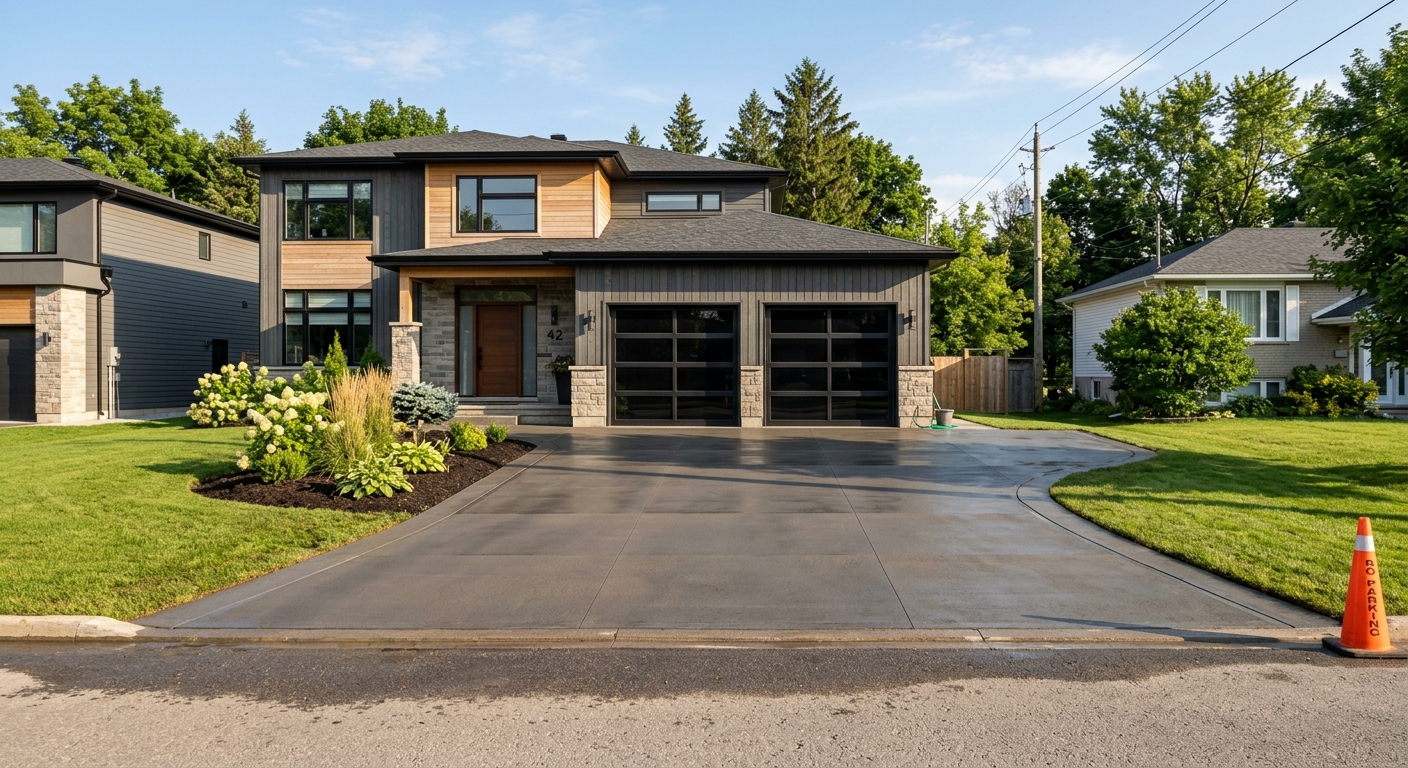
Concrete work options and costs in Albert Park/Radisson Heights
In Albert Park/Radisson Heights, Alberta, homeowners typically choose concrete flatwork and structural concrete based on how the local clay-to-gravel soils behave and how hard Calgary’s winter can be on exterior surfaces. With a population of 6,740 (Statistics Canada, 2021 Census), the area is small enough that you’ll often see the same crews working driveways, patios, and foundation work across nearby lots in the year’s main construction windows. A large share of households are in single-detached homes—one reason concrete driveway and walkway projects stay steady even when the market slows.
Concrete pricing here is shaped less by “style” and more by frost depth planning, freeze–thaw durability, and the logistics of getting trucks and finish crews on site during a short pour season. Calgary’s climate is cold continental, so the design frost depth is about 1.2 m (roughly 4 ft) for many residential applications, and footings must bear below undisturbed soil to reduce frost heave and seasonal movement. Exterior slabs and walkways also need air-entrained mixes plus proper base prep and control joints, otherwise you’ll see scaling or early cracking. Because late-fall and early-spring pours are higher risk, contractors often price in winter-grade measures—insulated blankets, occasional heat, and more careful curing—to protect the slab.
In practical terms, demand is especially strong around newer infill and busier residential pockets in Albert Park/Radisson Heights where garages, widened driveways, and backyard patios are common. Below are typical cost ranges for the most requested options, so you can compare like-for-like when quotes land in your inbox.
| Application |
Typical Size |
Key Spec |
Finish Option |
Price Range |
| Concrete driveway (standard broom finish) |
24 ft x 10 ft (240 sq ft) |
Air-entrained, rebar on base, granular base |
Broom finish |
$12,000–$16,000 |
| Exposed aggregate driveway |
24 ft x 10 ft (240 sq ft) |
Air-entrained, exposed mix + retarder |
Exposed aggregate |
$14,500–$18,000 |
| Stamped concrete driveway or patio |
200–300 sq ft |
Air-entrained, integral colour or release system |
Stamp pattern + hand finishing |
$15,000–$26,000 |
| Plain concrete patio or walkway |
12 ft x 16 ft (192 sq ft) or 4 ft x 20 ft (80 sq ft) |
Air-entrained, compacted base, control joints |
Float + broom or trowel finish (walkways) |
$5,000–$9,000 |
| Garage floor (interior slab) |
22 ft x 20 ft (440 sq ft) |
Interior mix, vapour considerations, mesh reinforcement |
Steel trowel or broom (typical choice) |
$6,500–$12,000 |
| Foundation footings (structural, below frost) |
1–2 storey footprint; typical 20 ft x 30 ft |
Engineered formwork, rebar, concrete below frost depth |
Structural finish (not decorative) |
$28,000–$45,000 |
Prices are estimates only and vary by project scope, site access and material selection.
What affects the price of concrete work in Albert Park/Radisson Heights
In Calgary and the surrounding market, quotes for what looks like the same concrete job can swing by 30–50% because the “real” cost drivers are hidden—excavation depth, frost-protection form heights, rebar placement, curing requirements, and how hard it is to get materials and finishing equipment to your exact lot. In Albert Park/Radisson Heights, small site differences (a tight driveway apron, soft spots, or the need to remove topsoil to reach a firm base) can turn a straightforward slab into a bigger earthwork and sub-base package.
The frost line depth is a major reason pricing is higher than in warmer regions. Local engineering practice uses a design frost depth of about 1.2 m (roughly 4 ft), so foundation and footing excavations and concrete volumes go up when contractors have to reach undisturbed soil below that depth. Exterior slabs also need air-entrained concrete to survive freeze–thaw cycles; without it, you’ll see surface scaling and spalling sooner. Cold weather also shortens the practical pour season for exterior concrete, and contractors may need cold-weather curing precautions such as insulated blankets and sometimes temporary heating—extra labour and equipment that show up in the quote.
Finally, de-icing salt is a local durability factor on driveways and steps. Sealing isn’t “mandatory,” but it’s often the difference between a surface that stays looking good for years versus one that starts to break down faster under repeated salt application.
To make it concrete: if you’re choosing between a plain patio in the $5,000–$9,000 band and a stamped driveway in the $15,000–$26,000 band, the price jump is usually justified by extra labour time for stamping, release compounds, and hand-finishing—not just the cost of the concrete itself. If your job is delayed into late fall, the cold-weather curing package can also push costs upward even for a basic broom-finish driveway.
| Price Factor |
Why It Matters |
Cost Impact |
| Frost line depth — determines footing depth and form height |
Footings must extend below design frost depth to limit frost heave and seasonal movement |
Higher excavation and concrete volume; can add tens of thousands on foundations |
| Site preparation — excavation, grading, compacted granular base |
Calgary soils and soft spots require proper removal and compaction to prevent settlement |
Extra truckloads, hauling, and labour; often increases total by 10–25% |
| Reinforcement — rebar or wire mesh requirement |
Crack control and slab strength depend on correct reinforcement placement and chairing |
Material + labour; can shift driveway/garage pricing by thousands |
| Mix design — air-entrainment and compressive strength spec |
Air-entrained concrete helps resist freeze–thaw scaling in Alberta winters |
Usually modest per yard, but spec compliance can raise the project total |
| Finish type — broom vs. stamped vs. exposed aggregate |
Complex finishes add skilled labour and additional steps/materials |
Stamped/exposed typically lifts driveway/patio pricing materially |
| Pour size and concrete truck access to site |
Staging and wheelbarrow time affect labour and pour efficiency |
Hard access can add significant labour hours and equipment rental |
| Cold-weather curing precautions — heating and blankets |
Proper curing protects strength gain and reduces surface scaling risk |
Can add a noticeable premium if you pour near shoulder seasons |
| Control joint pattern and sealing cost |
Joints manage shrinkage cracking; sealing helps resist salt-driven surface wear |
More saw cuts and materials; often small compared with repairs |
Permits & regulations in Alberta
In Alberta, structural concrete work is typically handled under the building permit and sometimes engineered drawings reviewed as part of the municipal approval process. That means concrete footings, foundation walls, grade beams, and other structural components usually require a permit. For example, if you’re adding a basement foundation, underpinning, or replacing foundation footings, plan for permit steps and engineering involvement.
Concrete flatwork (patios, walkways, driveways, garage slabs) often does not require a building permit by default. However, it can require municipal attention if it affects lot grading, changes how stormwater drains, increases impervious surface beyond local limits, or impacts the municipal right-of-way (for example, if you’re altering a portion near curb lines). The safest approach in Albert Park/Radisson Heights is to confirm with the local authority before you break ground, especially if your plan includes regrading, new drainage, or work near a driveway approach.
Before you sign a contract, verify the contractor carries liability insurance and has WSIB/WCB coverage where applicable. Here’s a homeowner-friendly step-by-step check list: (1) ask for a current certificate of insurance (and confirm the address/name matches your project), (2) request proof of coverage/clearance for workers (WSIB/WCB documentation as applicable), (3) confirm the contractor’s Alberta registration/licensing details using the appropriate online registry where they apply, and (4) get clearance letters or coverage evidence in writing before work starts. Also request references for projects with similar scope—driveways built for freeze–thaw durability should look consistent with what was spec’d in the contract.
Getting concrete right in Albert Park/Radisson Heights's freeze-thaw climate
The biggest causes of concrete failure in Albert Park/Radisson Heights are usually avoidable: poor base support, incorrect mix design, weak curing, and control joints that don’t match the slab dimensions. In Calgary’s cold continental climate, water in the concrete and at the surface gets stressed by freeze–thaw cycles. If the concrete isn’t air-entrained (and properly cured), you’re more likely to see spalling and scaling—especially on driveways, steps, and patios where de-icing salt gets tracked.
To spec the job correctly, start with base preparation. A properly compacted granular sub-base to the right depth for local soil conditions helps limit settlement and keeps the slab stable through seasonal movement. Next, confirm the mix design: exterior flatwork should use air-entrainment (commonly targeted around 5–7% air content for durable performance) and a minimum compressive strength spec of about 32 MPa. Then plan the cracking strategy with control joints. Proper joint spacing limits random cracking and reduces the odds of water infiltration along fractures.
Curing is where many “cheap” pours run into trouble. In Alberta, use a minimum 7-day curing period under proper conditions. If temperatures are dropping, contractors may need insulating blankets or temporary heating to achieve safe strength gain. Finally, sealing matters with Calgary salt. A penetrating sealer applied about 28 days after the pour helps repel water and reduces surface wear; it’s a practical way to protect the finish you paid for.
As a dollar example, upgrading from a plain broom patio to stamped concrete might place you in the $15,000–$26,000 territory for driveway/patio packages, but that premium is only justified if the contractor also gets the base, air content, and curing right. If those fundamentals are skipped, the “pretty” finish won’t survive Alberta winters any longer than basic concrete.
| Spec |
Why It Matters in Albert Park/Radisson Heights |
What to Ask For |
Impact if Skipped |
| Compacted granular base (depth?) |
Reduces settlement and prevents frost-related movement on exterior slabs |
Granular sub-base depth and compaction method (to engineered thickness for your soil) |
Uneven cracking, slab heave/settlement, and premature failure |
| Air-entrained concrete mix (target air %?) |
Improves freeze–thaw durability under Calgary salt and winter cycling |
Air content target (commonly 5–7% for exterior flatwork) and confirm it’s air-entrained |
Higher risk of spalling and surface scaling |
| Compressive strength (MPa rating) |
Ensures proper strength gain for load-bearing and long-term performance |
Minimum 32 MPa spec (or project-engineered rating) |
Weak surface, increased cracking, and reduced lifespan |
| Control joints (spacing per ACI guidelines) |
Controls shrinkage cracking pattern where it’s easiest to manage |
Joint layout/spacing plan before the pour and saw-cut timing |
Random cracks and water pathways into the slab |
| Minimum 7-day curing period |
Strength development depends on time and temperature in Alberta weather |
Curing method and any cold-weather protection (blankets/heating if needed) |
Surface damage, reduced durability, and scaling risk increases |
| Penetrating sealer (when applied after cure) |
Salt and meltwater resistance improves with proper sealing after curing |
Confirm sealer type and application timing (around 28 days post-pour) |
Faster surface breakdown and colour/finish wear |
How to choose a concrete work contractor in Albert Park/Radisson Heights
Choosing a contractor in Albert Park/Radisson Heights is less about catchy marketing and more about verifying paperwork and demanding clarity in the scope. Start with Alberta verification: ask the company for proof of liability insurance and WSIB/WCB coverage (where applicable). For licensing/registration, check the contractor’s details using the appropriate Alberta online registry resources for the work classification they claim. Don’t rely on verbal confirmation—request documents in writing and make sure the certificate lists the correct legal business name and project location.
Next, get 2–3 itemised written quotes. You want breakdowns that separate labour, concrete supply, rebar/wire mesh, excavation/granular base, forming, finishing, saw cutting, and finishing/sealing if included. A lump-sum quote can hide major differences like whether rebar chairs are included, whether the contractor is using air-entrained mix for exterior work, or whether disposal is included for excess soil.
Read the scope carefully for exclusions and add-ons: permits pull included? disposal/hauling included? What happens if the frost-protection depth requires extra excavation? Is cold-weather curing included if temperatures drop? Warranty also matters—ask for the workmanship warranty length, whether the product/manufacturer warranty applies to you directly, and if it’s transferable in case you sell your home.
Finally, payment schedule and timeline: never pay more than 10–15% upfront. Use a holdback until the job is fully complete and cleaned up. Get the start date and estimated completion in writing, since Alberta weather can shift schedules quickly.
- Verify Alberta business details and ensure the contractor’s name matches the insurance paperwork.
- Request a certificate of liability insurance before work begins.
- Confirm WSIB/WCB coverage documentation (or applicable clearance) for the crew.
- Ask for 2–3 itemised quotes (labour vs materials vs disposal).
- Confirm the mix is air-entrained for exterior slabs and steps.
- Ask for base depth and compaction requirements, not just “we’ll prep it.”
- Confirm reinforcement type (rebar vs mesh), placement, and chairing.
- Get the control joint spacing plan and saw-cut timing.
- Ask how they’ll handle cold weather (blankets/heating) if temperatures fall.
- Clarify what’s included for formwork, finishing tools, and edging.
- Understand warranty terms and whether sealing is recommended/covered.
- Set a payment schedule with a holdback until final inspection and cleanup.
Concrete red flags I watch for in Albert Park/Radisson Heights: quotes that don’t mention air-entrainment for exterior work, no discussion of base depth and compaction, “we’ve always done it this way” answers to control joints and curing, vague warranty terms with no workmanship duration, and requests for large upfront payments without a signed schedule and scope.
Frequently asked questions — concrete work in Albert Park/Radisson Heights
When is the best time to pour concrete in Albert Park/Radisson Heights?
In Alberta, the best window is typically late spring through summer into early fall, when temperatures stay reliably above the contractor’s cold-weather thresholds for curing. In Albert Park/Radisson Heights, Calgary’s freeze–thaw cycle means exterior concrete is engineered around durability, but placement still needs the right temperature and curing support. If you’re pouring a driveway or patio near shoulder season, you should expect a cold-weather plan—insulated blankets and/or temporary heat—to protect curing and reduce scaling risk. That added protection can influence your final budget within the driveway band of $12,000–$18,000 depending on slab size and access. Plan for winter-grade logistics if you’re late in the season, because rushing curing is where problems start.
How long does concrete take to cure?
Concrete develops strength over time, and “cure time” depends on weather and mix design. For typical residential exterior flatwork in Alberta, contractors plan for a minimum 7-day curing period under proper conditions, with temperature protection if it’s cold. You can often walk on freshly finished concrete sooner than that, but early traffic doesn’t mean it’s structurally ready for vehicles, heavy loads, or long-term weathering. Sealing is usually scheduled later—around 28 days post-pour—because you want the slab dry enough for the sealer to perform. If you’re comparing options, remember that proper curing supports the durability you pay for; it’s one reason stamped or exposed work (often in the $15,000–$26,000 range) should never be rushed in the Calgary region’s temperature swings.
Do I need a permit for concrete work in Alberta?
In Alberta, structural concrete work like footings, foundation walls, and grade beams typically requires a building permit and may involve engineered drawings reviewed through the municipal process. For concrete flatwork such as patios, walkways, and driveways, permits are often not required by default, unless the work affects lot grading, stormwater drainage, impervious surface limits, or involves municipal right-of-way areas. For Albert Park/Radisson Heights homeowners, the practical step is to confirm before excavating—especially if you’re changing drainage patterns, raising a grade, or widening a driveway. Also verify your contractor carries liability insurance and has WSIB/WCB coverage where applicable, since permit requirements and inspections are more likely on structural work than on simple surface slabs.
Concrete vs pavers for a patio in Albert Park/Radisson Heights?
Concrete and pavers both work well, but they fail differently in Calgary’s climate. Concrete patios rely on correct base prep, air-entrainment for freeze–thaw durability, control joints, and careful curing. If those are done right, plain patios in the $5,000–$9,000 band can look good for many years, and sealing helps manage salt and meltwater effects. Pavers can be flexible in some ground conditions and allow localized repairs, but the sub-base and edging still matter—if drainage isn’t right, pavers can heave or settle. In Albert Park/Radisson Heights, if you want one strong, maintenance-light surface with a consistent finish and fewer moving parts, concrete is usually the better value. If you expect possible future grading changes, pavers can sometimes be more forgiving—but only with the right base.
How long does a concrete driveway last?
A well-built concrete driveway in Alberta can last 20+ years, sometimes longer, but lifespan depends on construction quality and maintenance. The Calgary region’s freeze–thaw cycles and de-icing salt accelerate wear, so air-entrainment, proper base compaction, and control joints are critical. If curing is rushed or the mix isn’t air-entrained, you’ll see early scaling or spalling, especially on the driving surface and near the garage apron. Sealing after the slab has cured (often around 28 days post-pour) helps repel moisture and reduce salt-driven surface breakdown. In practical terms, a standard broom-finish driveway often falls in the $12,000–$18,000 range, and skimping on base prep or curing typically shortens performance more than it saves money.
What is air-entrained concrete and why does it matter here?
Air-entrained concrete is designed to include tiny, evenly distributed air bubbles in the mix. Those air bubbles give ice room to expand during freeze–thaw cycles, reducing internal pressure that otherwise drives cracking, scaling, and spalling. In Alberta—especially in Albert Park/Radisson Heights—exterior slabs face repeated winter cycling, plus meltwater and de-icing salt. That combination is why your contractor should confirm an air-entrained mix for driveways, patios, and steps, not just “regular” concrete. Without it, even a good finish won’t hold up; you may see surface damage within a few seasons. This durability requirement is one of the reasons pricing is higher in the Calgary market than in milder provinces, even when the concrete footprint looks similar.