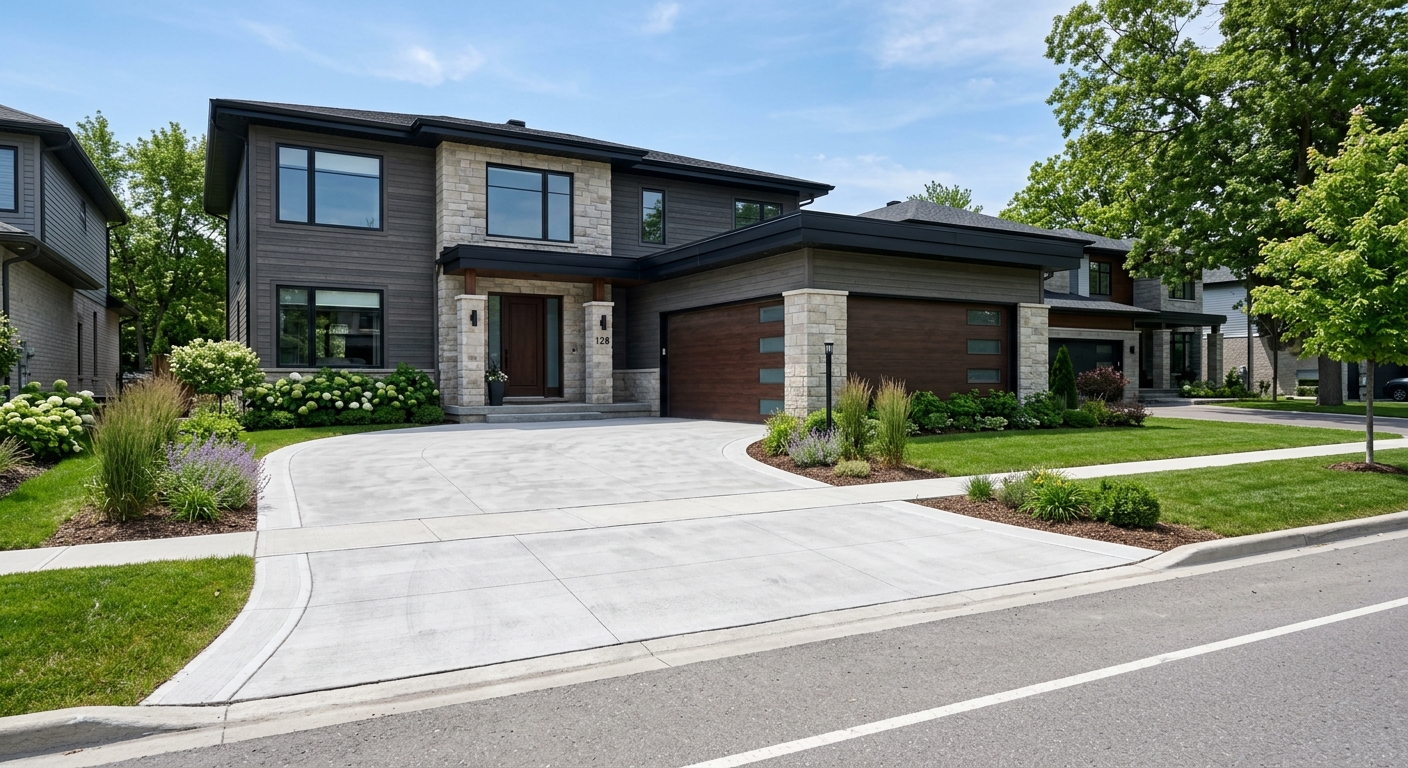
Concrete work options and costs in Terwillegar Towne
In Terwillegar Towne, Alberta, concrete work is one of those home upgrades you’ll see everywhere—from driveways and patios to structural foundations. With Terwillegar Towne’s base population of 6,627 people (Statistics Canada, 2021 Census), demand is steady for flatwork and the kind of foundation pours that keep new builds moving. The neighbourhood’s housing stock is also shaped by families and long-term homeowners, so contractors here regularly price concrete for daily-use surfaces like garage slabs, walkways and driveway approaches. In Calgary’s broader market, that consistent demand helps most reputable crews stay booked in peak seasons, which matters when you’re trying to line up the right weather window.
Calgary’s cold continental climate is the cost driver behind many “why is this quote different?” conversations. A design frost depth of about 1.2 m (roughly 4 ft) means excavations and footing volumes are more intensive than in milder regions. Add frequent freeze–thaw cycles and you get the need for air-entrained mixes, robust base preparation, and a careful pour/curing plan for exterior slabs—especially when temperatures swing in late fall or early spring.
In Terwillegar Towne, workmanship is particularly in demand around established and developing residential pockets like the south and west edges near newer build activity, where homeowners are often coordinating driveway approaches with landscaping and grading. If you’re budgeting, the simplest way to compare is to look at like-for-like scope—then use the cost bands below as a reality check before you sign.
| Application |
Typical Size |
Key Spec |
Finish Option |
Price Range |
| Concrete driveway (standard broom finish) |
24 ft x 10 ft (240 sq. ft.) |
Air-entrained exterior mix, compacted granular base |
Broom finish, control joints |
$12,000 – $18,000 |
| Exposed aggregate driveway |
24 ft x 10 ft (240 sq. ft.) |
Air-entrained exterior mix, engineered base, exposure process |
Exposed aggregate finish |
$15,500 – $22,500 |
| Stamped concrete driveway or patio |
20 ft x 12 ft (240 sq. ft.) |
Air-entrained exterior mix, sealer-ready prep |
Stamped pattern + release + curing and sealing |
$15,000 – $26,000 |
| Plain concrete patio or walkway |
12 ft x 10 ft (120 sq. ft.) |
Air-entrained mix, base prep and edging |
Light broom or smooth trowel + broom texture |
$5,000 – $9,000 |
| Garage floor (interior slab) |
22 ft x 20 ft (440 sq. ft.) |
Vapour control planning, reinforcement, standard interior mix |
Broom finish or hard-trowel, optional densifier |
$6,500 – $12,500 |
| Foundation footings (structural, below frost) |
Typical house build footprint (varies by plan) |
Below design frost depth bearing on undisturbed soil |
Structural concrete and rebar per engineering |
$28,000 – $45,000 |
Prices are estimates only and vary by project scope, site access and material selection.
What affects the price of concrete work in Terwillegar Towne
In Terwillegar Towne, you can see the same project description—say, a driveway or patio—swing by 30–50% between quotes because concrete pricing is a bundle of site work, engineering decisions, and schedule constraints. Two contractors might both say “240 sq. ft. driveway,” but one includes full excavation to engineered grades, the right compacted granular base thickness, reinforcement placement, and cold-weather curing precautions, while the other leaves those choices for later or treats them as “extras.” In a market like Calgary’s, where crews are busier in spring and early summer and exterior pours have a shorter practical window, speed and planning can also affect labour rates and the cost of equipment.
Frost line depth and freeze–thaw cycles dictate specs here. Footings and foundation elements must extend below the design frost depth (about 1.2 m in Alberta practice) to prevent frost heave and seasonal movement. For exterior flatwork, air-entrained concrete is essential for survival through repeated freeze–thaw, and control joints must be spaced and tooled to control where cracks form. When temperatures drop, contractors may need winter-grade mixes, insulated blankets, and sometimes temporary heating to get proper curing—cost adders that you won’t see in milder climates. Finally, de-icing salt accelerates surface damage, which is why sealing is such a practical line item for driveways and patios.
Here are a few real Terwillegar Towne examples that move cost up or down: (1) steep slopes or poor access can mean extra excavation and more labour time on haul-outs; (2) wider, thicker driveways often bump you into higher materials and reinforcement tiers; (3) if your driveway ties into a garage apron, transitions and regrading can add concrete and base prep. A standard broom driveway commonly sits within the $12,000–$18,000 band, while stamped or decorative work often justifies the $15,000–$26,000 range when the scope includes improved finishing, colour, and proper sealing.
| Price Factor |
Why It Matters |
Cost Impact |
| Frost line depth — determines footing depth and form height |
Footings must bear below frost to prevent heave |
High: excavation/forming volume can materially change |
| Site preparation — excavation, grading, compacted granular base |
Proper base prevents settlement and premature cracking |
Medium to high depending on soil and slopes |
| Reinforcement — rebar or wire mesh requirement |
Helps control cracking and supports loads |
Medium: material + placement labour |
| Mix design — air-entrainment and compressive strength spec |
Air entrainment reduces freeze–thaw damage |
Medium: cold-season and engineered mixes cost more |
| Finish type — broom vs. stamped vs. exposed aggregate |
Finish complexity drives labour and materials |
Medium to high: stamping tools/release/extra labour |
| Pour size and concrete truck access to site |
Access affects pump/placement time and sequencing |
Medium: pump calls, waiting time, and logistics |
| Cold-weather curing precautions — heating and blankets |
Protects strength gain and reduces scaling risk |
High in late fall/early spring if heat/blankets are needed |
| Control joint pattern and sealing cost |
Joints control cracking; sealing reduces salt scaling |
Low to medium, but important for long-term performance |
Permits & regulations in Alberta
For structural concrete work in Alberta, plan on needing a building permit for anything that’s part of the structural system—this typically includes footings, foundation walls, grade beams, and other load-bearing concrete elements. In practice, these projects are also commonly supported by engineered drawings that the municipality reviews as part of the permit process. For concrete flatwork—patios, walkways, and most driveways—permits are usually not required by default, but the work can trigger permitting or review if it impacts lot grading, changes drainage patterns, or affects impervious surface coverage limits or any municipal right-of-way considerations. When in doubt, confirm with the local authority before excavation.
For contractor qualification in Terwillegar Towne, treat it like a checklist. Step 1: verify Alberta licensing credentials where applicable for your contractor’s trade category, then confirm they carry liability insurance (request a current certificate of insurance). Step 2: check WSIB/WCB coverage—ask for a clearance letter or proof of active coverage, and verify the name matches the company on the contract. Step 3: ask for references from similar-scale work in Calgary’s climate, such as driveways poured with air-entrained mixes and proper winter curing controls. A solid contractor won’t resist documentation; they’ll build it into their normal estimating process.
Getting concrete right in Terwillegar Towne's freeze-thaw climate
Concrete failures in Terwillegar Towne usually trace back to the same fundamentals: water moves, freeze–thaw expands, and weak surfaces deteriorate. In our Calgary area cold continental climate, the fix starts at the base. Spec the base preparation as compacted granular sub-base to the right depth and at the right moisture/compaction targets for local soil conditions so you don’t end up with settlement and hairline cracking. Next, lock in the mix design—exterior work should use air-entrainment (commonly in the 5–7% air range) and a minimum compressive strength such as 32 MPa for typical exterior applications. Control joints matter because they give concrete a planned place to crack; if you skip them or space them incorrectly, random cracking can happen. Finally, curing and sealing are where durability is won: minimum 7-day curing under proper conditions, and a penetrating sealer applied after cure (often around 28 days) to help repel de-icing salts.
When homeowners compare options, remember that a lower price can look attractive until you ask what it includes. For example, the move from a plain broom patio (often within the $5,000–$9,000 band) to stamped concrete (often within the $15,000–$26,000 band) is usually justified by extra labour, finishing steps, and colour/sealer-ready prep—not just “nicer texture.” The right technical questions for avoiding spalling include: “What air content are you targeting for exterior exposure?”, “How are you protecting curing when it’s cold?”, and “What joint spacing and sealing plan are you using for winter salt conditions?”
| Spec |
Why It Matters in Terwillegar Towne |
What to Ask For |
Impact if Skipped |
| Compacted granular base (depth?) |
Stable base reduces settlement-related cracking |
Confirm excavation depth and granular base thickness; compaction method |
Cracks, uneven surface, premature failure |
| Air-entrained concrete mix (target air %?) |
Air voids help concrete withstand freeze–thaw expansion |
Target air content (typically 5–7%) documented on the mix |
Spalling/scaling, flaking surfaces in winter |
| Compressive strength (MPa rating) |
Strength supports durability and load performance |
Minimum 32 MPa stated in the scope |
Higher risk of surface and structural weakness |
| Control joints (spacing per ACI guidelines) |
Controls where shrinkage cracks appear |
Joint spacing plan and saw-cut timing method |
Random cracking and water infiltration |
| Minimum 7-day curing period |
Strength gain and surface quality depend on curing |
How curing will be protected in cold weather (blankets/heating if needed) |
Scaling, weak surface, reduced long-term durability |
| Penetrating sealer (when applied after cure) |
Helps reduce salt penetration and surface scaling |
Sealer type and timing after cure (commonly around 28 days) |
Faster deterioration under de-icing salts |
How to choose a concrete work contractor in Terwillegar Towne
Choosing the right concrete contractor in Terwillegar Towne is mostly about verification and scope clarity. Start with Alberta contractor eligibility: ask for their current liability insurance certificate (and confirm it matches the legal entity on your quote) and request proof of WSIB/WCB coverage—many reputable firms can provide a clearance letter or documentation upon request. Next, insist on quotes that are itemised. Ask for a breakdown that separates labour, concrete supply, excavation/grading, reinforcement, forms, finishing steps, and disposal. Avoid “lump sum” estimates that don’t specify what’s included.
Then, read the scope like you’re protecting your own basement: confirm whether the price includes permit pulls (if required), protection plans for curing in cold weather, and concrete delivery logistics. For exterior pours, ask whether winter-grade measures are included if frost/low temperatures are expected. Warranty matters too: request workmanship warranty length, what it covers (cracking due to shrinkage vs. structural issues), and whether manufacturer product warranties—like sealers or admixtures—are transferable to you.
On payment scheduling, don’t allow large deposits. A safe approach is never paying more than 10–15% upfront, with the remainder tied to milestones and holdback until completion and site cleanup. Finally, get the timeline in writing—start date, estimated pour date, curing/finishing days, and the completion window.
- Confirm liability insurance certificate is current and named correctly
- Verify WSIB/WCB clearance or active coverage before work starts
- Ask for 2–3 itemised quotes (labour vs. materials vs. prep)
- Require the mix spec details: air-entrainment and strength (e.g., 32 MPa class)
- Check base prep: excavation depth, granular base thickness, and compaction method
- Confirm reinforcement placement (wire mesh vs. rebar) per the intended use
- Ask for control joint spacing and when joints are cut/sawed
- Confirm curing plan: how they protect concrete in cold or windy conditions
- Ask whether penetrating sealer is included and when it’s applied (after cure)
- Clarify site access and concrete truck staging (avoid hidden pump/waiting charges)
- Confirm disposal and topsoil reinstatement (haul-away, grading, and cleanup)
- Get warranty terms in writing and know who issues the warranty
Concrete red flags we see in the Terwillegar Towne area include: quotes that skip air-entrainment details for exterior work, “we’ll cure it later” promises without temperature protection, no mention of base depth/compaction, asking for large upfront payments, and vague warranties that don’t define coverage for cracking or spalling.
Frequently asked questions — concrete work in Terwillegar Towne
How do I compare concrete quotes?
Start by comparing like-for-like scope, not just the total number. In Terwillegar Towne and the Calgary region, the biggest quote swings come from excavation depth, granular base preparation, reinforcement placement, and whether the mix is engineered for freeze–thaw. Ask each contractor to list: base thickness/depth, concrete type (including air-entrainment for exterior), compressive strength target (commonly 32 MPa class), control joint spacing, and curing/temperature protection. Also compare finishing: a broom finish driveway may land around the $12,000–$18,000 band, while stamped work usually costs more because the workflow is longer and the finishing steps are additional. Finally, confirm whether sealing is included and whether disposal/regrading is part of the price.
Can concrete be poured in cold weather in Terwillegar Towne?
Yes, concrete can be placed in cold weather in Terwillegar Towne, but it has to be engineered for the conditions. Calgary’s freeze–thaw cycle and cold nights mean contractors often use winter-grade mixes, insulated blankets, and sometimes temporary heating so the concrete can gain strength properly. The key is curing: if the surface cools too fast, you risk scaling and weak early-age strength. A responsible contractor will schedule based on forecast, protect the pour area, and document the steps taken during curing. If a contractor refuses to discuss cold-weather procedures, that’s a major gap—especially for exterior slabs like driveways and patios. In this market, “we pour anytime” isn’t the same as “we can achieve proper curing.”
How do I maintain concrete in Terwillegar Towne's freeze-thaw climate?
Maintenance is mostly about limiting water and de-icing salt damage. In Terwillegar Towne, the winter pattern of freeze–thaw cycles can cause scaling if the surface isn’t protected. After the recommended cure period, apply a penetrating sealer (commonly around 28 days post-pour) if it’s not already included in your scope; it helps repel salt and moisture. Keep drainage working—ensure downspouts and yard grading direct water away from the slab. Remove snow with methods that won’t gouge the surface, and avoid excessive salt. If you notice early minor surface pitting or joint erosion, address it sooner rather than waiting, because water intrusion can expand freeze-related damage.
What causes concrete to spall in Terwillegar Towne winters?
Spalling is often the visible result of freeze–thaw damage starting in the top surface. The most common technical cause is inadequate air-entrainment and improper mix design for exterior exposure. When water enters the concrete and freezes, expansion can break the surface, causing flakes or spalled edges—especially where de-icing salts are present. Another frequent contributor is poor curing in cold weather, which leaves the surface weaker and more vulnerable. Terwillegar Towne’s cycle of freezing nights followed by thaw days amplifies the problem when concrete isn’t protected during early strength gain. That’s why reputable contractors in Calgary will spec air-entrained mixes, include control joints properly, and discuss sealing and winter curing measures as part of the quote.
What is rebar and when is it required in Alberta?
Rebar is reinforcing steel installed inside concrete to control cracking and add tensile strength where concrete alone can’t reliably handle tension. In Alberta, whether rebar is required depends on what the concrete element is supporting and what the engineered design calls for. For foundation footings and foundation walls, reinforcement is typically part of engineered drawings for structural capacity and durability. For exterior flatwork like driveways, reinforcement may be specified based on slab thickness, soil conditions, and load considerations (for example, heavy vehicle use or weak subgrade). If you’re budgeting, reinforcement is one reason quotes differ even when the square footage looks the same—materials and labour for correct placement matter. Always ask your contractor to explain what reinforcement is included and why, referencing the project design or recommended spec.
How long does a concrete project take in Terwillegar Towne?
Timing depends on size, site conditions, and weather windows, but most concrete projects in Terwillegar Towne follow a predictable sequence. For a typical exterior driveway, the main workday(s) involve excavation/base prep, form and reinforcement setup, then the pour and finishing—often completed within 1–3 working days depending on access and crew size. The curing period is where the schedule changes: many contractors require a minimum curing window (often at least 7 days before subjecting the slab to full stress), and for sealing you typically wait until after cure (commonly around 28 days). Cold weather can extend timelines because heating/blankets are used to protect strength gain. If your scope includes stamped decorative finishing or aggregate exposure, additional finishing and curing steps can add a day or two beyond a plain broom pour.