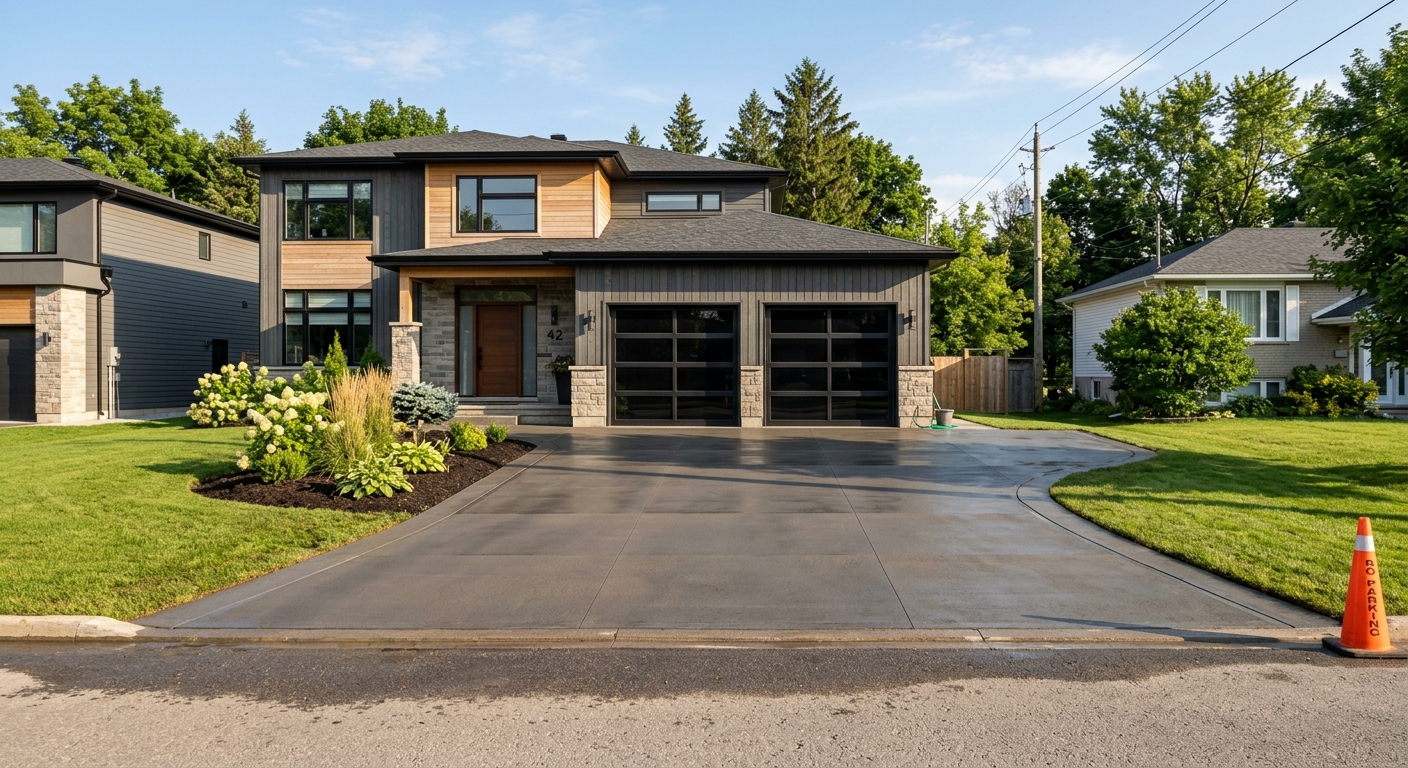
Concrete work options and costs in Wetaskiwin
Wetaskiwin is a practical place to build, and that shows in the demand for concrete flatwork—driveways, patios, walkways, and the slabs that tie a home together. With 58.2% of dwellings in the area being single-detached houses (Statistics Canada, 2021 Census), most concrete projects start with a homeowner’s plan to keep things simple, durable, and low-maintenance. It also matters that 55.7% of local homes were built before 1981 (Statistics Canada, 2021 Census): older lots often have settled drive approaches, worn walkways, or drainage issues that require more excavation and base repair before a new pour.
In the Edmonton economic region, concrete pricing is shaped by a cold continental climate, frost-aware design, and freeze–thaw cycles that can be brutal on exterior slabs. Driveways and patios poured in late fall or too late in spring face tighter scheduling windows, and cold-weather curing measures (insulated blankets or heated enclosures) can add cost. On top of that, properly spaced control joints and well-compacted granular bases are non-negotiable here—skipping them quickly leads to random cracking, surface spalling, and costly patchwork. The trade is especially busy around industrial growth and residential rebuild work near downtown Wetaskiwin, where homeowners commonly update driveways and front steps ahead of landscaping upgrades.
To help you compare quotes, here are realistic Wetaskiwin price bands by common concrete applications, including the typical specs contractors use to meet Edmonton-area durability expectations—then you can line up proposals item-by-item in the table below.
| Application |
Typical Size |
Key Spec |
Finish Option |
Price Range |
| Concrete driveway (standard broom finish) |
20 ft x 10 ft (200 sq ft) |
4 in slab, compacted base, air-entrained mix |
Broom finish + control joints |
$9,000–$18,000 |
| Exposed aggregate driveway |
20 ft x 10 ft (200 sq ft) |
4 in slab, air-entrained mix, wash/expose process |
Exposed aggregate finish |
$12,500–$22,000 |
| Stamped concrete driveway or patio |
12 ft x 18 ft (216 sq ft) |
4 in slab, reinforcement as required |
Stamp + colour hardener/sealer |
$14,000–$26,000 |
| Plain concrete patio or walkway |
10 ft x 12 ft (120 sq ft) |
4 in slab, granular base, air-entrained mix |
Light broom or smooth trowel |
$3,500–$9,000 |
| Garage floor (interior slab) |
22 ft x 20 ft (440 sq ft) |
4 in slab, vapour barrier as needed, interior curing |
Broom finish |
$10,000–$20,000 |
| Foundation footings (structural, below frost) |
Varies by home |
Engineered footing design, below design frost depth |
Structural concrete (no decorative finish) |
$25,000–$60,000 |
Prices are estimates only and vary by project scope, site access and material selection.
What affects the price of concrete work in Wetaskiwin
Even when homeowners think they’re comparing the “same job,” quotes for concrete work in and around Wetaskiwin can swing by 30–50%. The biggest reason is that exterior concrete here isn’t just a slab—it’s a frost-safe system. In the Edmonton region, frost depths are commonly designed around 1.5 m or more, and that means form height, excavation volume, and disposal can rise quickly as footing or base depth increases. A second driver is freeze–thaw cycling: exterior slabs need air-entrained mixes, good drainage, and a proper granular base. Contractors also face a shorter practical pour season for flatwork, so scheduling labour and cold-weather curing supplies can add premiums when temperatures drop.
For example, a typical driveway in the $9,000–$18,000 band can climb toward the top end when regrading is required, you’re replacing a failed sub-base, or reinforcement and joint layout are upgraded to reduce future cracking. A plain patio or walkway might fit the $3,500–$9,000 band, but add extensive base correction near downspouts or poor drainage and the “simple” patio quickly turns into a deeper excavation and rebuild.
Local examples that raise cost in Wetaskiwin include replacing frost-damaged base under existing walkways, reworking approach slopes where the old driveway has settled, and adding insulated curing blankets for a spring pour when temperatures fall below recommended curing conditions. Cost can come down when site access is easy, excavation is minimal, and the homeowner’s proposed timing supports normal curing without needing extra heat or insulation. Housing age also plays a role: many older lots (and homes built well before today’s drainage standards) require more foundation and flatwork prep to meet modern frost and drainage expectations—sometimes adding thousands before a single cubic metre is placed.
| Price Factor |
Why It Matters |
Cost Impact |
| Frost line depth — determines footing depth and form height |
Footings must extend below designed frost to prevent heave |
Higher excavation and concrete volume; can materially shift foundation pricing |
| Site preparation — excavation, grading, compacted granular base |
Controls settlement and drainage around slabs and approaches |
More labour and disposal; typically one of the top controllable variables |
| Reinforcement — rebar or wire mesh requirement |
Improves performance where loads, spans, or base conditions demand it |
Material + placement labour; small on paper, notable on larger slabs |
| Mix design — air-entrainment and compressive strength spec |
Air-entrainment and strength are critical for Edmonton-area freeze–thaw durability |
Ready-mix pricing increase; avoids premature spalling and failure |
| Finish type — broom vs. stamped vs. exposed aggregate |
Finishes add labour steps, tooling, and sealer/colour materials |
Decorative work typically moves you from standard bands into stamped/exposed ranges |
| Pour size and concrete truck access to site |
Access affects pump/short-hand placement time and crew efficiency |
Limited access can add truck/pump costs and extended labour time |
| Cold-weather curing precautions — heating and blankets |
Protects concrete from freezing before it gains strength |
Added materials and labour; most common during shoulder seasons |
| Control joint pattern and sealing cost |
Joints manage shrinkage cracking; sealing helps with de-icing salts |
More layout time and sealant; often minor cost versus long-term repairs |
Permits & regulations in Alberta
In Alberta, structural concrete work—commonly including footings, foundation walls, and grade beams—typically requires a building permit, and it’s often tied to engineered drawings reviewed by the municipality. Concrete flatwork such as patios, walkways, and driveways usually does not require a permit by default, but permits or approvals can come into play if the work changes lot grading, impacts drainage, or affects impervious surface coverage limits. Before any breaking ground, confirm with the local authority that your specific scope is permitted and meets municipal requirements.
For homeowners in Wetaskiwin, you should also verify the contractor is properly covered and accountable. Start with Alberta licensing/registration checks through the appropriate online contractor registry channels, then ask for a current certificate of insurance (general liability) showing the coverage date and project address. For jobsite safety and legal compliance, request proof of WSIB/WCB coverage and confirm the clearance letter or coverage status is active. Finally, ask for references—ideally homes in the Wetaskiwin area or similar-sized Edmonton-region residential work—so you can match workmanship expectations (base prep, joint layout, and cold-weather practices).
Typical permit-requiring concrete: structural foundation systems (footings and foundation walls), grade beams tied to structural design, and any engineered structural concrete repairs/alterations. Typically not permit-requiring: driveways, patios, and walkways (unless grading or drainage/lot coverage triggers a municipal approval).
Do the verification up front; it protects you from scheduling delays and keeps your warranty enforceable.
Getting concrete right in Wetaskiwin's freeze-thaw climate
Concrete in Wetaskiwin fails for predictable reasons: inadequate base prep, the wrong mix for freeze–thaw conditions, poor curing, and missing or poorly planned joints. In a cold continental climate with winter freeze–thaw cycles, the biggest “silent killer” is spalling caused by insufficient air-entrainment. When water gets in, it expands as it freezes, stressing the surface layer. That’s why you should spec both the engineering (base depth, reinforcement where needed) and the concrete properties (air-entrainment and strength).
Start with base preparation: the granular sub-base must be compacted to the required depth for local soil and frost conditions, with drainage flowing away from structures. For mix design, ask for an air-entrained concrete mix targeting about 5–7% air content for exterior flatwork and a minimum 32 MPa compressive strength (with the exact spec confirmed on the ready-mix ticket). Control joints matter as much as the pour: spacing is selected to limit random cracking, and joints should be cut or formed at the correct timing so cracks occur where you can maintain and seal them.
Curing is where many “cheap” quotes fall apart. In Edmonton-area conditions, you should plan for at least a 7-day curing period under proper protection, and cold weather often requires insulated blankets or heated enclosure practices so the slab doesn’t freeze early. Finally, sealing should be planned 28 days after the pour with a penetrating sealer to help repel de-icing salts.
As a dollar example: upgrading from a basic broom finish patio to a properly specified exterior frost-protected mix and tighter joint/sealing plan might cost you only a few hundred to around $1,000 more on a typical $3,500–$9,000 walkway/patio project—but it’s the difference between a surface that stays tight through winters and one that flakes and needs early replacement.
| Spec |
Why It Matters in Wetaskiwin |
What to Ask For |
Impact if Skipped |
| Compacted granular base (depth?) |
Settlement and frost movement are driven by weak or poorly drained base |
Compaction method + required base depth by your site’s conditions |
Premature settlement, uneven slabs, and recurring repairs |
| Air-entrained concrete mix (target air %?) |
Helps concrete survive freeze–thaw cycling without spalling |
Target 5–7% air content for exterior flatwork; confirm on ticket |
Surface scaling/spalling, especially after winters with road salts |
| Compressive strength (MPa rating) |
Adequate strength supports durability under moisture and temperature swings |
Minimum 32 MPa (or higher if engineered); confirm at placement |
Reduced long-term performance and early cracking |
| Control joints (spacing per ACI guidelines) |
Controls where shrinkage cracks occur to protect the surface |
Proposed joint layout + spacing consistent with ACI guidance |
Random cracks, water intrusion, and higher spalling risk |
| Minimum 7-day curing period |
Strength gain must happen before any freezing or heavy stress |
Written curing plan; protection if temperatures drop |
Lower strength and higher risk of scaling or premature failure |
| Penetrating sealer (when applied after cure) |
Repels de-icing salts and reduces chloride/moisture uptake |
Plan sealer after cure—commonly 28 days post-pour |
Faster deterioration and more frequent patching in winter cycles |
How to choose a concrete work contractor in Wetaskiwin
Choosing a concrete contractor in Wetaskiwin is less about the lowest number and more about verifying the fundamentals: Alberta coverage, correct specs, and jobsite discipline. First, confirm the contractor is properly licensed/registered in Alberta for the scope you’re hiring them for, then request a certificate of general liability insurance and confirm it covers the project timeframe and address. Next, ask for proof of WSIB/WCB coverage (or an active clearance letter, depending on the coverage documentation they provide) and verify it’s current. If they can’t produce documents quickly, treat that as a red flag.
Then ask for 2–3 written, itemised quotes. You want a breakdown that distinguishes excavation and disposal, granular base and compaction, reinforcement/matting (if included), concrete volume and mix design, forms, finish labour, joint cutting, and any curing protection or sealing. Avoid quotes that only show a lump sum “for concrete”—a transparent scope is how you compare apples-to-apples in Alberta’s climate.
Read exclusions carefully: is permit pull included (where required for foundations), is material disposal included, and are adjustments for truck access or pump needs covered? Ask about warranty details: workmanship warranty length, whether the warranty is written and transferable to future owners, and what the manufacturer warranty covers (if any) for specific products like sealers. For payment, never accept a schedule that asks for more than about 10–15% upfront; hold back the remainder until the work is complete and protected from winter exposure. Also require a start date and completion estimate in writing so you’re not waiting through weather delays without a plan.
- Provide a written scope with excavation, base depth, and compaction requirements.
- Confirm air-entrained mix and target strength on the quote or spec sheet.
- Require joint layout details (spacing and how/when joints will be formed).
- Ask whether sealing is included and when it will be applied after cure.
- Verify Alberta licensing/registration for the contractor’s role and scope.
- Request a current certificate of liability insurance with matching project address.
- Confirm WSIB/WCB coverage or active clearance letter documentation.
- Get at least two itemised quotes (no “concrete is concrete” lump sums).
- Ask who supplies ready-mix and whether tickets will be available for your job file.
- Clarify disposal: haul-away of removed material included or extra?
- Confirm access plan: shortest truck route, pump needs, or equipment restrictions.
- Agree on payment schedule (small deposit, holdback until completion and cleanup).
Concrete contractor red flags in Wetaskiwin: they promise a “standard” mix without mentioning air-entrainment, they skip base compaction details, they refuse to discuss joint layout or curing protection for shoulder-season pours, they want large upfront payments, or they can’t provide proof of insurance/WSIB/WCB coverage and recent references.
Frequently asked questions — concrete work in Wetaskiwin
What is the difference between concrete and cement?
In everyday terms, people say “cement” when they mean the full product “concrete,” but technically they’re different. Cement is one ingredient—usually Portland cement—mixed into concrete along with sand, gravel (or crushed stone), water, and often admixtures like air-entrainment. Concrete is the finished construction material you pour. In Wetaskiwin, the mix design details matter because exterior concrete has to handle freeze–thaw cycles and road-salt exposure. That’s why a good quote should reference the air-entrained concrete mix and the compressive strength spec, not just “cement work.” If you’re comparing bids for a standard patio or walkway (often in the $3,500–$9,000 range depending on size), ask whether the contractor will provide concrete tickets showing the mix requirements and air content.
How much does concrete work cost in Wetaskiwin?
Concrete pricing in Wetaskiwin generally follows Edmonton-region bands because costs are driven by frost-aware excavation, granular base prep, and the need for air-entrained mixes for exterior durability. For common flatwork, driveway and slab pricing often falls in the $9,000–$18,000 range depending on size, site access, reinforcement, and whether you need significant base repair. Patios and walkways typically land in the $3,500–$9,000 range for many residential projects, but drainage corrections or deeper base prep can push higher. Stamped or decorative work usually costs more due to additional labour steps and sealing, commonly $12,000–$26,000 depending on the pattern and surface prep. Foundation footings are a separate category and can run about $25,000–$60,000 depending on engineered scope and excavation depth. Always compare quotes with itemised scope, not just a total.
How deep must footings be for Wetaskiwin's frost line?
Footings in Wetaskiwin must extend below the design frost depth to prevent frost heave, but the exact depth is determined by your site conditions and the engineered foundation design. In Alberta’s colder continental climate (including the Edmonton economic region), frost depths are commonly designed around 1.5 m or more, and in practice can require deeper excavation depending on local soil and structural requirements. Because of that, two homes with the “same footprint” can still have different footing depths and different excavation volumes—and different foundation costs. For permit and engineering, the right answer comes from your foundation engineer’s drawings and the municipal review process for structural work. When you get a quote for foundation footings (often in the $25,000–$60,000 band), ask the contractor to confirm they’re building to the engineer’s footing elevations, not an estimate based on general rules of thumb.
Why does concrete crack in Wetaskiwin and how is it prevented?
Concrete cracks happen mostly because of shrinkage and movement as the slab cures and as temperatures swing. In Wetaskiwin, freeze–thaw cycling and moisture intrusion can also make small cracks become bigger problems if joints aren’t planned and sealed. Prevention is not about avoiding all cracking—it’s about controlling where it cracks and keeping water out. A properly compacted granular base reduces settlement, while air-entrainment helps the concrete resist freeze–thaw damage that can lead to spalling. Control joints are key: they manage shrinkage cracking so cracks form in predictable locations. Sealing after proper cure (commonly around 28 days for a penetrating sealer) helps repel de-icing salts. When you compare quotes, don’t accept vague statements like “we’ll add joints”—ask for the joint layout and timing, and confirm the mix is air-entrained for exterior work.
Stamped vs broom-finish concrete — cost difference?
Stamped concrete typically costs more than broom-finish because it involves extra labour and materials: additional surface prep, stamping tools, colouring, and often more detailed curing and sealing. In Wetaskiwin, you’re also still paying for the “system” underneath—base prep, correct mix design, joint layout, and protection during cure—so the price gap is mostly the decorative steps on top of structural/flatwork requirements. As a practical reference, many broom-finish driveways commonly align with the $9,000–$18,000 band for standard projects, while stamped concrete driveways or patios are often in the $12,000–$26,000 range depending on size and colour/sealer choice. If your main goal is durability through Alberta winters, broom-finish can be a smarter value—if you want curb appeal, stamped is worth it when the contractor still nails base prep, air-entrainment, and joint sealing.
When is the best time to pour concrete in Wetaskiwin?
The best time to pour concrete in Wetaskiwin is during the warmer window when weather supports proper curing—generally late spring through early fall—because cold snaps can freeze fresh concrete before it gains strength. In the Edmonton-area climate, a shorter practical pour season for flatwork can push scheduling, and some jobs require cold-weather curing precautions like insulated blankets or heated enclosures. That’s not upselling; it’s required to protect concrete during strength gain and reduce the risk of surface scaling and long-term durability issues. For homeowners, plan ahead: if you’re targeting a driveway or patio, book early so the contractor can schedule when temperatures and site conditions allow proper curing. For foundation structural work, the schedule is tied to engineering and permit steps, but the same cold-weather protection principles apply if work extends into colder periods.