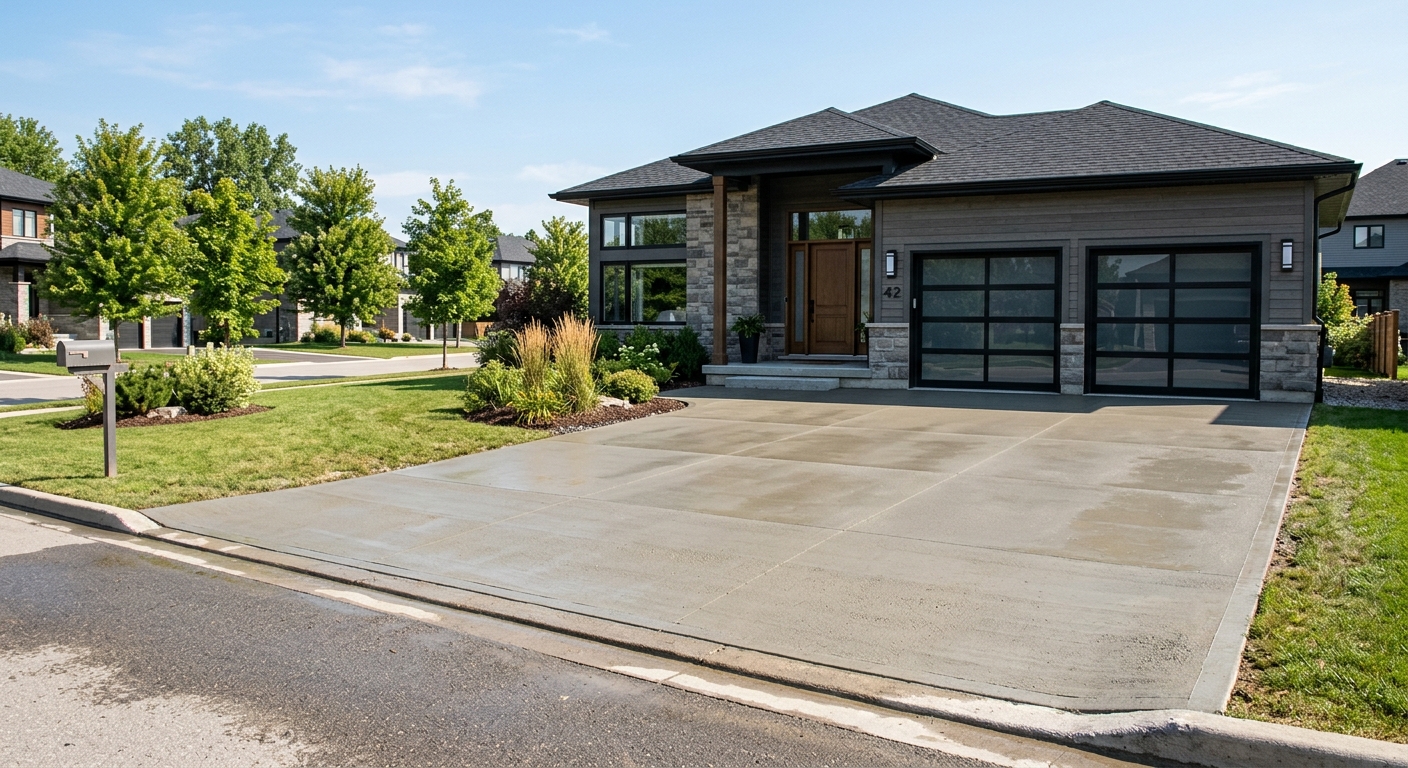
Concrete work options and costs in Crescent Heights
Crescent Heights is a well-established inner-city community in Calgary, and in 2021 it had a population of 6,240 people (Statistics Canada, 2021 Census). That mix of mature lots and ongoing renovations keeps demand steady for concrete flatwork like driveways, patios, and walkways—work that also supports the typical single-detached neighbourhood feel around Calgary’s inner residential areas. If you’re planning improvements on an older property, you’re usually working with existing grades, tree roots, and tight access, which affects excavation, drainage prep, and finishing time.
In Crescent Heights, Calgary’s cold continental climate drives many of the cost differences you’ll see between quotes. The design frost depth in this region is engineered at about 1.2 m (roughly 4 ft), so exterior footings and structural elements often require deeper excavation than in warmer parts of Canada. Freeze–thaw cycles are frequent, so exterior slabs and walkways need air-entrained concrete and a properly planned control-joint layout to reduce cracking and spalling. Late-season scheduling also matters: the pour window for exterior work is shorter, and cold-weather curing (insulated blankets and, sometimes, temporary heat) can add cost if the calendar gets tight.
In practice, contractors are especially busy around the commercial stretch and adjacent residential blocks near 16 Avenue NW in Crescent Heights, where driveway replacements and backyard patio builds tend to stack up during spring and early summer. Below is a clear comparison of common concrete options and typical price ranges, so you can budget and then tighten the scope with an itemised quote.
| Application |
Typical Size |
Key Spec |
Finish Option |
Price Range |
| Concrete driveway (standard broom finish) |
24 ft x 10 ft (240 sq ft) |
Air-entrained mix; compacted granular base |
Broom finish with control joints |
$12,000–$16,000 |
| Exposed aggregate driveway |
24 ft x 10 ft (240 sq ft) |
Air-entrained mix; polished aggregate exposure plan |
Exposed aggregate finish with sealer-ready surface |
$15,000–$18,000 |
| Stamped concrete driveway or patio |
20 ft x 12 ft (240 sq ft) |
Air-entrained mix; proper base and joint pattern |
Stamped pattern + release color (as specified) |
$17,000–$26,000 |
| Plain concrete patio or walkway |
12 ft x 12 ft (144 sq ft) |
Air-entrained mix; compacted base; joints as needed |
Light broom/steel-trowel depending on use |
$5,000–$9,000 |
| Garage floor (interior slab) |
24 ft x 22 ft (528 sq ft) |
Vapour retarder as applicable; fibre/rebar per design |
Float/steel finish (optional broom edges) |
$10,000–$15,000 |
| Foundation footings (structural, below frost) |
Typical detached home: ~1,000–1,400 linear ft (varies) |
Engineered sections; excavation below frost depth (~1.2 m) |
Reinforced concrete (formwork + pour) |
$28,000–$45,000 |
Prices are estimates only and vary by project scope, site access and material selection.
What affects the price of concrete work in Crescent Heights
Even when two contractors price what looks like “the same” concrete job in Crescent Heights, your quote can easily swing by 30–50%. That’s because concrete pricing here is less about the slab itself and more about what’s underneath it—excavation depth, base prep quality, reinforcement, and whether cold-weather placement and curing precautions are included. In a tight inner-city area, haul distance, disposal, and crane/skid-steer access for forms and rebar also affect labour and production rates, so bids don’t match unless the scopes match line-by-line.
Frost depth and freeze–thaw cycles dictate specifications across Calgary. Exterior footings must extend below the design frost depth (about 1.2 m here) to prevent frost heave and seasonal movement, which means deeper digs and more concrete volume than in milder climates. Freeze–thaw also drives air-entrained concrete for exterior flatwork, plus well-planned control joints to reduce random cracking and spalling. Cold-weather placement adds cost because contractors may need winter-grade mixes, insulated blankets, and sometimes temporary heat to achieve proper curing—especially when you’re trying to pour late fall or early spring. Finally, because de-icing salts accelerate surface deterioration, sealing is often recommended to extend service life.
Local examples: swapping from a standard driveway to exposed aggregate typically increases labour and materials, so you’ll often see movement from the $12,000–$18,000 driveway band toward the upper end. A simple broom-finished walkway can stay closer to the $5,000–$9,000 band, but if your backyard has poor drainage or soil needs more granular base replacement, costs climb fast. On older lots, existing concrete removal and regrading can also add thousands—sometimes outweighing finish upgrades—so scope clarity matters as much as the chosen finish.
| Price Factor |
Why It Matters |
Cost Impact |
| Frost line depth — determines footing depth and form height |
Footings must bear below local design frost to prevent heave |
Can add major excavation and concrete volume; biggest driver for foundations |
| Site preparation — excavation, grading, compacted granular base |
Proper base reduces settlement and keeps slabs supported through freeze–thaw |
Higher when soil is unsuitable, access is limited, or haul/disposal is required |
| Reinforcement — rebar or wire mesh requirement |
Controls cracking and supports loads (especially driveways and slabs) |
Material and placement labour increase with thicker slabs or engineered specs |
| Mix design — air-entrainment and compressive strength spec |
Air-entrainment improves freeze–thaw durability of exterior concrete |
Costs rise with engineered mixes and higher cement content requirements |
| Finish type — broom vs. stamped vs. exposed aggregate |
More steps, tighter timing, and additional materials |
Stamped/exposed typically push driveway/patio pricing toward the top of bands |
| Pour size and concrete truck access to site |
Access affects pumping, labour, and pour efficiency |
Tighter lots can increase labour and may require pump/extended handling |
| Cold-weather curing precautions — heating and blankets |
Proper curing prevents scaling and early surface/structural problems |
Can add meaningful line-items if work is scheduled near colder weeks |
| Control joint pattern and sealing cost |
Joints manage cracking; sealing improves resistance to salts and moisture |
Sealing adds cost but reduces long-term repair likelihood |
Permits & regulations in Alberta
In Alberta, structural concrete work is typically tied to building permits and engineering review. Projects like foundation footings, foundation walls, grade beams, and engineered structural concrete elements generally require a building permit, and municipalities often expect engineered drawings (or stamped design) as part of the submission package. Concrete flatwork—driveways, patios, and walkways—usually does not require a permit on its own, unless it impacts lot grading, drainage, impervious surface limits, or the municipal right-of-way/sidewalk area. Because Crescent Heights has a mix of mature lots and established drainage patterns, it’s wise to confirm early if your plan changes surface runoff or touches any city-owned edges.
Step-by-step verification for Crescent Heights homeowners starts with contractor legitimacy:
- Ask for the contractor’s Alberta business details and check their online licensing/registration information where applicable through provincial resources.
- Request a current Certificate of Liability Insurance showing active coverage amounts and dates.
- Confirm WSIB/WCB coverage (worker protection). They should be able to provide clearance documentation or proof on request.
- Verify they have done similar-scale work locally (ask for photos of foundations/driveways and addresses in the Calgary area).
- Get everything in writing: permit responsibility, engineering/inspections (if required), and disposal/restoration scope.
When you’re comparing bids, the “small print” matters—if permit handling or engineered sign-off is excluded, that can become an extra cost you didn’t budget for.
Getting concrete right in Crescent Heights's freeze-thaw climate
Concrete failures in Crescent Heights usually trace back to one of five things: weak base support, inadequate air-entrainment, poor control-joint planning, rushed curing, or skipping sealing. Calgary’s freeze–thaw cycles are tough on surfaces, and the design frost depth of about 1.2 m means foundations and structural concrete must be built on stable soil below that depth. For slabs like driveways and patios, the goal is durability: a compacted granular sub-base to the correct thickness, a mix with air-entrainment suitable for exterior exposure, and a joint layout that limits random cracking.
Spec your job like this: (1) base preparation—excavate to the planned depth and compact granular material in lifts; avoid “good enough” over topsoil or disturbed fill. (2) mix design—use air-entrained concrete for exterior flatwork (commonly in the 5–7% air range for durability) and a minimum compressive strength (often 32 MPa for typical exterior work). (3) control joints—plan spacing to control where cracks form, rather than letting shrinkage cracks show up anywhere. (4) curing—aim for at least 7 days of proper curing conditions; in cold weather that may require blankets/heat so the surface doesn’t scale or dust prematurely. (5) sealing—apply a penetrating sealer after curing (commonly around 28 days) to help repel moisture and de-icing salt impacts.
Here’s a dollar example: if you choose a cheaper finish without the right mix and base spec, the initial savings can be misleading. A standard broom driveway often lands in the $12,000–$18,000 band, but if air-entrainment or base prep is cut, you can be paying for patching and resealing sooner—typically costing more than the difference between a mid- and higher-spec install.
| Spec |
Why It Matters in Crescent Heights |
What to Ask For |
Impact if Skipped |
| Compacted granular base (depth?) |
Stable support prevents settlement and slab movement through freeze–thaw |
State the excavation depth, granular thickness, and compaction requirements |
Uneven slabs, cracking, and premature breakdown |
| Air-entrained concrete mix (target air %?) |
Air bubbles help concrete resist freeze–thaw scaling and spalling |
Confirm target air content (commonly 5–7% for exterior flatwork) and mix design |
Surface scaling, spalling, and faster deterioration |
| Compressive strength (MPa rating) |
Ensures structural capacity under loads and environmental exposure |
Confirm minimum MPa rating (commonly 32 MPa for many exterior applications) |
Reduced durability and higher risk of cracking and defects |
| Control joints (spacing per ACI guidelines) |
Controls shrinkage cracking locations to protect long-term appearance and performance |
Ask for the joint spacing plan and joint type (saw-cut timing, depth guidance) |
Random cracking, water infiltration, and more freeze–thaw damage |
| Minimum 7-day curing period |
Proper hydration strength gain resists early surface failure in cold swings |
Confirm curing method and cold-weather precautions if temperatures drop |
Dusting/scaling, lower long-term strength |
| Penetrating sealer (when applied after cure) |
Repels moisture and de-icing salt exposure that accelerates surface deterioration |
Confirm sealer type and application timing (commonly ~28 days after pour) |
Faster staining, scaling, and reduced service life of the surface |
How to choose a concrete work contractor in Crescent Heights
Choosing the right contractor in Crescent Heights is mostly about verification and clarity. Start with Alberta compliance: request the contractor’s proof of liability insurance (a current Certificate of Insurance) and confirm they have WSIB/WCB coverage for their workers. If they won’t provide certificates or clearance documentation, that’s a red flag. For licensing/registration, ask for their Alberta business information and check their standing through provincial online resources where available, then cross-check that the person on the quote matches the insured entity.
Next, get 2–3 itemised written quotes—not just a lump sum. You want labour and material breakdowns, including removal/disposal (if existing concrete is being cut out), excavation depth, granular base thickness, reinforcement type, concrete mix spec (including air-entrainment), finishing method, curing/blankets provisions, and sealing. Confirm what’s excluded: permits, inspections, sidewalk/approach restoration (if relevant), and any slope/drainage fixes to keep water away from the foundation.
Warranty matters. Ask for workmanship warranty length, whether it’s tied to specific defects, and whether any product/manufacturer warranty applies to sealers or other materials. Ask if the warranty is transferable if you sell the home. Finally, payment schedule: never pay more than about 10–15% upfront, and hold back funds until the job is complete and cleaned, with curing and sealing (if included) addressed.
- Ask for a written start date and completion estimate.
- Confirm who pulls permits (if required) and who pays inspection fees.
- Get mix design details in writing (air-entrainment and strength).
- Verify reinforcement type and coverage plan (rebar vs. mesh; thickness).
- Require a base-prep statement: excavation to grade, granular thickness, and compaction.
- Confirm control joint spacing and saw-cut timing.
- For exterior work near cold snaps: ask about blankets/heating and curing protection.
- Confirm whether sealing is included and the application date relative to cure (often ~28 days).
- Make disposal/restoration explicit (haul away of concrete, topsoil replacement, grading).
- Check insurance certificates name the correct property/legal entity and show current dates.
- Request references for similar jobs in Calgary or nearby communities.
- Ensure there’s a clear scope for finishing (broom vs. exposed aggregate vs. stamped) and colour options.
Concrete contractor red flags in Crescent Heights include: vague mix specs (no air-entrainment), skipping engineered/joint plans, refusing to show insurance/WSIB/WCB clearance, promising work “anytime without cold-weather precautions,” and quoting a low price that doesn’t include base prep, disposal, or sealing when required.
Frequently asked questions — concrete work in Crescent Heights
How do I seal concrete to protect it in Crescent Heights?
In Crescent Heights, sealing is one of the best practical defences against the twin problems of moisture and de-icing salts. You generally apply penetrating sealer after the concrete has cured properly—often around 28 days after the pour—so the slab is dry enough to accept the sealer. Ask your contractor for the exact sealer product and whether it’s intended for exterior, salt-exposed surfaces. Because Calgary freeze–thaw cycles can open up micro-paths for water, a good sealer helps reduce how quickly water and salts move through the surface. For budgeting, sealing is usually a line-item add-on compared with a basic broom finish, but it protects assets that otherwise wear faster.
What is the difference between concrete and cement?
In everyday terms, many people use “cement” and “concrete” interchangeably, but they’re not the same. Cement is one ingredient—typically Portland cement—that binds everything together. Concrete is the full mix: cement plus water plus fine and coarse aggregates (sand and stone), often including admixtures for air-entrainment and performance. In Alberta’s freeze–thaw climate, the overall concrete mix design is what matters most. For exterior slabs and driveways in Crescent Heights, you want air-entrainment and a strength spec appropriate for durability. That’s why two quotes can vary even when the “cement type” sounds similar—admixtures, water-cement ratio, and curing practices change the final performance.
How much does concrete work cost in Crescent Heights?
Pricing in Crescent Heights depends heavily on excavation, base prep, frost-related specs, and the finish level. For example, a concrete driveway in this tier commonly lands in the $12,000–$18,000 range depending on size, access, and whether you choose broom-finish versus exposed aggregate. Simple patios and walkways often budget around $5,000–$9,000 for typical residential sizes. Foundation footings (structural, below frost) are a different category and are commonly estimated around $28,000–$45,000, largely because excavation is deeper and frost protection is engineered. If your quote is low, double-check whether base prep, reinforcement, cold-weather curing provisions, disposal, and joint/sealing details are included.
How deep must footings be for Crescent Heights's frost line?
For Crescent Heights and the Calgary region, local engineering practice uses a design frost depth of about 1.2 m (roughly 4 ft). That means structural footings for typical house and foundation systems must bear on undisturbed soil below that depth to reduce frost heave and seasonal movement. The exact excavation depth can change based on soil conditions, foundation type, and engineered design requirements, so don’t treat 1.2 m as a “universal” number without the drawing. This is also why foundation quotes can vary—if a site has unsuitable soils, groundwater issues, or poor bearing strata, excavation and remediation can increase. Always ensure the contractor’s plan aligns with the engineered foundation requirements and local permit/inspection process in Alberta.
Why does concrete crack in Crescent Heights and how is it prevented?
Cracking is common in Calgary-area concrete because concrete shrinks as it cures and then expands/contracts with temperature swings, and freeze–thaw cycles add stress when moisture gets into the surface or microcracks. In Crescent Heights, freeze–thaw durability depends on correct base prep, proper air-entrained mix design, and a control-joint pattern that tells the slab where to crack. Prevention starts with a well-compacted granular base (not topsoil), exterior-ready concrete with air-entrainment, and correctly spaced joints. Curing also matters—if you pour in colder periods without blankets/heating, surface scaling and reduced strength can make defects show up earlier. Finally, sealing and ongoing maintenance reduce salt and moisture intrusion that worsens freeze–thaw damage.
Stamped vs broom-finish concrete — cost difference?
Stamped and decorative concrete usually costs more than broom-finish because it requires extra materials, more labour steps, and tighter finishing timing—plus the base and joints still need to be right for durability in Alberta. For typical Crescent Heights driveway/patio projects, stamped options often sit higher in the driveway band and can move into the $15,000–$26,000 range depending on size and complexity. By comparison, a standard broom-finished driveway frequently fits closer to $12,000–$18,000. The key point is that paying for stamped concrete is often justified when you want the appearance and you’re also specifying the correct exterior mix and joint/sealing plan. If a contractor offers “cheap stamping,” ask what’s different in the concrete spec and base prep—appearance upgrades shouldn’t replace durability requirements.