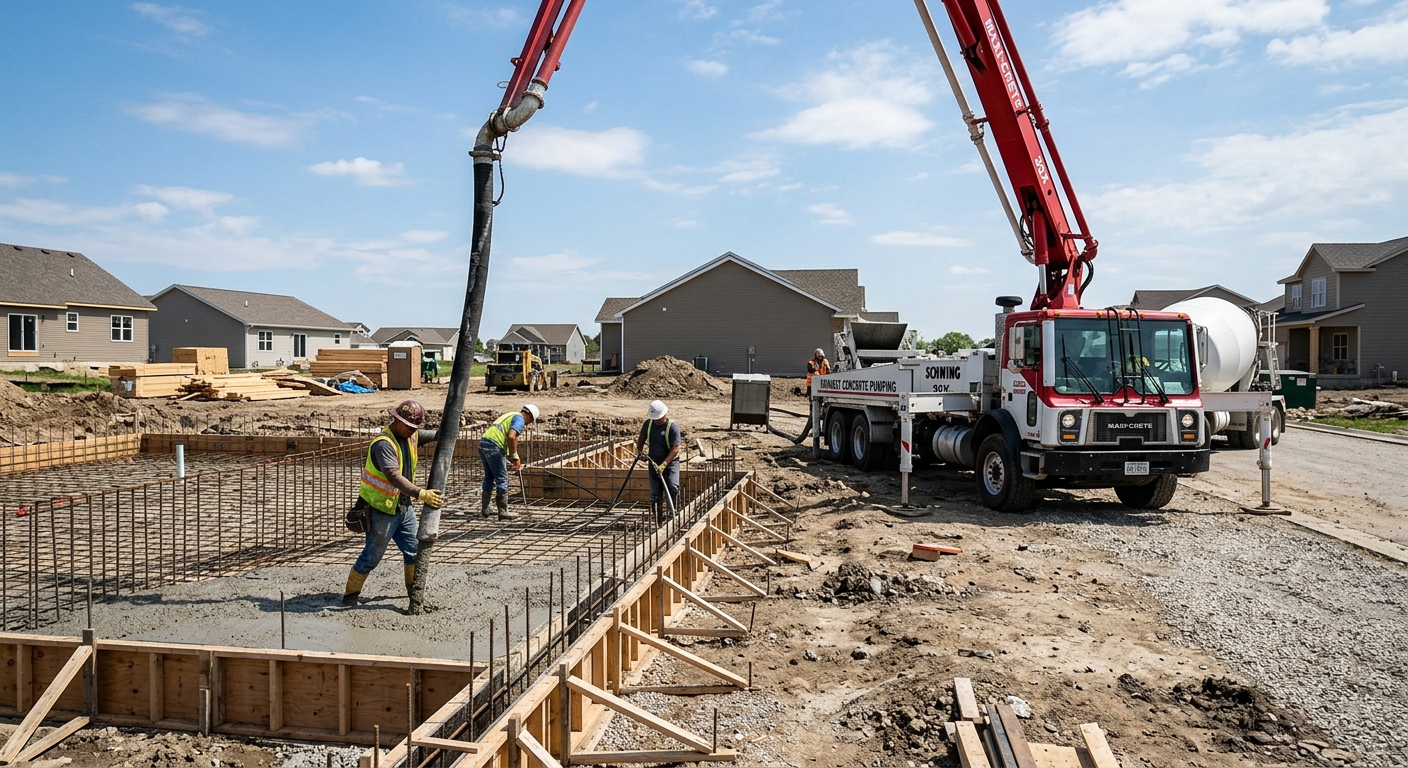
Concrete work options and costs in Grande Prairie
Concrete work in Grande Prairie tends to be priced with the climate in mind first, because northern freeze–thaw cycles and deep frost requirements drive excavation, base prep, and concrete volume. In a city with 64,141 residents and 16,305 homeowner households (Statistics Canada, 2021 Census), a large share of demand comes from single-detached homes—61.6% of dwellings—where driveways, patios, and walkways are some of the most visible exterior upgrades. That homeowner focus is especially strong around established areas of town such as Patterson Place and the broader south-side neighbourhoods, where many lots are already improved and residents regularly refresh older flatwork.
In the Athabasca–Grande Prairie–Peace River region, costs can shift materially even when the “same” driveway is proposed on paper. Frost line depth typically requires footings and slab edges to be set below frost to help prevent heave, while repeated freeze–thaw cycles demand proper drainage, air-entrained concrete mixes, and tighter control-joint planning to limit cracking and scaling. Crews also work within a shorter reliable pour season for flatwork, and when cold, wet conditions arrive, contractors must use insulated blankets and/or heating so the concrete can reach strength—adding handling time and equipment time to your quote.
To help you compare apples-to-apples, here are typical project ranges for common concrete options in Grande Prairie, based on the current regional pricing bands and real-world jobsite factors like access, excavation depth, and finishing complexity.
| Application |
Typical Size |
Key Spec |
Finish Option |
Price Range |
| Concrete driveway (standard broom finish) |
24 ft x 20 ft (about 480 sq. ft.) |
Air-entrained mix, compacted base, control joints |
Standard broom |
$14,000–$20,000 |
| Exposed aggregate driveway |
24 ft x 20 ft (about 480 sq. ft.) |
Air-entrained mix, proper surface retarder/cleaning |
Exposed aggregate |
$17,000–$26,000 |
| Stamped concrete driveway or patio |
20 ft x 16 ft (about 320 sq. ft.) |
Air-entrained mix, release agent and sealer |
Stamp + sealer |
$10,500–$16,500 |
| Plain concrete patio or walkway |
12 ft x 16 ft (about 192 sq. ft.) |
Compacted base, air-entrained exterior mix |
Broom/smooth float |
$2,800–$4,900 |
| Garage floor (interior slab) |
24 ft x 22 ft (about 528 sq. ft.) |
Vapour control (if specified), fibre or mesh, trowel finish |
Trowel finish |
$13,500–$21,000 |
| Foundation footings (structural, below frost) |
Typical house perimeter (varies by plan) |
Engineered rebar and below-frost excavation |
Structural concrete |
$9,500–$14,000 |
Prices are estimates only and vary by project scope, site access and material selection.
What affects the price of concrete work in Grande Prairie
In the Athabasca–Grande Prairie–Peace River region, two quotes for the “same” driveway can easily diverge by 30–50% because the cost drivers are mostly in site work and specification, not just the concrete. In colder climates with deeper frost, the requirements for footings, slab edges, and proper drainage often push excavation and forming higher. Contractors also face scheduling pressure during the shorter reliable pour season for flatwork, which can concentrate equipment and labour during peak weeks and raise the effective labour and standby costs.
Frost line depth dictates footing depth and form height; exterior concrete must be designed to resist frost heave, and that’s why Alberta projects commonly involve substantial excavation. Freeze–thaw cycles also require air-entrained concrete for exterior slabs and well-planned control joints to limit random cracking and surface scaling. When temperatures drop, cold-weather curing precautions—like insulated blankets and controlled curing/temperature management—add time and material handling. If you plan to use de-icing salt (very common for Grande Prairie winters), sealing becomes more than cosmetic; it helps reduce surface damage and spalling risk.
In practice, a job with minimal access and shallow removal might land near the driveway band of about $14–$20 per square foot equivalent project totals, while a replacement with deeper frost-related excavation, thicker slab, and rebar/mesh can push you into the upper end or beyond. Likewise, a simple broom-finished walkway (often closer to the $12–$18 band) stays budget-friendly, but stamped concrete with specialized finishing and higher material/labour requirements typically moves you into the $22–$35 stamped/decorative band range. If you’re in a neighbourhood with a higher share of older homes—26.9% of dwellings were built before 1981 (Statistics Canada, 2021 Census)—you’ll more often see settled subgrades and unknown drainage, which raises base-prep scope and cost.
| Price Factor |
Why It Matters |
Cost Impact |
| Frost line depth |
Determines footing depth and form height |
Higher excavation and concrete volume can add thousands |
| Site preparation |
Excavation, grading, compacted granular base |
Unstable soils or poor drainage increase base depth and quantities |
| Reinforcement |
Rebar or wire mesh requirement |
Material and placement labour adds cost, but improves long-term durability |
| Mix design |
Air-entrainment and compressive strength spec |
Exterior-rated mix costs more and may require stricter QA |
| Finish type |
Broom vs. stamped vs. exposed aggregate |
Specialty finishes require extra labour, tooling, and sealing |
| Pour size and concrete truck access to site |
Hauling, pump use, and placement speed |
Tight access or long carry distances increases labour and risk |
| Cold-weather curing precautions |
Heating and blankets |
Can add mobilization time, equipment time, and extended curing |
| Control joint pattern and sealing cost |
Limits cracking; protects from de-icing salts |
More joints and proper sealing increase materials and labour but reduce failures |
Permits & regulations in Alberta
In Alberta, structural concrete work generally requires a building permit and, in many cases, engineered drawings reviewed through the municipal process. That means work such as footings, foundation walls, grade beams, and other structural foundation components typically falls under the “permit-required” category. Concrete flatwork—driveways, patios, and walkways—usually does not require a permit by itself unless your project affects lot grading, drainage plans, impervious surface coverage limits, or municipal right-of-way considerations. Because rules can vary by site conditions and scope, confirm requirements with the City of Grande Prairie planning/building office before you break ground.
When you’re hiring a contractor in Grande Prairie, you should also verify credentials. First, ask for proof of general liability insurance and ensure the certificate lists you as an additional insured if your contract requires it. Second, confirm workers’ compensation coverage (WSIB/WCB). In Alberta, clearance letters and account status are typically handled through the relevant workers’ compensation system—your contractor should be able to provide proof upon request. Third, verify licensing/registration where applicable for the scope being performed; don’t rely on “we’ve done it before.”
Step-by-step: (1) request the contractor’s certificate of insurance and clearance proof, (2) check the contractor details and status using the appropriate online registry for Alberta (license/registration when applicable), (3) match the contractor’s legal name on the documents to the quote paperwork, and (4) ask for references on similar-scale jobs (driveways/patios and below-frost foundation work if they’re quoting structural concrete).
Getting concrete right in Grande Prairie's freeze-thaw climate
Concrete fails in Grande Prairie most often due to water movement and freeze–thaw damage—so “getting it right” starts before the first truck arrives. In this region of Alberta, base preparation is everything: you need a compacted granular sub-base to the correct depth for your local soil and the project’s frost design, with drainage that prevents water from pooling under slabs. Next is mix design. Exterior flatwork should use air-entrained concrete with the right air content to resist freeze–thaw scaling, and it should meet minimum compressive strength requirements (commonly 32 MPa for typical exterior structural specs, depending on design).
Control joints must be planned so cracks occur where they’re expected, not randomly through decorative surfaces. Curing is also critical here because cold periods can interrupt strength gain; while a standard baseline is minimum 7-day curing under proper conditions, Grande Prairie jobs often need extended cure time and cold-weather practices (blankets/heating) when pours land near the shoulder season. Finally, sealing helps manage de-icing salt exposure—apply a penetrating sealer after curing (typically after the 28-day cure point) so the concrete can better repel salts and moisture.
To ask the right questions, push your contractor on air-entrainment testing, joint spacing, curing method, and sealing timing. For example, if a stamped patio quote is higher than a plain patio by roughly $1,200 to $3,500 (depending on size and access), that difference can be justified when the stamped option includes proper base prep, thicker/stronger specification where needed, and a proper sealer schedule—rather than simply “adding stamps” over a weak base.
| Spec |
Why It Matters in Grande Prairie |
What to Ask For |
Impact if Skipped |
| Compacted granular base (depth?) |
Prevents settlement and reduces water under the slab |
Documented base depth, compaction method, and granular type |
Cracking, uneven surface, and early scaling |
| Air-entrained concrete mix (target air %?) |
Resists freeze–thaw scaling in winter |
Specify air content (commonly 5–7% for exterior flatwork) |
Higher risk of spalling and surface deterioration |
| Compressive strength (MPa rating) |
Ensures strength gain for durability in cold cycles |
Minimum 32 MPa rating (or project-specified strength) |
Weaker slab/foundation leading to faster breakdown |
| Control joints (spacing per ACI guidelines) |
Limits random cracking under thermal movement |
Joint layout and spacing plan tied to slab size |
Random cracks and poor look; more water infiltration |
| Minimum 7-day curing period |
Cold weather can slow strength gain |
Curing plan, blankets/heating if required, and curing verification |
Surface weakness, increased cracking, reduced service life |
| Penetrating sealer (when applied after cure) |
Repels moisture and helps protect against de-icing salts |
Penetrating sealer applied after cure (often around 28 days) |
More staining and accelerated surface damage |
How to choose a concrete work contractor in Grande Prairie
Choosing the right concrete contractor in Grande Prairie is mostly about verification and clarity. Start by confirming Alberta compliance and financial protection: ask for proof of general liability insurance and a current workers’ compensation clearance/coverage document (WSIB/WCB). Then check the contractor’s licensing/registration status where applicable using the appropriate Alberta online registry, and ensure the legal company name on the quote matches the insurance paperwork. If they can’t produce documents quickly or they give you vague screenshots, treat that as a red flag.
Next, get 2–3 itemised written quotes instead of one lump-sum number. You want a breakdown for labour, excavation/base prep, reinforcement, concrete supply, finishing, joints, disposal, and sealing (if included). Carefully review exclusions: does the quote include permit handling, waste disposal, saw cutting, drain adjustments, and cold-weather curing provisions? For a region with freeze–thaw pressure, the curing and joint plan are not “nice-to-haves.”
Warranty matters too. Look for a workmanship warranty length and understand what’s covered versus not covered (especially around settlement beyond the contractor’s scope). If there’s a product/manufacturer warranty for sealers or related systems, ask whether it’s transferable to you and how long it lasts. Payment schedules should be conservative: never pay more than 10–15% upfront, and hold back a portion until the job is complete and any deficiencies are corrected. Finally, insist on a written timeline with a start date and estimated completion—based on the crew’s pour schedule and seasonal conditions.
- Provide a written scope that lists excavation depth, base thickness, and compaction targets.
- Confirm air-entrainment and strength spec on the quote (don’t accept “standard mix”).
- Ask how they handle drainage and water management around the slab edges.
- Verify control joint spacing and saw-cut timing in writing.
- Require cold-weather curing detail: blankets/heating plan and cure extension.
- Ask whether rebar/mesh is included, and where it’s placed (not just “we use it”).
- Request finishing specifics: broom vs. trowel, exposed aggregate process, stamping method.
- Confirm sealing: product type (penetrating), and when it’s applied after cure.
- Include disposal/haul-off for excess soil and concrete waste if it applies.
- Get clarity on site access: truck route, lifting/pumping, and any protection for landscaping.
- Ensure the insurance certificate and clearance proof are valid at the time of work.
- Have a payment schedule in the contract with holdback until acceptance.
Concrete red flags in Grande Prairie include contractors who won’t discuss air-entrainment or joint spacing, quotes that omit base preparation and compaction details, “we always pour no matter the temperature” statements without curing plans, missing insurance/WCB paperwork, and poorly worded contracts that exclude disposal, sealing, or cold-weather curing provisions.
Frequently asked questions — concrete work in Grande Prairie
How do I compare concrete quotes?
To compare concrete quotes in Grande Prairie, start by making sure the scope is identical: same thickness, same base preparation depth, same reinforcement (if required), and the same finishing details. Ask each contractor to quote in writing with a line-item breakdown for excavation, granular base, vapour barrier (if applicable), concrete supply, reinforcement placement, joints, saw cutting, and sealing. Then compare “specs,” not just totals. For exterior work, confirm air-entrainment and curing plans—freeze–thaw cycles here make those non-negotiable. If one quote is near the driveway band (for example, within the $14–$20 range) but another is much higher, you should see exactly what changed: colder-weather curing, deeper excavation, added reinforcement, or premium finishing like stamping (often aligned with the $22–$35 stamped/decorative band). Finally, watch for exclusions: disposal, permit handling, and drainage adjustments can easily explain differences.
Can concrete be poured in cold weather in Grande Prairie?
Yes, concrete can be poured in cold weather in Grande Prairie, but it must be done with a cold-weather curing plan—otherwise strength gain and durability suffer. Good contractors protect fresh concrete using methods such as insulated blankets and/or heating, and they extend curing time so the mix can reach the required strength before temperatures drop further. Ask your contractor how they’ll manage curing for footings and slabs separately, because foundation work and flatwork respond differently. Also confirm they’ll monitor conditions and adjust timing so placement, finishing, and curing are within their documented limits. If your pour date is in the shoulder season, a contractor may quote a higher range because heating/blanketing adds labour and equipment time—this is typically reflected in job cost more than material cost. If a contractor offers a “standard pour” with no mention of insulation, curing duration, or temperature protection, that’s a serious concern for Alberta’s freeze–thaw winters.
How do I maintain concrete in Grande Prairie's freeze-thaw climate?
Maintenance in Grande Prairie is mainly about keeping water out and protecting surfaces from de-icing salts. First, plan to seal exterior concrete after it fully cures—many contractors apply penetrating sealer around the 28-day mark—so moisture and salts don’t penetrate as easily during winter. Keep edges clear so runoff doesn’t pool against the slab. When you shovel, avoid digging into the surface; use plastic or rubber blade attachments where possible to reduce surface chipping. If you see small cracks, don’t ignore them—prompt joint and crack repair helps stop water migration under the slab, which is where freeze–thaw damage starts. For driveways and patios, re-check joint caulking/sealant (where specified) and follow your contractor’s recommended resealing schedule. In older neighbourhoods with mature drainage challenges, maintenance matters even more because settled subgrades can magnify water movement over time.
What causes concrete to spall in Grande Prairie winters?
Concrete spalling in Grande Prairie winters is usually tied to moisture entering the concrete and then expanding during freeze–thaw cycles. The most common root causes are inadequate air-entrainment (or the wrong mix design), poor curing, and allow-for-water conditions such as weak base compaction or inadequate drainage. When freeze–thaw cycles occur, trapped water can break down the surface paste, leading to scaling and spalling. De-icing salts can accelerate the process by increasing ion penetration and freezing-point effects near the surface. That’s why exterior mixes should be air-entrained and why control joints and sealing matter. If a quote doesn’t clearly specify air content targets (commonly 5–7% for exterior flatwork) or doesn’t address curing and sealing, it’s more likely you’ll see surface damage within a few winters. The best way to reduce spalling is to insist on proper base prep, air-entrained concrete, correct jointing, and a penetrating sealer applied after cure.
What is rebar and when is it required in Alberta?
Rebar (reinforcing bar) is steel reinforcement placed inside concrete to control cracking and improve structural performance. In Alberta, rebar is typically required when the design calls for tensile capacity or when loads and conditions demand it—especially for structural elements like foundation footings, grade beams, and many engineered foundation walls. For non-structural concrete flatwork such as sidewalks, some driveways, and patios, reinforcement may be specified based on thickness, soil conditions, and load expectations; sometimes contractors use wire mesh or fibre, depending on the design. The key is that it should be specified for the project, not added randomly. When freeze–thaw cycling and heavier vehicle loads are expected (like on driveways), proper reinforcement placement can improve performance. If you’re getting both flatwork and foundation work, ask whether the reinforcement is included in the price and whether it’s installed at the correct location and coverage, not just “supplied.”
How long does a concrete project take in Grande Prairie?
Timelines in Grande Prairie depend on weather, curing needs, and the scope—especially because cold snaps can affect finishing and strength gain. A typical small patio or walkway might be staged quickly (site prep and placement in a day), but the overall calendar time still depends on curing and any sealing schedule. Many contractors will pour and finish within the pour day, then allow a minimum 7-day curing period before certain light use, while sealing is commonly done after full cure (often around 28 days). Driveways involve more base prep and often require additional time for saw cutting and joint planning. Foundation and below-frost work generally takes longer because excavation depth, forming, and inspection-ready sequencing are involved. If your work includes cold-weather curing (blankets/heating), plan for extra calendar time to protect the concrete. As a rough guide, the “construction activity” can be short, but the durability-focused approach requires you to respect curing milestones—so the full project readiness often extends beyond the pour date.