Concrete work options and costs in Maple Ridge
Maple Ridge is seeing steady demand for concrete flatwork—especially around driveways, patios, walkways and garage slabs—because it’s a practical way to add curb appeal on a small lot. In a community where most households are in single-detached homes (Statistics Canada, 2021 Census), many homeowners choose exterior concrete improvements that fit the way families actually use their properties: parking in winter, walking to the back door year-round, and enjoying the backyard during short summer windows. Population-wise, Maple Ridge is a small community (Statistics Canada, 2021 Census), so when a contractor’s schedule is full, availability can affect lead times and pricing on time-sensitive pours.
In the Calgary economic region, the cold continental climate drives higher foundation and exterior-slab costs than in milder parts of Canada. Calgary’s design frost depth is engineered to be about 1.2 m (roughly 4 ft), so footings for decks, garages and foundations often require more excavation and higher concrete volumes. Frequent freeze–thaw cycles also mean driveways and patios are expected to include air-entrained mixes, well-built granular bases and control-joint detailing. Add in shorter exterior pour seasons and cold-weather curing precautions (insulated blankets or temporary heat), and you’ll see why two “similar” concrete jobs can land in different price brackets.
Trade demand is especially noticeable in established residential areas like the older-lane neighbourhoods near the core, where upgrades are common as homes age and homeowners refresh front steps, drive approaches and back patios. With that context, here’s a practical comparison of typical Maple Ridge project options and their price ranges.
| Application |
Typical Size |
Key Spec |
Finish Option |
Price Range |
| Concrete driveway (standard broom finish) |
400–600 sq. ft. |
4 in. slab, air-entrained mix, rebar/wire mesh as required |
Broom finish, control joints |
$12,000–$18,000 |
| Exposed aggregate driveway |
400–600 sq. ft. |
5–6 in. slab (often), air-entrained mix, proper base compacting |
Exposed aggregate, colour integral (where specified) |
$14,000–$20,500 |
| Stamped concrete driveway or patio |
300–550 sq. ft. |
4–5 in. slab, air-entrained mix, integral colouring |
Stamping + release + sealer |
$15,000–$26,000 |
| Plain concrete patio or walkway |
200–450 sq. ft. |
4 in. slab, edge forms, air-entrained mix |
Light broom finish (or smooth trowel if requested) |
$5,000–$9,000 |
| Garage floor (interior slab) |
400–600 sq. ft. |
4–5 in. slab, vapour barrier, reinforcement where required |
Broom finish + sealant (recommended) |
$13,000–$20,500 |
| Foundation footings (structural, below frost) |
Varies by house size and layout |
Engineered footing design, concrete placement below frost depth |
Plain structural concrete |
$28,000–$45,000 |
Prices are estimates only and vary by project scope, site access and material selection.
What affects the price of concrete work in Maple Ridge
In the Calgary region, it’s common to see quotes for the “same” concrete job swing by 30–50%. The reason is that concrete pricing isn’t just the slab: it’s engineering decisions (especially below-grade), excavation and hauling, reinforcement detailing, mix design and—most importantly in Alberta—what it takes to survive winter. A driveway in Maple Ridge that’s priced like a smooth, easy pour can cost substantially more if the subgrade is wet, the granular base needs replacement, or access forces smaller pours and extra labour.
Frost depth is the headline driver for structural work. Footings must be founded below the design frost depth to prevent frost heave and seasonal movement. In Alberta, that can mean deeper excavation and taller formwork than homeowners expect. Next, freeze–thaw cycles dictate specs: exterior flatwork is typically air-entrained, with spacing and sealing to control cracking and protect against spalling. Because the pour season is shorter, contractors often need winter-grade methods—insulated blankets and sometimes timed heating—so concrete reaches adequate curing targets. De-icing salts then accelerate surface wear, which is why sealing is a smart add-on for driveways and patios that see winter traffic.
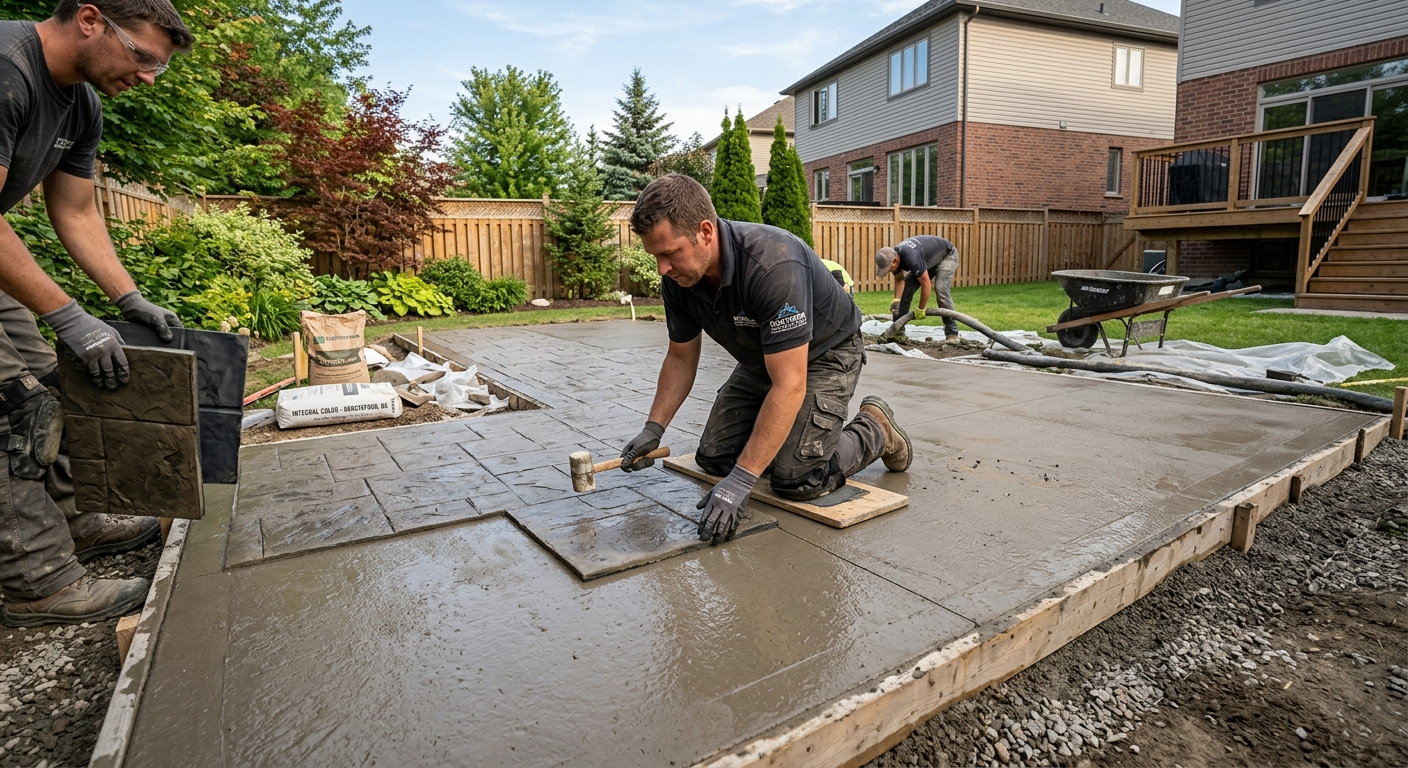
Two local examples that typically push costs up in Maple Ridge: (1) replacing poor-quality topsoil with compacted granular base (more excavation and material delivery), and (2) adding reinforcement beyond light wire mesh when soil conditions or slab size require it. On the flip side, a straightforward broom-finish patio may land nearer the lower end of $5,000–$9,000 when access is good and there are no major elevation changes. A stamped driveway is usually where you see the biggest jump because labour-intensive finishing and curing requirements shift you toward $15,000–$26,000, especially if colour/texture steps are part of the scope.
| Price Factor |
Why It Matters |
Cost Impact |
| Frost line depth |
Determines footing depth and form height |
Higher excavation and more concrete; can strongly affect foundation/footings budgets |
| Site preparation |
Excavation, grading, compacted granular base |
Wet/soft soil or poor base can add significant haul, labour and granular material cost |
| Reinforcement |
Rebar or wire mesh requirement |
More steel, chairs/dowels, and placement time; typically noticeable on driveways/garage slabs |
| Mix design |
Air-entrainment and compressive strength spec |
Exterior air-entrained mixes and engineered strengths cost more per yard but reduce failure risk |
| Finish type |
Broom vs. stamped vs. exposed aggregate |
Stamped/exposed work adds labour and finishing materials, pushing costs higher |
| Pour size and concrete truck access to site |
Delays or pumping/extra crew time |
Limited access may require smaller pours, pumps/boom, or extra coordination |
| Cold-weather curing precautions |
Heating, insulating blankets |
Winter-grade processes can add labour and equipment rental costs |
| Control joint pattern and sealing cost |
Crack control and surface protection against salts |
Proper jointing and sealing add line-item cost but reduce long-term maintenance |
Permits & regulations in Alberta
In Alberta, structural concrete work—like foundation footings, foundation walls, grade beams and other below-grade structural elements—typically requires a building permit, and engineered drawings are often reviewed by the municipality as part of the permit process. For concrete flatwork (driveways, patios, walkways), a permit usually isn’t required if the work doesn’t change lot drainage, violate impervious surface coverage rules, or involve municipal right-of-way issues. In Maple Ridge, the key is still verification: if your proposed slab affects grading, changes how water sheds, or ties into a retaining element, it can trigger additional approvals. When in doubt, confirm with the local authority before breaking ground.
Regardless of permit requirements, verify the contractor properly carries liability insurance and coverage for worker protection (WSIB/WCB). A reputable crew will also provide references for similar concrete work—ideally projects completed in Calgary’s freeze–thaw conditions.
Step-by-step homeowner checks in Alberta:
- Ask for the contractor’s proof of general liability insurance and request the certificate of insurance (ensure it lists your project address as applicable coverage).
- Ask for proof of WSIB/WCB coverage (or clearance, depending on their status) and confirm the policy is active.
- Verify their business registration/licensing information through the appropriate online registry resources available to Albertans (start with provincial business/licensing searches).
- Request a written scope and itemised quote, including whether excavation disposal and base supply are included.
- Check references from recent projects and confirm they used air-entrained mixes and a proper joint/sealer approach for exterior slabs.
Do this up front—before you pay deposits—so you’re not stuck later if the schedule slips or workmanship doesn’t meet expectations.
Getting concrete right in Maple Ridge's freeze-thaw climate
Concrete failures in Maple Ridge are almost always linked to how the job was designed for freeze–thaw and de-icing salt exposure. The most common problems I see are surface scaling and spalling from inadequate air-entrainment, plus random cracking from poor base prep or weak control-joint planning. To spec the job correctly for Calgary’s winter conditions, focus on five practical layers: (1) base preparation, (2) mix design, (3) control joints, (4) curing, and (5) sealing.
Start with a compacted granular sub-base to the right depth and density so the slab doesn’t settle. For exterior work, air-entrained concrete is essential; a typical target for exterior flatwork is 5–7% air content, with a minimum 32 MPa compressive strength. Then control cracking: plan joints so shrinkage cracks happen where you want them instead of randomly through the slab. Curing matters more in winter than people think—aim for at least 7 days under proper conditions, and if it’s cold, you need insulated blankets and/or temperature management to keep the concrete from curing too slowly. Finally, apply a penetrating sealer after the cure period (commonly at/around 28 days) to help repel de-icing salts that accelerate deterioration.
To frame it in dollars: if you choose a stamped driveway, you might be around $15,000–$26,000 versus a broom-finish option near $12,000–$18,000. The extra cost is justified when the contractor is also doing the hard stuff correctly—proper base, correct air content, and joint/sealer discipline—because that’s what prevents the “pretty finish” from becoming a maintenance problem.
When you ask technical questions (air content, base depth/density, joint spacing, curing method), you’re directly reducing the risk of spalling—the failure that hurts most in Maple Ridge winters.
| Spec |
Why It Matters in Maple Ridge |
What to Ask For |
Impact if Skipped |
| Compacted granular base (depth?) |
Reduces settling and limits freeze–thaw movement at the slab underside |
Base depth for your soil + compaction testing/density targets |
Cracking, unevenness, and premature joint failure |
| Air-entrained concrete mix (target air %?) |
Improves freeze–thaw durability and reduces scaling/spalling |
5–7% air for exterior flatwork and confirmation in the mix design |
Surface scaling and spalling, especially with de-icing salts |
| Compressive strength (MPa rating) |
Supports structural performance through seasonal stress cycles |
Minimum 32 MPa (or higher if engineered for your design) |
Reduced durability and higher cracking risk |
| Control joints (spacing per ACI guidelines) |
Controls where shrinkage cracks appear during curing and temperature swings |
Joint spacing plan and whether joints match slab geometry |
Random cracking that can trap water and accelerate damage |
| Minimum 7-day curing period |
Ensures adequate strength gain before cold exposure and stress |
How curing is handled in cold weather (blankets/heating if needed) |
Weak surface, scaling, and long-term deterioration |
| Penetrating sealer (when applied after cure) |
Helps repel salt and moisture, reducing freeze–thaw attack |
Sealer type and timing (commonly around 28 days post-pour) |
Faster surface wear and higher maintenance costs |
How to choose a concrete work contractor in Maple Ridge
Choosing a contractor is where you protect your budget. In Alberta, verify licensing/registration where applicable, confirm they carry active general liability insurance, and ensure they have proper WSIB/WCB coverage for their workers. The best practical approach is to ask for documents up front: a certificate of insurance (showing the policy is current and the contractor is insured for the type of work), and proof of WSIB/WCB status (or clearance where relevant). If they won’t provide documentation, that’s a red flag—walk away.
Next, don’t accept vague lump sums without a breakdown. Get 2–3 itemised written quotes that separate labour, concrete supply, reinforcement, excavation/grading, and disposal. Ask whether the quote includes the permit (if required), base materials, compaction measures, and sealing. For workmanship, look for a clear warranty length and what it covers—cracks due to restrained base issues and freeze–thaw failures should be addressed with the right spec, not just “coverage language.” Also ask whether any product/manufacturer warranty is included and whether it’s transferable.
Payment schedule matters: never pay more than 10–15% upfront. Hold back the remainder until the work is complete, cleaned and verified (including joint finishing, edging, and curing/sealer schedule).
Finally, timeline: request a written start date and completion estimate, plus what happens if weather delays the pour. In Calgary-area winter, that plan is as important as the price.
- Provide certificate of insurance showing active general liability coverage.
- Provide WSIB/WCB proof/clearance and confirm policies are in good standing.
- Use itemised quotes (labour, materials, excavation/disposal, reinforcement, sealing).
- Confirm air-entrained mix and minimum strength in writing (ask for mix design details).
- Ask for base depth and compaction approach for your soil conditions.
- Ask about joint layout: spacing, dowels/anchors where required, and how cuts are timed.
- Confirm curing plan for cold weather (blankets/heating if temperatures drop).
- Request a schedule for sealing (timing around cure, usually around 28 days) if included.
- Clarify whether truck access and any pumping are included.
- Ask how they protect landscaping, fences and adjacent slabs during excavation and finishing.
- Get warranty details in writing (workmanship scope and length).
- Keep deposits capped at 10–15% and hold back payment until completion.
Concrete red flags to watch in Maple Ridge: contractors who won’t discuss air content or joint spacing; quotes that ignore base prep and drainage; “cheap” stamped or exposed work with no clear curing plan; vague scopes that don’t specify disposal/haul-away; and crews that pressure you for large upfront deposits or refuse to provide insurance/WSIB/WCB proof.
Frequently asked questions — concrete work in Maple Ridge
What is a concrete overlay and is it suited to Maple Ridge?
A concrete overlay is a new layer of cementitious material installed over an existing slab (often after surface preparation, patching and crack treatment). In Maple Ridge, overlays can be suited to driveways and patios when the original slab is structurally sound—no major settlement, no widespread failure, and proper drainage still works. It’s not a cure-all: if the base has failed or the slab is heaving due to frost-related movement, an overlay will usually crack or debond over time. In the Calgary region, freeze–thaw cycles and de-icing salts are hard on surfaces, so overlays still need correct surface prep, bonding procedures and a sealer plan. If you’re comparing costs, a driveway in the $12,000–$18,000 range may be a better long-term value than repeated resurfacing when the underlying base isn’t right.
How do I seal concrete to protect it in Maple Ridge?
Sealing in Maple Ridge is about protecting the surface from moisture and de-icing salts that worsen freeze–thaw damage. Typically, you wait until the concrete is cured—often around 28 days—before applying a penetrating sealer. The slab needs to be clean and dry; pressure washing and stain removal are common prep steps, but you don’t want residue left behind that blocks penetration. Ask your contractor to confirm the sealer type (penetrating vs. film-forming) and whether it’s compatible with your finish (broom, stamped, exposed aggregate). Sealing won’t stop structural problems caused by poor base prep or inadequate air entrainment, but it can significantly slow surface scaling. If your driveway is part of a winter-usage routine, sealing is one of the most cost-effective maintenance steps, especially when your project is within the $12,000–$18,000 or $15,000–$26,000 driveway brackets where the finish quality is a big part of value.
What is the difference between concrete and cement?
Concrete is the finished building material—typically a mixture of cement, sand, gravel (or other aggregates), water, and sometimes admixtures like air-entrainment agents. Cement is only one ingredient inside concrete, acting as the binder that hardens when it reacts with water. Homeowners often hear “cement” used casually, but in contracting we specify “concrete” because that includes the whole mix design and performance requirements. In Alberta’s freeze–thaw climate, what matters most is the full concrete mix: air-entrainment percentage, minimum compressive strength (often at least 32 MPa for exterior flatwork), and proper curing. If a contractor talks only about “cement” but can’t explain air content, curing blankets/heating, or joint placement, you should ask more questions.
How much does concrete work cost in Maple Ridge?
Concrete costs in Maple Ridge follow Alberta’s winter realities: deeper excavation for frost protection, air-entrained mixes, and cold-weather curing considerations. For reference, driveways typically land around $12,000–$18,000 for standard broom-finish work, while stamped concrete projects commonly fall in the $15,000–$26,000 range depending on square footage and finishing complexity. Patios and walkways often come in near $5,000–$9,000 for smaller to mid-sized slabs, while structural foundation footings can be substantially higher, commonly $28,000–$45,000 depending on the engineered layout and excavation needs. Every quote still varies based on site access, base conditions, reinforcement requirements, and whether the schedule forces winter-grade placement. If you share your approximate dimensions and finish type, you’ll get a tighter estimate.
How deep must footings be for Maple Ridge's frost line?
For Maple Ridge projects within the Calgary region, footings need to be founded below the design frost depth to reduce frost heave and seasonal movement. Local engineering practice uses a design frost depth of about 1.2 m (roughly 4 ft) for this area, which drives how deep the excavation goes for houses, garages, decks and retaining structures. The exact footing depth and width can vary based on engineering drawings and soil conditions, but the key principle stays the same: the footing must bear on undisturbed soil below the frost line. Because excavation depth increases labour and concrete volume, this is one of the biggest reasons foundation work doesn’t get “cheaper” in winter—properly engineered frost protection remains a cost driver.
Why does concrete crack in Maple Ridge and how is it prevented?
Concrete cracks in Maple Ridge mainly due to shrinkage, temperature changes, and movement from freeze–thaw cycles acting on moisture in the slab and soil. Even well-made concrete will crack if joints and base support aren’t planned—so the goal is controlled cracking at joints, not random cracking through the slab. Prevention starts with correct base prep: compacted granular sub-base to the right depth/density for your soil. Next, exterior durability depends on air-entrained concrete and adequate curing; inadequate air content is a common reason for spalling in freeze–thaw and salt exposure. Control joints must be spaced appropriately and cut/formed to guide where cracks occur, and sealing after cure helps reduce moisture and de-icer salt attack. In practice, the “cheap” option often skips one of these layers. A properly specified driveway is designed to crack where it’s planned, not where it’s convenient to repair later.