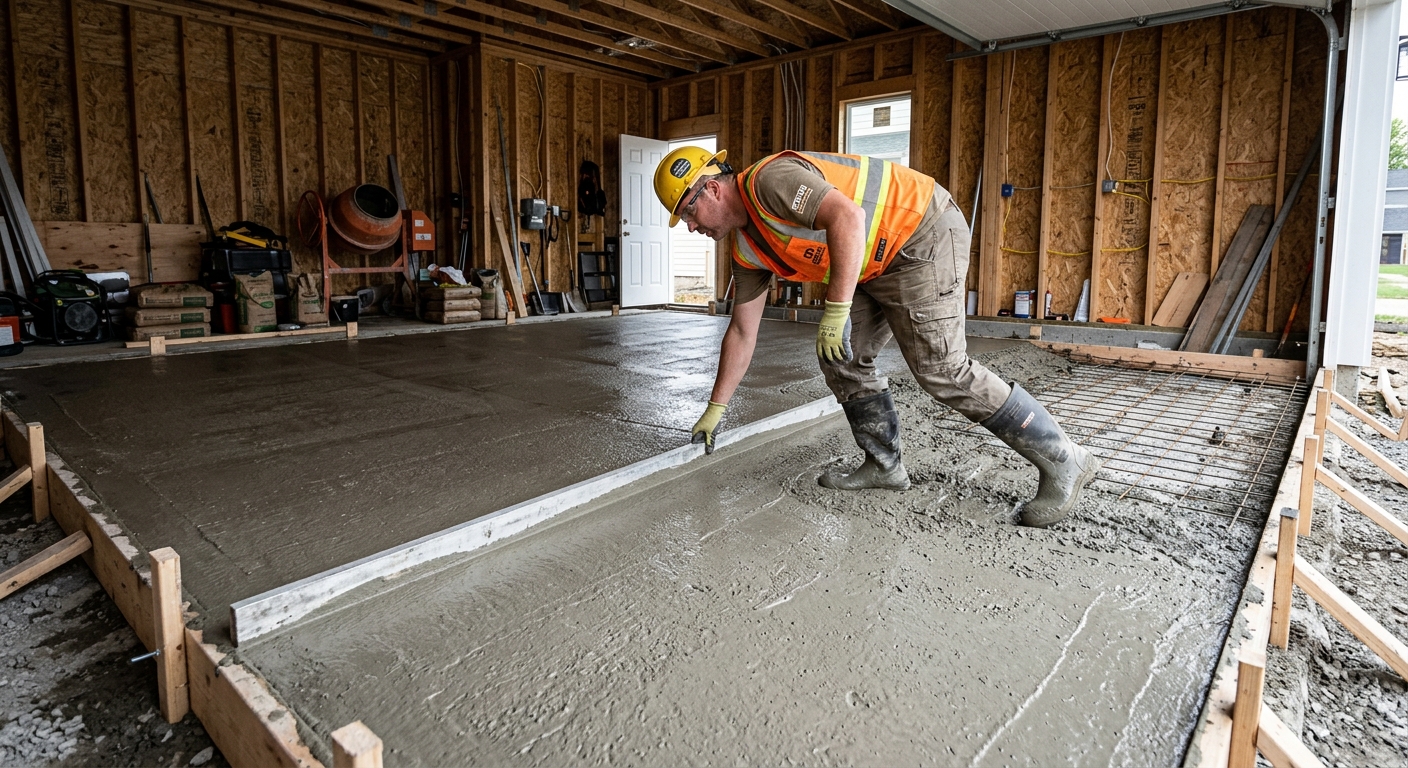
Concrete work options and costs in Sandstone Valley
Sandstone Valley, Alberta is a place where concrete gets tested every winter. With a population of 5,795 (Statistics Canada, 2021 Census), the local trades market is tight enough that experienced crews are in demand for driveways, patios and walkways—especially in neighbourhoods around the newer housing pockets near the Sandstone Valley/Garrison-style growth corridor where many homes are still being upgraded. Most homeowners here start with flatwork: concrete flatwork is a common complement to the predominant single-detached housing pattern, and it’s one of the most visible “curb appeal” projects before a full landscaping plan.
In the Calgary region, pricing is strongly shaped by frost and freeze–thaw. The design frost depth is about 1.2 m (roughly 4 ft), so footings for garages, decks and structural work must sit below that depth on undisturbed soil. Exterior slabs also need air-entrained concrete and a careful curing approach because late-fall and early-spring pours can scale if the concrete doesn’t cure properly. That’s why you’ll often see higher foundation/footing pricing than in warmer provinces, and why crews emphasize granular base prep and control joints on driveways and patios.
Contractor availability and material lead times also affect quotes. When a project needs cold-weather placement (insulated blankets/heating) or complex reinforcement, you’ll feel it in the schedule—and the labour component rises. Below is a practical side-by-side of typical scopes and cost ranges for Sandstone Valley homeowners, so you can compare estimates before you commit.
| Application |
Typical Size |
Key Spec |
Finish Option |
Price Range |
| Concrete driveway (standard broom finish) |
24 ft × 9 ft (216 sq. ft.) |
4 in slab, air-entrained mix, rebar/wire where required, proper base |
Broom finished + standard control joints |
$12,000–$18,000 |
| Exposed aggregate driveway |
24 ft × 9 ft (216 sq. ft.) |
4 in slab, air-entrained mix, polished finish system |
Exposed aggregate (scrub/wash) |
$15,000–$22,000 |
| Stamped concrete driveway or patio |
20 ft × 12 ft driveway pad (240 sq. ft.) |
4 in slab, colour hardener, air-entrained concrete |
Stamped pattern + release + sealer |
$15,000–$26,000 |
| Plain concrete patio or walkway |
12 ft × 16 ft (192 sq. ft.) |
4 in slab, air-entrained mix, compacted granular base |
Float and broom finish |
$5,000–$9,000 |
| Garage floor (interior slab) |
22 ft × 22 ft (484 sq. ft.) |
Thickness per design, vapour barrier, reinforcement as specified |
Steel trowel (or broom depending on plan) |
$8,000–$16,000 |
| Foundation footings (structural, below frost) |
Per plan (typ. 1,200–2,000 lin. ft.) |
Excavate below design frost depth (~1.2 m), concrete/steel per engineered spec |
Structural concrete—no decorative finish |
$28,000–$45,000 |
Prices are estimates only and vary by project scope, site access and material selection.
What affects the price of concrete work in Sandstone Valley
In Sandstone Valley and across the Calgary region, two quotes for the “same” concrete job can easily diverge by 30–50%. The reason is that concrete pricing is less about the slab itself and more about what it takes to keep it stable through winter: excavation to the right depth, compacted granular base, correct reinforcement, and a freeze-thaw-safe mix design with proper curing. When crews price carefully, they include the things that prevent movement and scaling—so the “low bid” sometimes looks lower but misses items that cost more later.
The design frost depth of about 1.2 m (roughly 4 ft) in this area means exterior structural elements and footings are deeper than in milder climates. That drives up excavation volume and formwork height, and it’s a direct reason foundation/footing projects land in the $28,000–$45,000 band more often. For exterior slabs like driveways and patios, freeze–thaw cycles also demand air-entrained concrete (and good jointing) to reduce spalling. Calgary’s shorter exterior pour season means cold-weather placement may require winter-grade mix, insulated blankets and sometimes temporary heat—additions that don’t show up in basic estimates.
Two common Sandstone Valley examples: (1) a driveway replacement that needs full base rebuild and proper tie-ins typically costs more than a “thin overlay” approach because it’s excavating to achieve a stable granular base; and (2) a stamped driveway can jump into the $15,000–$26,000 range because colour hardener, stamp mats, and a higher finishing labour time are required. Housing stock also matters: newer yards with tighter access and more landscaping often require additional truck choreography and disposal fees, while older sites with settled grades usually need more grading and removal.
| Price Factor |
Why It Matters |
Cost Impact |
| Frost line depth |
Determines footing depth and form height |
Major ($): deeper excavations and more concrete/steel |
| Site preparation |
Excavation, grading, compacted granular base |
Major to moderate ($): varies with soil conditions and yard access |
| Reinforcement |
Rebar or wire mesh requirement |
Moderate ($): depends on slab use and engineer/spec |
| Mix design |
Air-entrainment and compressive strength spec |
Moderate ($): exterior air content and winter-grade mixes cost more |
| Finish type |
Broom vs. stamped vs. exposed aggregate |
Moderate to major ($): labour time and materials increase with decorative finishes |
| Pour size and concrete truck access to site |
Impacts labour and logistics |
Moderate ($): tight access can mean extra pump/handling time |
| Cold-weather curing precautions |
Heating and blankets |
Moderate to major ($): winter protection can be significant on early/late-season pours |
| Control joint pattern and sealing cost |
Controls cracking and protects against salts |
Moderate ($): spacing, saw-cut timing and sealer add cost but prevent long-term damage |
Permits & regulations in Alberta
In Alberta, structural concrete work is typically a permit-driven scope. If you’re doing footings, foundation walls, grade beams, or other structural elements that support the building, you should expect a building permit and often engineered drawings reviewed by the municipality. For concrete flatwork—patios, walkways and many driveways—permits often are not required unless the work affects lot grading, impervious surface coverage rules, or the municipal right-of-way (for example, if you’re altering a curb/sidewalk interface). The safest approach in Sandstone Valley is to confirm with the local authority before any excavation begins.
Homeowner verification should be step-by-step and practical. First, confirm the contractor’s Alberta business licensing/registration status through the appropriate online registry tools available to the public. Second, request a current Certificate of Liability Insurance naming you (or your property address) as required by the contract terms—verify limits and that it’s active for the project start date. Third, ask for WSIB/WCB coverage proof (or applicable coverage documentation) so you’re not exposed if a worker is injured on site. Finally, ask for references on similar-scale projects in the Calgary region—especially exterior work where freeze–thaw and curing are critical.
When you book your consult, bring the scope (dimensions, thickness, reinforcement notes if you have them) and ask the contractor which permits they pull (if any) and what they include in the price (disposal, compaction testing, and excavation below frost depth for structural work).
Getting concrete right in Sandstone Valley's freeze-thaw climate
Concrete fails in Sandstone Valley most often for predictable reasons: water gets into weak surfaces, freeze–thaw expands it, and the surface spalls or scales. The cure is to spec the job around Calgary-area frost behaviour—starting with base preparation and ending with sealing at the right time. For base prep, the key is a compacted granular sub-base at the correct depth for local soil and frost conditions, with proper grading so water doesn’t pond. For the mix design, exterior flatwork should use air-entrained concrete—typically targeting 5–7% air content for freeze–thaw durability—and a minimum 32 MPa compressive strength depending on the application.
Control joints matter because random cracking is the “normal” outcome in concrete; we guide it. Joint spacing should limit crack width and reduce how much de-icing salt and water can penetrate. Curing is the quiet make-or-break step: you want at least 7 days under proper conditions. In cold snaps, insulation blankets and sometimes temporary heat may be required so the concrete develops strength instead of surface scaling. After the concrete fully cures, apply a penetrating sealer (commonly after 28 days) to repel salt-driven moisture.
Ask targeted questions to avoid the most expensive failure: spalling caused by inadequate air-entrainment. If a quote for a driveway in the $12,000–$18,000 band tries to cut corners on mix specs or curing protection, you may only save a few thousand up front—but you can pay for another removal and replacement sooner than you expect.
| Spec |
Why It Matters in Sandstone Valley |
What to Ask For |
Impact if Skipped |
| Compacted granular base (depth?) |
Stability for a deeper frost-impacted region |
Base depth and compaction method for your soil condition |
Settling, cracking, and uneven slab movement |
| Air-entrained concrete mix (target air %?) |
Protects against freeze–thaw damage and spalling |
Air content target for exterior flatwork (5–7% typical) |
Surface scaling/spalling and faster deterioration |
| Compressive strength (MPa rating) |
Ensures durability and adequate strength gain |
Minimum 32 MPa (or higher if specified) |
Reduced strength, increased cracking risk |
| Control joints (spacing per ACI guidelines) |
Manages where cracks form during shrinkage |
Planned joint spacing and saw-cut timing |
Wider random cracks and more salt infiltration |
| Minimum 7-day curing period |
Strength development before winter stress |
Curing plan for cold days (blankets/heating if needed) |
Weak surface, increased scaling and long-term damage |
| Penetrating sealer (when applied after cure) |
Repels de-icing salt-driven moisture |
Sealer type and schedule after adequate cure (often after 28 days) |
Faster deterioration from salt and water penetration |
How to choose a concrete work contractor in Sandstone Valley
Choosing the right contractor in Sandstone Valley is about verifying credentials, comparing scopes, and making sure they build to the climate—not just the minimum. First, confirm Alberta licensing/registration status using the public online registry tools available for businesses in Alberta. Next, request proof of current liability insurance; ask your contractor to provide an up-to-date Certificate of Insurance before work starts. Then ask for WSIB/WCB coverage documentation (or applicable clearance documentation where relevant). Don’t accept “we’re covered” without a document you can review.
For pricing, get 2–3 written, itemised quotes—not a single lump sum. The best quotes break out labour, materials, excavation/disposal, granular base prep, reinforcement, and finishing. Watch the exclusions: disposal of old concrete, compaction testing, permit handling (if any), and winter curing provisions should be clear. A dependable warranty should be in writing with workmanship coverage length, and you should also understand product/manufacturer warranty terms (and whether they’re transferable if you sell your home).
Payment terms should be conservative. As a homeowner, avoid paying more than about 10–15% upfront; keep a holdback until the work is complete and defects are corrected. Finally, insist on a written timeline with a start date and completion estimate. In Alberta’s freeze–thaw season, a clear curing plan matters as much as the date the concrete goes down.
- Ask for proof of Alberta licensing/registration before signing.
- Verify liability insurance is active for the project dates and confirm limits.
- Request WSIB/WCB coverage documentation (or applicable clearance records).
- Get quotes itemised by excavation/base, reinforcement, concrete supply, finishing, and disposal.
- Ensure thickness and spec (air-entrainment and compressive strength) are written on the quote.
- Confirm the plan for cold-weather curing (blankets/heating) if pour dates fall near shoulder season.
- Clarify what’s included for control joints (layout and saw-cut timing).
- Ask whether sealer is included and when it’s applied (after cure, not immediately).
- Verify who supplies and installs forms, and how they’ll protect edges and slopes.
- Confirm truck access plan, pumping (if required), and how they’ll handle cleanup.
- Check warranty: workmanship period, what’s covered, and how claims are handled.
- Set payment schedule: limit upfront and hold back until walk-through completion.
Concrete red flags in Sandstone Valley: quotes that don’t mention air-entrainment or curing protection; “we’ll do it in one pass” promises without a joint plan; missing reinforcement/thickness details; vague timelines that ignore cold-weather curing; and contractors who ask for large upfront payments without a signed scope and schedule.
Frequently asked questions — concrete work in Sandstone Valley
Concrete vs pavers for a patio in Sandstone Valley?
In Sandstone Valley (Calgary region), both concrete and pavers can work well, but concrete usually wins when you want fewer joints and a more uniform surface—especially under frequent freeze–thaw. A plain concrete patio typically falls around $5,000–$9,000 for common backyard sizes, whereas pavers can be priced similarly or higher depending on excavation, bedding material, and edging. The key climate factor is drainage: if water isn’t managed, any surface system can heave or shift. With concrete, a properly compacted granular base and correct jointing help control cracking. With pavers, the sub-base and polymeric sand are critical for long-term stability. Ask either contractor how they handle base prep, slope, and joint/edge detailing for winter performance in Alberta.
How long does a concrete driveway last?
A well-built concrete driveway in Alberta commonly lasts 20–30 years, and in good conditions longer, but “how long” depends on what was done under the slab. In Sandstone Valley, freeze–thaw and de-icing salt are the main stressors, so the durability comes from air-entrained concrete, proper base compaction, and timely curing. If joints are spaced correctly and sealed after adequate cure (often around 28 days), you typically slow down salt-driven deterioration. If a contractor cuts corners—like skipping winter curing protection on a shoulder-season pour or using the wrong mix—surface scaling and cracking can show up much sooner, sometimes within a few years. When comparing quotes, relate the price band to the spec: driveways are often in the $12,000–$18,000 range, and the right inclusions protect your lifespan.
What is air-entrained concrete and why does it matter here?
Air-entrained concrete is a mix designed to create tiny microscopic air bubbles that give expanding water somewhere to go during freeze–thaw cycles. In the Calgary region, that protection is what helps prevent spalling (the flaking/chipping of the surface) and scaling over time. In Sandstone Valley, exterior slabs are repeatedly exposed to cold snaps, thawing, and de-icing salts, so the air system matters more than on milder climates. When you request your quote, ask for the air-entrainment target (commonly 5–7% for exterior flatwork) and confirm the concrete meets the specified compressive strength (often a minimum 32 MPa). If a contractor can’t state air content and how they’ll cure in cold weather, that’s a major indicator the slab may not survive Alberta winters.
How do I prepare the base for a concrete slab?
For a concrete slab in Sandstone Valley, base preparation is the foundation of the foundation—literally. The contractor should excavate to achieve the required grade and frost-safe support, then place and compact granular base in layers to reduce voids and prevent pumping/movement. Because the design frost depth is about 1.2 m (roughly 4 ft) for this region, exterior slabs and structural elements must be engineered with adequate support beneath them. The contractor should verify soil conditions and confirm the granular base depth and compaction method. Proper drainage slope is also critical so water doesn’t pond near foundation/edges. When you review quotes, don’t just look at the final price—ask how thick the slab is, how deep the compacted base is, what they’re using for reinforcement, and how they’ll handle soft spots or contaminated soil.
How do I compare concrete quotes?
Comparing concrete quotes in Sandstone Valley is mostly about comparing scope, not just total dollars. Ask for itemised pricing so you can see labour, concrete supply, excavation, granular base prep, reinforcement, disposal, finishing, and (for exterior work) cold-weather curing provisions. Make sure the quote states thickness and specs that matter for freeze–thaw: air-entrainment and a minimum compressive strength rating. Also confirm the finish and protection plan—broom finish vs stamped vs exposed aggregate—and whether joints are included with a planned spacing and saw-cut timing. Compare whether sealer is included for driveways/walkways and whether it’s scheduled after cure. As a reality check, a standard driveway often lands in the $12,000–$18,000 band, while stamped/decorative projects more commonly fall into the $15,000–$26,000 range. Large gaps usually mean something important is missing.
Can concrete be poured in cold weather in Sandstone Valley?
Yes, concrete can be poured in cold weather in Sandstone Valley, but it must be engineered and protected to achieve proper curing. In the Calgary region, the risk isn’t just freezing during placement—it’s slow strength gain and surface scaling if the concrete doesn’t stay at safe curing temperatures. Contractors typically use winter-grade mixes, add insulation blankets, and sometimes use temporary heat depending on air temperature, wind, and slab size. The goal is reliable curing for at least 7 days under proper conditions so the slab reaches adequate strength. Before you approve a cold-weather pour, ask the contractor for their cold-weather plan: what temperature triggers their protection measures, what insulating materials they’ll use, and how they’ll manage curing time versus your pour date. A quote that doesn’t mention any cold-weather curing precautions should be treated cautiously.