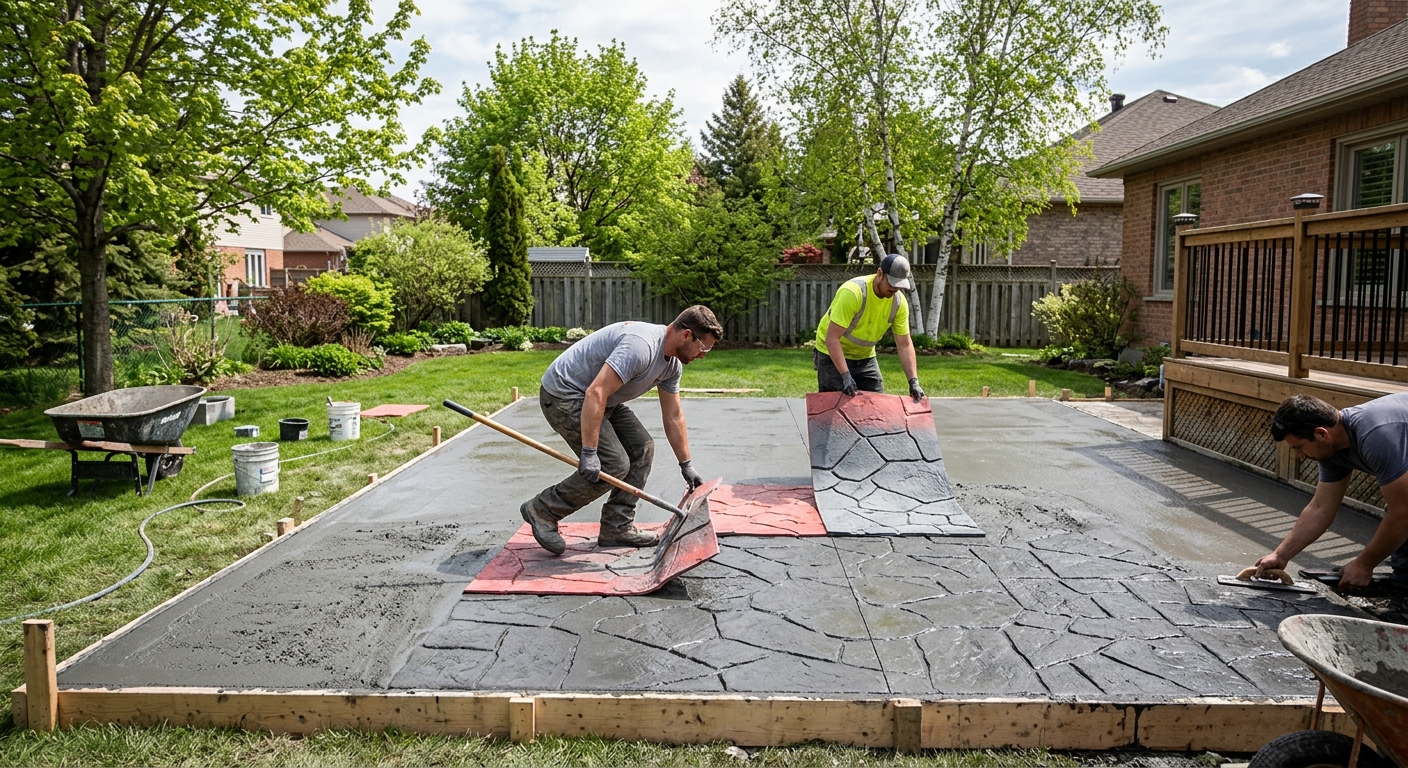
Concrete work options and costs in Manning
Manning, Alberta is a small community where concrete shows up year-round—driveways, patios, walkways, garage floors, and the structural concrete that supports homes. With 78.7% of dwellings being single-detached houses (Statistics Canada, 2021 Census), most concrete jobs here are residential flatwork and foundation work for owner-occupants (homeowner households make up 70.4% of households). That matters because these projects are typically built on a tight footprint, with an emphasis on durability through winter.
In the Athabasca–Grande Prairie–Peace River economic region, your cost isn’t driven only by cement prices—it’s driven by logistics and climate. Frost lines in Alberta typically require footings to be set well below frost to prevent heave, and the repeated freeze–thaw cycles in the Peace region demand air-entrained concrete and good drainage. Manning also experiences a shorter reliable pour season for flatwork, so when weather windows open, crews and equipment can be in peak demand. That can nudge pricing upward compared with southern Alberta, especially for thicker slabs or jobs that require heating/blankets for curing.
Concrete demand is especially consistent around the main residential areas near the downtown core and along older housing pockets built prior to 1981 (43.9% of homes), where upgrades to entrances and driveway approaches are common. If you’re comparing options, the table below uses our typical Manning project specs so homeowners can line up scope and finish choices before calling for a quote.
| Application |
Typical Size |
Key Spec |
Finish Option |
Price Range |
| Concrete driveway (standard broom finish) |
24 ft x 12 ft (288 sq ft) |
6 in slab, compacted base, air-entrained mix |
Broom finish + control joints |
$4,200 – $5,800 |
| Exposed aggregate driveway |
24 ft x 14 ft (336 sq ft) |
Air-entrained mix, proper curing and exposure |
Exposed aggregate (brush/spray exposed) |
$5,300 – $7,600 |
| Stamped concrete driveway or patio |
20 ft x 20 ft (400 sq ft) |
6 in slab, integral colour, air-entrainment |
Stamped pattern + sealer |
$9,000 – $14,000 |
| Plain concrete patio or walkway |
12 ft x 16 ft (192 sq ft) |
4 in slab, compacted base, control joints |
Float/hand trowel or light broom |
$2,300 – $3,900 |
| Garage floor (interior slab) |
24 ft x 22 ft (528 sq ft) |
4 in slab, mesh/rebar as specified, vapour considerations |
Standard trowel + light broom edge texture |
$6,000 – $9,200 |
| Foundation footings (structural, below frost) |
Per project (typical house varies) |
Engineered layout, excavation, formwork, rebar |
Structural concrete (no surface finish) |
$14,500 – $24,000 |
Prices are estimates only and vary by project scope, site access and material selection.
What affects the price of concrete work in Manning
It’s common to see two quotes for the “same” concrete job come in 30–50% apart across Athabasca–Grande Prairie–Peace River and the broader Alberta market. The difference is usually in the details that protect the slab and foundation: footing depth, base preparation, mix design, reinforcement, and how crews cure and control cracking. In a northern climate like Manning’s, those items aren’t optional—freeze–thaw cycles and frost action dictate the spec, and that drives labour, forming time, and concrete volume.
Frost line depth and freeze–thaw cycles dictate every exterior detail: footings must extend below the design frost depth to reduce frost heave, and all exterior slabs should use air-entrained concrete to survive repeated temperature swings. Cold-weather curing precautions also change the cost picture. When the pour season is short and the weather window is tight, we may need insulated blankets, heating, and extended curing time so the concrete reaches strength properly—often adding handling time and equipment time. On top of that, de-icing salt accelerates surface spalling in freeze–thaw environments, which is why sealing is a practical durability add-on.
In Manning, two examples frequently move the number up or down: (1) older lots with soft subgrade or poor drainage can require extra granular excavation and regrading before we can build a stable base; (2) a driveway replacement that includes removal, hauling, and tie-ins to existing grades costs more than a straightforward new pour. As a pricing anchor, plain patios/walkways commonly land near the $12–$18 per sq ft band, while stamped & decorative projects often fall into the $22–$35 per sq ft range because of the added materials and labour.
Even foundation-related work is influenced by local housing stock. With 43.9% of homes built before 1981 (Statistics Canada, 2021 Census), we often see retrofit conditions (small excavation clearances, uneven existing grades, or drainage adjustments) that add cost before any new concrete can be placed.
| Price Factor |
Why It Matters |
Cost Impact |
| Frost line depth |
Determines footing depth and form height |
Higher excavation/formwork increases labour and concrete volume |
| Site preparation |
Excavation, grading, compacted granular base |
More removal/haul and base material drives up project cost |
| Reinforcement |
Rebar or wire mesh requirement |
Material + labour increases; missed reinforcement can cause premature cracking |
| Mix design |
Air-entrainment and compressive strength spec |
Higher-spec air-entrained mixes can cost more but improve freeze–thaw durability |
| Finish type |
Broom vs. stamped vs. exposed aggregate |
Decorative finishes require extra steps, labour, and curing/sealer attention |
| Pour size and concrete truck access to site |
Batching and access affect productivity |
Hard access increases time and sometimes requires pump/extra handling |
| Cold-weather curing precautions |
Heating and blankets |
Equipment and extended curing window can add significant cost |
| Control joint pattern and sealing cost |
Controls cracking and helps manage surface durability |
More joints/extra materials (sealant) increase cost but reduce repairs |
Permits & regulations in Alberta
In Alberta, structural concrete work typically needs a building permit. That includes concrete footings, foundation walls, grade beams, and other structural elements that support the building. Municipalities often want engineered drawings reviewed as part of the permit process. For concrete flatwork—like patios, walkways, and driveways—the work usually does not require a permit by default, as long as it doesn’t change lot grading in a way that affects drainage, increases impervious surface beyond local limits, or touches municipal right-of-way requirements. Always confirm with the local authority before you break ground.
Regardless of permit needs, homeowners should verify the contractor is properly insured and qualified. Before signing in Manning, ask for (1) liability insurance, (2) WSIB/WCB coverage where applicable, and (3) proof of contractor registration/licensing information for the work being done. Step-by-step: first, check the contractor’s certificate of insurance and confirm the coverage is current for the job address. Next, request their WSIB/WCB clearance letter or an equivalent proof document. Then, verify the contractor’s Alberta registration/licensing details using the appropriate online registry for contractors (your contractor’s business name and legal entity should match the documents).
Finally, ask for references on similar-scale projects—especially exterior slabs in freeze–thaw conditions—so you can judge durability, not just appearance.
Getting concrete right in Manning's freeze-thaw climate
Concrete failures in Manning usually aren’t about the look—they’re about durability. The main culprits in the Athabasca–Grande Prairie–Peace River region are inadequate base preparation, insufficient air-entrainment, poor control-joint placement, and curing that’s too short for cold weather. When water gets into tiny surface voids and freezes, it expands and can break paste near the surface (spalling), especially when de-icing salts are used on rough winters. That’s why correct specs matter as much as the finish.
To spec the job correctly, start with base preparation: a compacted granular sub-base to the right depth for local soil and frost risk, with proper grading and drainage. Next, use the right mix design: exterior flatwork should target air-entrainment (typically 5–7% air content for freeze–thaw durability) and meet a minimum 32 MPa compressive strength at the required age. Then plan control joints so they relieve stress in predictable locations instead of random cracking. For curing, build in a minimum 7-day curing period under suitable conditions; in cold/wet weather, ask about heating or insulated blankets so the slab can reach strength. Finally, sealing should be planned 28 days post-pour with a penetrating sealer to repel salts and moisture.
Example to help you budget: choosing stamped concrete may cost roughly $22–$35 per sq ft, while plain broom-finished patios often come closer to $12–$18 per sq ft. The price difference is justified when you want decoration and added finishing steps—but it’s only “worth it” if air-entrainment, jointing, and curing are done properly. If those are cut, both finishes can fail; spalling doesn’t care whether the surface is stamped.
When you talk technical with your contractor, ask specifically how they’ll prevent spalling: “What’s the air content target, and how do you protect curing in Manning’s cold snaps?” That one question filters out a lot of poor workmanship risk.
| Spec |
Why It Matters in Manning |
What to Ask For |
Impact if Skipped |
| Compacted granular base (depth?) |
Stable support reduces settlement and cracking through freeze–thaw cycles |
“What granular depth and compaction testing are you using for my soil?” |
Voids/settlement lead to slab movement and early cracking |
| Air-entrained concrete mix (target air %?) |
Helps concrete tolerate repeated freezing and thawing |
“What air content are you targeting (typically 5–7%) and how is it verified?” |
Higher risk of surface scaling and spalling from salt + freeze–thaw |
| Compressive strength (MPa rating) |
Design strength is needed for durability and load performance |
“What minimum MPa do you meet (typically at least 32 MPa)?” |
Reduced strength can cause premature wear, cracking, and edge damage |
| Control joints (spacing per ACI guidelines) |
Manages shrinkage and temperature stresses |
“What joint spacing and layout are you using for my slab size?” |
Random cracking and wider, more difficult-to-seal fracture lines |
| Minimum 7-day curing period |
Cold and windy conditions need time and protection to build strength |
“How will you cure for at least 7 days, and what happens if it’s cold?” |
Incomplete strength gain increases cracking and durability loss |
| Penetrating sealer (when applied after cure) |
Repels moisture and helps manage de-icing salt effects |
“When will you apply sealer (after cure, typically around 28 days) and what type?” |
Faster surface deterioration and easier moisture intrusion |
How to choose a concrete work contractor in Manning
Choosing the right concrete contractor in Manning is mostly about verification and clarity. Start with Alberta checks: ask for their Alberta contractor registration/licence information (match it to the name on the quote and invoice), then request proof of liability insurance and WSIB/WCB coverage. Where to look: the contractor should provide their current certificate of insurance (showing coverage limits and project address details), and they should provide a WSIB/WCB clearance letter or equivalent document if required for their work and staffing. If a contractor can’t provide these documents promptly, that’s a red flag.
Next, get 2–3 itemised written quotes instead of one lump-sum number. You want labour and materials breakdown (excavation/base, concrete supply, reinforcement, forms, finishing, joints, sealing, and disposal). Read the scope carefully: are demo and hauling included? Is permit pulling included if needed for structural work? Are changes to site conditions covered (like poor subgrade or extra excavation)?
For warranty, ask for both workmanship warranty length and any product/manufacturer warranty terms. Confirm whether the warranty is transferable to future owners. For payment schedule, never agree to more than 10–15% upfront; hold back a portion until the job is complete and any punch-list items are addressed. Finally, request a start date and completion estimate in writing, so you understand how cold snaps or curing delays affect timelines.
- Quote includes slab thickness, reinforcement type, and base depth (not “allowance” language)
- Air-entrainment and minimum compressive strength are stated for exterior work
- Shows joint layout, joint spacing, and crack-control method
- Explains curing plan for cold weather (blankets/heating/temperature monitoring)
- Clarifies disposal/removal of concrete and spoils
- Includes site access notes (truck access, wheelbarrowing limits, staging plan)
- Names the sealer product and states whether it’s included (for driveways/patios)
- Provides proof of liability insurance before the job starts
- Provides WSIB/WCB clearance or equivalent proof for workers
- Includes permit responsibility clearly (especially for structural concrete)
- Gives a detailed schedule: demo/haul, prep, pour day, finishing, cure, and sealing timing
- Uses a written warranty with what’s covered and the process for service calls
Concrete contractor red flags in Manning: they won’t state air content or curing steps, they propose skipping control joints to “avoid lines,” they ask for large upfront payments, their quotes treat excavation as “included” without confirming base depth/compaction, or they can’t provide insurance/WSIB/WCB documents and references for similar freeze–thaw exterior work.
Frequently asked questions — concrete work in Manning
When is the best time to pour concrete in Manning?
In Manning, the best time is during a reliable warm-weather window when the ground isn’t frozen and temperatures stay workable for finishing and curing. Even if the calendar says “summer,” crews still watch for rain and cold snaps because Manning and the broader Athabasca–Grande Prairie–Peace River region can turn quickly. For flatwork like driveways and patios, we typically target periods where we can maintain curing conditions without excessive heating and insulated blanket costs. If you’re pouring close to cold weather, expect extra precautions (and possibly higher labour) because curing becomes a critical part of strength gain and freeze–thaw durability. If you want to budget, plain broom-finished patios often start around the $12–$18 per sq ft band when weather cooperation is good, while cold-weather precautions can push total project costs higher than expected.
How long does concrete take to cure?
Concrete develops strength over time, but curing isn’t a single-day event. For exterior slabs and driveways in Alberta, we generally plan for a minimum 7-day curing period under proper conditions so the slab can reach adequate strength before it’s exposed to heavier stress and moisture swings. In colder weather, curing often needs help—insulated blankets, heating, and temperature protection—so the mix can gain strength as designed. Even after it’s safe to walk on, surface durability benefits from continued curing. For sealing decisions, we commonly plan penetrating sealer around 28 days after the pour to help repel de-icing salts and reduce moisture intrusion. If your job includes structural elements like footings, curing and inspection timelines are more strict because they’re tied to engineered foundation performance.
Do I need a permit for concrete work in Alberta?
In Alberta, structural concrete work like footings, foundation walls, and grade beams typically requires a building permit, and municipalities may review engineered drawings as part of the process. Concrete flatwork—such as patios, walkways, and many standard driveways—often doesn’t require a permit unless it impacts drainage/lot grading, triggers impervious surface considerations, or involves work affecting the municipal right-of-way. For homeowners in Manning, the safest approach is to confirm with the local authority before starting any excavation or significant grade changes. Also, don’t assume the contractor will handle everything: ask your contractor to clearly state whether permit pulling is included in the quote for structural scope, and ensure they provide proof of liability insurance and appropriate WSIB/WCB coverage.
Concrete vs pavers for a patio in Manning?
Both concrete and pavers can work in Manning’s freeze–thaw climate, but the choice usually comes down to maintenance, look, and how your base is built. A concrete patio (plain broom or brushed finish) is typically more straightforward and can offer long-term performance when air-entrainment, proper base depth, and control joints are done right. Pavers can be attractive and allow for section-by-section repair, but they’re highly sensitive to base prep; if drainage and compaction aren’t excellent, movement can show up. Pricing is often competitive at the start, but decorative concrete may cost more depending on finish. If you want an easy durability baseline, plain concrete patios commonly align with the $12–$18 per sq ft band, while more decorative work sits higher (stamped & decorative often falls into the $22–$35 per sq ft band). The “best” option is the one built on the right base with a realistic drainage plan.
How long does a concrete driveway last?
A concrete driveway can last many years in Manning when it’s built for freeze–thaw and salt exposure: correct base prep, air-entrained concrete, proper joint spacing, and curing. That’s where longevity comes from—durability specs—not just colour or finish. If a driveway is sealed after curing (often around 28 days) and joints are maintained, it typically holds up better against scaling and spalling. If the job uses non-air-entrained mix, short curing, or poor drainage, you can see surface deterioration much sooner even if it “looks fine” at first. Cost-wise, most homeowners start by budgeting within typical concrete driveway pricing (often $14–$20 per sq ft for standard work), and decorative options can move higher. If a bid is far below typical rates, ask what they’re cutting—because durability changes can outweigh any initial savings.
What is air-entrained concrete and why does it matter here?
Air-entrained concrete is designed to include tiny air bubbles that help the hardened paste tolerate freeze–thaw cycles. In Manning and across the Athabasca–Grande Prairie–Peace River region, repeated freezing and thawing stresses concrete every winter. Without proper air entrainment, water that enters microscopic pores can freeze and expand, damaging the surface paste and leading to scaling and spalling—often worse when de-icing salts are used. For exterior flatwork, we target air entrainment (commonly around 5–7% for exterior exposure) so the concrete can survive cold weather cycling. When you review quotes, ask for the mix design details (air content target and compressive strength minimum, often at least 32 MPa). If a contractor can’t discuss air-entrainment and curing, that’s a major technical gap—especially in a northern climate.