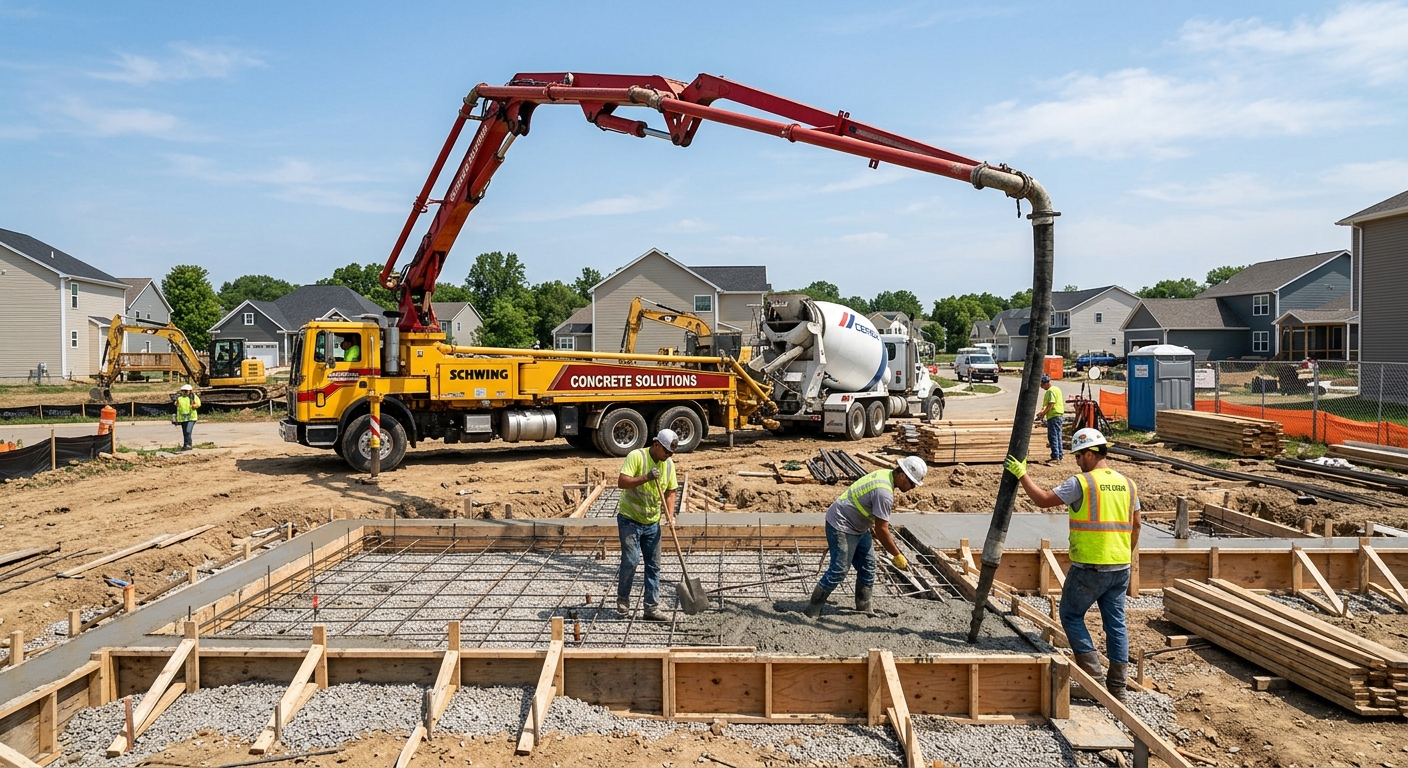
Concrete work options and costs in Ardrossan
Concrete work in Ardrossan is a little different than in milder parts of Canada because Calgary-area weather is shaped by long winters and frequent freeze–thaw cycles. With a 2021 population of 1,238 (Statistics Canada, 2021 Census), Ardrossan is small enough that local contractors often focus on repeatable, well-planned flatwork scopes—especially in the newer housing pockets off major corridors where driveways and back patios get added quickly. In the wider Calgary region, that steady demand for foundations and flatwork is one reason you’ll see competitive pricing where access is straightforward, and bigger swings where excavation and engineering details get complicated.
In this cold continental climate, engineering practice uses a design frost depth of about 1.2 m (roughly 4 ft) for typical building footings, so structural concrete isn’t just “more concrete”—it’s deeper excavation, more granular base prep, and additional formwork and rebar below grade. Exterior slabs also need air-entrained concrete and careful curing because late-fall or early-spring pours can trap moisture and chill the surface, increasing the risk of scaling. That’s why driveway, patio, and walkway pricing in Ardrossan is strongly influenced by scheduling, the season, truck access, and whether de-icing salt will be used on day one.
Demand is especially consistent around the growing family-oriented residential areas close to the core and along the main access routes, where homeowners tend to build driveways, garages, and rear-yard patios back-to-back. Below are realistic local ranges to help you compare options, then we’ll break down what drives the differences.
| Application |
Typical Size |
Key Spec |
Finish Option |
Price Range |
| Concrete driveway (standard broom finish) |
10 ft x 20 ft (200 sq ft) |
Air-entrained mix, compacted base, joints |
Broom finish, standard saw cuts |
$12,000–$18,000 |
| Exposed aggregate driveway |
10 ft x 20 ft (200 sq ft) |
Air-entrained mix, stronger surface durability |
Exposed aggregate (broom + wash) |
$15,000–$21,000 |
| Stamped concrete driveway or patio |
10 ft x 20 ft (200 sq ft) |
Air-entrained mix, release agent, sealer-ready |
Stamp + coloured or antiqued look |
$15,000–$26,000 |
| Plain concrete patio or walkway |
12 ft x 12 ft (144 sq ft) |
Air-entrained mix, compacted base, joints |
Plain trowel + broom edge |
$5,000–$9,000 |
| Garage floor (interior slab) |
20 ft x 22 ft (440 sq ft) |
Vapour barrier, thicker slab by spec, joints |
Float finish, optional hardener |
$9,000–$16,000 |
| Foundation footings (structural, below frost) |
Single detached footprint ~1,000–1,400 sq ft |
Below design frost depth, rebar, engineered forms |
Structural concrete only |
$28,000–$45,000 |
Prices are estimates only and vary by project scope, site access and material selection.
What affects the price of concrete work in Ardrossan
If you get two quotes for the “same” concrete job in Ardrossan, it’s common to see a 30–50% difference—especially across the Calgary market where access, excavation, and engineering requirements can vary a lot between neighbourhoods and lot conditions. A driveway can look similar on paper, but the real cost drivers are the things you can’t see: how much dirt must be removed and hauled, whether the base needs to be rebuilt, and how thick and how reinforced the slab must be for the intended use.
In Calgary’s cold continental climate, frost depth and freeze–thaw cycles dictate the specs. Footings must extend below the design frost depth of about 1.2 m (roughly 4 ft) to reduce frost heave and seasonal movement. That means deeper dig, more granular backfill, and more formwork for any structural pour. For exterior slabs—driveways, patios, and walkways—air-entrained concrete is essential to handle repeated freeze–thaw. And because the workable exterior pour season can be shorter, winter-grade placement, insulated blankets, and proper curing protection can add cost when projects slip into colder weeks. Finally, de-icing salts accelerate surface deterioration, so sealing decisions matter for long-term performance.
Concrete in Ardrossan can cost more when your site needs significant regrading, when you’re replacing an existing slab with unknown subgrade conditions, or when truck access is limited (long wheelbarrow distances and extra labour add up). Costs can be lower when the lot is level, base material can be reused, and the work can be poured efficiently in one planned session. For example, a standard broom-finished driveway often aligns with the $12,000–$18,000 band, while stamped work can climb into the $15,000–$26,000 range because of form-ready prep, stamping labour, and finishing time—provided the mix and air content are still being engineered for freeze–thaw.
Home construction timing also plays a role. Newer lots may have less mature fill or different drainage patterns, which can require extra granular base work under slabs and around foundations—sometimes adding thousands to excavation and base prep.
| Price Factor |
Why It Matters |
Cost Impact |
| Frost line depth — determines footing depth and form height |
Footings must bear below frost heave depth |
Higher excavation and formwork; can add thousands for structural work |
| Site preparation — excavation, grading, compacted granular base |
Frozen or weak subgrade leads to movement and cracking |
Unknown soil conditions can swing total price 20–40% |
| Reinforcement — rebar or wire mesh requirement |
Controls cracking and supports loads (garages, drive lanes) |
More steel and labour increases cost, especially for thicker slabs |
| Mix design — air-entrainment and compressive strength spec |
Exterior durability in freeze–thaw depends on engineered mix |
Winter-grade or higher specs can add material and QC cost |
| Finish type — broom vs. stamped vs. exposed aggregate |
Finishing labour and tooling time change dramatically |
Stamped/exposed typically adds price versus standard broom |
| Pour size and concrete truck access to site |
Efficiency affects labour and timing |
Bad access can require extra labour for distribution; larger pours need more coordination |
| Cold-weather curing precautions — heating and blankets |
Protects strength gain and surface integrity |
Can add costs when pours happen in late fall/early spring |
| Control joint pattern and sealing cost |
Joints guide cracking; sealing helps with de-icing salts |
Proper jointing and sealing add scope but reduce callbacks |
Permits & regulations in Alberta
In Alberta, concrete can fall under different permitting rules depending on what you’re building. Structural concrete work—such as footings, foundation walls, and grade beams—typically requires a building permit, and many projects also rely on engineered drawings reviewed through the municipal process. Concrete flatwork like patios, walkways, and driveways usually does not require a permit by itself, unless it changes lot grading, impacts drainage/impervious surface limits, or affects municipal right-of-way conditions (for example, work near a curb or driveway apron). Because each site is a little different in Ardrossan, the safest approach is to confirm with the local authority before breaking ground.
For contractor compliance, require proof they carry liability insurance and WSIB/WCB coverage (as applicable). Then ask for references on similar-scale work—driveways in freeze–thaw areas and structural footing pours are not “one-size-fits-all.”
Step-by-step homeowner checks in Alberta:
- Ask the contractor for their certificate of insurance and verify it’s current.
- Request their WSIB/WCB clearance documentation (or coverage details) and keep it on file.
- Verify the contractor’s business registration and any applicable trade licensing/credentials through the appropriate Alberta online listings.
- Confirm the permit scope in writing: what they will pull, what you must pull, and who is responsible for inspections.
- Check for a site plan: excavation, base prep, and placement timeline should be described before you sign.
If they can’t clearly explain permit responsibilities for footings or foundation-related pours, that’s a warning sign—especially in a region where engineered depth and drainage details are critical.
Getting concrete right in Ardrossan's freeze-thaw climate
Concrete failure in Ardrossan is usually about one of four things: insufficient base preparation, the wrong mix for freeze–thaw, poor jointing, or rushed curing. Because Alberta experiences repeated freeze–thaw cycles, surface scaling and spalling are the big risks for exterior flatwork when air-entrainment isn’t right or when water gets trapped and freezes. A properly specified Ardrossan job starts with compacted granular sub-base built to the correct depth for the local soil and frost considerations, followed by an engineered air-entrained mix.
For exterior slabs, spec air-entrainment (commonly 5–7% for well-proportioned exterior concrete mixes) and a minimum compressive strength such as 32 MPa for the placement. Then include control joints placed at a spacing that limits random cracking—especially important for driveways and patios where water and de-icing salt will find their way into cracks. Curing matters just as much as the pour: plan for at least a 7-day curing period under suitable protection conditions. In cold snaps, crews may need insulated blankets and/or temporary heat to protect early strength gain.
Sealing is the final layer of protection. Apply a penetrating sealer after the concrete has fully cured (commonly about 28 days post-pour) to help repel de-icing salts and reduce moisture movement into the slab surface.
Ask direct questions: “What air content are you targeting for freeze–thaw?” “What’s the minimum compressive strength?” “How are you building the granular base and where are your control joints?” “What are your cold-weather curing precautions if temperatures drop?” Those answers prevent the most common local complaint—spalling—because inadequate air-entrainment can’t be corrected after the fact.
On price: it may be tempting to choose the cheapest finish, but the durability specs come first. If a plain patio is in the $5,000–$9,000 band, stepping up to stamped concrete can move you into the $15,000–$26,000 range for the same general footprint. That jump is often justified by extra labour and timing for stamping and finishing—provided the base, joints, and air-entrained mix are still engineered for Ardrossan’s winters. If those aren’t covered in writing, the cheaper option is usually the more expensive one over time.
| Spec |
Why It Matters in Ardrossan |
What to Ask For |
Impact if Skipped |
| Compacted granular base (depth?) |
Stable support reduces movement during freeze–thaw |
Documented base depth, grading, and compaction testing approach |
Settlement, cracking, and premature slab failure |
| Air-entrained concrete mix (target air %?) |
Protects against freeze–thaw scaling and spalling |
Target air content in the mix design (commonly 5–7% for exterior) |
Surface deterioration and spalling within a few seasons |
| Compressive strength (MPa rating) |
Controls strength gain and long-term durability |
Minimum 32 MPa (or project-specified requirement) |
Reduced performance and increased cracking risk |
| Control joints (spacing per ACI guidelines) |
Joints manage shrinkage and temperature movement |
Planned joint layout and spacing consistent with industry guidance |
Random cracking that invites water and salt intrusion |
| Minimum 7-day curing period |
Early strength gain protects the surface in cold weather |
How curing is protected during temperature swings |
Scaling, dusting, and reduced surface durability |
| Penetrating sealer (when applied after cure) |
Repels moisture and de-icing salts at the surface |
When it’s applied (typically after full cure; commonly ~28 days) |
Faster salt-related surface wear and pothole-style spalling |
How to choose a concrete work contractor in Ardrossan
Choosing a contractor in Ardrossan is mostly about verifying compliance, matching the quote to the actual engineered scope, and making sure they build for freeze–thaw—not just “pour and go.” Start by verifying Alberta licensing/registration requirements applicable to their trade, then confirm they carry liability insurance with current coverage limits. Next, ask for their WSIB/WCB coverage documentation (as applicable) so you know you’re protected if a worker is injured. If they can’t provide clear documents quickly, that’s usually a red flag.
Get 2–3 itemised written quotes that separate labour and materials. You want line items for excavation/base prep, reinforcement, concrete supply, forming, finishing, saw-cutting/joints, sealing (if included), and disposal/haul-away. Avoid a single lump-sum number with vague language like “concrete and finish” because that’s where hidden costs appear later.
Read the scope carefully: what’s excluded? Is permit pulling included where required for footings and foundation walls? Who is responsible for disposal of excavated material? Is truck access planned, and what happens if weather requires delaying the pour?
Warranty matters, too. Ask for the length of workmanship warranty and what it covers (cracking due to shrinkage vs. spalling due to mix/air content errors). Also ask about manufacturer/product warranty and whether it’s transferable to you. Finally, payment schedule: never pay more than about 10–15% upfront. Hold back remaining payment until the job is complete and reviewed.
Request a timeline in writing—start date target, estimated completion, and what conditions trigger a reschedule. In Alberta’s cold snaps, a contractor who plans for insulated curing blankets and protection is usually a safer bet than one who only schedules “as weather allows.”
- Ask for proof of current liability insurance before signing.
- Request WSIB/WCB clearance/coverage details in writing.
- Verify Alberta business registration/licence status using the appropriate online sources.
- Require an itemised quote (labour, materials, base prep, reinforcement, finishing, joints, sealing, disposal).
- Confirm whether permit pulling is included for structural concrete (footings/foundation walls/grade beams).
- Ask how they confirm compacted base quality and what depth they plan.
- Ask for mix details: air-entrainment target and minimum compressive strength.
- Confirm control joint plan (layout and spacing) and when cuts will be made.
- Ask about curing protection for cold nights (blankets/heating) if temperatures drop.
- Clarify who supplies and applies any sealer and the timing (typically after full cure).
- Set a payment schedule with a small deposit and holdback until completion and cleanup.
- Get a written start/completion estimate and weather reschedule language.
Common Ardrossan contractor red flags: quotes that omit air-entrainment and joint spacing, “cheaper” mixes that don’t meet exterior freeze–thaw durability needs, vague curing timelines with no cold-weather plan, no written scope for base depth/compaction, and refusing to provide insurance/WSIB/WCB proof.
Frequently asked questions — concrete work in Ardrossan
When is the best time to pour concrete in Ardrossan?
For Ardrossan and the Calgary area, the best results usually come from late spring through early fall when air temperatures stay consistently above freezing and curing conditions are predictable. Cold nights in late fall and early spring can slow strength gain, so contractors often need insulated blankets and sometimes temporary heating to protect the slab. If you’re scheduling a driveway or walkway, plan around a window where the crew can complete finishing and curing without rushing. If your project timing lands in colder weeks, expect a seasonal premium for cold-weather placement and protection—especially for exterior work where freeze–thaw exposure starts immediately once surface moisture remains. A well-run schedule also protects your investment in the $12,000–$18,000 driveway range versus paying to repair scaling later.
How long does concrete take to cure?
Concrete curing depends on temperature, mix design, and whether curing protection is used. In Alberta, for typical structural strength development, you should plan for minimum early protection and a longer curing period before treating the slab like “full use.” As a practical homeowner guideline, plan for at least 7 days before expecting normal handling around a patio or walkway, and follow the contractor’s plan for cold-weather protection. For sealing (important for exterior flatwork exposed to de-icing salt), most penetrating sealers are applied after full cure—commonly around 28 days post-pour. That timing is also where joints, finishing, and surface moisture control matter most. If you need durability in Ardrossan’s freeze–thaw climate, curing and sealing timing are part of the job scope, not optional add-ons.
Do I need a permit for concrete work in Alberta?
In Alberta, it often depends on what concrete work you’re doing. Structural concrete—such as footings, foundation walls, and grade beams—typically requires a building permit and may involve engineered drawings reviewed through municipal processes. For flatwork like patios, walkways, and driveways, a permit is usually not required by itself, unless the work affects lot grading, drainage, impervious surface rules, or involves areas near the municipal right-of-way. For Ardrossan homeowners, the safe approach is to ask what the contractor will do and what you must do before excavation begins. Also verify the contractor has liability insurance and WSIB/WCB coverage and can explain which inspections (if any) are required. It’s better to confirm early than to rework base elevations after concrete is placed.
Concrete vs pavers for a patio in Ardrossan?
In Ardrossan’s freeze–thaw climate, both concrete and pavers can work well, but they fail differently when installed incorrectly. Concrete patios rely on proper base preparation, air-entrained mix, and control joints; when those are done right, a plain patio in the $5,000–$9,000 band can last many years with manageable maintenance. Pavers are flexible and allow localized replacement of individual stones, but they still need a properly compacted base and correct drainage so they don’t heave or rock. Pavers can also cost more when you factor in fine-grading, edge restraints, and re-labour over time. If you want a clean, uniform surface that resists weed growth, concrete is often the straightforward choice—especially if you also plan for sealing when appropriate. If aesthetics and easy repairs matter most, pavers can be worth considering, but base prep must be equally disciplined.
How long does a concrete driveway last?
With correct construction in Alberta—meaning air-entrained concrete for exterior freeze–thaw, adequate compacted base, proper reinforcement (where specified), and properly spaced control joints—a driveway can often perform well for decades. The biggest early-life threats are scaling and spalling caused by inadequate air-entrainment, poor curing protection in cold weather, and moisture intrusion around cracks. De-icing salt accelerates surface wear, so sealing and good joint performance matter in Ardrossan where winters are long. If your driveway is poorly planned, you can see surface defects within a few seasons, even if the initial cost was lower. That’s why it’s better to compare quotes that include specs and curing steps, not just finish names. A driveway priced in the $12,000–$18,000 range is often built for realistic longevity when the durability requirements are included.
What is air-entrained concrete and why does it matter here?
Air-entrained concrete is mixed with tiny, evenly distributed air bubbles that provide relief space when water freezes inside the concrete. In Alberta’s cold continental climate, freeze–thaw cycles expand and contract moisture repeatedly. Without correct air entrainment, the pressure from freezing water can damage the cement paste at the surface—leading to scaling and spalling, especially on driveways, patios, and walkways exposed to snowmelt and de-icing salts. That’s why in Ardrossan exterior concrete should be engineered with air-entrainment (commonly targeting about 5–7% for many exterior flatwork mixes) and placed and cured with cold-weather precautions when needed. When you ask contractors how they meet freeze–thaw durability requirements, you’re essentially asking how they protect your investment against Alberta winters—not just how they finish the top.