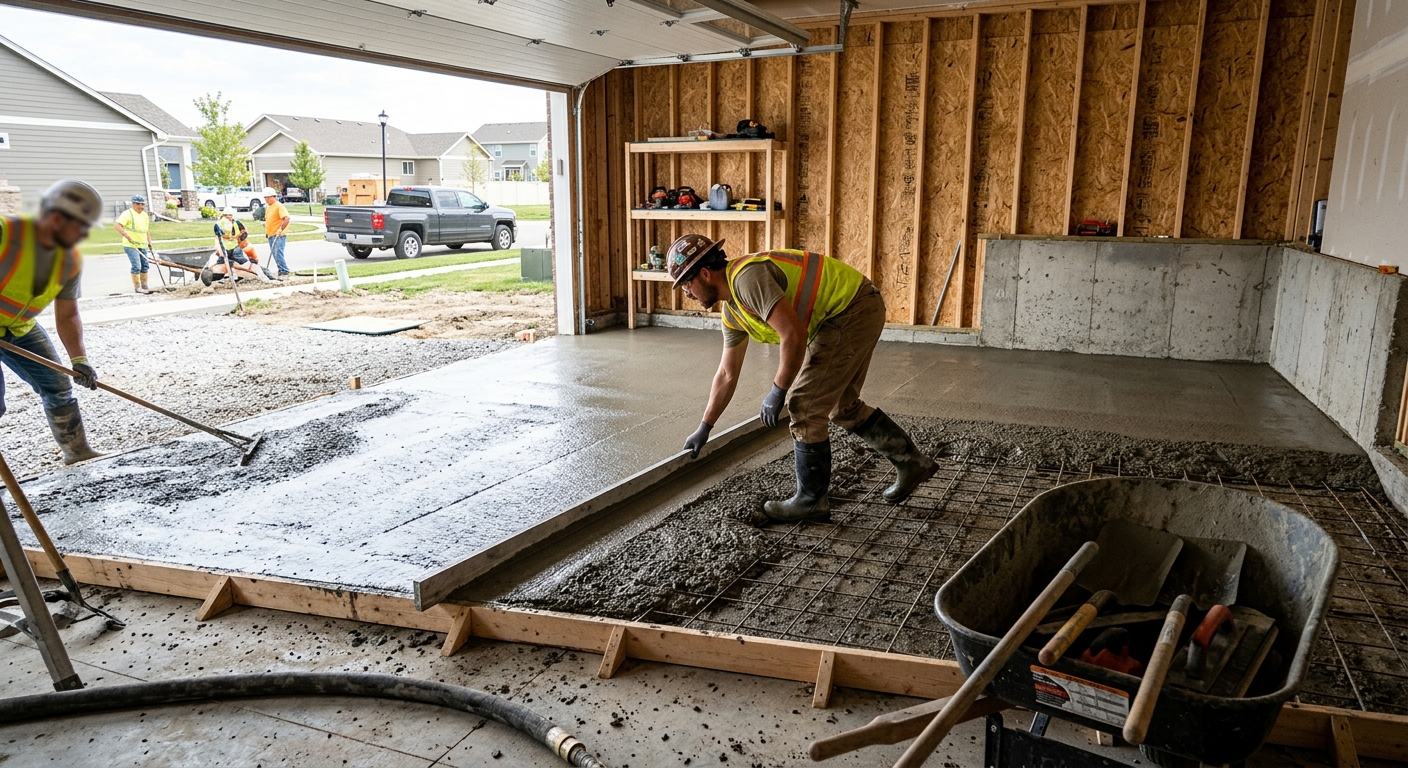
Concrete work options and costs in Grimshaw
Concrete work is a common upgrade in Grimshaw, especially where homeowners want durable surfaces that can handle local freeze–thaw swings. In this market, most of the housing stock is detached—74.1% of dwellings are single-detached—so driveways, patios, walkways and garage slabs are steady demand items. It’s also a “mature” housing base: 54.2% of homes were built before 1981, and older lots often need re-grading, drainage improvements, or replacement of cracked flatwork before a new slab will perform.
In the Athabasca–Grande Prairie–Peace River region, costs are driven heavily by climate and logistics—not just material price. Frost lines are deep and exterior concrete needs to be placed on footings and bases that sit below frost to prevent heave, which means more excavation, more forming, and more concrete volume than many southern projects. Freeze–thaw cycles also require air-entrained concrete for any exterior slab, plus careful curing in a shorter reliable pour season. Crews and equipment can be stretched during peak weather windows, so timing and access (especially in neighbourhoods like downtown/centre-ville Grimshaw where lots are often more compact) can influence the final budget.
Use the table below as a practical starting point for typical scopes—then we’ll break down what drives the spread between quotes.
| Application |
Typical Size |
Key Spec |
Finish Option |
Price Range |
| Concrete driveway (standard broom finish) |
24 ft x 10 ft (240 sq ft) |
5 in slab, air-entrained, compacted granular base |
Broom finish, control joints |
$3,400 – $4,800 |
| Exposed aggregate driveway |
24 ft x 10 ft (240 sq ft) |
5 in slab, air-entrained, proper curing |
Exposed aggregate with sealer-ready surface |
$4,200 – $6,200 |
| Stamped concrete driveway or patio |
20 ft x 12 ft (240 sq ft) |
5 in slab, air-entrained, integral colour |
Stamp pattern + release + seal |
$5,000 – $7,400 |
| Plain concrete patio or walkway |
12 ft x 10 ft (120 sq ft) |
4 in slab, air-entrained where exterior |
Smooth trowel or broom, light finishing |
$1,450 – $2,450 |
| Garage floor (interior slab) |
22 ft x 20 ft (440 sq ft) |
4–5 in slab, vapour barrier (as required) |
Broom finish, optional hardener |
$6,500 – $10,200 |
| Foundation footings (structural, below frost) |
Varies by house plan (typ. 8–12 lin ft per wall) |
Engineered dimensions, rebar, below-frost depth |
Structural concrete only (no decorative finish) |
$9,800 – $18,600 |
Prices are estimates only and vary by project scope, site access and material selection.
What affects the price of concrete work in Grimshaw
Even when two contractors quote what looks like the “same” concrete job in Grimshaw, prices can swing by 30–50% across the Athabasca–Grande Prairie–Peace River region and Alberta. The biggest reasons are the specs that protect the slab in our weather—frost depth, air-entrainment, base preparation, reinforcement and curing—plus how efficiently crews can work with winter access, travel time and equipment availability.
In this region, frost and freeze–thaw cycles dictate the job from the ground up: residential exterior footings and foundations must be set well below frost to prevent heave. Exterior slabs also need air-entrained mixes to survive repeated cycles that can lead to scaling and spalling. We often work with a shorter reliable pour season for flatwork, so cold-weather curing precautions—insulated blankets, heating setups, and extended cure times—can add cost but are the difference between a slab that lasts a decade and one that starts degrading early. De-icing salt is common on driveways, and it can accelerate surface deterioration if the concrete isn’t properly designed and sealed.
Concrete can cost more or less depending on your site conditions. For example: if your driveway needs significant re-grading and drainage corrections, you may pay closer to the upper end of driveway pricing (often aligning with the $14–$20 per sq ft band), while a simple replacement over a well-prepared base may land closer to the low-mid range. Older homes (like the 54.2% pre-1981 housing stock) often require additional excavation around existing footings or replacement of undersized drainage. On the decorative side, stamped work typically pushes the budget toward the $22–$35 per sq ft tier because it needs integral colour, release systems and more detailed finishing.
Below are the factors that most often explain quote differences, so you can compare apples to apples.
| Price Factor |
Why It Matters |
Cost Impact |
| Frost line depth |
Determines footing depth and how much excavation/forming is required |
Higher depth = more labour and concrete; can materially increase foundation/footing scopes |
| Site preparation |
Excavation, grading and compacted granular base control settlement and cracking |
Unfavourable soil/topsoil removal can push costs toward the upper range |
| Reinforcement |
Rebar or mesh affects resistance to cracking from loads and movement |
Steel detailing and placement labour adds cost, especially on larger slabs |
| Mix design |
Air-entrainment and compressive strength specs are critical for freeze–thaw durability |
Proper mix costs more but reduces early spalling and scaling call-backs |
| Finish type |
Broom, exposed aggregate and stamped finishes require different finishing systems |
Stamped/exposed often adds labour and sealer/colour materials |
| Pour size and concrete truck access to site |
Small pours and tight access can require extra handling, pumps or more trips |
Remote travel and access constraints increase crew time and equipment costs |
| Cold-weather curing precautions |
Heating and insulated blankets help concrete reach strength safely |
Can increase labour days and add equipment; often required near cold snaps |
| Control joint pattern and sealing cost |
Joint layout reduces random cracking; sealing helps resist de-icing salt damage |
Tighter jointing and sealing add cost but protect surface and edges |
Permits & regulations in Alberta
In Alberta, structural concrete work—think footings, foundation walls, and grade beams—typically requires a building permit, and many projects use engineered drawings that the municipality reviews as part of approvals. For concrete flatwork like patios, walkways and driveways, a permit is often not required unless the work impacts lot grading, drainage, or municipal impervious surface/lot coverage considerations, or it affects a municipal right-of-way.
Before breaking ground in Grimshaw, verify the plan is approved where required. Then, confirm the contractor is properly covered: ask for proof of liability insurance and WSIB/WCB coverage. These documents should match the contractor you’re hiring (and the job address).
How to check step-by-step:
- Confirm contractor registration/licensing: look up the business using Alberta’s relevant online construction/contractor registry options (and ensure the named company matches the quote).
- Request Certificate of Insurance: ask for a current COI showing liability coverage and the correct insured party; don’t rely on screenshots without dates.
- Verify WSIB/WCB coverage: request a clearance letter or proof of coverage number; follow up if the letter is expired.
- Check references: ask for similar scopes (driveways, footings, or slabs) built in northern Alberta conditions.
- Permit responsibility: ask who pulls the permit (if required) and whether permit fees are included.
Getting concrete right in Grimshaw's freeze-thaw climate
Concrete failures in Grimshaw usually come from predictable problems: inadequate base prep, poor mix design (especially insufficient air-entrainment) and rushed curing during cold snaps. With freeze–thaw cycles, water infiltrates tiny surface or edge defects and expands as it freezes, leading to scaling and eventually spalling. The spec that matters most is durability: proper base compaction, an exterior-grade air-entrained mix, controlled jointing, and curing that allows the concrete to reach strength before winter stresses hit.
To spec the job correctly: (1) Base preparation—ensure a compacted granular sub-base to the right depth for local soil and frost protection; don’t bury organics or oversize topsoil. (2) Mix design—for exterior flatwork, target 5–7% air and a minimum 32 MPa compressive strength. (3) Control joints—plan spacing so cracking is controlled, not random. (4) Curing—minimum 7 days under proper conditions, and if it’s cold, curing may need blankets or heat to protect early strength gain. (5) Sealing—apply a penetrating sealer about 28 days after the pour to help repel de-icing salt effects.
As you compare options, note where price differences are justified. For example, a standard broom driveway might land in the $14–$20 per sq ft range, while stamped concrete typically moves toward the $22–$35 tier because of integral colour and finishing complexity. If a contractor prices stamped nearly like broom, ask how they’ll achieve proper colour hardener, release process and sealing.
The right technical questions help you avoid the most expensive failure mode: spalling from inadequate air-entrainment and rushed curing.
| Spec |
Why It Matters in Grimshaw |
What to Ask For |
Impact if Skipped |
| Compacted granular base (depth?) |
Reduces settlement and keeps frost movement from damaging the slab |
Base depth and compaction method; confirm removal of topsoil/organics |
Cracking, uneven surfaces and premature failure |
| Air-entrained concrete mix (target air %?) |
Freeze–thaw durability depends on correct air content |
State air target (5–7% for exterior flatwork) and test/QA approach |
Scaling and spalling, especially along edges and corners |
| Compressive strength (MPa rating) |
Ensures the slab reaches design strength before cold weather stresses |
Minimum 32 MPa for exterior flatwork (and any engineered spec) |
Surface wear, cracking and reduced long-term performance |
| Control joints (spacing per ACI guidelines) |
Controls where shrinkage and movement cracks form |
Joint layout plan and spacing for your slab dimensions |
Random cracking and moisture paths for freeze–thaw damage |
| Minimum 7-day curing period |
Early strength gain is critical before temperature drops |
How curing is protected (blankets/heating if needed) |
Weak early structure and increased risk of surface deterioration |
| Penetrating sealer (when applied after cure) |
Helps repel de-icing salt and reduces moisture penetration |
Penetrating sealer scheduled about 28 days post-pour |
Faster staining, scaling and edge breakdown |
How to choose a concrete work contractor in Grimshaw
Choosing the right contractor in Grimshaw is mostly about verifying coverage and matching your scope to their documented experience. Start by confirming Alberta licensing/registration where applicable, then verify liability insurance and WSIB/WCB coverage. Ask for the current Certificate of Insurance and a WCB/WSIB clearance letter (not a general policy number). Check the insured party name matches the contractor on the quote, and that dates are current for the entire job window.
Next, get 2–3 written, itemised quotes rather than a single lump sum. You want to see separate line items for excavation and haul/disposal, granular base and compaction, reinforcement (rebar/mesh), concrete supply, forming, finishing, curing protection (blankets/heating if needed), and sealing (if included). Pay attention to what’s excluded: some quotes include concrete but not grinding, disposal, surface patching, or permit responsibilities.
Warranty matters too. Ask for a clear workmanship warranty length and what it covers (for example, surface scaling vs. structural issues). Also ask whether the product/manufacturer warranty is separate and whether it is transferable to you.
On payment, use a cautious schedule: never pay more than 10–15% upfront. Hold back the remainder until the job is complete, cleaned up and meets the agreed finish and jointing plan. Finally, demand a written timeline with a start date and estimated completion window—tight northern schedules can slip when crews and equipment are in peak demand.
- Use itemised quotes (labour + materials) not “global” lump sums.
- Confirm concrete mix specs: air-entrainment and minimum MPa.
- Require base prep details: excavation depth, compaction and granular type.
- Ask about reinforcement for your slab type (mesh vs. rebar placement).
- Get the proposed control joint spacing and layout in writing.
- Discuss curing plan for cold or windy days (blankets/heating if needed).
- Clarify whether sealing is included and when it’s applied (timing after cure).
- Confirm disposal/haul-away is included if excavation is required.
- Ask about protection of finished surfaces from early freezing.
- Verify liability insurance limits and certificate validity dates.
- Verify WSIB/WCB coverage with a clearance letter (not just a number).
- Set payment milestones with a meaningful completion holdback.
In Grimshaw, a few red flags I see often are: quotes that won’t state air content or compressive strength, “sealed later” promises without specifying when sealing is applied, vague base preparation descriptions, missing references for similar northern conditions, and demanding large upfront payments without a signed scope and schedule.
Frequently asked questions — concrete work in Grimshaw
Do I need a permit for concrete work in Alberta?
In Alberta, structural concrete—like footings, foundation walls and grade beams—usually requires a building permit and often engineered drawings reviewed through the municipal process. For flatwork such as driveways, patios and walkways, permits often aren’t required unless the work affects lot grading, drainage, impervious surface considerations, or a municipal right-of-way. For homeowners in Grimshaw, the practical step is simple: ask your contractor what permits (if any) are required and confirm with the local authority before excavation. Also verify the contractor’s documentation—liability insurance and WSIB/WCB coverage—so you’re protected if something changes during winter excavation and backfilling (Statistics Canada, 2021 Census shows Grimshaw’s household base is largely owner-occupied, which makes replacement decisions common).
Concrete vs pavers for a patio in Grimshaw?
Concrete and pavers both can perform well in Grimshaw, but they fail differently. Concrete patios rely on correct base prep, air-entrainment (if exterior) and properly spaced control joints. Pavers depend on a well-draining base, correct bedding sand depth and firm edge restraint so they don’t shift during freeze–thaw. In a northern climate, concrete is often the more straightforward long-term “maintenance plan” when it’s built with a compacted granular base and proper curing; pavers can be repaired panel-by-panel if something settles. Cost-wise, a plain concrete patio may fall around $1,450 – $2,450 for a small typical footprint, while paver pricing varies widely with the unit cost and labour intensity. The best choice depends on whether you want a continuous surface (concrete) or a modular repair approach (pavers), and both should include drainage planning.
How long does a concrete driveway last?
A well-built concrete driveway in Grimshaw commonly lasts 20+ years, and longer when it’s designed for freeze–thaw and salt exposure. What drives lifespan is the early foundation: compacted granular base, correct air-entrainment for exterior exposure and a curing plan that protects early strength. Control joints also matter—proper spacing reduces random cracking that lets water infiltrate and freeze at the slab edges. Many replacements occur in older neighbourhood lots (Grimshaw’s housing includes a large share built before 1981), where the base may have settled or drainage has changed. If you’re comparing quotes, pay attention to finishing and durability claims; a “cheap” broom driveway often skips curing blankets or uses an under-specified mix. For budget reference, driveway pricing is often in the $14–$20 per sq ft band for standard work, while decorative options can be higher because they need extra finishing systems.
What is air-entrained concrete and why does it matter here?
Air-entrained concrete is engineered to include tiny, evenly distributed air bubbles that provide room for water to expand when it freezes. In Grimshaw’s freeze–thaw cycle, that air cushion is what reduces the risk of surface scaling and spalling. Without the correct air content, exterior slabs can start deteriorating along edges and corners after repeated temperature swings, even if the slab “looks fine” the first year. This is why good concrete quotes should state an air-entrainment target (commonly about 5–7% for exterior flatwork) and include a curing plan. If a contractor won’t confirm that spec, treat the quote as incomplete. For exterior slabs and driveways in the Athabasca–Grande Prairie–Peace River region, air-entrainment isn’t optional—it’s part of why properly installed concrete costs more upfront but lasts longer under northern conditions.
How do I prepare the base for a concrete slab?
Base prep is the “invisible” work that protects your slab. For Grimshaw, it typically starts with removing unsuitable material (topsoil and organics), then excavating to the correct depth and placing a compacted granular sub-base. The contractor should specify base depth and the granular material used, then compact it in lifts to achieve uniform support. If there’s drainage risk, slope and sub-drain considerations should be part of the plan—because water sitting under a slab contributes to frost-related movement. Once the base is compacted, reinforcement placement (mesh or rebar where required) and proper forming keep the concrete thickness consistent. A common mistake is rushing base compaction; it may not be obvious immediately, but it shows up as settlement cracks and rough edges. When comparing quotes, ask whether base preparation is included and how they confirm compaction before the pour.
How do I compare concrete quotes?
To compare concrete quotes fairly in Grimshaw, insist on like-for-like specs and line items. Start by requesting a scope sheet that lists: excavation and disposal, granular base type and compaction method, slab thickness, reinforcement approach, concrete mix requirements (including air-entrainment and minimum MPa), finishing method, control joint spacing and whether sealing is included. Then compare the schedule—cold-weather curing may require heating or insulated blankets, and contractors should state whether those costs are included. A realistic price band helps sanity-check: for example, a standard concrete driveway often lands in the $14–$20 per sq ft range, while stamped concrete work is commonly higher, often tracking the $22–$35 tier because of integral colouring and finishing complexity. Finally, confirm coverage: liability insurance and WSIB/WCB proof. If one quote is dramatically cheaper and can’t explain the missing items, that’s a risk signal.