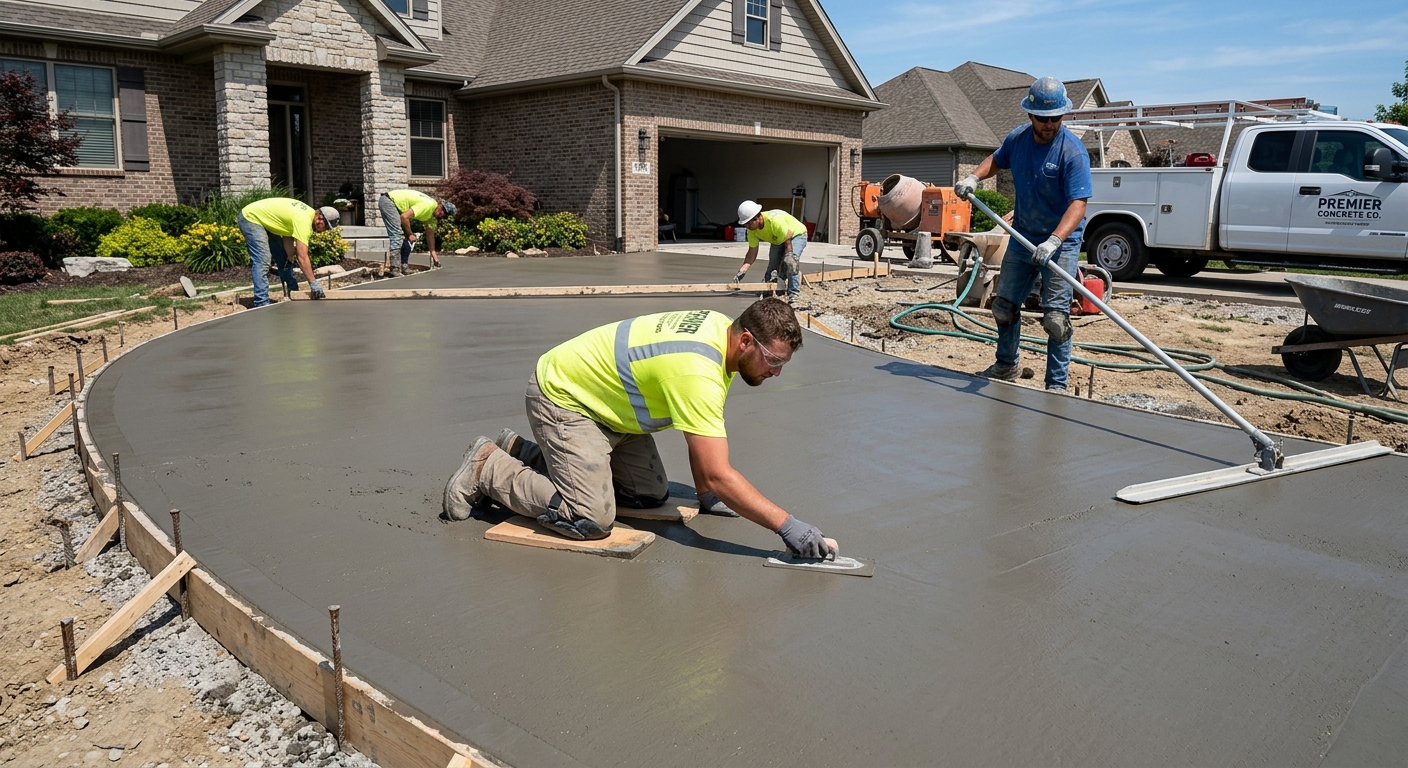
Concrete work options and costs in North Glenmore
Concrete work in North Glenmore, Alberta is shaped by a cold continental climate and a deep design frost depth, so the “same” driveway or patio can cost noticeably more here than in milder areas. North Glenmore is a smaller community within the broader Calgary market (population 2,435 as of the 2021 Census, Statistics Canada), and that size affects contractor availability and scheduling—especially for exterior flatwork where winter-ready curing plans are sometimes needed. Demand is closely tied to housing type and lot development patterns; in Calgary’s core and surrounding communities, many neighbourhoods are dominated by single-detached home lots where homeowners commonly upgrade driveways, patios and walkway connections.
In practice, Calgary-area concrete pricing reflects more than just the slab. Footings for foundations and some retaining features often must bear below frost depth (engineered around a design frost depth of about 1.2 m in Alberta), and that means more excavation and more concrete than many homeowners expect. Freeze–thaw cycles also drive mix design (air-entrainment), base preparation (granular compaction), and careful control joint layout to reduce cracking and surface deterioration. Exterior slab pours have a shorter practical season, so if you’re scheduling in late fall or early spring, contractors factor in winter-grade mix, insulated curing blankets and sometimes supplemental heat to protect the cement hydration process.
In North Glenmore, these trades are especially busy in fast-growing residential pockets near the Calgary boundary where lots are being serviced and driveways are being rebuilt. With that context, here’s a practical side-by-side comparison to help you budget before you request quotes.
| Application |
Typical Size |
Key Spec |
Finish Option |
Price Range |
| Concrete driveway (standard broom finish) |
400–600 sq. ft. |
Air-entrained mix, compacted granular base, control joints |
Broom finish, saw-cut joints |
$12,000–$18,000 |
| Exposed aggregate driveway |
400–600 sq. ft. |
Air-entrained mix, cure/late-age exposure method |
Exposed aggregate texture |
$14,500–$22,500 |
| Stamped concrete driveway or patio |
300–500 sq. ft. |
Air-entrained mix, proper base and jointing for pattern restraint |
Stamp + release + color hardeners/antiquing |
$15,000–$26,000 |
| Plain concrete patio or walkway |
150–300 sq. ft. |
Air-entrained mix, compacted base, edge form + joints |
Light broom or smooth trowel with broom texture |
$5,000–$9,000 |
| Garage floor (interior slab) |
400–520 sq. ft. |
Vapour control + reinforced slab where required |
Steel trowel or broom finish depending on use |
$10,500–$16,000 |
| Foundation footings (structural, below frost) |
Per engineered design |
Reinforced concrete; bearing below design frost depth |
Structural grade concrete (finish not applicable) |
$28,000–$45,000 |
Prices are estimates only and vary by project scope, site access and material selection.
What affects the price of concrete work in North Glenmore
In the Calgary region, it’s common to see quotes for the “same” concrete job swing by 30–50% once you price the real scope: excavation depth, granular base thickness, reinforcement requirements, finish complexity, access for the concrete truck, and—most importantly—cold-weather and freeze–thaw durability specs. Two contractors may both call it a “driveway,” but one might be pricing a slab over minimal base with ordinary concrete, while the other includes the deeper engineered excavation and the correct air-entrainment and curing approach that Calgary’s cycles demand.
Frost depth and freeze–thaw cycles dictate the engineering. Footings must extend below the design frost depth (about 1.2 m in Alberta practice) to limit frost heave and seasonal movement. For exterior slabs, air-entrained concrete is essential so water that enters and freezes has room to expand without pushing the paste apart. Calgary also has a shorter practical pour season; when temperatures dip, crews may need insulated blankets, winter-grade protection, and tighter scheduling to keep curing on track—any delay can increase labour time and equipment costs.
Local conditions in North Glenmore raise or lower costs in practical ways. If your driveway ties into an older basement sump or has a deeper frost-protected edge condition, excavation and formwork increase. If you have poor drainage or clay subgrade, you’ll likely need thicker compacted granular base, which adds trucking and labour. Conversely, if you already have good access and stable granular soil, a standard broom-finished driveway can land closer to the lower end of the $12,000–$18,000 band. Finishes like stamped concrete are higher—often landing in the $15,000–$26,000 range—because of extra labour, materials, and tighter jointing to keep the pattern from highlighting random cracking.
| Price Factor |
Why It Matters |
Cost Impact |
| Frost line depth — determines footing depth and form height |
Controls how deep excavation must go to prevent frost heave |
More depth increases excavation, formwork, and concrete volume |
| Site preparation — excavation, grading, compacted granular base |
Good base compaction reduces settlement and keeps slabs level |
Heavier grading/haulage can add significant labour and trucking |
| Reinforcement — rebar or wire mesh requirement |
Improves crack control and structural capacity under loads |
Material and placement time can add cost, especially for thicker slabs |
| Mix design — air-entrainment and compressive strength spec |
Air-entrainment is key for freeze–thaw durability |
Correct mix can cost more but prevents premature spalling |
| Finish type — broom vs. stamped vs. exposed aggregate |
Complex textures need extra steps, timing, and materials |
Stamped and exposed options typically move you toward higher bands |
| Pour size and concrete truck access to site |
Small, tight access increases labour for placement and equipment |
Limited access can raise costs even with similar slab area |
| Cold-weather curing precautions — heating and blankets |
Protects cement hydration and surface durability |
Warmer-weather jobs are cheaper; winter protection adds daily costs |
| Control joint pattern and sealing cost |
Joints guide cracking and sealing helps resist salts |
Better jointing and sealing add labour/material but extend service life |
Permits & regulations in Alberta
In Alberta, structural concrete work typically needs a building permit and often engineered drawings, especially when the concrete is part of the load-bearing system. That includes footings, foundation walls, grade beams, and any structural foundation elements that affect how the home carries loads. For North Glenmore homeowners, this is where getting details right matters: the frost-protected design isn’t something you “guess” on site. Exterior flatwork like patios, walkways and standard driveways usually does not require a permit, unless it impacts lot grading, alters stormwater drainage, or touches municipal impervious-surface/coverage rules or right-of-way conditions.
Before you hire, verify the contractor is properly set up. Step-by-step, you can check:
- Alberta licence/clearance: Look for the contractor’s business details in the appropriate online registry results (use the company name and legal entity name). If they claim an accreditation, ask for proof and documentation numbers.
- Liability insurance: Request a current certificate of insurance made payable to you or your legal/owner-of-record. Confirm coverage is active for the dates of construction.
- WSIB/WCB coverage: Ask for current clearance documentation or evidence of coverage for workers. Don’t rely on verbal assurances.
- References: Ask for similar jobs in the Calgary region—driveways, patios, or foundation work—so you can confirm workmanship under Alberta freeze–thaw conditions.
If your project is near lot grading or drainage changes, confirm with your local authority before breaking ground so you don’t end up with costly rework after the fact.
Getting concrete right in North Glenmore's freeze-thaw climate
Concrete fails in North Glenmore mainly through moisture movement and repeated freeze–thaw. When water gets into the paste or behind a weak interface and then freezes, it expands and can push the surface layer off (spalling), especially where air-entrainment, curing, or jointing were compromised. The way to spec the job correctly starts with base prep, because a poorly compacted sub-base allows settlement cracks that water can exploit. Next comes mix design: for exterior flatwork, you want air-entrained concrete (commonly target 5–7% air content for exterior exposure) so freezing water has “space” to expand. Finally, the job needs a control joint pattern that limits random cracking, plus curing and sealing that keep moisture out.
For cold-weather placement in the Calgary market, don’t treat curing as optional. Minimum 7-day curing under proper conditions is the baseline, and if temperatures are dropping, crews may use insulated blankets and, in some cases, temporary heat. Skipping cold-weather precautions can be more expensive than doing it right: a resurfacing or early replacement often costs close to the original work, especially on driveways that see de-icing salts.
To justify the price differences: if you’re between a standard broom-finished driveway ($12,000–$18,000) and a stamped driveway or patio ($15,000–$26,000), the extra cost only makes sense when the contractor also budgets for correct base depth, correct air-entrainment, proper jointing strategy, and a curing plan that holds the finish quality without sacrificing durability.
Ask your contractor directly how they’ll prevent spalling by meeting the air-entrainment spec, how they’ll place and cure in the current forecast window, and what joint/seal plan they’re including for de-icing conditions.
| Spec |
Why It Matters in North Glenmore |
What to Ask For |
Impact if Skipped |
| Compacted granular base (depth?) |
Reduces settlement and prevents water pooling under the slab |
State the compacted base depth and soil prep method |
Settlement cracking, uneven slab, faster deterioration |
| Air-entrained concrete mix (target air %?) |
Improves freeze–thaw durability in Alberta’s winters |
Target air content (commonly 5–7% for exterior flatwork) and mix design paperwork |
Higher risk of spalling and scaling after freeze–thaw cycles |
| Compressive strength (MPa rating) |
Supports structural performance and reduces surface wear |
Minimum 32 MPa (or higher if engineered) and test/cert documentation |
Premature wear and cracking under load and salt exposure |
| Control joints (spacing per ACI guidelines) |
Controls where cracks form so they’re predictable and sealable |
Planned joint spacing, layout, and saw-cut timing |
Random cracking, water ingress, and joint sealing failure |
| Minimum 7-day curing period |
Ensures adequate hydration and surface integrity |
Curing method, including blankets/heating if cold weather hits |
Surface scaling, weak near-surface concrete, reduced longevity |
| Penetrating sealer (when applied after cure) |
Helps repel de-icing salts and moisture migration |
Confirm sealer is applied after cure—typically at 28 days post-pour |
Salt penetration accelerates spalling and staining |
How to choose a concrete work contractor in North Glenmore
Choosing the right concrete contractor in North Glenmore starts with verification. In Alberta, confirm you’re dealing with a business that can legally perform the scope and that it’s insured for construction risks.
- Licence/registration: Ask for their Alberta contractor information and any required business registration details.
- Liability insurance: Request a certificate of insurance showing current coverage limits and effective dates.
- WSIB/WCB clearance: Ask for current coverage documentation for workers on your project.
- Two or three quotes: Get itemised written quotes with labour and materials breakdown—not just a lump sum.
- Scope exclusions: Confirm what’s not included (demo, haul-off, topsoil removal, snow/ice management, permits if needed).
- Disposal included? Make sure removal of concrete and spoil is included if excavation is required.
- Reinforcement details: Ask whether rebar/wire mesh and chair supports are included (and what thickness).
- Mix design and air content: For exterior work, ask for air-entrainment targets and concrete spec sheets.
- Curing plan: In cold snaps, confirm blankets/heating is included or clearly priced as a variation.
- Control joints: Require a stated joint plan (spacing and saw-cut timing).
- Sealing: Ask if penetrating sealer is included and when it will be applied.
- Payment schedule: Don’t pay more than 10–15% upfront; hold back part of the payment until completion/cleanup.
Then keep it practical: require a clear start date and completion estimate in writing.
Concrete red flags in North Glenmore: vague “we’ll figure it out” answers about air-entrainment, no mention of frost-protected excavation or granular base depth, refusal to provide insurance/clearance documentation, quotes that omit jointing/sealing details, and unusually low pricing compared with the typical $12,000–$18,000 driveway or $28,000–$45,000 foundation-footings bands.
Frequently asked questions — concrete work in North Glenmore
How do I maintain concrete in North Glenmore's freeze-thaw climate?
In North Glenmore and across the Calgary region, maintenance is mostly about controlling moisture and salts. Keep water from pooling by maintaining downspouts and ensuring the grading slopes away from the slab. If you use de-icing salt, use it moderately and avoid blasting ice directly with metal tools that can chip edges and joints. For exterior flatwork, sealing is a key durability step: a penetrating sealer applied after the concrete has fully cured helps repel water and salt intrusion. Inspect control joints a few times per year—if joints are failing or debris-filled, water can migrate and accelerate freeze–thaw damage. If you’re budgeting, remember that a sealed, properly spec’d driveway in the general $12,000–$18,000 range typically lasts longer than a “cheaper” slab that skips correct mix and cure steps.
What causes concrete to spall in North Glenmore winters?
Spalling usually comes from freeze–thaw pressure building up inside the concrete. In Alberta winters around Calgary, the most common causes are inadequate air-entrainment and curing shortcuts. If the mix doesn’t have the right air content for exterior exposure, water that enters pores freezes and expands, weakening the paste and breaking the surface layer. Another frequent contributor is poor base prep or weak interfaces that allow water to sit under or against the slab, feeding repeated wetting and freezing. High de-icing salt exposure can also worsen the surface once moisture is present, because salts pull in water and increase damage cycles. Scheduling matters too: if concrete is placed and cured during cold weather without blankets/heating, early surface scaling is more likely. A contractor who can show an exterior-grade air-entrainment plan and a winter curing approach is protecting you from those failures.
What is rebar and when is it required in Alberta?
Rebar is steel reinforcing bars embedded in concrete to improve strength and crack control—especially where slabs and beams carry structural loads or where the design anticipates tension forces. In Alberta, whether rebar is required depends on the engineered design and the thickness/usage of the slab or foundation element. Structural work like foundation footings and foundation walls is typically engineered and will specify reinforcement and concrete specs. For exterior flatwork like driveways, reinforcement requirements are common for thicker or higher-load areas, but some designs use wire mesh or a combination with slab thickness and base support. The important part for homeowners is to ask your contractor to point to the design criteria in their quote: slab thickness, reinforcement type/placement, and chair support so steel stays properly embedded. Don’t assume “more is better”—the correct spec for freeze–thaw durability and loading matters more.
How long does a concrete project take in North Glenmore?
Timelines vary with site conditions, weather, and scope, but you can think in phases. Prep and base work often takes the longest upfront for driveways and patios because excavation, grading and compaction must be done correctly for Calgary freeze–thaw durability. Concrete placement itself is usually a single day, but the project is not “done” until curing conditions are met and finishing/sealing steps are complete. Standard exterior slab work also depends on temperature; in late fall or early spring, crews may need insulated blankets and heating to maintain proper curing, which can extend the calendar schedule even if the pour day is quick. Sealing typically isn’t immediate—penetrating sealer is commonly applied about 28 days after the pour once curing is complete. If you’re planning around family move-in dates, align your expectations with the curing schedule rather than only the pour day.
What is a concrete overlay and is it suited to North Glenmore?
A concrete overlay is an additional layer poured over an existing slab—usually to improve appearance and level out minor deterioration without full replacement. In North Glenmore, overlays can be suited to the right situation, but they’re not a universal fix. Overlays work best when the original slab is still structurally sound, properly bonded surfaces can be achieved, and drainage issues are addressed—otherwise the overlay can bond poorly and deterioration continues underneath. Calgary’s freeze–thaw cycles and de-icing salts make the bond and moisture control critical. You’ll also want to understand joint lines: if the original slab has major cracking or active movement, the overlay may reflect those problems. If your existing driveway is failing or the slab is uneven with significant settlement, full replacement tends to be the more durable approach, and budgeting often aligns with the typical $12,000–$18,000 driveway band rather than gambling on a cheaper surface solution.
How do I seal concrete to protect it in North Glenmore?
Sealing is about repelling water and salts so freeze–thaw cycles don’t keep breaking down the surface. In North Glenmore, use a penetrating sealer designed for exterior concrete; these products soak in and help reduce moisture migration. The timing is important: plan for sealing after the concrete has properly cured—commonly about 28 days post-pour—so the sealer can do its job rather than trapping excess moisture. Before sealing, the surface should be clean and free of dust, curing residue, and loose particles; a good contractor will prep accordingly. Also, sealing can’t replace proper mix design (air-entrainment), base prep, or control joints—those are the backbone. If you’re comparing quotes, ask whether sealing is included and which sealer type is specified. That’s especially relevant for driveways and patios where salt exposure is heavy.