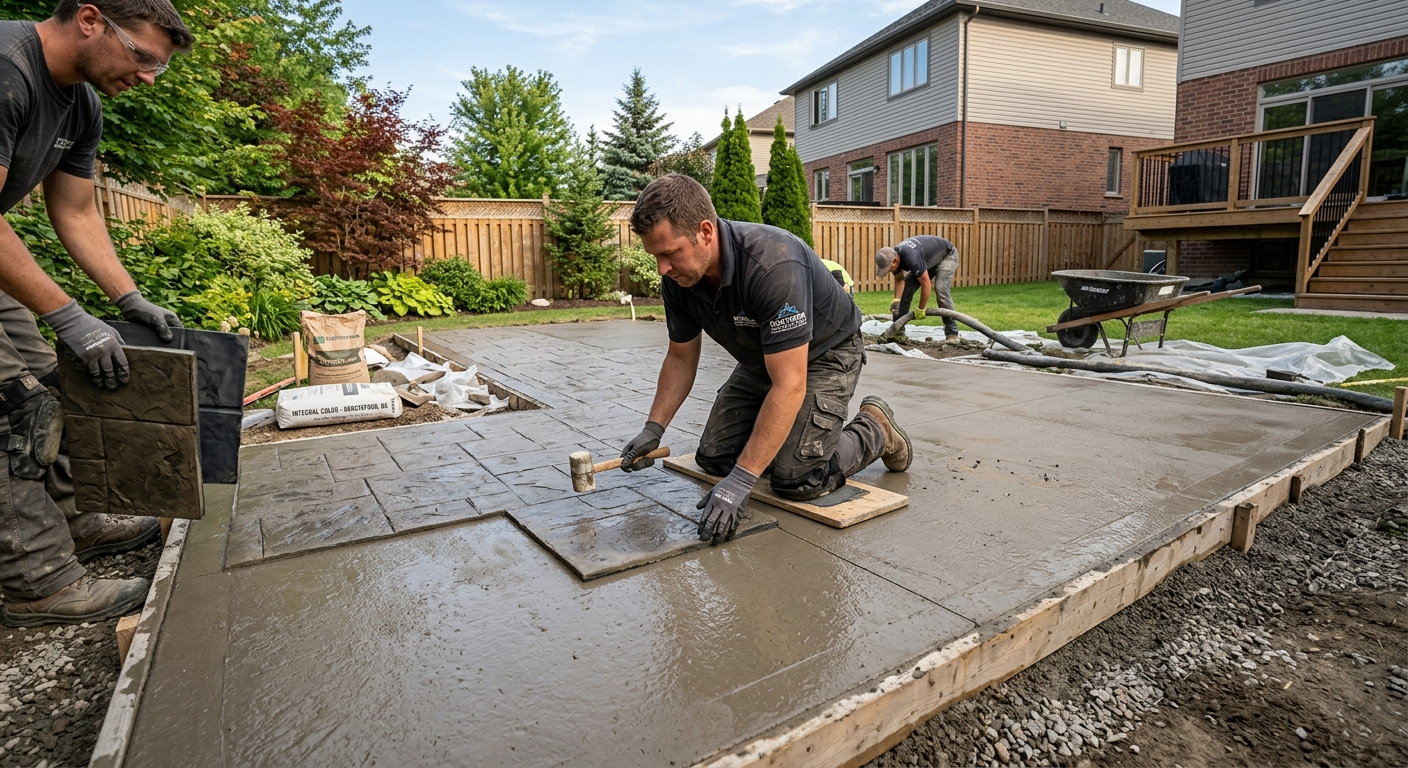
Concrete work options and costs in Abbottsfield
Concrete work in Abbottsfield, Alberta is typically driven by the same practical constraints Calgary homeowners see across the region: cold winters, frequent freeze–thaw cycles, and a deeper design frost line that forces more excavation for durable foundations and exterior flatwork. With a 2021 population of 1,775 (Statistics Canada, 2021 Census), Abbottsfield is a smaller market, so many concrete projects are scheduled alongside crews moving through Calgary—especially when multiple homeowners want driveway and walkway upgrades in the same season.
In this part of the Calgary economic region, the most common concrete flatwork projects tend to support single-detached housing and related upgrades, where driveways, patios, and garage floors are the first “high-visibility” improvements. That means contractors who can form, pour, and cure properly during a short exterior season are in demand—particularly near busier residential corridors around Calgary’s northeast and connecting areas where lots of owners plan landscaping and hardscaping in spring.
Because Calgary-area weather changes fast, pricing can shift from one quote to the next: exterior pours often need winter-grade considerations (insulated blankets and sometimes temporary heat) to protect curing, and slabs require air-entrained mixes and good granular base prep to resist scaling and spalling. Foundations also cost more here than in milder provinces because footings must bear below the local design frost depth (about 1.2 m in Alberta practice), which increases footing volumes and labour time. For many homeowners, the “right” option is the one that matches how much freeze–thaw punishment the surface will take—then fits the budget bands used across the Calgary area.
Use the comparison table below to map typical project types to realistic cost ranges in Abbottsfield.
| Application |
Typical Size |
Key Spec |
Finish Option |
Price Range |
| Concrete driveway (standard broom finish) |
24 ft x 10 ft (240 sq. ft.) |
Air-entrained mix, compacted granular base, control joints |
Broom finish |
$12,500 – $17,500 |
| Exposed aggregate driveway |
24 ft x 10 ft (240 sq. ft.) |
Air-entrained mix, retarder or wash process, sealed surface |
Exposed aggregate |
$14,500 – $20,500 |
| Stamped concrete driveway or patio |
200–300 sq. ft. |
Air-entrained mix, integral colour, release agent, proper curing |
Stamp pattern + colour |
$16,000 – $26,000 |
| Plain concrete patio or walkway |
10 ft x 12 ft (120 sq. ft.) or 3 ft x 20 ft (60 sq. ft.) |
Air-entrained mix, compacted sub-base, joints |
Float/trowel with light broom |
$5,500 – $9,000 |
| Garage floor (interior slab) |
24 ft x 22 ft (528 sq. ft.) |
Reinforcement (mesh), proper thickness, vapour considerations if needed |
Broom finish |
$11,000 – $17,000 |
| Foundation footings (structural, below frost) |
Typical detached house footprint (varies) |
Engineered footing size/rebar, excavation below design frost depth |
Structural finish (not a decorative surface) |
$30,000 – $45,000 |
Prices are estimates only and vary by project scope, site access and material selection.
What affects the price of concrete work in Abbottsfield
In Abbottsfield, Alberta, it’s common to see quotes for the “same” concrete project swing by 30–50% across Calgary and the broader region. The biggest drivers are usually not the concrete itself—they’re the excavation depth, the granular base prep, the reinforcement details, and how the contractor protects curing during freeze–thaw conditions. In practice, crews that budget properly for frost protection and cold-weather curing can price higher, but they reduce the risk of early scaling, cracking and spalling, which is where low bids often come back to cost you.
Here, the frost line and freeze–thaw cycling dictate nearly every spec. Footings for houses, garages, decks and retaining structures must extend below the design frost depth (about 1.2 m in Alberta practice) so the soil below stays stable and doesn’t heave. Exterior slabs also need air-entrained concrete to survive repeated cycles; that air entrainment is not optional if you want long-term durability, and it’s one reason an exterior driveway can land in the $12,000–$18,000 band rather than a bare “materials-only” figure. When pours happen in shoulder seasons, the short effective placement window can require cold-weather curing precautions—insulated blankets and controlled curing temperatures—which add labour and equipment cost.
Two concrete examples from Abbottsfield: (1) a driveway that looks straightforward can jump noticeably when the sub-base is deeper than expected due to local grade changes or removal of unsuitable material; (2) a decorative stamped job can cost significantly more than plain concrete (often in the $15,000–$26,000 range) because it adds colour, release agents, and stricter curing and timing. On older homes, foundation retrofits and re-levels may also trigger extra excavation and disposal, which can push the project toward the upper end of the $28,000–$45,000 foundation band.
| Price Factor |
Why It Matters |
Cost Impact |
| Frost line depth — determines footing depth and form height |
Footings must bear below design frost depth to reduce frost heave risk |
Higher excavation volume; more formwork and concrete |
| Site preparation — excavation, grading, compacted granular base |
Sub-base stability controls settlement and cracking patterns |
Extra hauling/compaction time can add thousands |
| Reinforcement — rebar or wire mesh requirement |
Controls cracking and improves slab performance under loads |
Material + labour to place and support reinforcement |
| Mix design — air-entrainment and compressive strength spec |
Air entrainment resists freeze–thaw damage; strength supports long-term durability |
Higher-spec mix; sometimes longer pump/placement planning |
| Finish type — broom vs. stamped vs. exposed aggregate |
Decorative finishes add steps and stricter surface timing |
More labour and specialty materials |
| Pour size and concrete truck access to site |
Smaller access issues increase labour for placement and finishing |
Potential spot-pour logistics and extra crews/hours |
| Cold-weather curing precautions — heating and blankets |
Improper curing in cold conditions increases scaling and surface failure |
Blankets/heat rental and monitoring labour |
| Control joint pattern and sealing cost |
Joints manage shrinkage cracks; sealing helps resist de-icing salt damage |
Additional sawing, sealant product and scheduling at 28 days |
Permits & regulations in Alberta
In Alberta, structural concrete work—especially anything supporting a building’s load path—typically involves a building permit and often engineered drawings that get reviewed by the municipality. That includes footings, foundation walls, grade beams and other structural elements tied to the house’s foundation system. Concrete flatwork like patios, walkways and standard driveways usually does not require a permit by default, unless your project affects lot grading, impervious surface coverage limits, drainage patterns, or it touches municipal right-of-way requirements. The safest approach in Abbottsfield is to confirm with the local authority before you break ground, particularly if you’re changing drainage or regrading for slope and runoff.
For selecting a contractor, verify they carry the right insurance and coverage. A homeowner should always request a certificate of liability insurance and proof of WSIB/WCB coverage (or appropriate clearance documentation depending on the contractor’s situation). Step-by-step, you can: (1) ask the contractor for their current liability certificate; ensure it includes the named insured and active job coverage; (2) confirm WSIB/WCB status by requesting clearance information directly from the contractor and matching it to the company’s legal name; (3) verify licensing eligibility by checking the appropriate Alberta registry entry tied to the contractor’s business name; (4) confirm they can provide references for similar-scale projects (driveway + approach work, or foundation footings with below-frost excavation).
Getting concrete right in Abbottsfield's freeze-thaw climate
Concrete failures in Abbottsfield usually come from a few predictable weak points: poor base preparation, mix designs without adequate air entrainment, and curing done too fast in cold weather. Freeze–thaw cycles can break apart weak, non-air-entrained mortar surfaces, leading to scaling and eventual spalling—especially where de-icing salts and water get trapped. To spec the job correctly, start with base prep: compacted granular sub-base at the right depth so the slab doesn’t settle and so frost can’t access unstable soil layers. Then move to mix design: for exterior flatwork, use air-entrained concrete with a typical target of 5–7% air content and plan a minimum 32 MPa compressive strength spec for durability.
Next, control joints. Proper joint spacing helps limit random shrinkage cracking (cracks you don’t control tend to show up where water can penetrate). Finally, curing and sealing matter more here than in milder climates: aim for at least 7 days of curing under suitable conditions. If you’re near freezing temperatures, ask about insulated blankets or temporary heat to keep the concrete protected while it gains strength. After curing—typically 28 days post-pour—use a penetrating sealer to repel de-icing salts and reduce moisture movement.
Where is the money justified? For example, a plain broom-finished patio might fit in the $5,000–$9,000 band, but adding sealing and the correct air-entrained mix is what keeps it from turning rough and flaky after winter. If you skip those specs, you risk early surface scaling and repair costs that quickly erase the savings.
| Spec |
Why It Matters in Abbottsfield |
What to Ask For |
Impact if Skipped |
| Compacted granular base (depth?) |
Stability prevents settlement cracking and helps manage frost influence at the slab edge |
Granular base depth based on local frost and soil conditions; compaction test method |
Uneven settling, random cracking, faster deterioration |
| Air-entrained concrete mix (target air %?) |
Freeze–thaw cycling depends on proper air void structure to resist scaling |
Target 5–7% air content for exterior flatwork; mix design provided |
Surface scaling and spalling within a few winters |
| Compressive strength (MPa rating) |
Strength gain supports long-term load and surface durability in cold climates |
Minimum 32 MPa (or higher if engineered/required by spec) |
Premature surface wear, cracking under normal use |
| Control joints (spacing per ACI guidelines) |
Manages shrinkage cracks and limits water intrusion into cracks |
Joint spacing plan and saw-cut schedule |
Random wide cracks and more costly repairs |
| Minimum 7-day curing period |
Cold conditions slow strength gain and increase surface vulnerability |
How they protect curing (blankets/heat) if temperatures drop |
Lower surface strength; higher scaling and dusting risk |
| Penetrating sealer (when applied after cure) |
Sealer helps resist de-icing salt and reduces moisture movement through the surface |
Penetrating sealer application around 28 days post-pour |
Faster breakdown and spalling near edges and traffic zones |
How to choose a concrete work contractor in Abbottsfield
Choosing a concrete contractor for projects in Abbottsfield comes down to verifying capability and coverage, not just getting a low number. First, confirm Alberta compliance and risk protection. Ask for a current certificate of liability insurance (showing the company’s legal name and active dates). Then verify WSIB/WCB coverage: request clearance information or proof of coverage documentation, and match it to the contractor you’re contracting with. For licensing eligibility, check the appropriate Alberta registry entry using the contractor’s legal business name, and make sure it aligns with the individual or company on the quote and contract.
Next, request 2–3 itemised written quotes rather than a single lump-sum. You want a breakdown that shows labour and materials, concrete placement assumptions, excavation and disposal, reinforcement details, and any cold-weather or curing protection line items. Carefully read what’s excluded: permit pull included or not, grading/drainage changes included or not, and whether saw-cut control joints and sealing are part of the scope. If a driveway quote lands near the $12,000–$18,000 band but excludes sealing and air-entrained mix details, that’s a red flag in a freeze–thaw climate.
Warranty matters too. Look for a workmanship warranty length in writing and ask whether the product/manufacturer warranty is included and whether it’s transferable to future owners. For payment, never pay more than 10–15% upfront; hold back a portion until completion and final cleanup. Finally, demand a start date and an estimated completion timeline in writing, including weather contingency planning for exterior pours in winter-edges.
- Confirm liability insurance certificate is current and matches the contract company name.
- Verify WSIB/WCB clearance/proof and keep a copy for your records.
- Request itemised quotes (labour, concrete supply, excavation, rebar/mesh, curing/blankets if applicable).
- Ask who is responsible for permit pulls (structural work usually needs one; flatwork may not).
- Get explicit base prep details (granular depth and compaction approach).
- Ensure the quote states air-entrained concrete and the intended exterior specs.
- Confirm reinforcement assumptions (mesh vs rebar, and where it’s placed).
- Ask about control joints: spacing and timing (saw-cut schedule).
- Clarify curing plan for cold nights (blankets, heat, and monitoring).
- Include sealing scope and schedule (penetrating sealer after cure, often around 28 days).
- Review disposal and hauling assumptions for removed soil or unsuitable material.
- Set payment terms: small deposit, then staged payments; holdback until final acceptance.
Concrete contractor red flags I commonly see in Abbottsfield include: vague specs that don’t mention air entrainment, refusing to provide insurance/WSIB/WCB proof, skipping compaction and basing plans to “save time,” pricing that’s far below the local $12,000–$18,000 driveway band without explaining mix/curing differences, and schedules that ignore cold-weather curing protection when temperatures fall near freezing.
Frequently asked questions — concrete work in Abbottsfield
How long does concrete take to cure?
In Abbottsfield, Alberta, curing time depends on temperature and whether cold-weather protections are used. For most structural concrete and exterior flatwork, you should plan for at least 7 days of curing before the surface is fully handled as “work-ready,” assuming proper curing conditions. True strength keeps developing beyond that—so you should avoid heavy loads and construction traffic until the concrete has reached the spec’d strength. If you pour in colder shoulder-season weather, contractors may use insulated blankets or temporary heat to maintain curing temperatures. For sealing (if included), plan on around 28 days post-pour for penetrating sealer so it can bond and perform as intended against de-icing salts and freeze–thaw exposure.
Do I need a permit for concrete work in Alberta?
Generally in Alberta, structural concrete work such as footings, foundation walls, and grade beams typically requires a building permit and often engineered drawings reviewed by the municipality. Concrete flatwork—driveways, patios and walkways—usually doesn’t require a permit by default, unless it changes lot grading, drainage patterns, or impervious surface considerations, or impacts municipal right-of-way requirements. In Abbottsfield, the practical advice is to confirm early with the local authority, especially if you’re altering grades or adding substantial new hard surface. If your job includes foundation work that extends below frost depth, treat it as permit-required until proven otherwise. A reputable contractor should be able to tell you which parts of the scope trigger permitting and who handles the paperwork.
Concrete vs pavers for a patio in Abbottsfield?
For patios in Abbottsfield, concrete is often the better value when you want a uniform surface that tolerates Calgary freeze–thaw cycles with the right air-entrained mix and control joints. Pavers can look great and sometimes offer easier individual panel replacement, but they still require excellent base prep and drainage detailing. If the contractor’s base preparation is weak, both systems can shift; the difference is that concrete failures often show up as cracking or surface scaling, while pavers may develop unevenness over time. Cost-wise, a plain concrete patio typically falls in the $5,000–$9,000 band, while pavers commonly come out higher once you include edging, base layers, and labour. With concrete, sealing after cure can meaningfully extend service life where de-icing salts and winter moisture are a factor.
How long does a concrete driveway last?
A well-built concrete driveway in Abbottsfield can last decades, but service life depends heavily on the specs and curing, not just the finish. In a freeze–thaw climate, the key durability factors are air-entrainment, compacted granular base prep, correct thickness, reinforcement (where applicable), and an appropriate control joint pattern. Sealing also matters because de-icing salts can accelerate surface wear and spalling. If your driveway is in the local $12,000–$18,000 range, a good contractor should be including air-entrained concrete and proper base prep—otherwise the price savings can shorten lifespan. Decorative options like exposed aggregate or stamped surfaces can look better, but they still need the same durability foundation to hold up to Alberta winters.
What is air-entrained concrete and why does it matter here?
Air-entrained concrete is designed with tiny air bubbles (entrained air) that give water expansion somewhere to go during freeze–thaw cycles. In Abbottsfield and the broader Calgary region, that matters because repeated freezing and thawing can otherwise break down the cement paste at the surface, causing scaling and spalling. For exterior flatwork, contractors typically target about 5–7% air content and specify a durable mix designed for freeze–thaw exposure. If a quote doesn’t clearly mention air-entrained mix design or shows vague language like “standard concrete,” treat it as an incomplete spec. You’ll often see higher quotes for proper mix design—yet it’s one of the main reasons durable driveways and patios survive Alberta winters without needing early repairs.
How do I prepare the base for a concrete slab?
Base preparation is the foundation of a long-lasting slab in Alberta. For Abbottsfield, start by ensuring the contractor excavates to the proper depth for local conditions and frost considerations, then installs and compacts a suitable granular sub-base. The goal is a stable, well-drained base that won’t settle or allow frost to work into unstable soil layers. Contractors should describe the granular material type, compaction approach, and how they deal with unsuitable soil or grade changes. Poor compaction is a common root cause of cracking and uneven surfaces. Ask how they confirm compaction (for example, using compaction testing methods where practical) and whether they’re allowing for proper drainage and thickness at edges, which is where many slabs fail first under freeze–thaw stress.