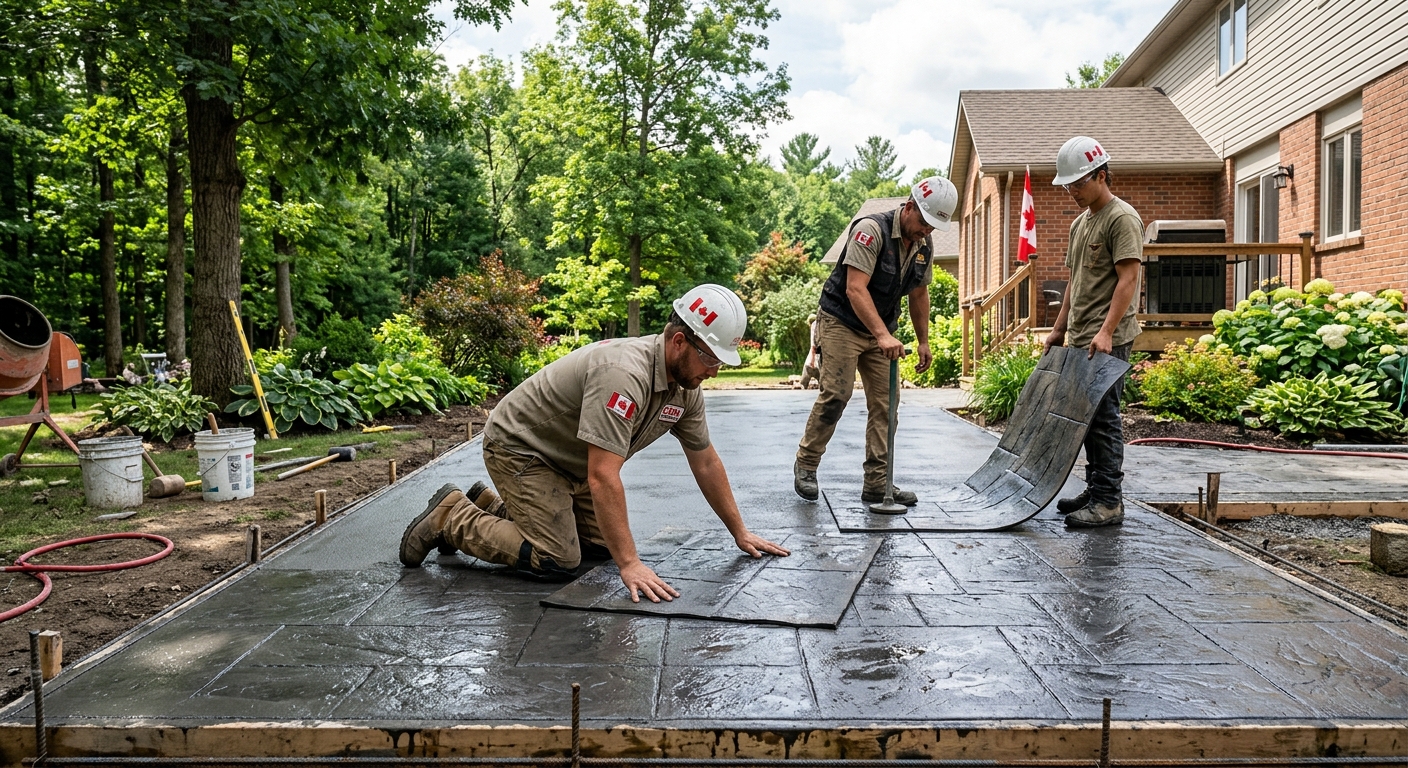
Concrete work options and costs in Bergman
Bergman is a small community on the Calgary side of Alberta, and that shows up in how concrete contractors schedule flatwork and foundations—jobs are planned tightly around weather, access, and crew availability. With a 2021 population of 1,452 (Statistics Canada, 2021 Census), the demand for driveways, patios, walkways and garage floors tends to cluster around active housing builds and renovations. You’ll usually see the most frequent concrete work tied to single-detached homes and family-focused lots, which is where durable exterior slabs and solid footings pay off. In the Calgary region, the cold continental climate and repeated freeze–thaw cycles are a big reason concrete pricing moves faster here than in milder provinces.
In practical terms, Calgary-area pours are engineered around a design frost depth of about 1.2 m (roughly 4 ft). That means excavation and footing volumes are larger, and foundation work costs run higher than in places with shallower frost penetration. For exterior slabs, air-entrained mixes, granular base prep, proper control joints, and winter-grade curing steps are standard—not optional—because cold-weather placement has a shorter “safe” window. If a contractor rushes curing during late fall or early spring, you can end up with surface scaling and long-term spalling.
In Bergman, demand is especially noticeable around established residential areas near local roads where vehicle access is typical—driveways and garage floors are often the first concrete projects homeowners tackle when upgrading curb appeal or preparing for a new build. Below is a straightforward comparison of common options and what they typically cost so you can line up quotes efficiently.
| Application |
Typical Size |
Key Spec |
Finish Option |
Price Range |
| Concrete driveway (standard broom finish) |
10 m x 3 m (30 m²) |
Air-entrained mix, compacted base, control joints |
Broom finish, saw-cut joints |
$12,000–$18,000 |
| Exposed aggregate driveway |
10 m x 3 m (30 m²) |
Air-entrained mix, proper retarder/application |
Exposed aggregate finish |
$14,500–$22,500 |
| Stamped concrete driveway or patio |
9 m² to 25 m² |
Air-entrained mix, reinforcement as required |
Stamped pattern + seal coat |
$15,000–$26,000 |
| Plain concrete patio or walkway |
12 m² to 20 m² |
Compacted granular base, air-entrained mix |
Float finish or light broom |
$5,000–$9,000 |
| Garage floor (interior slab) |
22 m² (e.g., 4.9 m x 4.5 m) |
Minimum 32 MPa mix, vapour control as needed |
Standard trowel or broom (light |
$9,000–$14,500 |
| Foundation footings (structural, below frost) |
Typical house footprint |
Engineered dimensions, excavation, rebar, below frost depth bearing |
Structural concrete (no decorative finish) |
$28,000–$45,000 |
Prices are estimates only and vary by project scope, site access and material selection.
What affects the price of concrete work in Bergman
In Bergman and the wider Calgary economic region, it’s common to see quotes for the “same” concrete job vary by 30–50%. The difference usually isn’t the concrete supplier—it’s the hidden engineering and site work: excavation depth, base preparation, reinforcement placement, mix design, curing method, and finish labour. Two contractors may both offer a driveway for roughly the same square footage, but one may be priced for a shallow base and generic mix, while the other is priced correctly for Alberta’s frost and freeze–thaw conditions. That’s why it’s easy to land in the driveway range of $12,000–$18,000 for a standard broom finish, while a more specialized build—like reinforced stamped work—can move toward $15,000–$26,000 once labour and materials step up.
Concrete engineering here starts with frost line depth. Exterior footings and foundation elements must bear on undisturbed soil below the design frost depth (about 1.2 m in this region) to prevent frost heave. Also, Calgary’s repeated freeze–thaw cycles require air-entrained concrete mixes for exterior slabs and work that faces road salt. Cold-weather placement shortens the pour season, and to achieve proper curing, contractors may use insulated blankets, winter-grade mixes, or temporary heat. Add in de-icing salt accelerating surface wear, and you typically need sealing and a well-planned joint pattern to reduce spalling.
In Bergman, costs can rise when access is tight (more labour time and sometimes smaller concrete pours), when the native soil needs deeper granular replacement, or when the design calls for reinforcement beyond wire mesh. Conversely, costs can soften when your site is level, base material is straightforward, and the pour area is consolidated into one efficient truck routing. Even with a small local population of 1,452 (Statistics Canada, 2021 Census), workmanship and engineering discipline drive pricing more than volume alone.
| Price Factor |
Why It Matters |
Cost Impact |
| Frost line depth — determines footing depth and form height |
Footings must extend below the design frost depth to prevent frost heave |
Higher excavation and concrete volume when deeper bearing is required |
| Site preparation — excavation, grading, compacted granular base |
Proper base reduces settlement and cracking during freeze–thaw cycles |
More granular and labour if soil is variable or needs replacement |
| Reinforcement — rebar or wire mesh requirement |
Improves performance under loads and helps control cracking |
Cost rises with steel quantity and placement labour |
| Mix design — air-entrainment and compressive strength spec |
Air entrainment protects against freeze–thaw damage and scaling |
Winter-grade/engineered mixes can increase material costs |
| Finish type — broom vs. stamped vs. exposed aggregate |
Finishes require different labour, tools, and sealing |
Stamped/exposed finishes typically add significant labour and materials |
| Pour size and concrete truck access to site |
Shortens placement time and reduces re-handling |
Tight access can add labour, pump/extra handling charges |
| Cold-weather curing precautions — heating and blankets |
Ensures concrete gains strength and cures properly in Alberta winters |
Blankets, heaters, and scheduling coordination add cost |
| Control joint pattern and sealing cost |
Joints manage shrinkage cracks; sealing repels salt and water |
More saw-cuts/edges and sealer product & labour |
Permits & regulations in Alberta
In Alberta, many concrete projects start with municipal planning and permit rules that depend on what the concrete is supporting and whether it changes drainage or building footprint. Structural concrete work—like house or garage foundation footings, foundation walls, grade beams, and other load-bearing elements—typically requires a building permit, and it’s often tied to engineered drawings that the municipality expects to review. For concrete flatwork (driveways, patios, and walkways), permits are usually not required by default unless the work affects lot grading, drainage, impervious surface coverage limits, or the municipal right-of-way (for example, work near a boulevard or curb tie-in). Because these details vary by lot and municipality, confirm requirements before excavation.
Before you sign anything in Bergman, verify the contractor is set up to work legally and safely in Alberta: ask for their certificate of insurance, and confirm they carry appropriate liability coverage. For worker coverage, request proof of WSIB/WCB coverage (coverage depends on the contractor’s setup). Then, get references on similar-scale work—especially cold-climate exterior slabs and below-frost foundation pours.
Step-by-step verification you can do as a homeowner:
- Request the contractor’s Alberta business details and license/registration information.
- Check licensing through the relevant online registry entry (and confirm it matches the company name on the quote).
- Ask for a current certificate of insurance and confirm it lists you or your property as additionally insured where applicable.
- Request WSIB/WCB clearance or proof of coverage documentation.
- Compare the scope wording to ensure permit responsibilities (if any) are clearly assigned.
Getting concrete right in Bergman's freeze-thaw climate
Concrete fails in Bergman’s freeze–thaw climate mainly when water gets in and then expands repeatedly through cold cycles. The most common homeowner-visible issue is spalling (surface scaling) caused by inadequate air-entrainment or poor finishing and curing. When de-icing salt and meltwater contact a weak or poorly protected surface, the top layer can break down faster than the interior—then it’s harder and more expensive to repair later. That’s why “good enough” specs don’t survive long here.
To get the job right, the spec should cover five essentials. First, base preparation: contractors should excavate to the proper depth for local soil conditions and then place a properly compacted granular sub-base. This matters because foundation-bearing and slab performance depend on support that doesn’t shift during freeze. Second, mix design: exterior flatwork should be air-entrained (typically 5–7% air content) and meet a minimum compressive strength such as 32 MPa, with winter-grade considerations when pours occur in cold weather. Third, control joints: use a predictable spacing pattern so cracks form where they can be managed. Fourth, curing: plan for at least 7 days of appropriate curing conditions; cold weather often requires insulated blankets and/or temporary heat to protect strength gain. Fifth, sealing: apply a penetrating sealer after the concrete has cured (commonly after 28 days) to help repel de-icing salts.
Ask your contractor directly how they’ll prevent the spalling pathway. If you’re comparing options, it’s usually worth paying for correct air-entrainment and curing controls even if it adds a few hundred to over a thousand dollars on a driveway or patio; skipping it is where long-term repairs start. For example, a standard broom driveway often lands in the $12,000–$18,000 band, but if you later need replacement or major patching due to scaling, you can easily exceed the cost difference of doing the proper spec the first time.
| Spec | Why It Matters in Bergman |
What to Ask For |
Impact if Skipped |
| Compacted granular base (depth?) |
Document the excavation depth to achieve a properly compacted sub-base suited to local soil and frost performance |
Settlement and cracking as freeze–thaw cycles lift and stress the slab |
| Air-entrained concrete mix (target air %?) |
Confirm air entrainment target (commonly 5–7% for exterior flatwork) and that it’s specified for freeze–thaw exposure |
Accelerated scaling/spalling when water and salt get into the surface |
| Compressive strength (MPa rating) |
Ask for minimum 32 MPa (or higher if engineered) and winter-grade requirements if conditions are cold |
Surface weakness, reduced durability, and premature wear |
| Control joints (spacing per ACI guidelines) |
Request a joint spacing plan that limits random cracking and includes curing/cut timing |
Uncontrolled cracks that allow water intrusion and freeze damage |
| Minimum 7-day curing period |
Confirm curing method and protection plan, especially for cold-weather scheduling |
Poor strength gain leading to brittle surface and early breakdown |
| Penetrating sealer (when applied after cure) |
Ask for penetrating sealer application after cure (often around 28 days) and confirm product type |
Faster salt and water penetration; surface deterioration increases |
How to choose a concrete work contractor in Bergman
Choosing the right contractor in Bergman is mostly about verifying coverage, matching the scope to Alberta’s cold-climate requirements, and getting quotes that break down what you’re actually buying. Start with licensing and insurance. Ask for the contractor’s Alberta business and any applicable registration/clearance details, then verify they carry liability insurance for jobsite risks. For worker coverage, request proof of WSIB/WCB coverage and a clearance letter or documentation that matches the company doing the work.
Next, insist on itemised written quotes. You want labour and materials broken down—excavation and base prep, reinforcement (if included), concrete supply, finishes, curing protections, saw-cut joints, and sealing (when relevant). Avoid “lump sum” quotes that don’t state what’s included, because concrete projects often change when excavation surprises show up or when reinforcement is required for the engineered design.
Also review warranty terms and payment structure. A workmanship warranty should be clearly stated with a timeframe and what it covers. Separate product/manufacturer warranty from labour coverage, and ask if it’s transferable to future owners. For payment, never agree to more than about 10–15% upfront; hold back the remaining balance until key milestones are completed and the surface is accepted. Finally, get a timeline in writing: a start date and completion estimate, especially for exterior work where cold curing precautions can shift schedules.
- Confirm Alberta registration/licensing information matches the contracting company on the quote.
- Get a current certificate of liability insurance before any work starts.
- Request WSIB/WCB clearance or proof of coverage.
- Ask for 2–3 itemised quotes (labour + materials, not just totals).
- Ensure excavation depth, base type, and compaction method are spelled out.
- Verify the mix design includes air entrainment for exterior freeze–thaw exposure.
- Confirm reinforcement scope (when required) and how it’s installed/positioned.
- Ask how control joints will be laid out and when cuts will be made.
- Confirm winter curing steps: blankets/heating if temperatures require it.
- Ask whether sealing is included (and when it’s applied after cure).
- Check disposal/haul-away is included if excavation is involved.
- Review warranty length for workmanship and confirm product warranty details.
Concrete red flags in Bergman: vague scopes that don’t mention air-entrainment or curing protections; quotes that exclude joint cutting or sealing without explanation; contractors asking for large upfront deposits (beyond ~10–15%); refusing to provide insurance/WSIB/WCB proof; and finishing details that look rushed (no protection plan for cold conditions after the pour).
Frequently asked questions — concrete work in Bergman
When is the best time to pour concrete in Bergman?
For Bergman, the best time to pour is when overnight temperatures are reliably warm enough for proper curing—typically late spring through summer, and into early fall if conditions stay favourable. Calgary’s freeze–thaw cycle means cold snaps can shorten the workable window for exterior slabs, especially driveways, patios, and walkway pours. If you’re scheduling later in the season, ask your contractor how they’ll handle cold-weather curing (insulated blankets, temperature monitoring, and sometimes temporary heat) to ensure strength gain. If curing can’t be protected, you’ll often see problems like scaling sooner, particularly in salted driveway areas.
As a rule of thumb, plan ahead so the crew isn’t forced into “rush curing.” If you’re doing foundation footings, timing also matters because excavation and inspection schedules affect below-frost work volumes. (Statistics Canada, 2021 Census: Bergman’s population is 1,452.)
How long does concrete take to cure?
Concrete doesn’t reach full strength in a day, and in Alberta you should plan curing with cold-weather realities in mind. A common benchmark is about 7 days for initial curing progress, assuming temperatures and protection are appropriate. Full design strength usually develops over a longer period (often around 28 days), especially for exterior durability under freeze–thaw loads. That’s why reputable crews protect the slab for at least the first week and then finish the job with sealing when the surface is properly cured.
For homeowners: don’t confuse “hard to touch” with “ready for long-term exposure.” If you’re comparing finishes, the durability difference matters—standard broom driveways might land around $12,000–$18,000, while stamped options (including sealing) often fall in the $15,000–$26,000 band because they rely more on controlled finishing and curing. Ask what protection plan is used if temperatures drop overnight.
Do I need a permit for concrete work in Alberta?
In Alberta, whether you need a permit depends on what you’re building with the concrete. Structural concrete work—like foundation footings, foundation walls, and grade beams—typically requires a building permit and often engineered drawings reviewed through the municipal process. For regular concrete flatwork (driveways, patios, and walkways), permits are usually not required unless the work affects lot grading/drainage, impervious surface limits, or involves municipal right-of-way areas.
For Bergman homeowners, the safe approach is to ask the contractor to confirm the scope against the local requirements before excavation. Also confirm who is responsible for any permit pull (if needed). Separately, verify the contractor carries liability insurance and has WSIB/WCB coverage documentation—those are practical “must-check” items regardless of whether a permit is required.
Concrete vs pavers for a patio in Bergman?
Concrete and pavers can both work well in Bergman, but the trade-off is usually cost predictability vs surface flexibility. Concrete patios (plain, stamped, or decorative) can be engineered with air-entrained mixes, proper base prep, control joints, and then sealed, which helps them resist water and de-icing salt conditions. Pavers can also perform well, but the overall system depends heavily on the base depth, bedding sand, and edge restraints; if those shift during freeze–thaw, you may see uneven settling or joint washout.
Price-wise, a plain concrete patio or walkway commonly falls around $5,000–$9,000 depending on size and site access. Stamped concrete patios generally move up toward $15,000–$26,000. If you want a low-maintenance, monolithic surface with fewer individual pieces to reset, concrete usually wins—but your decision should follow the base spec and drainage plan more than aesthetics alone.
How long does a concrete driveway last?
A properly built concrete driveway in Bergman often lasts decades, but “lasts” depends on construction details that target Alberta’s freeze–thaw stress. Key factors include air-entrained concrete, a correctly compacted granular base, reinforcement where required, correctly spaced control joints, and curing that isn’t rushed. Sealing also helps—especially in areas exposed to de-icing salt, where salts can accelerate surface spalling.
If a driveway is built with the right frost-aware base and engineered mix, it tends to perform better through repeated winter cycles. If it’s built with inadequate air entrainment or weak curing, surface scaling can appear early and repairs start sooner. Typical driveway budgets often fall in the $12,000–$18,000 range for a standard broom finish, and you’ll usually only justify stepping up (toward $15,000–$26,000) when the added finish and sealing are part of a full durability plan—not just a visual upgrade.
What is air-entrained concrete and why does it matter here?
Air-entrained concrete is mixed with microscopic air bubbles that create room for freezing water to expand without cracking the hardened paste. In Bergman and the Calgary region, freeze–thaw cycles are frequent, and exterior flatwork is exposed to meltwater and de-icing salts. Without the correct air content, water absorption and salt exposure can drive surface scaling and spalling over time—even if the concrete looks fine at first.
This is why you should ask for an air-entrained exterior mix and a proper finishing approach. Many exterior flatwork specs target about 5–7% air content and minimum 32 MPa compressive strength, with curing protections when cold weather is possible. If a quote doesn’t mention air entrainment and curing steps, treat it as incomplete for Alberta conditions. The cheapest bid on day one often becomes the most expensive when repairs begin.