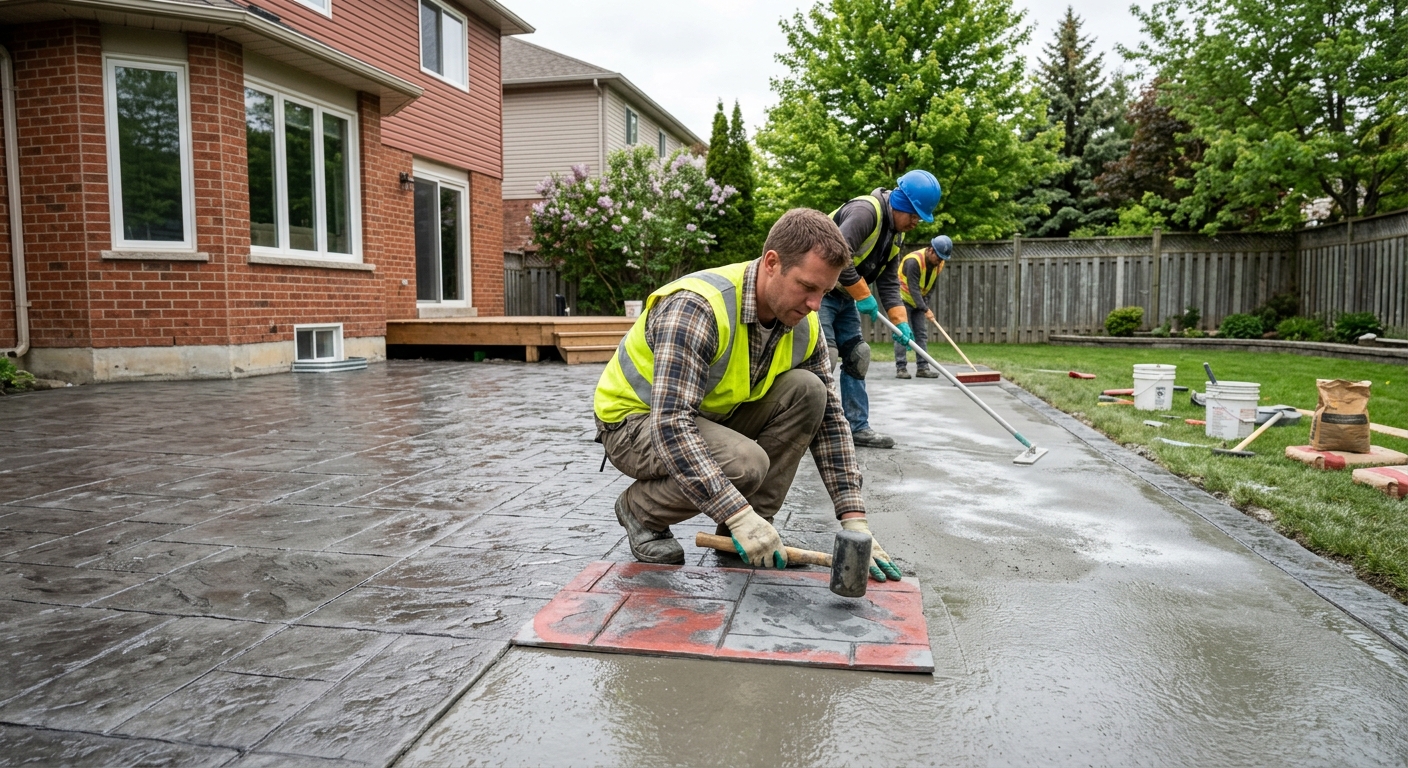
Concrete work options and costs in Mount Pleasant
Mount Pleasant, Alberta has a lot of demand for concrete flatwork—especially because the Calgary area market deals with deep frost and frequent freeze–thaw cycles. In a town of 6,325 people (Statistics Canada, 2021 Census), most homeowners are building or improving single-detached housing where driveways, patios, walkways and sometimes interior slabs are part of everyday maintenance and upgrades. That’s why you’ll see steady trade activity in established pockets like the Evergreen / country-reserve edges of Calgary-facing routes, where new infills and renovations tend to bring concrete crews back year after year.
Local pricing is shaped by the engineering reality that footings for houses, garages and retaining structures must sit below the design frost depth (about 1.2 m, roughly 4 ft, in this region) to reduce frost heave and seasonal movement. On top of that, exterior slabs need air-entrained mixes and better granular base prep to handle winter cycling. The concrete pour season is shorter than in milder provinces, and cold-weather placement often means insulated blankets or temporary heating to achieve proper curing—both of which add cost. Materials also vary: standard broom finishes are the most budget-friendly, while decorative work (stamped patterns and exposed aggregate) requires extra prep, additional labour, and higher material allowances.
Below are typical cost bands you can use when comparing quotes from Mount Pleasant contractors, before we get into what drives differences project to project.
| Application |
Typical Size |
Key Spec |
Finish Option |
Price Range |
| Concrete driveway (standard broom finish) |
24 ft x 10 ft (240 sq ft) |
Air-entrained mix for exterior, compacted base, control joints |
Broom finish |
$12,000–$18,000 |
| Exposed aggregate driveway |
24 ft x 10 ft (240 sq ft) |
Air-entrained mix, proper curing, aggregate exposure process |
Exposed aggregate |
$14,500–$21,500 |
| Stamped concrete driveway or patio |
20 ft x 12 ft (240 sq ft) |
Air-entrained exterior mix, densifier/sealer plan, control joints |
Stamped pattern |
$15,000–$26,000 |
| Plain concrete patio or walkway |
12 ft x 16 ft (192 sq ft) |
Air-entrained mix, compacted base, sawcut joints |
Plain broom |
$5,000–$9,000 |
| Garage floor (interior slab) |
24 ft x 24 ft (576 sq ft) |
Vapour barrier (if specified), reinforcement, proper curing window |
Light broom (or trowel float if required) |
$10,000–$16,000 |
| Foundation footings (structural, below frost) |
House/garage footing package (varies by plan) |
Excavation to frost depth, engineered rebar placement, concrete strength per design |
Structural finish (not decorative) |
$28,000–$45,000 |
Prices are estimates only and vary by project scope, site access and material selection.
What affects the price of concrete work in Mount Pleasant
In Mount Pleasant (and across the wider Calgary economy), it’s common to see quotes for what looks like the “same” concrete job differ by 30–50%. The biggest reason is that concrete pricing isn’t just the volume of cement—it’s engineered placement: excavation to correct depths, the quality of granular base prep, reinforcement detailing, concrete mix design (especially air entrainment), and the cure method needed to protect the slab during cold snaps.
Frost depth drives a lot of the cost variation. In this region, footings must extend below the design frost depth (about 1.2 m) so the ground can’t lift and settle seasonally. That means more excavation and larger footing volumes than homeowners expect. Freeze–thaw cycles also require air-entrained concrete for all exterior slabs, plus control joints spaced to limit random cracking. Calgary’s colder placement window is shorter too, so contractors may need winter-grade mixes, insulated curing blankets, and sometimes temporary heat—especially for patios and walkways poured in late fall. Add de-icing salt exposure, and sealing becomes a practical “must” to reduce surface scaling and spalling.
Concrete can be cheaper or more expensive depending on how your site behaves. For example, a driveway with easy truck access and solid native subgrade usually lands closer to the lower end of the $12,000–$18,000 driveway band. But if the base has to be over-excavated and replaced due to poor soils, the same driveway may move toward the high end. For a patio or walkway that’s well-sized and drained properly, the $5,000–$9,000 range is realistic; however, adding decorative borders, thicker edges, or extra reinforcement can push cost up quickly.
| Price Factor |
Why It Matters |
Cost Impact |
| Frost line depth |
Determines footing depth and form height |
More excavation and concrete volume; typically a major driver for foundations |
| Site preparation |
Excavation, grading, compacted granular base |
Bad soils or tight grading can add days and truckloads |
| Reinforcement |
Rebar or wire mesh requirement |
Labour-heavy installation; thickness and loading determine the spec |
| Mix design |
Air-entrainment and compressive strength spec |
Exterior air-entrained mixes and winter-grade requirements raise material cost |
| Finish type |
Broom vs. stamped vs. exposed aggregate |
Decorative work adds surface prep, labour, and finishing materials |
| Pour size and concrete truck access to site |
Placement logistics for consistent coverage |
Tight access may require pumps/longer labour; reduces efficiency |
| Cold-weather curing precautions |
Heating and blankets |
Shortens schedule risk but adds active protection costs |
| Control joint pattern and sealing cost |
Controls cracking and reduces salt damage |
Improper joints increase repairs; sealing is a recommended add-on for longevity |
Permits & regulations in Alberta
In Alberta, structural concrete work—like concrete footings, foundation walls, and grade beams—typically requires a building permit and, in many cases, engineered drawings that the municipality reviews. That includes foundation systems where loads are transferred into the ground, and anything tied directly to the engineered structural design of a house or garage. Concrete flatwork (driveways, patios, and walkways) usually does not require a separate permit by default, but you should confirm whether your scope affects lot grading, drainage, or any impervious surface coverage rules, and whether any work occurs near a municipal right-of-way. Before breaking ground in Mount Pleasant, always confirm with the local authority.
On the contractor side, protect yourself with paperwork checks. Step one: request the contractor’s liability insurance certificate (you want it in your name or at least showing they’re insured for work in your area). Step two: verify they have proper WSIB/WCB clearance for the concrete crew. Step three: ask for references on similar-scale Calgary-area projects—especially exterior slabs poured in winter. Finally, confirm the contractor understands Alberta documentation expectations: permit pull responsibility (who does it), inspection scheduling, and what happens if weather slows the cure window.
When you’re buying concrete work in Mount Pleasant, the best quotes are the ones that come with clarity: who pulls the permit, who provides engineered support documents (when required), and exactly what protection and curing method they’ll use.
Getting concrete right in Mount Pleasant's freeze-thaw climate
Concrete failure in Mount Pleasant usually isn’t “cheap concrete”—it’s concrete that wasn’t engineered for the freeze–thaw cycle. The common culprits are insufficient base preparation, weak or non-air-entrained mix, poor control joint planning, rushed curing, and skipping sealing where de-icing salts splash onto exterior surfaces. In a cold continental climate like Calgary’s, moisture expands as it freezes; if water can reach the slab edges or subgrade, the slab can heave, crack, and eventually spall.
To spec the job correctly, build the plan around five essentials. First, base preparation: a properly compacted granular sub-base to the correct depth for local soil conditions and frost considerations. Second, mix design: exterior air-entrainment typically targets about 5% to 7% air content, with at least a 32 MPa compressive strength (or higher if your engineer/spec requires it). Third, control joints: sawcut or tooled joints placed to manage shrinkage cracking—spacing needs to reflect slab size and thickness, not guesswork. Fourth, curing: plan for minimum 7-day curing under proper conditions; in cold weather, the contractor should use insulated blankets and/or heating so the slab reaches adequate strength without surface scaling. Fifth, sealing: apply a penetrating sealer after the concrete has cured (often around 28 days) to help repel de-icing salts and reduce surface damage.
Here’s where the money makes sense: a stamped patio might cost more than a plain broom-finished slab. If your choice between plain and stamped is, say, $5,000–$9,000 versus $15,000–$26,000, the premium is justified when the contractor is also getting the base, joints, and curing right—otherwise decoration only highlights problems faster.
| Spec |
Why It Matters in Mount Pleasant |
What to Ask For |
Impact if Skipped |
| Compacted granular base (depth?) |
Controls settlement and prevents water migration to the slab |
Base depth and compaction method documented; confirm over-excavation if soils are weak |
Uneven cracking, rocking slabs, and faster wear |
| Air-entrained concrete mix (target air %?) |
Improves freeze–thaw durability for exterior exposure |
Target 5%–7% air content for exterior flatwork; confirm mix is exterior-grade |
Spalling and surface scaling during winter cycles |
| Compressive strength (MPa rating) |
Ensures strength gain for trafficking and long-term performance |
Minimum 32 MPa (or higher per design); curing and protection plan tied to strength |
Surface weakness, cracking, and reduced lifespan |
| Control joints (spacing per ACI guidelines) |
Limits random cracking and guides where cracks form |
Joint spacing and sawcut timing confirmed; sealing plan if joints are filled/treated |
Cracks in visible areas and accelerated freeze–thaw damage |
| Minimum 7-day curing period |
Allows strength development before the worst weather returns |
What they’ll do to protect the slab (blankets/heat) if cold conditions occur |
Insufficient strength, scaling, and early deterioration |
| Penetrating sealer (when applied after cure) |
Helps repel moisture and de-icing salts that drive spalling |
Sealer type and schedule; typically after cure (often around 28 days) |
More salt damage, surface roughening, and quicker appearance deterioration |
How to choose a concrete work contractor in Mount Pleasant
Choosing the right contractor in Mount Pleasant is mostly about verification and documentation. In Alberta, ask for their liability insurance certificate and make sure it matches the work you’re hiring for, including concrete flatwork or structural concrete scope as applicable. Next, verify WSIB/WCB clearance—concrete crews use specialized labour and equipment, and you want proof they’re compliant for workplace coverage. Then check licensing or registration where required by their trade category and ensure they’re insured for the equipment they bring (saw cutting, excavation, pumps if used).
Get 2–3 itemised written quotes, ideally with a breakdown that separates labour, concrete supply, excavation/grading, reinforcement, forms, pumping (if needed), and finishing/sealing. A lump-sum number with vague language is where cost surprises happen. Read the scope for exclusions: is site disposal included? Is permit pulling included (where required)? Who protects landscaping during excavation? Is the schedule weather-contingent?
Warranty matters too. Look for a workmanship warranty that states duration and coverage clearly, and confirm whether the product/manufacturer warranty applies to the specific materials used. Ask whether warranties are transferable to future owners. Payment schedule should be conservative—never pay more than about 10% to 15% up front, and negotiate a holdback until the job is complete and your punch list is addressed. Finally, insist on start and completion timing in writing, including what happens if temperatures drop mid-cure.
- Ask whether they’ll use air-entrained mix for exterior slabs and provide the mix basis in writing.
- Confirm footing depth and frost planning for any foundation-related work.
- Request a detailed base prep plan (depth, compaction, and any soil stabilization).
- Check if reinforcement is included where required (and how it’s supported/spaced).
- Verify control joint spacing and sawcut timing to limit random cracking.
- Ask about cold-weather curing: insulated blankets, heating, and protection time.
- Get a sealing plan if it’s exterior and exposed to de-icing salts.
- Ensure concrete truck access and placement method are addressed (no “we’ll figure it out later”).
- Confirm disposal of excavated material and any backfill source/spec.
- Review the quote for exclusions: permits, inspections, pumping, and landscaping reinstatement.
- Ask for photos from similar Calgary-area winter pours and references you can call.
- Use a payment schedule with a holdback until finish items and cleanup are complete.
Concrete red flags in Mount Pleasant include: a quote that treats exterior slabs the same as interior (no air-entrainment discussion), skipping documentation on cure/blankets, promising decorative finishes without a base and joint plan, vague “all-in” pricing with no disposal or sealing scope, and contractors asking for large upfront payments before any protection and prep work starts.
Frequently asked questions — concrete work in Mount Pleasant
What causes concrete to spall in Mount Pleasant winters?
Spalling in Mount Pleasant winters is usually tied to freeze–thaw damage combined with de-icing salt exposure. When water gets into the slab surface pores, it freezes, expands, and breaks down the surface layer over repeated cycles. If the concrete wasn’t properly air-entrained for exterior exposure, freeze–thaw durability drops significantly and surface scaling can turn into spalling. Another contributor is inadequate base prep or poor drainage, which lets moisture collect near edges and joints. Sealing helps repel moisture and reduce salt penetration, but it has to be applied after the slab has cured—typically around 28 days. If your driveway or walkway is in direct salt splash zones, you’ll see deterioration sooner than a sheltered area. In Alberta, good joint spacing and winter-grade curing are just as important as the mix itself. (Statistics Canada, 2021 Census)
What is rebar and when is it required in Alberta?
Rebar (reinforcing bar) is steel reinforcement placed inside concrete to control cracking and help carry tension forces. It’s required when the slab or foundation design calls for reinforcement based on structural loads, slab thickness, soil conditions, and the engineering spec. In Alberta, structural concrete elements like certain footings, foundation walls, and grade beams typically require engineered reinforcement layouts and concrete strength specs—your drawings govern what’s needed. For interior slabs and some exterior flatwork, reinforcement may be required depending on thickness, whether the slab is load-bearing (like a garage floor), and the expected movement/settlement risk. A good contractor will explain whether mesh, rebar, or both are included and where it sits (proper cover), because reinforcement that’s placed too close to the surface can still fail during freeze–thaw. If your contractor can’t point to the design requirements, that’s a sign to ask more questions.
How long does a concrete project take in Mount Pleasant?
Concrete project timelines in Mount Pleasant depend on weather, cure protection, and site preparation. For many small flatwork jobs, you might see excavation and base prep completed in 1 to 2 days, followed by forming, reinforcement, pouring, and finishing on a single day. After the pour, the “calendar time” isn’t just until it looks done—curing is what matters. In cold conditions, crews often extend protection using insulated blankets or heating to support strength gain, and you should plan for at least 7 days before expecting normal use, with longer timelines for full strength readiness. Stamped and exposed aggregate work can add time because patterns, finishing steps, and curing/sealer coordination must be handled carefully. For projects like a standard driveway that falls in the $12,000–$18,000 band, a typical overall timeline is often about 1 to 2 weeks including prep, curing protection decisions, and final clean-up. If the soil needs additional removal or there are access constraints, expect longer.
What is a concrete overlay and is it suited to Mount Pleasant?
A concrete overlay is a new layer of concrete poured over an existing slab after preparation. It can be suited to Mount Pleasant when the existing driveway or walkway has stable base conditions, limited structural damage, and acceptable thickness for proper prep and bonding. However, overlay isn’t a bandage for a slab that’s heaved, severely cracked, or failing due to poor drainage—because the movement and moisture problems come through and can reappear under the overlay. Overlays also need proper surface preparation (often grinding and patching) to promote bonding, and they must still be engineered for exterior freeze–thaw durability with air-entrainment and appropriate curing. In this Calgary-region climate, you’ll also want an exterior sealing plan to resist salt-driven surface breakdown. If your existing slab is mainly cosmetic and firmly seated, overlay can sometimes save money compared to full replacement. If it’s structurally compromised, full replacement—often aligning with the $12,000–$18,000 driveway band depending on scope—will usually be the more reliable long-term fix.
How do I seal concrete to protect it in Mount Pleasant?
To seal concrete in Mount Pleasant, you generally wait until the slab cures fully—commonly around 28 days—then clean thoroughly so the sealer can penetrate properly. Penetrating sealers are typically used for driveways and exterior flatwork to repel moisture and reduce salt penetration, which helps lower the risk of surface scaling and spalling during freeze–thaw cycles. Timing matters: sealing too early can trap moisture and reduce effectiveness. Also, you should choose a sealer designed for exterior use in cold climates, and follow temperature and humidity requirements in the manufacturer’s instructions. Apply it evenly and let it cure as directed before heavy traffic or de-icing use. If you’re comparing concrete quote options, ask whether sealing is included—especially if you’re choosing finishes like broom concrete or stamped concrete. Decorative slabs often benefit from sealing not only for protection but also for appearance retention.
What is the difference between concrete and cement?
Concrete is the final building material you pour—it's a mixture made from cement, water, aggregates (like sand and gravel), and often admixtures such as air-entrainment for exterior durability. Cement is one ingredient in that mix. In Alberta’s freeze–thaw climate, the specific concrete mix design matters more than the word “cement” people commonly use. For example, exterior slabs typically need air-entrained concrete to survive winter cycling, and many projects specify a minimum compressive strength (often 32 MPa for flatwork unless engineering requires more). Contractors also use winter-grade practices and curing protection to help the concrete reach strength during a shorter pour season. So when a quote references “cement content” without explaining mix design and air entrainment, it’s incomplete. A quality contractor will talk about the whole concrete package—air content, strength target, base preparation, control joints, curing, and sealing—because that’s what determines how your driveway or patio performs through Calgary-area winters.