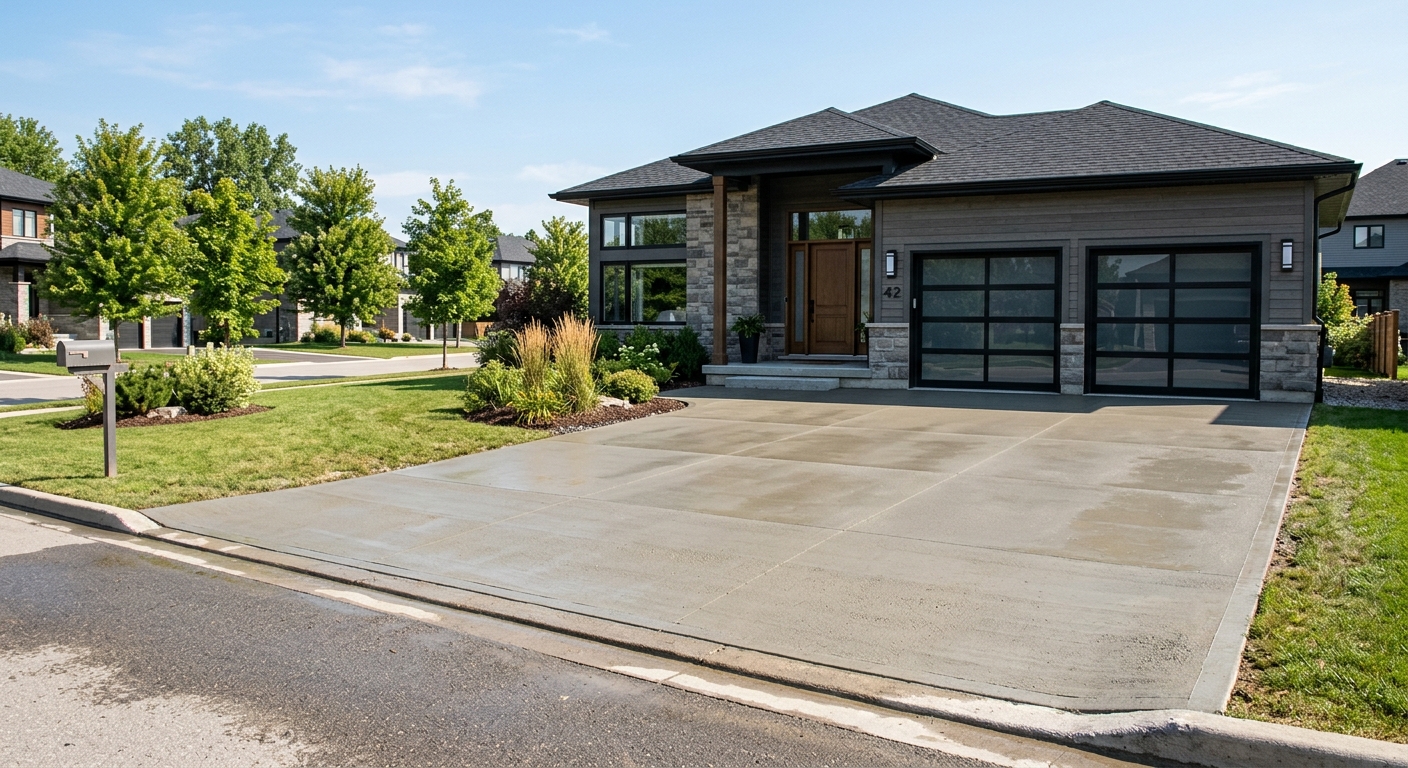
Concrete work options and costs in Lethbridge
Lethbridge is where concrete pricing has to reflect real winter performance. With single-detached homes making up about 62.6% of dwellings (Statistics Canada, 2021 Census), most homeowners are planning concrete flatwork—driveways, patios, walkways—and that means contractors are busiest in the exterior season. At the same time, a large share of the housing stock is older (44.8% of homes built before 1981), so upgrades like replacing cracked aprons, re-surfacing steps, or tying into existing grades are common in established neighbourhoods.
In the Lethbridge–Medicine Hat region, freeze–thaw cycles and a deep frost line are the cost drivers. Footings for structural work are typically taken below frost (often around the 5–6 ft range for structural elements), and exterior slabs require air-entrained concrete plus tight control joints to manage cracking. On top of that, the practical pour season for exteriors is shorter, so scheduling can be compressed into warmer weeks—especially when multiple crews are working on simultaneous residential projects.
You’ll notice demand concentrates in areas with lots of redevelopment and infill, including neighbourhoods such as Riverstone and Copperwood. For homeowners there, the “same-looking” concrete can come at different prices because prep, drainage, and mix spec change the long-term durability.
Use the table below as a realistic starting point, then we can narrow your scope to the right mix, base depth, and finish for your site.
| Application |
Typical Size |
Key Spec |
Finish Option |
Price Range |
| Concrete driveway (standard broom finish) |
24 ft x 10 ft (240 sq ft) |
Air-entrained exterior mix; granular base + compacted sub-base |
Broom finish |
$3,360 – $5,280 |
| Exposed aggregate driveway |
24 ft x 10 ft (240 sq ft) |
Air-entrained exterior mix; proper curing/protection |
Exposed aggregate |
$4,320 – $6,720 |
| Stamped concrete driveway or patio |
300 sq ft (example) |
Air-entrained mix; control joints at proper spacing |
Stamped texture + release |
$6,000 – $9,600 |
| Plain concrete patio or walkway |
200 sq ft (example) |
Air-entrained mix; granular base + drainage slope |
Float + broom or light broom |
$2,400 – $4,000 |
| Garage floor (interior slab) |
22 ft x 20 ft (440 sq ft) |
Vapour barrier as needed; fibre or mesh if required by spec |
Plain/smooth trowel finish |
$6,600 – $10,560 |
| Foundation footings (structural, below frost) |
Per lin. ft (varies by design) |
Excavation below frost; reinforcement as engineered; concrete spec varies |
Structural finish (not decorative) |
$18 – $35 |
Prices are estimates only and vary by project scope, site access and material selection.
What affects the price of concrete work in Lethbridge
In the Lethbridge–Medicine Hat region, it’s normal to see the “same” concrete job priced 30–50% differently across the city and the wider Alberta market. The reason isn’t just contractor overhead—it’s that the specifications change to survive local ground conditions. When frost depth, freeze–thaw intensity, and drainage details are handled properly, the job costs more up front but reduces costly replacements and patching.
Here’s what pushes quotes apart. First, frost line depth dictates excavation and formwork height. Footings must extend below design frost to prevent frost heave; in Alberta that depth can be substantial, and the excavation alone drives labour and disposal. Second, exterior slabs require air-entrained concrete so water that freezes inside the matrix has room to expand. Third, the pour season is shorter: if crews must pour near shoulder seasons, cold-weather curing precautions—like heaters, insulating blankets, and longer curing schedules—add labour and equipment. Finally, de-icing salt accelerates surface deterioration, so sealing becomes part of maintaining the finish.
In Lethbridge, granular base prep and drainage often raise the budget compared with “thin slab” shortcuts. For example, an exterior slab might land closer to the $12–$20 per sq ft patio range when the base depth and slope are correct, but it can rise beyond that when we add thicker granular layers, improved subdrainage, and reinforced areas. On driveways, decorative options also move the needle: a standard broom driveway sits around the $14–$22 band, while stamped or exposed aggregate increases labour for forming, finishing, and surface treatment.
Local soil and how your lot sheds water matter too. Homes built before 1981 often have legacy drainage patterns—if we need to re-grade or fix low spots before the pour, costs increase in a way homeowners feel immediately in excavation and prep.
| Price Factor |
Why It Matters |
Cost Impact |
| Frost line depth — determines footing depth and form height |
Footings must be below frost to prevent heaving and movement |
High: drives excavation, forming, and concrete volume |
| Site preparation — excavation, grading, compacted granular base |
Proper base and drainage reduce settlement and premature cracking |
Medium to high: labour + granular material + equipment time |
| Reinforcement — rebar or wire mesh requirement |
Supports loads and helps control cracking in exterior and structural work |
Medium: depends on engineered/structural requirements |
| Mix design — air-entrainment and compressive strength spec |
Freeze–thaw durability relies on air entrainment and strength targets |
Medium: higher spec mix and tighter placement timing |
| Finish type — broom vs. stamped vs. exposed aggregate |
Decorative finishes require more labour and surface treatments |
Medium: labour/time varies significantly by finish |
| Pour size and concrete truck access to site |
Access affects pumping/placement time and safety planning |
Low to high: can jump with tight sites or long carries |
| Cold-weather curing precautions — heating and blankets |
Strength gain slows in cold; curing protection protects durability |
Medium: equipment and added curing time |
| Control joint pattern and sealing cost |
Joints manage random cracking; sealing helps resist de-icing salt |
Low to medium: small line items that prevent big failures |
Permits & regulations in Alberta
In Alberta, structural concrete work typically requires a building permit, especially when it’s part of a foundation system—think footings, foundation walls, and grade beams. Municipalities often want engineered drawings reviewed before construction so the reinforcement, loads, and elevations match the design. For homeowners in Lethbridge, that usually means your concrete schedule has to align with permit reviews and inspections.
Concrete flatwork—like patios, walkways, and driveways—usually does not require a permit by default, unless your project affects lot grading, impervious surface coverage limits, drainage patterns, or ties into the municipal right-of-way. The safest approach is to ask the local authority before you start excavation or remove existing surfaces, because drainage and slope are where flatwork can become a compliance issue.
Before hiring, verify the contractor carries liability insurance and has the right worker coverage (WSIB/WCB). Here’s a practical step-by-step homeowner check in Alberta: (1) ask for a current certificate of insurance with your contractor named as the insured; (2) confirm worker coverage paperwork or a clearance letter; (3) confirm references for similar Lethbridge projects (especially exterior work that dealt with deep frost and winter curing); and (4) check that the quote ties to a defined scope, including base prep and drainage, so it aligns with how inspections and durability expectations are set.
Getting concrete right in Lethbridge's freeze-thaw climate
Concrete fails in Lethbridge mainly because freeze–thaw pressure attacks weak spots: insufficient air in the mix, inadequate base support, poor drainage, and short or poorly protected curing. To spec the job correctly, start with base prep. We need a compacted granular sub-base at the depth required for your soil and frost conditions—thin bases settle and create micro-movements that widen cracks. Next is mix design: for exterior flatwork, air-entrainment is essential (commonly around 5% to 7% air), and the concrete should meet a minimum compressive strength target (commonly 32 MPa for many exterior applications). Control joints then help manage where cracks are allowed to form instead of random surface cracking.
Curing is where shoulder-season pours can go wrong. In cold weather, concrete gains strength more slowly, so we plan for proper curing and often extend protection time. If you rush curing or expose fresh concrete to freezing conditions, you can end up with surface scaling and weaker long-term performance. Finally, sealing matters in southern Alberta because de-icing salts can speed up surface deterioration. A penetrating sealer applied after the concrete has cured—typically around 28 days post-pour—helps repel salt and moisture.
Ask technical questions that target the failure modes, especially spalling. If a contractor can’t clearly explain air-entrainment, base depth, and curing protection, that’s a red flag. A concrete driveway priced in the $14–$22 per sq ft band can be a better value than a “cheap” option if the higher price includes the right base prep, air-entrained mix, and proper jointing. In Lethbridge, paying for durable specs usually costs less than replacing a driveway two winters later.
| Spec |
Why It Matters in Lethbridge |
What to Ask For |
Impact if Skipped |
| Compacted granular base (depth?) |
Supports the slab and limits movement during frost cycles |
Specified granular depth, compaction method, and slope/drainage plan |
Settlement, cracking, uneven wear |
| Air-entrained concrete mix (target air %?) |
Freeze–thaw resistance depends on air space in the hardened concrete |
Air-entrainment target (commonly 5%–7%) for exterior flatwork |
Spalling/scaling and early surface failure |
| Compressive strength (MPa rating) |
Affects how the concrete performs under loads and freeze–thaw exposure |
Minimum 32 MPa (or project-specific rating) stated in the quote |
Reduced durability and cracking under load |
| Control joints (spacing per ACI guidelines) |
Controls where cracks form as the slab shrinks and moves |
Joint spacing plan and sealing approach for joints |
Random cracking and more water intrusion |
| Minimum 7-day curing period |
Cold weather slows strength gain, so curing protection is critical |
Written curing and protection plan (blankets/heaters if needed) |
Surface defects and weaker long-term performance |
| Penetrating sealer (when applied after cure) |
Repels salt and moisture from de-icing exposure |
Application timing (commonly about 28 days post-pour) |
Faster surface deterioration and salt damage |
How to choose a concrete work contractor in Lethbridge
Start by verifying coverage and legitimacy. In Alberta, confirm the contractor’s liability insurance is current and ask for the certificate of insurance showing your address as an interested party if possible. Next, verify worker coverage (WSIB/WCB) so you’re not exposed if a worker is injured on your site. How to check: (1) request documents before you sign anything; (2) ensure the certificate is not expired; (3) compare the contractor name on the certificate to the legal business name on the quote; and (4) ask for a clearance letter or equivalent proof of coverage when applicable.
Then, get 2–3 itemised written quotes—not lump sums. Ask for labour and materials breakdowns that reflect local realities: granular base prep, compaction, forms, reinforcement, air-entrained mix specification, and curing/protection. Read the scope line by line: what’s excluded (demo, hauling, disposal, snow removal, form ties)? Is the permit included if required for structural work? Are they including drainage corrections and proper slope, or only “pour and finish”?
Warranty matters too. Look for a workmanship warranty length and clarity on whether product/manufacturer warranties apply to materials used (like sealers). Confirm if anything is transferable if you sell the home.
Payment schedule should protect you: never pay more than 10–15% upfront. Hold back remaining funds until completion and final cleanup, and make sure the start date and estimated completion date are in writing.
- Ask the contractor to specify base depth and compaction method (not just “granular base”).
- Confirm exterior mix is air-entrained and state the target air range (typically 5%–7%).
- Request joint spacing details and whether joints will be sealed after curing.
- Verify curing plan for cold nights (blankets/heaters if needed near the season edge).
- Require a written scope for disposal/hauling of removed material.
- Clarify whether truck access/pumping is included and how they handle tight sites.
- Ask whether reinforcement is wire mesh vs. rebar and what areas get it.
- Get finish samples or photos of projects with similar freeze–thaw exposure.
- Confirm the sealer type and timing (typically around 28 days post-pour).
- Make sure the quote includes protection and cleanup (curing covers, barrier protection).
- Check references for similar-sized slabs in Lethbridge neighbourhoods.
- Ensure warranty terms are in writing, including what they cover and for how long.
Concrete contractor red flags in Lethbridge: they won’t explain air-entrainment or joint spacing; they want a large deposit (more than 15%) before any prep is done; their quote ignores base preparation or drainage correction; they can’t show valid insurance/coverage documents; or they promise a quick timeline without addressing cold-weather curing protection.
Frequently asked questions — concrete work in Lethbridge
How long does concrete take to cure?
In Lethbridge, curing time matters more than many homeowners expect because freeze–thaw can arrive quickly during shoulder seasons. Concrete typically reaches a “workable strength” sooner, but full durability needs proper curing. For most exterior flatwork, we plan for at least a 7-day curing period under good conditions, and then allow additional time to gain strength before heavy loading or backfilling. If we’re pouring in colder stretches, we may need insulating blankets or heaters to keep temperatures in the safe range while it gains strength. A practical way to think about it: your schedule shouldn’t assume “dry to walk on” equals “ready for years of winter.” Also, sealing is usually delayed until the concrete is properly cured—commonly around 28 days—especially if you’re dealing with de-icing salts.
Do I need a permit for concrete work in Alberta?
In Alberta, structural concrete work—like footings, foundation walls, and grade beams—almost always needs a building permit and often engineered drawings reviewed by the municipality. Concrete flatwork such as patios, walkways, and driveways usually does not require a permit unless it affects lot grading, drainage patterns, impervious surface limits, or impacts the municipal right-of-way. Because Lethbridge homes (including many older properties built before 1981) may have legacy drainage issues, it’s smart to confirm early whether your project could trigger a grading or drainage review. The best homeowner approach is to ask the contractor to clarify what type of work you’re doing and then contact the local authority before you break ground. For your file, keep a written note of the permit/confirmation outcome.
Concrete vs pavers for a patio in Lethbridge?
Both can work well in Lethbridge, but the decision usually comes down to maintenance and frost movement tolerance. Concrete patios are strong and can be priced efficiently; in this region, plain patio work commonly falls in the $12–$20 per sq ft band depending on base prep and finish requirements. Pavers can be attractive and easier to replace if a few units shift, but they still need correct granular base, proper compaction, and edge restraints to handle freeze–thaw cycles. If your yard drainage is unpredictable—common in older neighbourhoods—the concrete option often wins when a contractor includes improved grading and adequate slope. If you want the option to spot-repair later and you’re comfortable with joint sand maintenance, pavers may fit better. Either way, ask both contractors how they manage drainage and control joints (or paver restraint details) to prevent movement.
How long does a concrete driveway last?
A well-built concrete driveway in Lethbridge can last decades, but longevity depends heavily on what’s under the concrete and how it’s spec’d for freeze–thaw. The big drivers are base preparation, air-entrainment in the mix, correct thickness, and a control joint plan that manages cracking. If a driveway is built at the lower end of the $14–$22 per sq ft range without adequate base depth or with a mix that isn’t properly air-entrained, it may start showing spalling or cracking sooner—often within a few winters. If it’s built with proper granular base, air-entrained concrete, and sealing (especially where de-icing salt exposure is high), it typically performs far better over time. The surrounding grade and how water drains from your property also affect lifespan, so addressing low spots and directing runoff away from the slab is part of a “long-life” driveway strategy.
What is air-entrained concrete and why does it matter here?
Air-entrained concrete is a mix that includes microscopic air bubbles designed to relieve internal pressure when water freezes. In Lethbridge’s climate, freeze–thaw cycles are relentless, and that pressure is a major cause of spalling and scaling when air is missing or insufficient. For exterior flatwork, contractors commonly target around 5%–7% air content (exact targets depend on the spec and exposure). What matters is that the air-entrainment is part of the mix design and verified during placement practices. If a contractor can’t explain how they’re achieving freeze–thaw durability—or if they treat “exterior mix” like a generic product—you should be cautious. Proper air entrainment is one of the most cost-effective durability choices you can make, especially when de-icing salts and winter moisture are involved.
How do I prepare the base for a concrete slab?
Base preparation is the foundation of durability in Lethbridge—literally. The goal is to create a stable, well-drained, compacted granular support layer at the right depth for your soil and frost conditions. A good process includes excavating to the required level, removing unsuitable material, then placing and compacting granular base in lifts (not just dumping material and moving on). Proper grading and drainage slope are also critical; you don’t want water pooling under the slab during melt cycles. Your contractor should specify the granular depth and compaction approach in writing. For exterior work, we also need air-entrained concrete and careful curing to protect strength gain. If you’re comparing quotes, ask whether the plan includes base compaction, disposal of unsuitable soil, and drainage fixes—those details are often what separate a patio near the $12–$20 per sq ft band from one that fails prematurely.