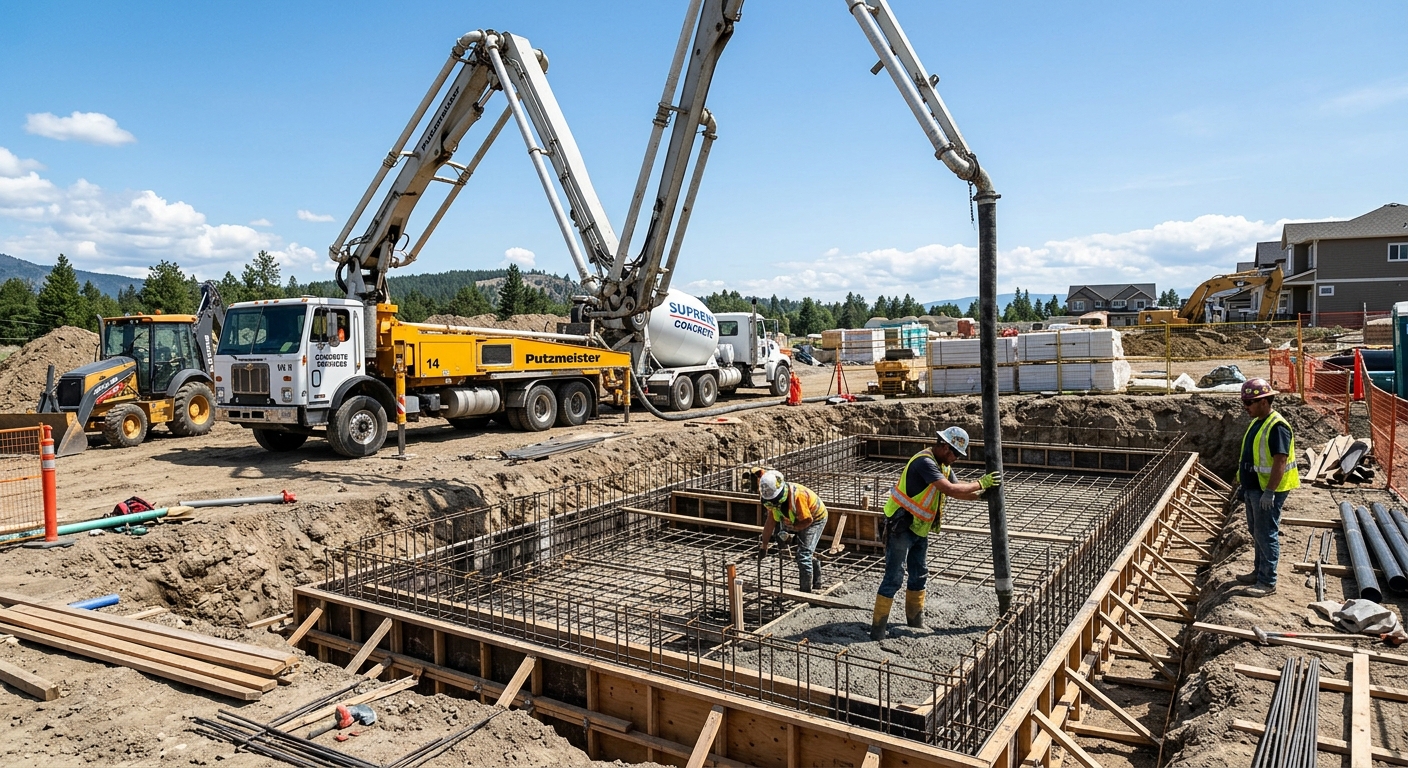
Concrete work options and costs in Westlock
Westlock homeowners typically approach concrete work with two priorities: a durable surface and a neat finish that survives our long freeze–thaw season. In Westlock, about 67.7% of dwellings are single-detached homes, which is why driveways, walkways, and patios are so common, along with interior slabs and the occasional structural upgrade. With 1,475 homeowner households (68.6% of households own), many projects are renovation-driven—garage conversions, front entry upgrades, and replacing older flatwork as homes age. Also, 63.3% of homes were built before 1981, so it’s not unusual to see settlement at older edges, deteriorating base layers, or cracks that need proper re-build rather than patching.
In the Edmonton economic region, cold continental conditions shape concrete pricing in practical ways: frost depths are commonly designed around 1.5 m or more, so footings have to be excavated deeper and formed higher before you even place steel and concrete. Exterior pours also face frequent freeze–thaw cycles during late fall, winter and spring, which means air-entrained mixes, well-compacted granular bases, and correctly spaced control joints are non-negotiable. If winter conditions compress the pour season, contractors often rely on cold-weather curing (heated enclosures or insulated blankets), which adds labour and fuel costs. Demand is especially steady in areas around Westlock’s Main Street / downtown core where homeowners tend to upgrade entryways and parking pads.
Below are realistic cost bands you can use when comparing quotes, then we’ll break down what pushes a project higher or lower.
| Application |
Typical Size |
Key Spec |
Finish Option |
Price Range |
| Concrete driveway (standard broom finish) |
10 m x 3 m (30 m²) |
Exterior, air-entrained mix; compacted granular base |
Broom finish + control joints |
$9,000–$15,500 |
| Exposed aggregate driveway |
10 m x 3 m (30 m²) |
Air-entrained mix; aggregate exposure process |
Exposed aggregate with sealer |
$12,000–$18,000 |
| Stamped concrete driveway or patio |
40 m² (drive/patio blend) |
Air-entrained mix; proper sub-base and joints |
Stamp texture + colour hardener |
$15,500–$26,000 |
| Plain concrete patio or walkway |
25 m² (patio) or 12 m² walkway |
Exterior slab with drainage consideration |
Steel trowel or broom finish |
$3,500–$9,000 |
| Garage floor (interior slab) |
24 m² (e.g., 20 ft x 12 ft) |
Vapour barrier; typical interior mix; properly levelled base |
Plain float + light broom for traction (optional) |
$6,500–$12,500 |
| Foundation footings (structural, below frost) |
Varies by house |
Engineered footing size; excavation below frost depth |
Reinforced concrete footings (no finish) |
$25,000–$60,000 |
Prices are estimates only and vary by project scope, site access and material selection.
What affects the price of concrete work in Westlock
Even when two contractors are quoting “the same” project, concrete prices in the Edmonton economic region can swing by 30–50% because the hidden drivers aren’t the concrete itself—they’re excavation depth, base prep quality, reinforcement requirements, and how cold-weather protection is handled. In Westlock, frost-aware design changes everything: exterior footings must be placed below the design frost depth (commonly around 1.5 m or more in this region) to reduce the risk of frost heave. That depth drives excavation and forming time, and deeper excavation also means more disposal and backfill work. For flatwork like driveways and patios, the freeze–thaw cycle pushes contractors toward air-entrained concrete mixes and tight control joint patterns, which increases material and labour time.
Climate also affects scheduling. The residential pour season is realistically shorter in cold continental climates, so some jobs get compressed into late spring to early fall. When trucks and crews are booked tightly, scheduling premiums can appear. Cold-weather curing precautions—insulated blankets or heated enclosures—can also add cost, especially for larger slabs or foundation work.
Concrete examples in Westlock: (1) A driveway with poor drainage under the slab may require additional granular base and better grading; that pushes costs toward the higher end of flatwork bands (for example, driveway rebuilds can land near the $9,000–$18,000 range). (2) Replacing older, poorly prepared walkways might look “small,” but if the existing base has washed out, the contractor may rebuild the sub-base, which moves the job closer to the $3,500–$9,000 walkway/patio band rather than a minimal patch. (3) For structural footing work, older homes may need more excavation to meet frost depth and engineered sizes, and that’s why foundation/footings often land in the $25,000–$60,000 band depending on scope.
| Price Factor |
Why It Matters |
Cost Impact |
| Frost line depth — determines footing depth and form height |
Deeper footings reduce frost heave risk |
Higher excavation, forms and disposal time; can be a major driver on foundations |
| Site preparation — excavation, grading, compacted granular base |
Correct base reduces settlement and surface failure |
More granular haul and compaction time if soil is unsuitable or washed out |
| Reinforcement — rebar or wire mesh requirement |
Controls cracking and improves load capacity |
Material and labour cost increases; necessary for driveways and structural work |
| Mix design — air-entrainment and compressive strength spec |
Exterior durability depends on freeze–thaw resistance |
Air-entrained mixes and higher spec mixes add cost versus basic mixes |
| Finish type — broom vs. stamped vs. exposed aggregate |
Surface method affects time, tools and labour |
Stamped/exposed often adds steps, increasing total project cost |
| Pour size and concrete truck access to site |
Access affects pumping, line setup and cycle time |
Long pump runs, limited access, or extra labour for placement can raise quotes |
| Cold-weather curing precautions — heating and blankets |
Proper curing prevents surface scaling and strength loss |
Heated enclosure or blanket rental plus labour can add meaningful cost |
| Control joint pattern and sealing cost |
Joints manage cracking; sealing helps against de-icing salts |
Skipping or simplifying joints/sealing can reduce cost initially but increases failure risk |
Permits & regulations in Alberta
In Alberta, concrete work is split into “structural” versus “flatwork,” and that’s what usually determines permits. Structural concrete—such as foundation footings, foundation walls, grade beams, and other load-bearing elements—typically requires a building permit and often engineered drawings that the municipality reviews. Concrete flatwork (driveways, patios, walkways, garage slabs) usually does not require a permit on its own, unless it affects lot grading, drainage, impervious surface coverage limits, or municipal right-of-way conditions.
For a Westlock homeowner, the safe approach is to verify early—before excavation—because changing grades after the pour can trigger additional requirements. Also confirm your contractor carries liability insurance and is properly covered for worksite risks (WSIB/WCB coverage). Then ask for references on similar-scale projects (a driveway crew isn’t the same as a foundation crew).
Step-by-step: how to verify:
- Check the contractor’s Alberta licence/credentials using the appropriate online registry resources (and match the business name to the quote).
- Ask for a certificate of insurance (liability) and confirm it’s active for the project period.
- Request WSIB/WCB clearance documentation or proof of coverage for the company and workers involved.
- Verify the scope alignment: ensure permit responsibility is clear in writing (who pulls it, if one is required).
- Confirm references for similar Edmonton-area cold-weather pours.
Getting concrete right in Westlock's freeze-thaw climate
Concrete failures in Westlock usually come down to three things: inadequate base preparation, the wrong concrete mix for freeze–thaw conditions, and poor curing/jointing. With frost depths commonly designed around 1.5 m or more in this region, the foundation and footing system must be built below the frost line. For exterior flatwork—driveways, patios and walkways—the freeze–thaw cycle and de-icing salts quickly expose weak spots if the slab isn’t designed for durability. The good news is that these problems are avoidable when the spec matches the Edmonton market reality.
To spec the job correctly, start with (1) base preparation: compacted granular sub-base to the right depth for local soil and drainage. (2) mix design: air-entrainment typically around 5–7% air for exterior flatwork, along with a minimum of 32 MPa compressive strength. (3) control joints: a planned joint pattern to limit random cracking; spacing is tied to slab thickness and panel dimensions. (4) curing: protect and cure properly—minimum 7 days under favourable conditions, and use cold-weather protection when temperatures drop. (5) sealing: apply a penetrating sealer after the cure period (commonly at about 28 days post-pour) to help repel de-icing salts.
If you’re comparing options on price, this is where the dollars make sense. For example, upgrading from plain broom-finish driveway work to stamped concrete can add cost (often aligning with the broader driveway band—moving from a plain driveway approach near the $9,000–$15,500 side toward higher stamped ranges). If a quote is cheaper because it omits air-entrainment, reduces base depth, or ignores joint layout, it won’t hold up in Westlock—cracking and spalling usually show up sooner than homeowners expect.
| Spec |
Why It Matters in Westlock |
What to Ask For |
Impact if Skipped |
| Compacted granular base (depth?) |
Prevents settlement and supports load through freeze–thaw |
Granular type and compaction targets; specify base thickness |
Uneven slab, early cracking, spalling at edges |
| Air-entrained concrete mix (target air %?) |
Improves freeze–thaw durability for exterior exposure |
Confirm air-entrainment target (commonly 5–7% for exterior) |
Higher risk of spalling/scaling during winter cycles |
| Compressive strength (MPa rating) |
Strength affects long-term durability and wear resistance |
Specify minimum 32 MPa (or higher where required) |
Weaker surface, faster deterioration and raveling |
| Control joints (spacing per ACI guidelines) |
Controls where cracks form under thermal movement |
Joint spacing and saw-cut timing in writing |
Random cracking, water infiltration and salt damage |
| Minimum 7-day curing period |
Strength gain requires stable conditions |
Protection plan for cool temps; confirm curing method |
Surface scaling, reduced strength and premature failure |
| Penetrating sealer (when applied after cure) |
Helps resist de-icing salt and water movement |
Specify sealer type and application timing (often ~28 days) |
Faster surface breakdown and staining |
How to choose a concrete work contractor in Westlock
Choosing the right concrete contractor matters more in Westlock than in milder climates. Start with credentials: in Alberta, verify the company is properly licensed/registered for the type of work it’s quoting, and request proof of liability insurance and WSIB/WCB coverage. Don’t accept verbal assurances—ask for a current certificate of insurance and coverage clearance documentation before scheduling any excavation.
Next, require 2–3 itemised written quotes rather than one lump sum. A good quote separates labour and materials so you can compare concrete mix design, reinforcement, base prep thickness, joint layout, and whether disposal and grading are included. Pay attention to what’s excluded: removal of existing concrete, trucking/haul distances, pump or crane allowance, weed-control fabric, supply of granular, and permit responsibilities (if applicable).
Warranty is another differentiator. Ask for the length of the workmanship warranty and whether it is supported by manufacturer/product warranties. Clarify transferability if you sell your home, and make sure warranty terms don’t rely on “normal wear” without defining what that means for concrete cracking.
Finally, protect your cash flow: never pay more than about 10–15% upfront. Use a holdback until completion and final cleanup. Get the start date and estimated completion timeline in writing, including curing and protection steps in cold weather.
- Provide proof of Alberta registration/licensing for the job type.
- Supply current liability insurance certificate (active dates).
- Provide WSIB/WCB coverage proof for the company and workers.
- Include an itemised breakdown (concrete volume, granular, rebar/mesh, finishing).
- State the mix spec (air-entrainment and minimum MPa).
- Specify base prep thickness and compaction approach.
- Confirm reinforcement type/placement (especially for driveways).
- Detail joint pattern, saw-cut timing, and sealing plan if included.
- List included site work: excavation, disposal, backfill, and final grading.
- Clarify truck access/pump allowances and any extra charges for limited access.
- Define curing/protection in writing for cool nights and variable temps.
- Use a payment schedule with limited upfront payment and a completion holdback.
Red flags in Westlock include: (1) quotes that don’t mention air-entrainment or MPa strength, (2) base prep described vaguely (“we’ll get it level”) without thickness/compaction, (3) pushing for large upfront payments, (4) no written joint/sealing plan for exterior slabs, and (5) dismissing cold-weather curing as “not necessary” even when temperatures drop.
Frequently asked questions — concrete work in Westlock
How deep must footings be for Westlock's frost line?
For Westlock and the broader Edmonton area, footings must be placed below the design frost depth to reduce frost heave risk. In cold continental climates like ours, frost depths are commonly designed around 1.5 m or more, and sometimes deeper depending on the specific soil conditions and engineered requirements for your house. That’s why two quotes can vary a lot: deeper excavation increases forming, labour, granular/backfill and disposal time. Because most structural footing sizing is project-specific, the most reliable answer comes from the engineered foundation plan for your home and the local requirements tied to grading and drainage. If you’re comparing contractors, ask them to show how their footing depth matches the engineered drawings and frost-aware spec.
Why does concrete crack in Westlock and how is it prevented?
Concrete cracking is common in Westlock because of thermal movement and freeze–thaw cycling. Even well-built slabs move slightly as temperatures change; the goal is to control where cracking happens. The prevention plan is practical: proper sub-base preparation, correct air-entrained mix for exterior durability, reinforcement where required, and—most importantly—a planned control joint pattern with correct saw-cut timing. Sealing also helps reduce water and de-icing salt intrusion at microcracks. If a contractor is vague about joints or skips sealing, you may save money upfront but increase the chance of random cracking and early surface deterioration. When homeowners compare driveway options, a move from basic flatwork finishing into better-spec exterior durability typically matters more than surface “looks.”
Stamped vs broom-finish concrete — cost difference?
Stamped concrete costs more mainly because it takes extra labour steps: colour hardeners, stamping mats, additional finishing time, and often stricter timing and curing attention. In Westlock’s market, plain concrete flatwork often lines up with the $9,000–$15,500 type range for driveways, while stamped decorative options commonly fall closer to the higher end—about $12,000–$26,000 depending on size, patterns, and access. Exposed aggregate and stamps also tend to show imperfections more clearly, so base prep and finishing quality must be higher. If a quote for stamped work is only slightly higher than broom-finish, ask what’s being reduced: air content, joint layout, or base depth. In Edmonton-area freeze–thaw conditions, skipping durability specs can turn a “decorative” job into an early-failure repair plan.
When is the best time to pour concrete in Westlock?
In Westlock, the best window is typically late spring through early fall when daytime temps stay consistently workable and overnight temperatures are easier to manage for curing. The Edmonton economic region’s cold-season freeze–thaw cycles can make curing unpredictable if you pour during shoulder months. If you must pour in cooler conditions, the contractor should plan cold-weather protection—insulated blankets or heated enclosures—so the concrete reaches the strength needed without surface scaling. That protection increases cost and scheduling, which is one reason quotes can differ. For planning purposes, discuss your pour date early and ask the contractor how they’ll handle nights, wind, and temperature drops, especially if your project is an exterior slab (driveway/patio/walkway) or a thicker structural pour.
How long does concrete take to cure?
Concrete curing is measured in stages. For practical homeowner expectations, many exterior slab processes allow limited finishing and early handling after the initial set, but durability depends on continued curing for strength development. As a general target for Westlock projects, plan for at least a 7-day curing period under proper conditions, with additional time for strength gain—especially for thicker pours. If your contractor includes sealing, penetrating sealer is commonly applied after the cure window (often around 28 days post-pour) to help repel de-icing salts and water movement. If the weather is cold, curing protection becomes critical and can extend practical timelines. When reviewing quotes in Westlock, ask whether curing blankets/heating are included for cool spells and confirm the schedule for sealing.
Do I need a permit for concrete work in Alberta?
In Alberta, the permit requirement usually depends on whether the concrete is structural or simply flatwork. Structural work—such as foundation footings, foundation walls, and grade beams—typically requires a building permit and often engineered drawings that the municipality reviews. Concrete flatwork like driveways, patios, and walkways usually does not require a permit by itself, but a permit (or at least a confirmation) may be needed if the work affects lot grading, drainage, impervious surface coverage rules, or impacts a municipal right-of-way. For Westlock homeowners, the safe move is to confirm early with the local authority before breaking ground and to ensure the contractor’s scope states who handles permits (if any). Also verify the contractor has current liability insurance and WSIB/WCB coverage—don’t rely on a “we don’t need permits” assumption.