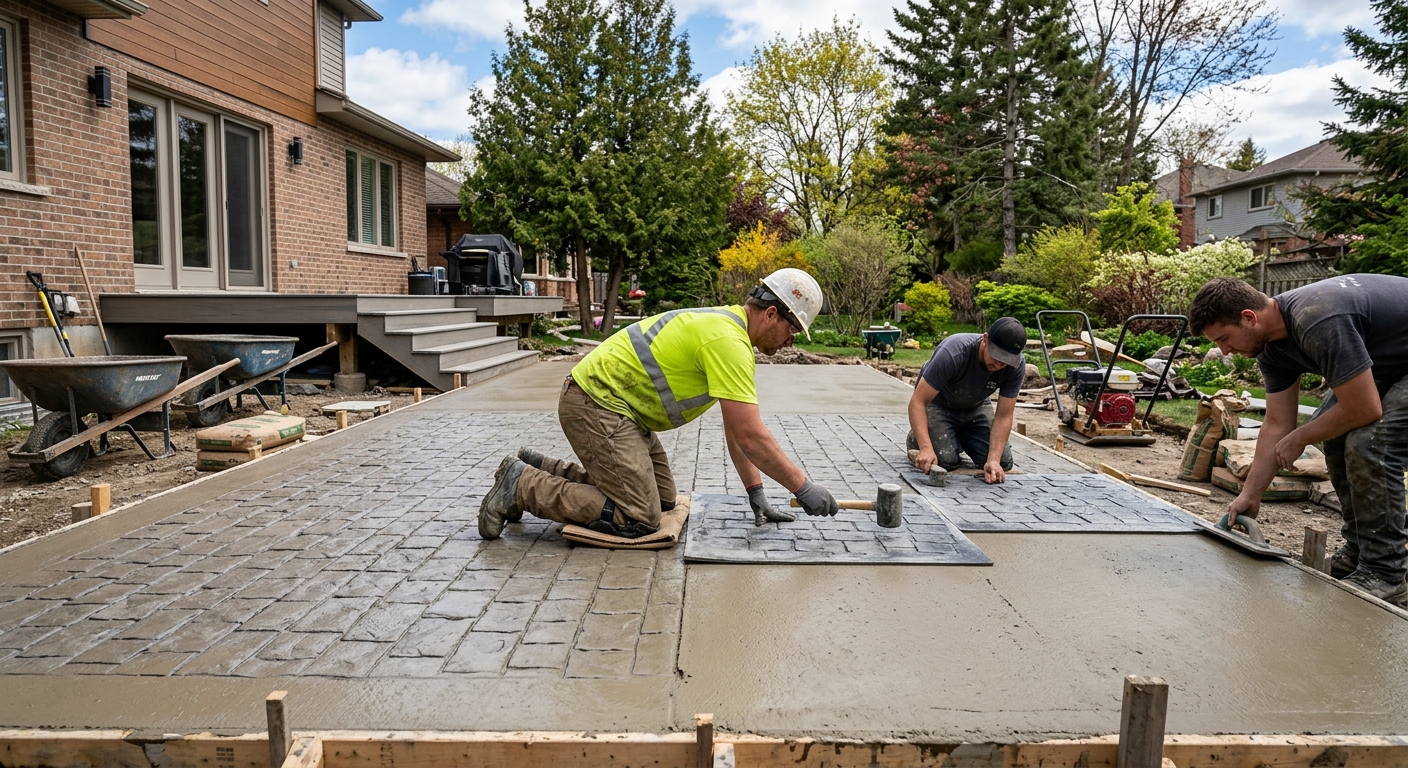
Concrete work options and costs in Athabasca
Athabasca homeowners rely on concrete for durable driveways, patios, and walkways—especially because the region’s cold continental climate drives frost and frequent freeze–thaw cycles. In Athabasca, the market is strongly residential: 68.0% of dwellings are single-detached homes, which is why concrete flatwork demand stays steady for longer driveways, sidewalks, and backyard patios. Just as importantly, 58.0% of households own their homes (Statistics Canada, 2021 Census), so many projects are planned for the long term—replacement, upgrades to drainage, and finishing choices like stamped or exposed aggregate.
In the Edmonton economic region, concrete pricing is shaped by frost-aware design and the realities of the pour season. Footings for foundations must extend below the design frost depth (commonly around 2.4 m in Alberta) to reduce frost heave, and exterior slabs typically need air-entrained mixes plus well-compacted granular base and properly spaced control joints. That means more excavation, more forming, and more granular and curing-related labour. Scheduling can also carry a premium because the time window for exterior flatwork is often shorter, and cold-weather curing precautions (insulating blankets or heated enclosures) can add material and fuel costs. Availability of finishing crews may tighten during the peak months, so getting quotes early matters.
If you live along the more established residential pockets around town (including the areas closer to downtown Athabasca and the broader serviced neighbourhoods), exterior concrete replacements tend to be especially in demand when homeowners are reworking drainage or expanding parking pads. Below are realistic price bands to help you compare typical scopes before you request itemized quotes.
| Application |
Typical Size |
Key Spec |
Finish Option |
Price Range |
| Concrete driveway (standard broom finish) |
24 ft × 10 ft (about 240 sq. ft.) |
Air-entrained concrete, compacted base, control joints |
Exposed aggregate not included; broom finish top |
$9,000–$14,500 |
| Exposed aggregate driveway |
24 ft × 10 ft (about 240 sq. ft.) |
Air-entrained concrete, proper curing and wash timing |
Exposed stone texture, higher finish labour |
$13,500–$18,000 |
| Stamped concrete driveway or patio |
20 ft × 12 ft (about 240 sq. ft.) |
Air-entrained mix; sealed finish after cure |
Stamp pattern and colour hardener (as selected) |
$16,000–$26,000 |
| Plain concrete patio or walkway |
12 ft × 12 ft (about 144 sq. ft.) |
Compacted granular base, control joints |
Broom or smooth trowel, light edging |
$3,500–$8,500 |
| Garage floor (interior slab) |
20 ft × 22 ft (about 440 sq. ft.) |
Vapour barrier (if specified), reinforcement if required |
Standard finish; optional sealer |
$8,500–$14,500 |
| Foundation footings (structural, below frost) |
Typical single-detached footing scope |
Excavation to frost depth, rebar/formed footings |
Engineered reinforcement as applicable |
$25,000–$60,000 |
Prices are estimates only and vary by project scope, site access and material selection.
What affects the price of concrete work in Athabasca
In Athabasca (and across the Edmonton economic region), you’ll often see quotes for the “same” concrete project differ by 30–50%. The usual driver isn’t just concrete cost—it’s how each contractor designs for Alberta conditions: frost depth, drainage, base prep, reinforcement, finish type, and how they handle curing when temperatures dip. A driveway that’s poured over an under-compacted base might look fine in year one, but it will typically show issues sooner when freeze–thaw cycles hit. That’s why excavation and granular base scope often determines whether a quote lands on the low or high end.
Frost line depth dictates every major spec for exterior work. Footings must extend below the design frost depth (often about 2.4 m in Alberta) to prevent frost heave, and exterior slabs need air-entrained concrete mixes to survive the repeated expansion and contraction of freeze–thaw. The cold also compresses the pour season for flatwork, so cold-weather curing precautions—insulating blankets or heated enclosures—can add material and fuel costs. On top of that, de-icing salts accelerate surface wear and spalling risk, so sealing becomes a practical “cost now, protect later” step for driveways.
Two local examples that commonly move the needle: (1) sites with heavier clay or poor drainage can require deeper excavation and more granular replacement, which pushes costs toward the $9,000–$18,000 range for driveways; (2) if you choose stamped concrete, the labour for formwork/texture and the added curing/sealing steps often justify landing closer to the $12,000–$26,000 band. Housing age also matters: 39.4% of homes were built before 1981 (Statistics Canada, 2021 Census), and older properties often have older drainage routes or settlement patterns that require extra site work before concrete goes in.
| Price Factor |
Why It Matters |
Cost Impact |
| Frost line depth |
Determines footing depth and form height |
Higher excavation and forming can push foundation/footings toward the upper end of $25,000–$60,000 |
| Site preparation |
Excavation, grading, compacted granular base |
Extra haul-away and base replacement often adds thousands to driveway and patio pricing |
| Reinforcement |
Rebar or wire mesh requirement |
Adding steel plus chairs/tie-in labour can increase both material and crew time |
| Mix design |
Air-entrainment and compressive strength spec |
Upgraded mix and testing typically add cost but reduce freeze–thaw surface failure risk |
| Finish type |
Broom vs. stamped vs. exposed aggregate |
Stamps and exposed aggregate add labour and schedule complexity; cost rises toward the $12,000–$26,000 band |
| Pour size and concrete truck access to site |
Distance/placement efficiency and labour time |
Long wheelbarrow/limited access can increase labour and require multiple pours |
| Cold-weather curing precautions |
Heating and blankets |
Insulating and temperature control can add material/fuel costs during shoulder-season work |
| Control joint pattern and sealing cost |
Manages cracking and protects from salts |
Proper joint saw-cut timing and sealer add line-item cost, but reduce premature spalling |
Permits & regulations in Alberta
In Alberta, structural concrete work—especially anything tied to the building’s load path—typically requires a building permit. That includes foundation footings, foundation walls, grade beams, and any engineered structural elements. For many projects, engineered drawings are reviewed as part of the permitting process, and the inspection steps are tied to those drawings. For homeowners in Athabasca planning a new foundation or significant structural modification, don’t assume it’s “just concrete.” The permit and documentation piece is part of getting the work built to spec.
Concrete flatwork like patios, walkways, driveways, and garage slabs usually does not require a permit by default. However, permits or approvals can become relevant if your plan affects lot grading, stormwater drainage, impervious surface coverage limits, or work near municipal right-of-way. The safe approach is to confirm with your local authority before excavation.
To verify an Athabasca contractor is properly set up, go step-by-step:
- Ask for their insurance certificate: confirm liability coverage is active and the project address is listed.
- Confirm WSIB/WCB coverage (or proof of exemption where legitimately applicable).
- Request references on similar-size concrete jobs (driveways and exterior slabs are especially relevant here).
- If they claim an Alberta licence/registration, check the appropriate online registry listing the business name and status.
- Get a written scope that includes disposal, forming details, and curing provisions.
Clear paperwork first protects you when freeze–thaw issues appear later and the warranty discussions start.
Getting concrete right in Athabasca's freeze-thaw climate
Concrete can fail in Athabasca’s freeze–thaw climate when any part of the system—base, mix, joints, curing, or drainage—falls short. The most common homeowner complaint I hear is premature surface spalling or random cracking. That’s often tied to inadequate air-entrainment or rushed curing. In Edmonton-area conditions, exterior slabs need to be designed and placed like “cold climate durability work,” not just a basic flat pour.
Start with base preparation: you want a compacted granular sub-base to the right depth and density for the soil and expected frost movement. Next, lock in the mix design. For exterior flatwork, specify air-entrainment typically around 5–7% air content and a minimum 32 MPa compressive strength rating, so the concrete can tolerate freezing cycles. Third, control joints: they should be cut to a planned pattern and spacing to limit random cracking; joints are where the concrete is allowed to crack. Fourth, curing matters. Even if it looks “set,” you need a minimum 7-day curing period under proper conditions, and in colder weather that may mean insulated blankets or a heated enclosure so the concrete develops strength. Finally, sealing: apply a penetrating sealer after the cure (often around 28 days post-pour) to help repel de-icing salts and reduce surface deterioration.
As a dollar example, upgrading from a basic broom-finish driveway to exposed aggregate usually costs more labour and finishing time, but the real value is durable texture plus correct curing and joint detailing. If a cheaper quote skips proper base compaction or under-specifies the air-entrained mix, that “savings” can be wiped out by repairs—often well before the lifespan you paid for.
| Spec |
Why It Matters in Athabasca |
What to Ask For |
Impact if Skipped |
| Compacted granular base (depth?) |
Proper support prevents settlement and reduces freeze-related movement |
Granular depth and compaction test method/target density |
Cracks, dips, and accelerated deterioration after freeze–thaw |
| Air-entrained concrete mix (target air %?) |
Air void system controls damage during freezing cycles |
Air content target (typically 5–7% for exterior flatwork) and mix design sheet |
Spalling and scaling increase significantly in Alberta winters |
| Compressive strength (MPa rating) |
Strength gain helps durability and reduces early surface failure |
Minimum 32 MPa rating and cure schedule confirmation |
Surface wear and premature cracking under traffic and salts |
| Control joints (spacing per ACI guidelines) |
Controls where shrinkage and temperature cracking occur |
Planned joint layout and saw-cut timing |
Random cracking across the slab and easier water infiltration |
| Minimum 7-day curing period |
Cold conditions can slow strength gain |
Protection plan for temperature and wind (blankets/heating if needed) |
Reduced strength and higher risk of early failure |
| Penetrating sealer (when applied after cure) |
Helps repel de-icing salts used during Athabasca winters |
Application timing (often around 28 days post-pour) and product type |
Faster scaling/spalling and more frequent patching |
How to choose a concrete work contractor in Athabasca
Choosing the right contractor in Athabasca is mostly about verifying the basics and matching the quote to the technical spec needed for Alberta winters. Start by verifying Alberta coverage: ask for the contractor’s liability insurance certificate and confirm WSIB/WCB coverage is in place (or a legitimate exemption, if applicable). Then make them show you the paperwork—don’t rely on verbal assurances. For Alberta licensing/registration status, use the applicable online registry tools and search by the business name you’ll see on the quote and invoice. If you’re not comfortable interpreting the certificate, ask for a straightforward confirmation letter naming the project and coverage dates.
Next, get 2–3 itemized written quotes instead of only one lump sum. Look for a breakdown that separates labour, concrete supply, base prep (excavation and granular), reinforcement, forms, finish labour (broom versus stamped), and line items for disposal. Ask whether permits (when required for structural work) are included, and whether site cleanup and waste removal are part of their scope. For warranty, get the workmanship warranty length in writing and clarify whether product/manufacturer warranties are included and transferable if you sell your home.
Payment schedule matters: never pay more than 10–15% upfront. Hold back funds until the final finish, joint sealing steps, and cure protection expectations are met. Finally, demand timing in writing: a start date, a concrete delivery window, and an estimated completion date. In Athabasca’s shorter exterior pour season, having a defined schedule prevents “ready later” delays that can push work into colder conditions.
- Confirm liability insurance certificate is current and includes your address/job description.
- Verify WSIB/WCB coverage and ask for proof.
- Request the mix design and confirm air-entrainment for exterior slabs.
- Ask how they prepare the base: excavation depth and compaction method.
- Verify reinforcement requirements (rebar/wire mesh) match your design.
- Get a joint layout plan (spacing and saw-cut timing).
- Clarify curing/temperature protection procedures for shoulder-season pours.
- Confirm sealing scope (type and when applied after cure).
- Ensure disposal is included if they remove excess soil/old concrete.
- Require an itemized quote that breaks labour and materials.
- Ask about warranty terms for labour and any product warranties.
- Set a clear payment schedule with holdback until completion.
Concrete red flags I commonly see in Athabasca include: skipping a granular base/compaction discussion, proposing a “cheap” mix without air-entrainment confirmation, offering only lump-sum pricing with no scope details, and starting pours without a documented cold-weather cure plan when temperatures drop.
Frequently asked questions — concrete work in Athabasca
Concrete vs pavers for a patio in Athabasca?
For a patio in Athabasca, concrete and pavers can both work, but concrete usually wins when you want a low-maintenance surface that holds up to freeze–thaw and de-icing salts—especially when the contractor specifies air-entrainment and control joints. Pavers can be more forgiving for localized repairs (one section can be lifted and reset), which can be attractive if you expect future landscaping changes. The trade-off is that pavers require excellent base prep and joint sand maintenance so they don’t heave or shift. With concrete, the base and mix are what protect you: in the Edmonton region, air-entrained exterior concrete and proper sealing after cure matter. Typical plain patio pricing often lands around $3,500–$8,500, while stamped options go higher. If drainage is a concern, either system should be detailed to shed water away from the house.
How long does a concrete driveway last?
In Athabasca and the Edmonton economic region, a well-built concrete driveway often lasts decades, but “how long” depends on whether it was designed for Alberta winters. The big durability drivers are frost-aware base support, air-entrained concrete for exterior exposure, and a joint pattern that controls cracking. Driveways are also exposed to tire wear, winter salt, and repeated freeze–thaw cycles, so sealing and correct finishing can make a real difference. If a driveway is poured over a weak base or without proper air-entrainment, you’ll commonly see surface scaling or spalling sooner. Cost plays a role, but it’s not just the concrete line item—site prep and curing are where quality is either protected or lost. A standard broom-finish driveway in Athabasca often falls near $9,000–$14,500 for typical sizes, and higher-end finishes can move toward $13,500–$18,000. A durable long-term build is usually worth paying for the right spec upfront.
What is air-entrained concrete and why does it matter here?
Air-entrained concrete is made with a controlled amount of tiny air bubbles that give freezing water space to expand without rupturing the cement paste. In Athabasca, freeze–thaw cycles in late fall, winter, and spring are a major reason exterior slabs can fail—especially through scaling and spalling. That’s why your quote should explicitly call for an air-entrained mix suitable for exterior use; for exterior flatwork, many specs target roughly 5–7% air content. Contractors may mention “Durability” or “cold climate mix,” but you should ask for the mix design details so you know it’s intentional, not assumed. When air-entrainment is skipped or under-specified, even a correctly broom-finished driveway can begin deteriorating from the surface downward after repeated winters and salt exposure. This is also why sealing after cure (often after about 28 days) is a smart add-on in Alberta conditions.
How do I prepare the base for a concrete slab?
Base prep is the foundation of a durable slab in Athabasca. The contractor should excavate to the required depth and then install a compacted granular sub-base designed for local soil and expected frost movement. The key is compaction: you want consistent density across the whole footprint, not just “looks level.” If the site has poor drainage or heavier clay, the prep may include additional granular replacement and grading adjustments so water doesn’t sit under the slab. A good contractor will also address separation from organic material and ensure the sub-base thickness matches the design for frost stability. When you compare quotes, don’t accept a vague line like “we’ll prep the base.” Ask for granular depth, what they compact with (and whether they verify compaction), and how they handle haul-away or disposal. These choices are often one of the biggest reasons quotes differ by 30–50% across the Edmonton region.
How do I compare concrete quotes?
To compare concrete quotes in Athabasca, insist on itemized scope so you’re comparing apples to apples. Start by checking that each quote includes the same concrete thickness, air-entrained mix requirement, reinforcement (if applicable), granular base prep, and control joint layout. Verify what each contractor includes for excavation, re-grading, forms, and waste disposal. For exterior slabs, ask about cold-weather curing provisions—if temperatures are likely to drop, who provides insulated blankets or heating, and is it included? Also confirm finishing scope: broom finish versus stamped or exposed aggregate affects labour and material use. Price bands can guide you: for example, many standard driveways land around $9,000–$14,500 depending on size and access, while stamped work can move toward $16,000–$26,000. Finally, check the warranty and payment schedule. A lower quote is only “cheaper” if it includes equivalent specs; otherwise, you’re paying later through repairs.
Can concrete be poured in cold weather in Athabasca?
Yes, concrete can be poured in cold weather in Athabasca, but it must be done with a cold-weather plan. The risk isn’t only that it will freeze—it’s that curing becomes unreliable, strength gain slows, and the surface can be damaged if protection isn’t adequate. In Alberta, contractors typically use insulated blankets or heated enclosures, control placement temperature, and protect the slab long enough to develop strength safely. Your quote should spell out the cold-weather curing precautions, including what triggers additional protection and what they’ll do if the temperature drops. If the contractor doesn’t discuss curing measures, that’s a red flag. Also consider timing: Athabasca’s pour season for flatwork can be shorter, and work rushed into colder conditions may require additional fuel/material costs—so the price may move toward the higher end of typical bands. For quality, the “right spec” beats speed every time.