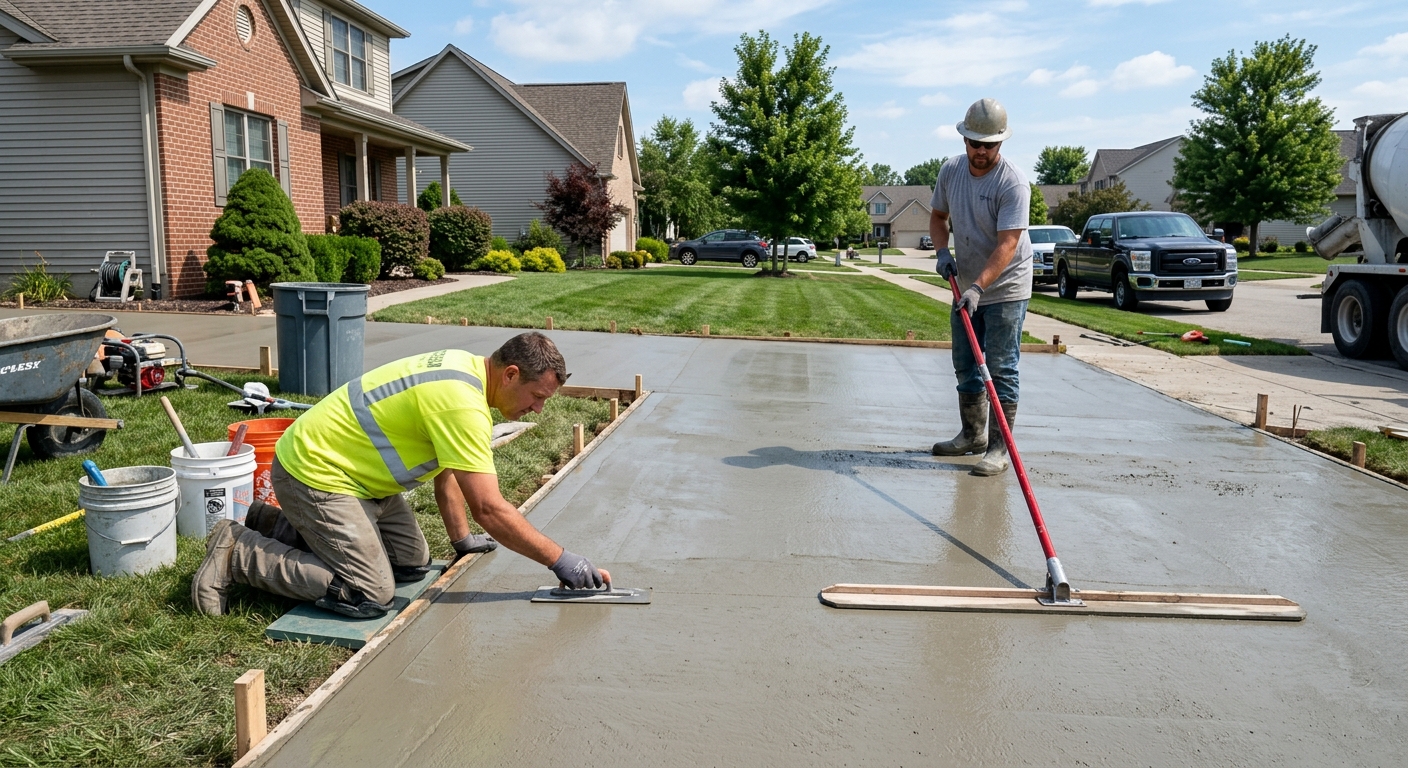
Concrete work options and costs in Pleasantview
Pleasantview, Alberta has a strong demand for concrete because most homeowners build and improve the “daily use” surfaces—driveways, patios, walkways, and garage floors. With a small-town population of 3,745 (Statistics Canada, 2021 Census), work often concentrates around established residential pockets and infill homes, so timing and availability can affect schedules. In this area of the Calgary region, builders and homeowners typically prioritize long-life flatwork that can handle winter freeze–thaw cycles and the deeper design frost depth Alberta uses for bearing below seasonal movement.
In practical terms, quotes in Pleasantview can change quickly because Calgary-area frost engineering expects footings and foundation-related concrete to extend below the design frost depth (about 1.2 m in the region profile, roughly 4 ft). That means extra excavation, more formwork, and larger concrete volumes for foundations, compared with milder climates. For exterior slabs like patios and driveways, air-entrained mixes, granular base prep, and cold-weather curing precautions are common add-ons—especially when pours land near the shoulder seasons. Contractors who are prepared with winter-grade materials, insulated blankets, and proper curing procedures generally price that capability into the job.
Trade activity is often especially strong in established neighbourhoods around the broader Calgary commuter belt (including the Pleasantview area’s higher turnover residential streets), where homeowners are renovating aging drive approaches and adding outdoor living spaces. Use the comparison below to calibrate what’s realistic for your specific application, then confirm the exact specs during your site measure.
| Application |
Typical Size |
Key Spec |
Finish Option |
Price Range |
| Concrete driveway (standard broom finish) |
400–600 sq ft |
Air-entrained slab, compacted granular base |
Broom finish + control joints |
$12,000–$18,000 |
| Exposed aggregate driveway |
400–600 sq ft |
Air-entrained mix + aggregate reveal system |
Exposed aggregate with sealer |
$15,000–$22,000 |
| Stamped concrete driveway or patio |
300–600 sq ft |
Air-entrained mix, thicker wear surface |
Stamped pattern + release + sealer |
$15,000–$26,000 |
| Plain concrete patio or walkway |
200–450 sq ft |
Proper base prep + joints |
Float/trowel top or light broom |
$5,000–$9,000 |
| Garage floor (interior slab) |
400–600 sq ft |
Vapour control as applicable + reinforced slab |
Light broom or trowel-finish |
$8,500–$14,500 |
| Foundation footings (structural, below frost) |
Varies by foundation design |
Designed depth below frost + engineered reinforcement |
Structural concrete; no decorative finish |
$28,000–$45,000 |
Prices are estimates only and vary by project scope, site access and material selection.
What affects the price of concrete work in Pleasantview
In Pleasantview, Alberta, two contractors can price the “same” concrete item 30–50% apart because the hidden variables—excavation, reinforcement, mix design, winter curing, and finishing labor—are where most of the cost lives. Calgary’s concrete market is busy around the practical exterior work window, and as temperatures drop, the crew planning and cold-weather equipment needed to pour properly become a bigger part of the quote.
The region’s frost depth and frequent freeze–thaw cycles dictate nearly every spec. Footings for homes, garages, decks, and retaining structures must bear on undisturbed soil below the design frost depth in the regional practice (about 1.2 m, roughly 4 ft in the profile). That drives more excavation and larger footing volumes, which is why foundation work often aligns with the $28,000–$45,000 band. For exterior slabs like driveways and patios, air-entrained concrete is required to resist freeze–thaw damage; without that, you’ll see early surface scaling and spalling. As for timing, Calgary’s exterior pour season is shorter, so late-fall and early-spring projects may require heated enclosures, insulated blankets, and longer cure management—raising costs versus a summer pour. Finally, de-icing salt is a tough environment; a good penetrating sealer applied after cure helps protect the surface.
In Pleasantview, a few common cost drivers can either raise or lower your final number. A driveway with complicated forms around a slope and tight access to the truck can land toward the high end of the $12,000–$18,000 driveway band because of extra labour and base thickness. On the other hand, a small, straightforward patio on well-prepared, level ground can stay near the lower $5,000–$9,000 patio band because excavation and reinforcement complexity stay minimal. If your foundation includes deeper engineered footings to suit site soil, the footing total can climb within the $28,000–$45,000 range quickly as excavation and reinforcement increase.
| Price Factor |
Why It Matters |
Cost Impact |
| Frost line depth — determines footing depth and form height |
Footings must extend below seasonal movement to prevent frost heave |
Higher excavation and concrete volume; can materially increase foundation costs |
| Site preparation — excavation, grading, compacted granular base |
Proper base reduces settlement and cracking on exterior slabs |
More labour and granular material when access/soil conditions are challenging |
| Reinforcement — rebar or wire mesh requirement |
Reinforcement controls cracking and improves slab durability |
Additional material and tying/placement time; cost varies by design |
| Mix design — air-entrainment and compressive strength spec |
Air entrainment helps concrete survive freeze–thaw; strength supports loading |
Winter-rated and engineered mixes cost more than standard pours |
| Finish type — broom vs. stamped vs. exposed aggregate |
Finishing is labour-intensive and affects wear layer thickness |
Stamped/exposed finishes typically add significant labour and material steps |
| Pour size and concrete truck access to site |
Smaller pours may require more mobilizations; poor access slows production |
Delays and extra crew time can push pricing upward |
| Cold-weather curing precautions — heating and blankets |
Maintains adequate temperature for hydration during shorter pour windows |
Heaters/blankets and longer scheduling increase costs and overhead |
| Control joint pattern and sealing cost |
Joints and sealing reduce random cracking and salt-driven surface damage |
Skipping or reducing these items can lower price short-term but harms longevity |
Permits & regulations in Alberta
In Alberta, structural concrete work typically requires a building permit, and in many cases engineered drawings are reviewed as part of the approval process. This commonly includes foundation footings, foundation walls, and grade beams, because these elements carry structural load and are designed around frost depth, soil conditions, and reinforcing requirements.
Concrete flatwork—like driveways, patios, and walkways—usually does not require a permit on its own unless it impacts grading or municipal requirements such as lot drainage, impervious surface coverage limits, or work within/affecting the municipal right-of-way. Even when a permit isn’t required, your contractor should still coordinate with the homeowner’s obligations for drainage and existing service locations.
Step-by-step verification for a Pleasantview homeowner starts with confirming the contractor carries the right protection:
- Ask for a certificate of insurance showing liability coverage and ensure it lists your project/address as applicable.
- Ask for WSIB/WCB coverage documentation for Alberta work (and verify it’s current).
- Request references for similar-scale jobs in the Calgary region, especially exterior slabs poured in cold-weather conditions.
- Confirm who will pull permits (if required) and whether the quote includes permit-related admin costs when applicable.
- Before work begins, review the contract for scope, exclusions, and curing/blanketing provisions where needed.
For contractor licensing and active standing, use the relevant Alberta online registry tools and confirm clearance status where available, then match the details on the certificate(s) to the company that will actually do the work. If anything doesn’t line up, treat it as a red flag and ask for correction before the pour.
Getting concrete right in Pleasantview's freeze-thaw climate
Concrete failures in Pleasantview usually come down to one of five things: weak base support, incorrect mix, poor air entrainment, inadequate curing, or neglected joint/sealer detailing. Alberta’s winter chemistry is especially unforgiving—freeze–thaw cycles plus de-icing salts can turn small imperfections into spalling and surface scaling if the job is rushed or under-specified. To spec the job correctly, start at the base: a compacted granular sub-base to the designed depth is what prevents differential settlement and random cracking.
Next, focus on the mix and freeze–thaw durability. For exterior flatwork, specify an air-entrained mix with typical target air content in the 5–7% range and a minimum 32 MPa compressive strength requirement (site conditions and engineering details can shift this). Control joints must be spaced to limit random cracking, and curing has to be managed—plan on minimum 7 days of curing under proper conditions, and if you pour near colder temperatures, ask about blankets/heat so hydration doesn’t stall.
Finally, sealing matters in a salt environment. A penetrating sealer applied after cure (commonly 28 days post-pour) helps repel water and slow down salt-driven surface deterioration. If you’re choosing between options, remember where the price difference is justified: a broom-finished driveway may land around the $12,000–$18,000 band, while stamped decorative work commonly increases labour and installation steps into the $15,000–$26,000 range. Paying for the right mix and joints is the bigger longevity win than paying for extra patterns if the base and air content aren’t correct.
To avoid the most common failure—spalling from inadequate air entrainment—ask your contractor to confirm mix design air content, show the proposed joint plan, and explain how they will protect curing concrete during cold or windy conditions.
| Spec |
Why It Matters in Pleasantview |
What to Ask For |
Impact if Skipped |
| Compacted granular base (depth?) |
Prevents settlement and cracking under load in freeze–thaw conditions |
Designed base depth and compaction proof (e.g., test results if provided) |
Settlement cracks, uneven surface, faster deterioration |
| Air-entrained concrete mix (target air %?) |
Air void system allows freeze–thaw expansion to occur safely |
Confirm target air content for exterior work (typical 5–7%) |
Surface scaling and spalling in winters |
| Compressive strength (MPa rating) |
Strength supports loading and reduces wear in cold climates |
Minimum 32 MPa (or higher if engineered/required) |
Premature wear, cracking, and reduced slab life |
| Control joints (spacing per ACI guidelines) |
Controls where cracking occurs instead of random cracks |
Joint spacing plan based on slab size and thickness |
Random cracking and wider repair needs |
| Minimum 7-day curing period |
Ensures hydration and durability before exposure |
How curing will be maintained in cold weather (blankets/heating if needed) |
Weak surface, scaling, and long-term durability loss |
| Penetrating sealer (when applied after cure) |
Repels water and reduces salt intrusion |
Apply after cure—commonly around 28 days post-pour |
Faster salt damage and staining |
How to choose a concrete work contractor in Pleasantview
Choosing a concrete contractor in Pleasantview comes down to verifying capability, not just price. Start by confirming Alberta coverage and responsibility. Ask for their current certificate of liability insurance, including project/job details where applicable. Then verify WSIB/WCB coverage for the workers assigned to your job—don’t rely on verbal assurances. Next, check contractor licensing/standing through the appropriate Alberta online registry tools for the company that will be on-site, and make sure the names and addresses on the insurance and paperwork match the invoicing contractor.
For quoting, request 2–3 itemised written quotes rather than one lump sum. You want the breakdown of labour and materials: excavation/base prep, reinforcement, concrete supply/mix spec, finishing, jointing, sealing (if included), and disposal. Confirm whether permits are included when required (typically for structural concrete like footings/walls/grade beams) and whether the quote includes any municipal-required compliance.
Look at warranty terms: there should be a clear workmanship warranty length and separation between contractor responsibility and manufacturer/product warranty. A good contract also spells out if warranties are transferable for future homeowners. For payment scheduling, avoid large upfront deposits—typically keep it to 10–15% maximum upfront and request a holdback until the work is complete, cleaned, and any sealant is finished. Finally, get a start date and completion estimate in writing, especially for cold-weather pours where curing protection is a real cost driver.
- Ask for mix design air-entrainment confirmation for exterior work.
- Require a written joint plan (location and spacing) before the pour.
- Confirm base preparation depth and compaction approach.
- Request proof of reinforcement placement (photos or standard details).
- Ask how they manage cure temps in late fall/early spring (blankets/heating).
- Verify insurance and WSIB/WCB coverage are current.
- Check the company name on the quote matches the insured legal entity.
- Ensure disposal/removal of excess material is explicitly included or excluded.
- Confirm whether sealer is included and when it will be applied.
- Get start/completion dates and weather contingency notes in writing.
- Review exclusions: what happens if the truck can’t access the site?
- Clarify who provides and installs control joint materials/tools.
Concrete red flags in Pleasantview: (1) they won’t commit to air-entrained specs for exterior slabs, (2) they treat curing as optional (especially in cold snaps), (3) they leave joint spacing vague or skip control joints on small slabs, (4) they require full payment upfront or won’t hold back until cleanup and touch-ups, and (5) they can’t show itemised labour/materials or provide references for Calgary-area exterior pours.
Frequently asked questions — concrete work in Pleasantview
Stamped vs broom-finish concrete — cost difference?
In Pleasantview, stamped concrete typically costs more than broom-finish because it adds labour-intensive setup (base finishing for stamping), stamping/release materials, and extra finishing time to achieve consistent texture. As a local reference, standard exterior driveways often fall around $12,000–$18,000 for broom finish, while stamped options commonly land in the $15,000–$26,000 range depending on size, detailing, and whether it’s a driveway or a smaller patio. The bigger cost lever, though, is durability spec: regardless of pattern, the mix still needs proper air entrainment and the slab needs the right base and joint spacing for freeze–thaw. If a contractor “saves money” by cutting air content or base prep, stamped texture won’t protect it from spalling.
When is the best time to pour concrete in Pleasantview?
The best time is typically late spring through summer when temperatures reliably support proper curing without heavy winter protection. Pleasantview’s Calgary-region freeze–thaw cycles shorten the practical pour season for exterior slabs, so late-fall and early-spring pours can still be done—but usually require cold-weather measures like insulated curing blankets and sometimes temporary heat to keep hydration on track. This is where quotes can vary because winter-rated mix, extra materials, and longer scheduling are real costs. If your goal is a driveway or patio that looks good and lasts, plan for a window with stable weather and ask your contractor to explain how they’ll maintain curing conditions. For foundations/footings, engineering often accounts for depth below frost, but concrete placement still needs careful sequencing and protection.
How long does concrete take to cure?
Concrete curing is measured in stages. For typical flatwork, contractors often plan for at least a 7-day curing period under proper conditions before treating the slab as serviceable for light use. Full strength development continues beyond that; many mixes reach design strength over longer periods, and cold weather can extend timelines. In Pleasantview, where winters are harsh, curing temperature matters—if hydration slows too much, you can get weaker surface durability and a higher chance of early scaling. For sealing decisions, most homeowners will be best served by a “wait-then-seal” approach: a penetrating sealer is commonly applied after cure is complete, often around 28 days post-pour. Ask your contractor what curing plan they’re using and whether they’ll protect the slab if temperatures drop.
Do I need a permit for concrete work in Alberta?
In Alberta, structural concrete work like footings, foundation walls, and grade beams typically requires a building permit and often engineered drawings reviewed by the municipality. Concrete flatwork—such as driveways, patios, and walkways—usually does not require a permit on its own unless it affects lot grading, impervious surface requirements, or impacts drainage/municipal right-of-way. In Pleasantview, the practical move is to ask your contractor what category your scope falls under and who will pull any required permit. Before breaking ground, confirm the contractor’s liability insurance and WSIB/WCB coverage and ensure the scope matches the permit requirements if one is needed. If anything touches drainage or right-of-way boundaries, verify early so you’re not forced to redesign after excavation.
Concrete vs pavers for a patio in Pleasantview?
Concrete and pavers both work well in Pleasantview, but they fail differently in freeze–thaw. Concrete patios rely on a properly compacted granular base, correct air-entrained mix, and control joints; when those are done right, concrete can handle Calgary’s winter cycles well. Pavers spread loads and can be easier to repair locally if a section heaves—however, their performance depends heavily on base gradation, bedding sand, and edge restraints. Cost-wise, a plain concrete patio typically sits around $5,000–$9,000 for common sizes, while decorative approaches can increase quickly if you move into stamped work territory. If you want the most predictable “one pour” durability, concrete is often the straightforward choice—just ensure sealing and jointing are specified.
How long does a concrete driveway last?
A well-built concrete driveway in the Calgary region can last decades, but longevity depends on the specs—not just the finish. The biggest drivers are frost-resistant base prep, air-entrained concrete for freeze–thaw, proper reinforcement/jointing, and curing done correctly in the cold-weather window. In Pleasantview, de-icing salt is a factor, so a penetrating sealer applied after cure (commonly around 28 days) helps repel water and slow surface deterioration. Finishes like broom and even stamped patterns won’t compensate for inadequate air content or poor base compaction—those are the causes of early cracking and spalling. If you’re budgeting, driveway pricing commonly sits around $12,000–$18,000 for standard work; choosing the right durability steps within that range is what typically determines how long it stays looking solid.