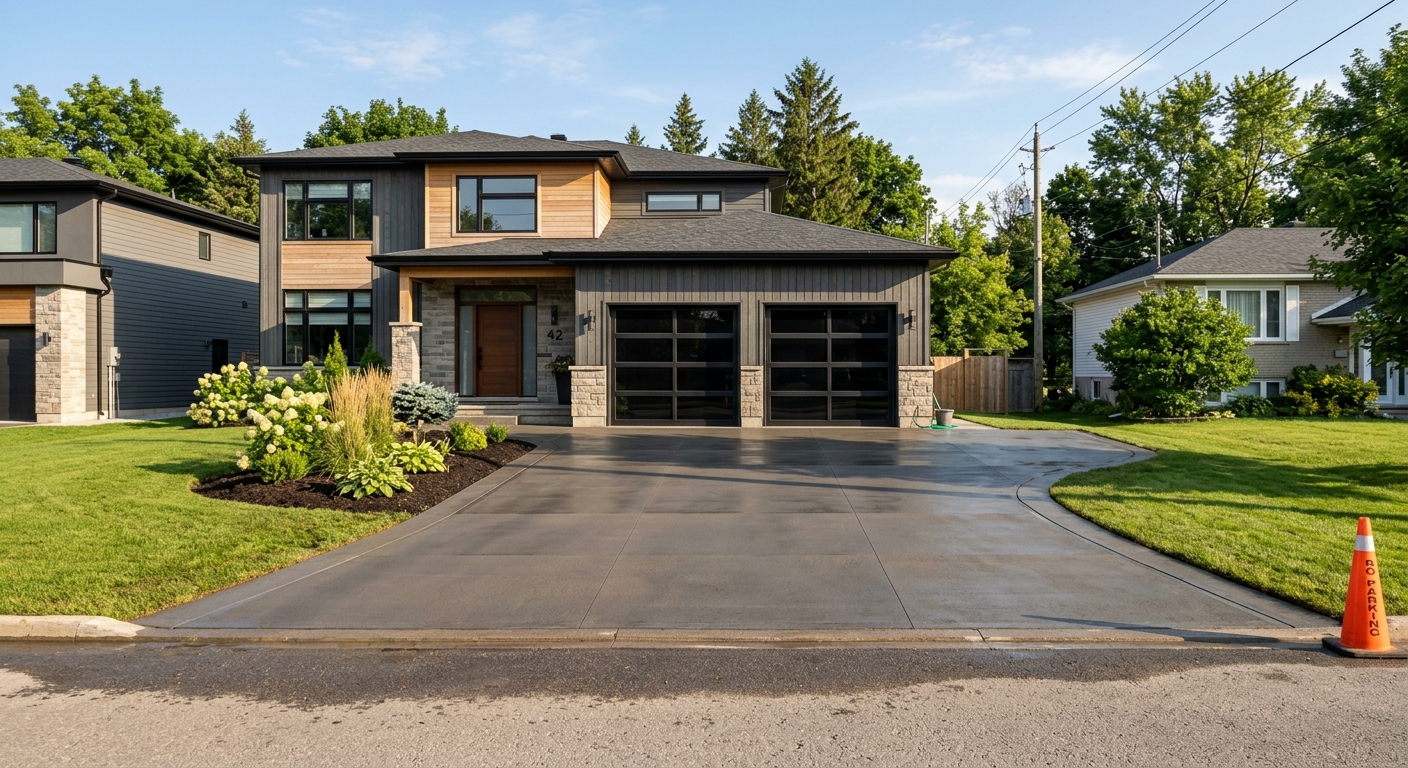
Concrete work options and costs in Brooks
Brooks is a practical town for homeowners, and most concrete flatwork gets built for the same reason: durability through Alberta winters. With single-detached houses making up 54.5% of dwellings and homeowner households at 64.8% (Statistics Canada, 2021 Census), driveways, patios, and walkways are constant demand items, especially in older residential pockets where upgrades and replacements are more common. In the Lethbridge–Medicine Hat region, pricing is shaped by a deep frost line and aggressive freeze–thaw cycles. For exterior work, we design around frost heave—so footings for structural elements are set below frost and excavation/forming costs rise. Those same cycles demand air-entrained concrete mixes for slabs and flatwork, plus a tight control joint layout to manage shrinkage cracking.
Seasonality also matters in Brooks: the exterior pour window is tighter than in milder climates, so labour and equipment are more concentrated in warmer months. If a job needs a shoulder-season pour, we may add insulated blankets, heaters, or accelerators—reasonable measures, but they move the price. Access is another local reality; neighbourhood streets and drive approach grades near areas like the newer growth around Downtown/central Brooks often require tighter scheduling and careful truck staging.
Below is a quick, realistic way to compare typical options before you get itemised quotes for your site.
| Application |
Typical Size |
Key Spec |
Finish Option |
Price Range |
| Concrete driveway (standard broom finish) |
12 m x 3 m (typical double-wide approach) |
Air-entrained mix; granular base + compaction |
Broomed surface with control joints |
$14,000–$22,000 |
| Exposed aggregate driveway |
12 m x 3 m |
Air-entrained mix; surface retarder/proper wash timing |
Exposed aggregate with sealed finish |
$18,000–$28,000 |
| Stamped concrete driveway or patio |
10 m x 4 m (or 40 m² typical) |
Air-entrained mix; integral colour or stain system |
Stamped pattern + release + seal coat |
$20,000–$32,000 |
| Plain concrete patio or walkway |
35 m² patio or 10–12 m walkway |
Air-entrained mix; proper base drainage slope |
Float/trowel, broomed edges |
$12,000–$20,000 |
| Garage floor (interior slab) |
20 m² (single bay) up to 30 m² |
Vapour barrier; reinforcing as needed |
Smooth or light broom finish |
$10,000–$18,000 |
| Foundation footings (structural, below frost) |
Typical perimeter for small home additions |
Below-frost depth; engineered rebar cage |
Structural formed concrete |
$18,000–$35,000 |
Prices are estimates only and vary by project scope, site access and material selection.
What affects the price of concrete work in Brooks
In Brooks, the same “type” of concrete job can land in very different price bands across the Lethbridge–Medicine Hat region and other parts of Alberta because the work is never just the slab—it’s excavation, base prep, mix design, and protection. Homeowners often see quotes spread by 30–50% when one contractor includes proper frost-depth excavation and engineered reinforcement, and another “keeps it basic.” In our region, footings must be set below the design frost depth to prevent frost heave, and exterior slabs require air-entrained concrete to survive repeated freeze–thaw cycles. That drives material specs and labour time, especially where soils are variable or drainage is poor.
Cold-weather conditions also compress the pour season. When a job slips into cooler shoulder months, we may need blankets and heaters to protect the pour until it reaches strength for backfilling and loading. That’s why you’ll often see a standard driveway closer to the $14–$22 range, while decorative work like stamped concrete or exposed aggregate tends to sit higher because it uses more labour per square metre and typically requires more controlled finishing and curing. The age of the housing stock plays in too: with 47.5% of homes built before 1981 (Statistics Canada, 2021 Census), many properties are due for re-grading, drainage corrections, and replacement of failed sections—those add excavation and disposal line items, pushing the total up.
In Brooks specifically, I often see costs rise when soil is expansive or drainage has failed, and come down slightly when a site has good access for concrete trucks and the base can be prepared to the full depth without surprises.
| Price Factor |
Why It Matters |
Cost Impact |
| Frost line depth — determines footing depth and form height |
Deeper excavation/Formwork prevents frost heave |
High: can add significant labour and haulage |
| Site preparation — excavation, grading, compacted granular base |
Good base reduces settlement and cracking |
Medium to high: depth and soil conditions vary |
| Reinforcement — rebar or wire mesh requirement |
Controls crack width and supports load |
Medium: labour + material pricing swings |
| Mix design — air-entrainment and compressive strength spec |
Air-entrainment reduces freeze–thaw damage |
Medium: spec-grade materials and testing |
| Finish type — broom vs. stamped vs. exposed aggregate |
Finishing steps affect time and rework risk |
Low to high: decorative finishes increase labour |
| Pour size and concrete truck access to site |
Access affects pump use and placement time |
Low to high: distance/staging changes workflow |
| Cold-weather curing precautions — heating and blankets |
Ensures concrete reaches strength before exposure |
Medium to high in shoulder months |
| Control joint pattern and sealing cost |
Joints manage cracking; sealant protects surfaces |
Low to medium: small line item that prevents failures |
Permits & regulations in Alberta
In Alberta, structural concrete work—like footings, foundation walls, and grade beams—generally requires a building permit, and many projects also involve engineered drawings reviewed through the municipal process. Concrete flatwork (like driveways, patios, and walkways) usually does not require a permit unless it changes lot grading, impacts stormwater drainage, affects impervious surface limits, or encroaches into municipal right-of-way requirements. Because rules can vary by lot and how drainage is handled, the safest approach in Brooks is to confirm with the local authority before you break ground.
For contractor accountability, verify three things before signing: (1) the contractor has the right business registration/licensing for their work scope, (2) they carry liability insurance, and (3) they have the required WSIB/WCB coverage where applicable. A good contractor won’t be offended by documentation requests.
Step-by-step homeowner check in Brooks:
- Ask the contractor for a certificate of insurance and confirm the coverage is active for the project dates.
- Request proof of WSIB/WCB clearance/coverage (the “clearance letter” or equivalent proof), then verify the status is current.
- Confirm liability limits are appropriate for excavation and concrete placement work.
- Ask whether engineering is included for foundation/footings and whether permit documents are part of the scope.
- Check project references specifically for similar-sized concrete in your area (driveways, slabs, or foundations).
Getting concrete right in Brooks's freeze-thaw climate
Concrete fails in Brooks mainly because water gets in and then freezes, expanding against a weak surface or a poorly prepared base. In freeze–thaw cycles, the two biggest causes I see are (1) base prep that isn’t compacted to the correct depth and drainage slope, and (2) concrete mixes without enough air-entrainment for exterior exposure. When those happen, spalling and scaling show up sooner—often within a couple winters—even if the slab looks fine in summer.
To spec the job correctly in the Brooks/Lethbridge–Medicine Hat region, we focus on five fundamentals. First, base preparation: use a compacted granular sub-base to the proper depth for local soil and frost considerations, with correct grading so water doesn’t pool. Second, mix design: use air-entrained concrete (commonly 5–7% air content for exterior flatwork) and a minimum 32 MPa compressive strength where specifications call for it. Third, control joints: place them to limit random cracking and help cracks occur where you can maintain them. Fourth, curing: plan for at least 7 days of curing under proper conditions; in cooler weather, curing protection (blankets/heaters) matters because low temperatures slow strength gain. Fifth, sealing: apply a penetrating sealer after the concrete cure period (commonly at 28 days) to help repel de-icing salts.
Here’s a practical pricing example: a standard broom driveway may sit around the local $14–$22 range, while a stamped driveway often moves into the $20–$32 range. That difference is justified when the contractor budgets extra labour for finishing control, colour consistency, and the right curing/protection steps that prevent early surface issues.
When you’re interviewing contractors, ask whether they’ll use an air-entrained exterior mix, how they’ll handle joint spacing, and what curing protection they plan if temperatures drop overnight.
| Spec |
Why It Matters in Brooks |
What to Ask For |
Impact if Skipped |
| Compacted granular base (depth?) |
Prevents settlement and reduces frost-related movement |
Confirm base depth to design and soil conditions; compaction proof |
Cracking, uneven slabs, early failure |
| Air-entrained concrete mix (target air %?) |
Protects concrete during freeze–thaw cycling |
Target 5–7% air for exterior flatwork; include in mix design |
Spalling/scaling, surface flaking in winter |
| Compressive strength (MPa rating) |
Ensures strength gain before loading/backfill |
Minimum 32 MPa (or per engineer/permit specs) |
Surface wear, premature deterioration |
| Control joints (spacing per ACI guidelines) |
Controls where cracks form in freeze–thaw |
Joint layout plan and sealant readiness where required |
Random cracking and water infiltration |
| Minimum 7-day curing period |
Critical when nights are cold in Brooks |
How curing will be protected if temperatures drop |
Weak concrete and higher cracking risk |
| Penetrating sealer (when applied after cure) |
Repels de-icing salts and moisture ingress |
Sealer timing after cure (commonly at 28 days) and product type |
Accelerated scaling and salt damage |
How to choose a concrete work contractor in Brooks
Choosing the right concrete contractor in Brooks is mostly about verification and clarity. Start by confirming Alberta compliance: ask for proof of liability insurance (certificate with active coverage), and proof of WSIB/WCB coverage where applicable. Then check licensing/registration appropriate to their scope. In practice, homeowners should ask for documentation and verify it’s current—don’t rely on “it’s on file.”
Next, get 2–3 itemised written quotes instead of only comparing total numbers. You want a line-by-line breakdown for labour and materials (excavation, granular base, reinforcing, concrete supply, finishing/curing, sealing, disposal, and any pump/access costs). Read the scope for exclusions: will they handle permit pulls if required for structural work, include disposal of concrete/asphalt removal, and address drainage/grading? Make sure the quote specifies the concrete mix characteristics (air-entrained for exterior), reinforcement allowances, joint planning, and curing/protection steps.
Finally, evaluate warranty and payment timing. Workmanship warranties should be clear (length and what’s covered). Product/manufacturer warranties may exist for sealers/finishes—ask if they’re transferable. Payment schedule should be conservative: never pay more than 10–15% upfront, and use a holdback until completion and final cleanup. Get the start date and completion estimate in writing so schedule pressure doesn’t cause shortcuts to finishing or curing.
- Ask for a mix design sheet or written confirmation of air-entrainment for exterior slabs.
- Confirm granular base depth and compaction method (and whether they provide proof/documentation).
- Require a joint layout plan (spacing and where joints/control lines land).
- Check whether they budget curing protection for cold nights or shoulder-season pours.
- Request details for sealing (product type and application timing after cure).
- Confirm reinforcement method (rebar/wire mesh) and whether it matches your design/load needs.
- Verify excavation scope includes proper subgrade preparation—not “remove and replace to an estimate.”
- Ask if they include disposal/haul-away for removed concrete and excess soil.
- Make sure concrete truck access or pump costs are included if required.
- Look for a written warranty with a clear process for claims and timelines.
- Insist on a realistic schedule that doesn’t assume all curing happens in warm weather.
- Confirm cleanup and restoration: edges, landscaping protection, and final grade checks.
Concrete red flags in Brooks: (1) quotes that don’t mention air-entrained mix for exterior work, (2) vague answers about base depth/compaction, (3) no plan for control joints and curing protection, (4) refusing to provide insurance/WSIB/WCB documentation, and (5) requiring large upfront payments beyond a small deposit.
Frequently asked questions — concrete work in Brooks
How long does a concrete project take in Brooks?
In Brooks, the timeline depends on whether you’re doing flatwork (driveways, patios, walkways) or structural work (footings/foundations). A typical exterior slab like a broom-finished driveway often follows a workflow of excavation and base prep (usually 1–2 days), formwork (if needed), then the pour day. Finishing is usually same-day as the pour, but curing and protection matter: you need proper curing conditions, and the slab shouldn’t be treated like it’s fully ready immediately. For many projects, homeowners can plan on a usable surface after about a week, while full strength and seal timing often follow later. If cold nights are expected, we may extend schedule planning for curing blankets/heaters, especially during shoulder months. For most jobs, you’ll get a written start and completion estimate during quoting, based on access and weather assumptions. (Statistics Canada, 2021 Census)
What is a concrete overlay and is it suited to Brooks?
A concrete overlay is an additional layer placed over existing concrete, usually to restore a worn driveway or patio without full removal. It can be suited to Brooks when the existing slab is still structurally sound—no major settlement, deep spalling throughout, or widespread failure at the joints. In freeze–thaw climates like southern Alberta, overlays can fail if water still penetrates through cracks or if the original slab has significant movement. That’s why prep is everything: surface profiling, cleaning, bonding system selection, and addressing drainage are critical. If your current driveway is only lightly worn and properly drained, an overlay may reduce cost compared with full replacement. But if your slab is already scaling or rocking, replacement is often the more durable long-term value—especially since exterior concrete in our region must be air-entrained and cured correctly to resist winter damage.
How do I seal concrete to protect it in Brooks?
Sealing helps protect concrete from moisture and de-icing salts, which are a big contributor to winter surface damage in Brooks. The right approach is to seal after the concrete has cured properly—commonly after 28 days—so you don’t trap moisture inside. Use a penetrating sealer (not just a surface film) designed for concrete absorption and salt resistance. Before sealing, the surface should be clean and dry, free of dust, curing residue, and contaminants. If your job is still curing, don’t rush—cold nights can delay strength gain. Ask your contractor what product they use, how they prep the surface for maximum penetration, and whether they’ll protect landscaping and nearby surfaces during application. A sealed surface also pairs well with a proper joint pattern and exterior air-entrained mix, which together reduce how much water gets into the slab in the first place.
What is the difference between concrete and cement?
Concrete is the full material system: cement plus water plus aggregates (sand and gravel/crushed stone), plus admixtures like air-entrainers used for freeze–thaw durability. Cement is only one component inside the mix—it’s the binding ingredient that helps harden when water is added. For Brooks homeowners, the practical difference shows up in specifications: when we talk about exterior concrete performance, we’re really talking about the full concrete mix design, including air-entrainment targets, compressive strength, and curing needs. Air-entrainment is essential for exterior slabs because Brooks experiences repeated freezing and thawing that can damage concrete if it’s not protected from internal ice expansion. So when you request a quote, ask for the mix characteristics (air content and strength) rather than focusing only on “cement” as a standalone term.
How much does concrete work cost in Brooks?
Concrete pricing in Brooks is driven by frost-depth excavation, base prep, mix specification for freeze–thaw, and finish labour. For typical driveway and flatwork pricing in our local Brooks tier, homeowners often see standard concrete driveways around $14,000–$22,000, while decorative stamped projects commonly land in the $20,000–$32,000 range depending on size and detailing. Patios and walkways are usually in the $12,000–$20,000 band, while structural footings for below-frost work are often estimated around $18,000–$35,000 for the typical scope. Your final total can shift if access requires extra staging, if soil conditions demand deeper excavation, or if shoulder-season curing protection is required. With Brooks’ housing stock—many homes built before 1981 (Statistics Canada, 2021 Census)—you may also see add-ons for drainage/grading corrections and removal of older, failing sections.
How deep must footings be for Brooks's frost line?
Footing depth in Brooks is set below the design frost depth so frost heave doesn’t move the structure. In Alberta, this typically means excavating deeper than in milder climates; the frost depth can be up to about 2.4 m in Alberta, which is why footing excavation and form height are major cost drivers. Your exact requirement should follow the design/engineer and the permit documents for your specific site, soil conditions, and structural loads. A common mistake homeowners make is asking for a “guess” depth without reviewing drawings—depth needs to be correct to prevent long-term movement and cracking. When getting quotes, ask whether the contractor is building to the engineered footing elevations and whether they’ll include all excavation, rebar placement, and proper curing for structural concrete below frost. We also plan granular base and drainage carefully because water control is part of frost protection.