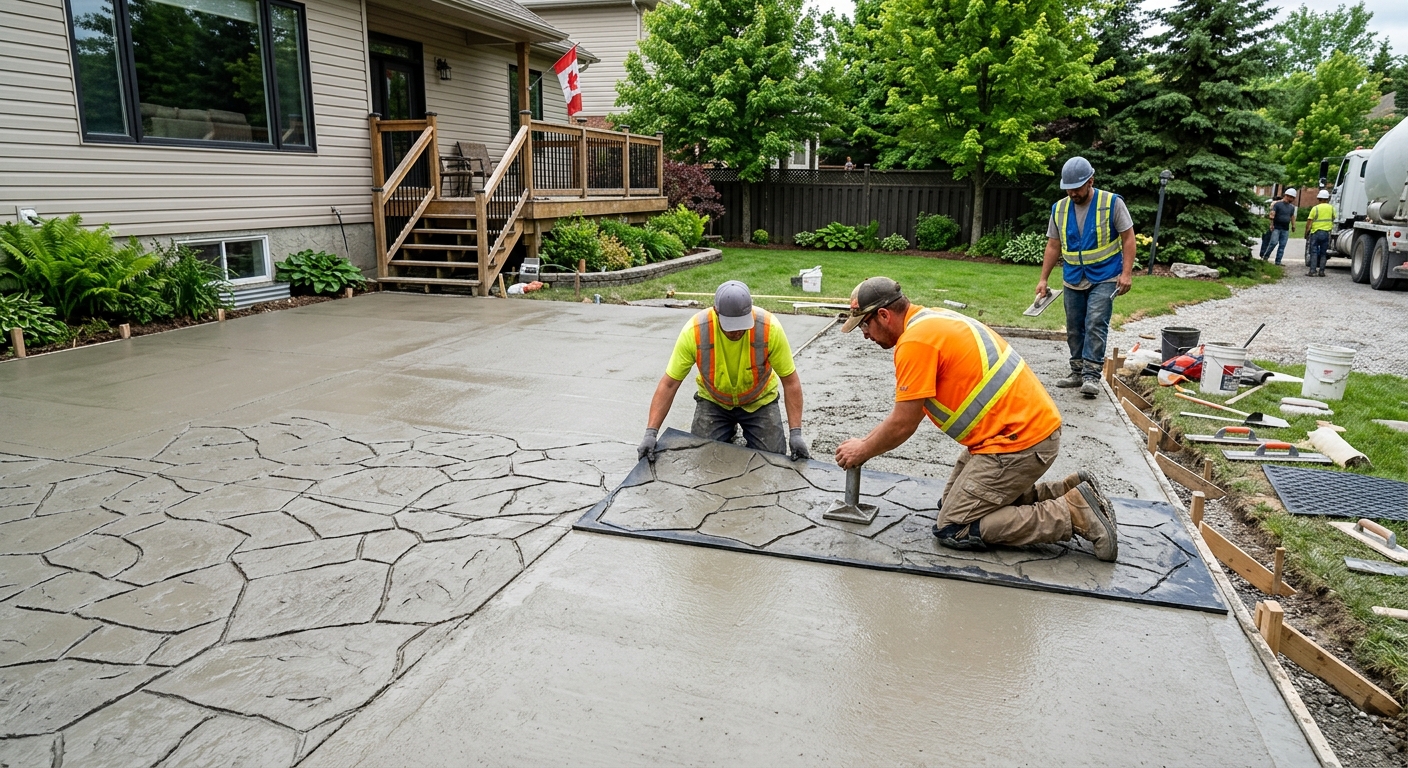
Concrete work options and costs in Cliff Bungalow
Concrete work in Cliff Bungalow, Alberta is driven by the realities of a cold continental climate: freeze–thaw cycles, a deeper design frost depth (about 1.2 m, roughly 4 ft), and shorter exterior pour seasons than warmer parts of the country. That combination means more excavation, air‑entrained mixes, and careful curing—so bids can move quickly depending on schedule and site constraints. In a neighbourhood with about 1,805 residents (Statistics Canada, 2021 Census), most homeowners are renovating older properties or adding curb appeal improvements that often include driveways, patios and walkways. Cliff Bungalow is also a mature, established area in Calgary, so contractors frequently see tie-ins to existing grades, sidewalks, and garage approaches, which affects haul distance and labour.
In the Calgary market, concrete availability is generally good, but the trade is more in demand around warmer windows and when backlogs hit—especially for larger flatwork packages. Neighbourhood demand is especially noticeable in areas closer to the inner-city corridors and busy access routes where machine access is limited and careful traffic/footpath planning is required (you’ll see more competition for projects near main roads and tight laneways). For many homes, choosing between options is about balancing durability and appearance. A standard broom finish driveway is usually the most cost-stable approach, while stamped or exposed aggregate adds value—but only if the base prep and jointing are done to the same standard.
Below are practical “typical project” ranges you can use to compare proposals, and to sanity-check whether a quote matches Calgary frost-and-cure requirements.
| Application |
Typical Size |
Key Spec |
Finish Option |
Price Range |
| Concrete driveway (standard broom finish) |
400–600 sq. ft. |
Air-entrained exterior mix; rebar at control joints as needed; compacted granular base |
Broom finish |
$12,000–$18,000 |
| Exposed aggregate driveway |
400–600 sq. ft. |
Air-entrained exterior mix; appropriate cement paste control; sealed exterior-ready mix |
Exposed aggregate |
$14,000–$21,000 |
| Stamped concrete driveway or patio |
300–500 sq. ft. |
Air-entrained exterior mix; integral colour; stamped pattern system |
Stamped |
$15,000–$26,000 |
| Plain concrete patio or walkway |
150–350 sq. ft. |
Air-entrained exterior mix; compacted base; proper slope and edging |
Broom or light trowel float |
$5,000–$9,000 |
| Garage floor (interior slab) |
500–700 sq. ft. |
Vapour barrier; fibre/mesh optional; proper thickness for vehicle loads |
Standard broom finish |
$7,500–$13,000 |
| Foundation footings (structural, below frost) |
House/garage footprint varies |
Engineered design; excavation to undisturbed soil below design frost depth; reinforced footings |
Structural concrete only |
$28,000–$45,000 |
Prices are estimates only and vary by project scope, site access and material selection.
What affects the price of concrete work in Cliff Bungalow
In Cliff Bungalow, it’s normal to see the “same” concrete scope land 30–50% apart across Calgary when contractors price different assumptions: excavation conditions, reinforcement needs, haul/access, and how they protect curing in cold snaps. A driveway bid can look similar on paper, but if one crew expects compacted granular base under frost-sensitive areas and the other treats it as “just a slab,” the spec—and the durability—will diverge. In a cold continental climate, every part of the system matters: footings must be engineered to bear below the design frost depth (about 1.2 m here) to prevent frost heave, and exterior flatwork needs air‑entrained concrete to resist freeze–thaw damage.
Freeze–thaw cycles also tighten quality control around base prep and finishing. Shorter exterior pour windows mean crews sometimes schedule tighter and use cold‑weather precautions (insulated blankets, sheltered placement, and in some cases temporary heat) to keep curing on track. That matters because late-season curing issues can lead to surface scaling and early deterioration, and then you end up paying again for repairs. Even de‑icing salt affects service life, so sealing isn’t a luxury for driveways and patios.
Two common local examples: (1) a driveway replacement with limited machine access—think tight setbacks or landscaping—often adds labour and disposal time, pushing closer to the $12,000–$18,000 driveway band or beyond; (2) a stamped patio that’s properly detailed (base prep, integral colour, and joints) may cost in the $15,000–$26,000 decorative band, but the price is justified if the contractor’s joint layout matches freeze–thaw stress patterns. With older neighbourhood housing stock, tie-ins to existing grades can force deeper removal and regrading, which increases foundation and slab volumes and drives cost.
| Price Factor |
Why It Matters |
Cost Impact |
| Frost line depth |
Footings and form height must extend to undisturbed soil below design frost depth (about 1.2 m in this market) |
Higher excavation and concrete volume; can materially increase foundation pricing |
| Site preparation |
Bad drainage or weak soil leads to settlement and cracking; compacted granular base controls movement |
Extra excavation, granular material, compaction passes, and trucking |
| Reinforcement |
Vehicle loads and shrinkage require steel or wire mesh placement at correct coverage |
Material + labour; impacts both flatwork and foundation costs |
| Mix design |
Air-entrainment and minimum strength are essential for Calgary freeze–thaw exposure |
Higher material cost; fewer failures reduce long-term callbacks |
| Finish type |
Stamping and exposed aggregate require specialist steps and tighter control |
Stamped/exposed typically costs more than broom-finish driveways |
| Pour size and concrete truck access to site |
Smaller or harder-to-access sites may need more handling time or pump costs |
Labour increases; potential equipment or pumping charges |
| Cold-weather curing precautions |
Insulated blankets/heating help concrete reach strength before freeze risks occur |
Added day-of labour and materials; prevents scaling |
| Control joint pattern and sealing cost |
Jointing manages crack locations; sealing reduces salt-driven surface breakdown |
More layout time plus sealing material and application after cure |
Permits & regulations in Alberta
In Alberta, structural concrete work—think foundation footings, foundation walls, grade beams, and other elements that support the structure—typically needs a building permit, and engineered drawings are often required for review before construction starts. For concrete flatwork like most patios, walkways, and driveways, a permit usually isn’t required by default. However, you may need approvals if the project affects lot grading, drainage, impervious surface coverage rules, or the municipal right-of-way (for example, work tied directly into sidewalk approaches or drainage features). Because these thresholds can vary by municipality and site conditions, confirm with the local authority before breaking ground.
When choosing a contractor in Cliff Bungalow, don’t skip the paperwork. Step 1: verify they carry liability insurance by requesting a current certificate of insurance naming the project parties as required (and confirming coverage limits). Step 2: confirm WSIB/WCB coverage—ask for proof and check that their clearance is current for the construction period. Step 3: ensure they can share references on similar-scale foundation or flatwork jobs. Step 4: ask whether permit pulling/engineering coordination is included when structural work is involved, and who is responsible for drawing submissions and inspections.
Finally, always read the quote to see what’s included: demolition/disposal, hauling, and whether the contractor is scheduling inspections where structural permits apply.
Getting concrete right in Cliff Bungalow's freeze-thaw climate
Concrete failures in Cliff Bungalow usually come down to three things: insufficient base support, wrong mix for freeze–thaw exposure, and poor curing/jointing. To spec the job correctly, start with (1) base preparation: excavate and build a compacted granular sub-base sized for local soil conditions and frost protection—footings must be designed to bear below the design frost depth (about 1.2 m). For exterior slabs, the base must be properly graded and compacted so water doesn’t sit underneath. Next, (2) mix design: exterior concrete should be air‑entrained (commonly targeting about 5–7% air content for freeze–thaw durability) and meet a minimum compressive strength of about 32 MPa for typical exterior applications. Then (3) control joints: plan joint locations and spacing to limit random cracking, and ensure joints are cut/finished on the right schedule. (4) Curing matters: allow a minimum 7-day curing period under proper conditions, and in cold weather use insulating blankets or approved cold-weather placement methods so strength gain isn’t interrupted. (5) Sealing: apply a penetrating sealer after the concrete has cured—commonly at 28 days—so de‑icing salts don’t aggressively attack the surface.
If you want a simple “value” example: a broom-finish driveway at $12,000–$18,000 is often the safest budget choice. A stamped driveway can be in the $15,000–$26,000 range, and the extra cost is justified when the contractor uses the same base, jointing and air-entrained mix discipline. If they can’t explain their air content, base specs, and joint layout, the cheaper quote is likely where the long-term spalling risk is hiding.
| Spec |
Why It Matters in Cliff Bungalow |
What to Ask For |
Impact if Skipped |
| Compacted granular base (depth?) |
Reduces frost-driven movement and prevents water pooling under slabs in Calgary’s freeze–thaw cycles |
Granular base depth and compaction method; drainage/slope plan |
Settlement, cracking, and premature breakdown near edges |
| Air-entrained concrete mix (target air %?) |
Improves freeze–thaw durability so water inside concrete doesn’t expand and scale/spall |
Documented air content target (typically 5–7% for exterior flatwork) |
Surface scaling and spalling, especially with salt |
| Compressive strength (MPa rating) |
Ensures adequate strength gain for structural and service conditions through winter |
Minimum 32 MPa (or project-specific engineered requirement) on the mix design |
Reduced durability and increased cracking potential |
| Control joints (spacing per ACI guidelines) |
Controls where shrinkage cracks occur so they don’t wander under thermal cycling |
Joint spacing plan and timing for sawing/cutting |
Random cracks, wider openings, and faster salt ingress |
| Minimum 7-day curing period |
Cold nights can slow hydration; proper curing reduces early-age weakness |
How curing will be maintained in cold weather (blankets/heating if needed) |
Scaling, weak surface, and long-term performance loss |
| Penetrating sealer (when applied after cure) |
Helps repel salt and moisture movement at the surface level |
Sealer type and application timing after cure (commonly after 28 days) |
Faster spalling and staining on driveways/patios |
How to choose a concrete work contractor in Cliff Bungalow
Choosing the right concrete contractor in Cliff Bungalow is mostly about verifying proof and getting clarity on the spec—not just the price. In Alberta, verify licensing/registration where applicable to their trade activity, confirm current liability insurance, and check WSIB/WCB coverage. How to check: request a current certificate of insurance (look for expiry date, coverage limits, and project details), then ask for WSIB/WCB proof/clearance showing the account is in good standing. If a contractor can’t produce these quickly, it’s a red flag.
Next, get 2–3 itemised written quotes. Ask for a labour + materials breakdown (concrete supply, reinforcement, excavation/granular base, formwork, finishing, and disposal). Don’t accept a vague allowance for “demo and haul” or “prep as needed.” Read the scope carefully: what’s excluded (existing slab removal, landscaping restoration, sawcutting, sealing, temporary heat/blankets for cold weather, permit fees if structural)? If you’re doing foundation work, confirm who pulls the permit and who coordinates engineered drawings and inspections.
Warranty matters. Ask for a workmanship warranty length and whether it’s tied to specific conditions (like maintaining the seal). Also ask if product/manufacturer warranties apply to coatings or decorative systems and whether they transfer to future owners. For payment schedule, a common safe approach is to keep upfront payment around 10–15% max and hold a portion until the job is complete and cured. Require a start date and completion estimate in writing, especially because Calgary’s pour window is shorter and weather swings can affect schedule.
- Request certificate of liability insurance and confirm it’s current.
- Provide WSIB/WCB clearance or proof of coverage for the project period.
- Ask for 2–3 recent references in Calgary/inner-city neighbourhoods with similar scope.
- Get itemised quotes (no lump sums without a clear scope breakdown).
- Confirm base prep depth and compaction requirements, not just “proper prep.”
- Ask the exact mix spec for exterior work: air-entrainment and strength target.
- Require jointing/cut schedule details and who monitors crack control.
- Ask how the contractor handles cold-weather curing (blankets/heating plan).
- Confirm whether sealing is included and when it will be applied.
- Clarify demolition and disposal/haul: what is included and where materials go.
- Verify truck access plan: pump needs, wheelbarrow distances, and protection of lawns/sidewalks.
- Get warranty terms in writing and understand any exclusions for de-icing practices.
Concrete red flags in Cliff Bungalow include: air content not being discussed for exterior slabs; vague curing plans during shoulder seasons; no written joint layout (or “we’ll see how it goes”); quotes that don’t specify base prep depth/compaction; and contractors asking for large upfront payments before excavation and formwork are complete.
Frequently asked questions — concrete work in Cliff Bungalow
What is the difference between concrete and cement?
In everyday conversation people use “concrete” and “cement” interchangeably, but they aren’t the same. Cement is one ingredient—typically Portland cement—that acts as the binder. Concrete is the full mixture: cement + sand + gravel (or other aggregates) + water, and for many exterior Calgary projects, a plasticizer/superplasticizer and air‑entrainment are included to survive freeze–thaw exposure. In Cliff Bungalow and across Alberta, the “right” concrete mix design matters as much as the finish, especially for driveways and patios where de‑icing salt and winter cycling can drive surface scaling if the air content and curing are wrong.
How much does concrete work cost in Cliff Bungalow?
Pricing in Cliff Bungalow typically follows Calgary’s cold-climate concrete economics: deeper excavation for frost protection, air‑entrained mixes, and sometimes cold-weather curing precautions. For quick budgeting, a concrete driveway is commonly in the $12,000–$18,000 range depending on size, reinforcement, and site access. Plain patios and walkways often fall around $5,000–$9,000 for typical homeowner sizes. If you want decorative work like stamping, expect about $15,000–$26,000 depending on square footage and pattern complexity. Foundation/footings (structural, below frost) commonly land in the $28,000–$45,000 band based on engineered scope and excavation requirements.
How deep must footings be for Cliff Bungalow's frost line?
Footings in this Calgary-area market are engineered around a design frost depth of about 1.2 m (roughly 4 ft). That means footings for houses, garages, decks and retaining structures must be placed on undisturbed soil below that depth, not just “as deep as we can dig.” The exact depth can vary with soil conditions and engineering requirements on a specific site, but the frost line concept governs excavation and formwork height. In Alberta, this is where bids can differ significantly: more excavation and greater footing volume increases material and labour, which is why foundation quotes can swing even when the house footprint looks similar on the plan.
Why does concrete crack in Cliff Bungalow and how is it prevented?
Concrete can crack in Cliff Bungalow because it moves: shrinkage during curing, thermal expansion/contraction, and—if drainage/base preparation is inadequate—soil movement under freeze–thaw cycles. Even with good concrete, you must manage where cracks occur through reinforcement placement (as specified), proper base prep, and control joints with a planned pattern. Prevention starts before the pour: compacted granular base, correct slope, and air‑entrained mix for durability. After the pour, finishing and joint timing matter so cracks form at joints rather than randomly. Sealing after cure helps reduce salt-driven deterioration at the surface, which is especially relevant when winters are hard and de‑icing is used routinely.
Stamped vs broom-finish concrete — cost difference?
Stamped concrete costs more than broom-finish because the system includes colour (often integral or a process with release agents), stamping mats, and additional finishing steps to achieve a consistent pattern. In the Cliff Bungalow market, a standard broom-finish driveway commonly fits around the $12,000–$18,000 range, while stamped concrete driveways or patios typically land around $15,000–$26,000 depending on square footage and the complexity of the pattern and edges. The key point: you should not accept cheaper stamped work that cuts corners on base prep, air‑entrainment, and joint layout—those are what determine whether it performs through Calgary’s freeze–thaw cycles.
When is the best time to pour concrete in Cliff Bungalow?
The best time to pour in Cliff Bungalow is during the warmer, more stable part of the season when concrete can cure reliably without excessive temperature drops. In Calgary, crews plan around the shorter exterior pour season, and you’ll often see projects coordinated for spring and summer into early fall. If you’re pouring in colder shoulder months, the contractor should use cold-weather curing precautions—insulated blankets or temporary heat—so the concrete reaches strength before freeze risk. That curing discipline directly impacts long-term performance and helps prevent surface scaling and early spalling. Ask your contractor what temperature thresholds trigger protective measures and how they’ll manage curing and scheduling on your exact date.