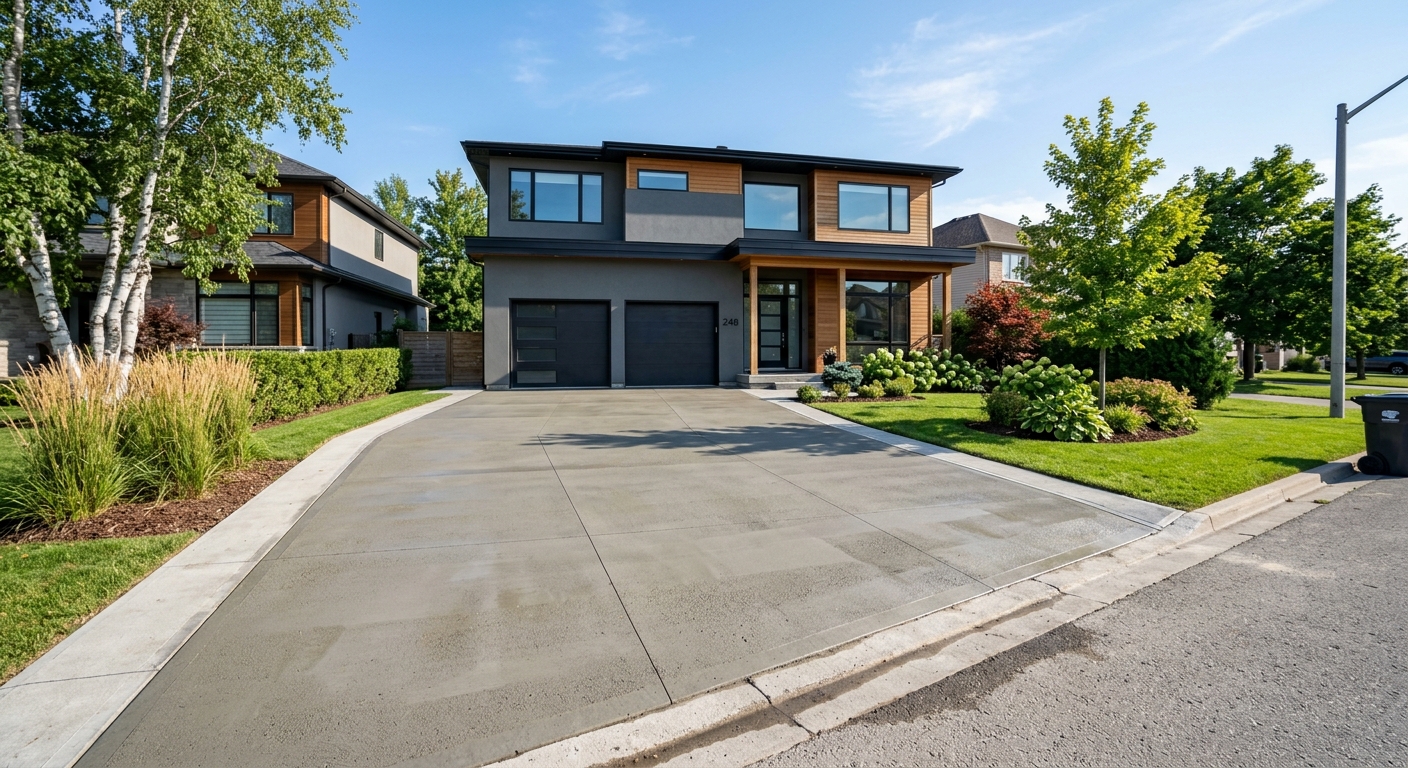
Concrete work options and costs in Bankview
Bankview is a tight, well-established community in Calgary where concrete flatwork is a daily need for driveways, patios, walkways, and garage floors. With a population of 5,125 (Statistics Canada, 2021 Census), demand here tends to cluster around established residential pockets and the ongoing rebuild/renovation cycle. In a typical year, homeowners are updating practical surfaces—especially where freeze–thaw stress and de-icing take their toll—so contractors with strong cold-weather execution are busy.
Calgary’s cold continental climate drives pricing more than people expect. Our region is engineered around a deeper design frost depth (about 1.2 m, roughly 4 ft), which means footing and foundation excavations are more intensive than in milder provinces, and exterior slab bases need to be built to a frost-resistant profile. On top of that, frequent freeze–thaw cycles require air-entrained mixes for exterior slabs and a reliable plan for control joints and curing. When crews rush curing in late fall or early spring, you can see early surface scaling and later spalling.
Within Bankview, concrete work is especially in demand along busier access routes and around common renovation corridors where new driveways and backyard patios are frequently added or replaced. If you’re comparing options, the numbers below will help you translate “look” and “performance” into realistic project budgets—then you can match the right spec to your site.
| Application |
Typical Size |
Key Spec |
Finish Option |
Price Range |
| Concrete driveway (standard broom finish) |
400–500 sq. ft. |
Air-entrained mix, compacted granular base, control joints |
Broom finish, sealant recommended |
$12,000–$18,000 |
| Exposed aggregate driveway |
400–500 sq. ft. |
Exposed aggregate setup, proper curing before wash |
Exposed aggregate (stone reveal) |
$14,500–$21,000 |
| Stamped concrete driveway or patio |
300–500 sq. ft. |
Air-entrained mix, release agent, colour hardener (if selected) |
Stamped pattern + sealer |
$15,000–$26,000 |
| Plain concrete patio or walkway |
250–400 sq. ft. |
Reinforcement as needed, slope/drainage, joints |
Broom or light trowel, sealant optional |
$5,000–$9,000 |
| Garage floor (interior slab) |
500–600 sq. ft. |
Vapour barrier (if specified), adequate thickness, joints |
Light trowel/steel finish |
$9,500–$15,500 |
| Foundation footings (structural, below frost) |
Variable (typical house perimeter) |
Excavate to frost depth; engineered rebar placement |
Structural concrete + rebar |
$28,000–$45,000 |
Prices are estimates only and vary by project scope, site access and material selection.
What affects the price of concrete work in Bankview
In Bankview and across Calgary, it’s common to see quotes for the “same” concrete project swing by 30–50%. The biggest drivers are how the contractor designs around frost depth, freeze–thaw durability, and access/crew time—especially because our frost depth target is about 1.2 m (roughly 4 ft). Contractors who build to that standard (proper excavation, granular base, reinforcement where required, and cold-weather curing precautions) usually cost more upfront, but they’re protecting you from the failure patterns we see locally: scaling, surface spalling, and random cracking.
Freeze–thaw cycles also dictate the mix. Exterior slabs typically need air-entrained concrete to survive repeated wetting and freezing, and exterior work placed during cold snaps often requires cold-weather measures (insulated blankets, temporary heating, and longer curing management) to reach adequate strength. Even de-icing salt contributes to surface wear—so sealing is a practical add-on, not just cosmetics.
Two common cost examples in Bankview: (1) If your driveway base is over-excavated poorly or left too shallow, the contractor may reduce material costs, but you’ll pay later in settlement and scaling—whereas correct base prep aligns with the region’s frost depth requirements and supports pricing in the driveway band of roughly $12,000–$18,000. (2) If you add a stamped finish, you’re paying for forms, pattern mats, and higher-colour labour, which is why stamped projects often track closer to $15,000–$26,000 depending on square footage.
Local housing stock also plays a role. Older homes in established neighbourhoods tend to have tighter lot lines and more constrained access for skid-steer/mini-excavation, which increases labour hours. Weather timing matters too: pouring in shoulder seasons can add cold-weather curing precautions that move your final cost even when the square footage doesn’t change.
| Price Factor |
Why It Matters |
Cost Impact |
| Frost line depth — determines footing depth and form height |
Footings must bear on undisturbed soil below the design frost depth to prevent frost heave |
Higher excavation volume and formwork can raise foundation costs significantly |
| Site preparation — excavation, grading, compacted granular base |
Weak sub-base leads to settlement and cracking during freeze–thaw cycles |
Extra hauling/compaction adds labour and equipment rental time |
| Reinforcement — rebar or wire mesh requirement |
Reinforcement controls cracking and supports slabs, walkways and some foundations |
Material + labour increases, especially for larger or structural slabs |
| Mix design — air-entrainment and compressive strength spec |
Air entrainment improves durability against freezing and scaling |
Higher-spec mix and batch planning can increase material costs |
| Finish type — broom vs. stamped vs. exposed aggregate |
Finish selection changes labour time, materials and curing/handling requirements |
Stamped and exposed options typically cost more than broom-finish |
| Pour size and concrete truck access to site |
Access constraints affect how fast concrete can be placed and finished |
More time with pumps/placement tools or extra trucks can add cost |
| Cold-weather curing precautions — heating and blankets |
Proper curing in cold conditions prevents surface scaling and strength loss |
Blankets/heaters and longer schedule days increase labour overhead |
| Control joint pattern and sealing cost |
Joints manage crack locations; sealing helps resist salt scaling |
More layout/finishing work and sealer materials can raise the total |
Permits & regulations in Alberta
In Alberta, the line between “typically permit-free” and “requires a permit” is mainly about structural impact. Structural concrete work—such as footings, foundation walls, and grade beams—does require a building permit, and it’s commonly tied to engineered drawings reviewed through the municipality’s process. Concrete flatwork (patios, walkways, driveways) often does not require a permit by itself, unless it affects lot grading, drainage, impervious surface coverage limits, or the municipal right-of-way (for example, changes near a sidewalk/curb area). Because specifics vary by site plan, always confirm before breaking ground.
For a homeowner in Bankview, the practical verification steps are:
1) Ask the contractor for their insurance documents. Verify liability insurance with an active policy date—your goal is to see a clear certificate that lists coverage and limits. 2) Confirm WSIB/WCB coverage where applicable (it should be provided on request). 3) Request a contractor reference list for similar concrete scope and square footage. 4) For structural pours, ask whether a permit will be pulled and who submits the engineering/inspection documents. 5) When licensing info is required for trades involved in the project, verify using the appropriate provincial online resources for active status.
If any contractor can’t provide insurance and coverage proof or won’t clearly explain permit responsibility for the structural portion, that’s a red flag. Get it in writing before you sign.
Getting concrete right in Bankview's freeze-thaw climate
Concrete fails in Bankview most often because of poor base prep, inadequate air entrainment, or rushed curing during cold snaps—especially on exterior slabs exposed to water, melt cycles, and de-icing salt. The correct spec starts underground: you need a compacted granular sub-base built to an appropriate depth and profile for local frost protection, not just “filled and tamped.” Calgary’s design frost depth target of about 1.2 m (roughly 4 ft) influences how deep excavation and footing-related work must go to reduce frost heave risk.
Next is the mix design. For exterior flatwork, use air-entrained concrete (commonly around 5–7% air content for durable freeze–thaw performance) and specify a minimum compressive strength of 32 MPa. Then plan control joints to limit random cracking—joints aren’t cosmetic, they’re how you manage shrinkage and movement. Curing matters too: minimum 7-day curing under proper conditions is a practical standard, and in colder periods that often means insulated blankets or temporary heat. After curing, apply a penetrating sealer (often 28 days post-pour) to help repel de-icing salts and reduce spalling.
Ask the contractor what they’re doing to prevent spalling from inadequate air-entrainment. If you’re choosing between plain broom-finish and stamped concrete, the extra cost can be justified if you’re upgrading the visual finish without sacrificing performance: stamped work typically sits higher—often around the $15,000–$26,000 band—because it’s more labour-intensive. If the quote difference is large but the base prep and mix specs aren’t clearly improved, you may be paying for appearance without durable engineering.
| Spec |
Why It Matters in Bankview |
What to Ask For |
Impact if Skipped |
| Compacted granular base (depth?) |
Controls settlement and provides frost protection against heave |
Confirm required depth/profile for your slab and soil conditions; compaction testing method if offered |
More cracking, uneven surface, and early failure after freeze–thaw cycles |
| Air-entrained concrete mix (target air %?) |
Prevents freezing damage and reduces scaling/spalling on exterior slabs |
Target air content (commonly 5–7% for exterior flatwork) and verify it on the ticket/spec |
Increased spalling and surface scaling after winters and salt exposure |
| Compressive strength (MPa rating) |
Ensures the slab reaches adequate strength for durability |
Minimum 32 MPa and curing plan to achieve it in cold weather |
Surface weakness, cracking, and reduced long-term performance |
| Control joints (spacing per ACI guidelines) |
Manages shrinkage cracking location in a climate with freeze–thaw movement |
Joint layout plan, spacing consistent with standard practice, and alignment with edges |
Random cracks that are harder to repair and allow water ingress |
| Minimum 7-day curing period |
Builds strength and stabilizes the surface during temperature swings |
How curing will be protected; when finishing operations and traffic are allowed |
Weak surface, early scaling, and durability loss |
| Penetrating sealer (when applied after cure) |
Helps repel de-icing salts that accelerate surface breakdown |
Application timing (often after full cure, e.g., ~28 days) and product type |
Faster salt-driven deterioration and shortened slab life |
How to choose a concrete work contractor in Bankview
Choosing the right contractor for concrete in Bankview is less about flashy photos and more about proof: insurance, coverage, and a written scope that matches Calgary’s freeze–thaw requirements. Start by verifying Alberta insurance: request a current certificate of liability insurance and confirm it aligns with the project address and coverage period. Next, ask for WSIB/WCB clearance or proof of coverage where applicable. These documents should be provided before work starts, not after you’ve paid a deposit.
Then get 2–3 itemised quotes—not just lump sums. A good quote breaks labour and materials separately (excavation/grading, forms, rebar or mesh, concrete supply, finish work, sealing, and any concrete truck/pump logistics). Read exclusions carefully: is disposal included, is permit work included (for structural components), and who handles site protection? For warranties, look for a workmanship warranty length in writing, plus product/manufacturer warranty terms where relevant. Ask whether warranties are transferable if you sell your home.
Finally, watch the payment schedule. Avoid paying more than 10–15% upfront. A typical holdback is released after key milestones and final acceptance. Ask for an exact start date and completion estimate in writing, and confirm cold-weather curing procedures if you’re pouring near the shoulder seasons.
- Ask for their air-entrained mix specification and confirmation on the concrete ticket.
- Request the granular base plan (depth/profile) and how they confirm compaction.
- Ensure reinforcement requirements are stated, not assumed.
- Get the control joint layout/spacing described in the scope.
- Confirm cold-weather curing measures (blankets/heaters) if temperatures drop.
- Ask whether penetrating sealer is included and the timing (after full cure).
- Check disposal and haul-away is included if excavation is required.
- Verify liability insurance is current and project-specific.
- Confirm WSIB/WCB coverage or clearance proof is provided.
- Request at least two references for similar scope and finish in the last 12–24 months.
- Make sure truck access constraints are addressed in the plan (pump/placement tools if needed).
- Get a written timeline with weather-based contingencies and responsibilities.
Concrete red flags in Bankview: contractors who won’t discuss air-entrainment, quotes that omit base prep depth, vague curing promises for cold-weather pours, “cheap” stamped work without better specs, and refusal to provide insurance/coverage paperwork before signing.
Frequently asked questions — concrete work in Bankview
Stamped vs broom-finish concrete — cost difference?
In Bankview (Calgary area), the cost difference is mostly labour and materials for patterning and colouring—not just “how it looks.” A broom-finish driveway typically aligns with the general driveway band of about $12,000–$18,000 depending on square footage and base prep. Stamped concrete generally moves higher because it adds pattern mats, release agents, colour hardeners/colours (if selected), and more careful finishing. That’s why stamped driveways and patios often track around $15,000–$26,000. The key is to compare both options on the same technical spec: air-entrainment for exterior durability, correct granular base, control joints, and curing plan. If the stamped quote costs more but quietly reduces base or mix details, you’re paying for appearance while accepting higher risk.
When is the best time to pour concrete in Bankview?
The best window is typically late spring through early fall in Bankview, when temperatures allow normal curing without heavy protection. In Calgary’s cold continental climate, late fall and early spring pours require extra planning: winter-grade mixes, insulated blankets, and sometimes temporary heat to keep concrete curing within an acceptable range. Even if you can place concrete, the real question is whether you can protect it long enough to hit strength targets and reduce scaling. For exterior slabs (driveways, patios, walkways), contractors usually tighten scheduling because the curing window is critical. If your timeline is flexible, schedule to avoid cold nights and snow events. If you must pour during colder weeks, confirm in writing the cold-weather curing precautions and how long the protection will stay on.
How long does concrete take to cure?
Concrete curing has two ideas homeowners should separate: “initial set” and “strength development.” For most exterior flatwork in Alberta, crews plan for at least a minimum 7-day curing period under proper conditions before you expect it to perform as a finished surface. That said, concrete reaches design strength over a longer period, and many contractors use 28 days as a practical benchmark for sealing decisions and final performance assumptions. In Bankview winters, curing can take longer and needs active protection—blankets or heat—so the surface doesn’t scale and the slab doesn’t under-develop strength. Ask your contractor to spell out their curing plan (what they’ll do day-by-day) and when you’re allowed to drive or place heavy loads.
Do I need a permit for concrete work in Alberta?
In Alberta, structural concrete work generally needs a permit—this includes footings, foundation walls, and grade beams. For typical concrete flatwork like patios, walkways, and driveways, permits often aren’t required by default. However, permits may come into play if the concrete affects lot grading, drainage, impervious surface limits, or any work near municipal right-of-way areas. Because Bankview sites can vary (especially around drainage and grade), the safest approach is to ask your contractor whether the scope is permit-triggering and to confirm with the municipality before excavation. Also verify the contractor is insured and can provide WSIB/WCB coverage proof, and—if a permit is needed—ensure engineered documentation is included where required.
Concrete vs pavers for a patio in Bankview?
Concrete and pavers both work well in Bankview’s freeze–thaw environment, but they fail differently. A properly built concrete patio uses an air-entrained mix for durability, a compacted granular base, control joints to manage cracking, and careful curing. If you want a clean, monolithic look with easier maintenance, concrete is usually the straightforward choice—plain patios commonly fall around $5,000–$9,000 depending on size and site conditions. Pavers can be more flexible: if a section settles, you may replace individual units. But pavers still require correct base prep and proper drainage; otherwise they can heave or develop weeds. If you expect heavy snow-melt and salt exposure, either system can perform well—just be sure the contractor specifies freeze–thaw appropriate materials and base depth for your soil and slope.
How long does a concrete driveway last?
A concrete driveway in Bankview can last decades when the slab is designed for Calgary’s freeze–thaw cycle: air-entrained mix, a properly compacted granular base, correct thickness for the use, and control joints that limit random cracking. The bigger threats are surface scaling/spalling (often linked to poor air entrainment or curing, and insufficient sealing against de-icing salts) and settlement from inadequate base prep. If you’re replacing a driveway, the most cost-effective improvements are usually the ones that match local climate engineering. For context, budgeting in the driveway band of about $12,000–$18,000 typically supports the materials and labour needed for a durable rebuild rather than a “minimum spec” pour. A well-executed driveway can hold up for many years, but it’s only as good as the base prep and the curing plan—especially if you’re pouring in colder shoulder-season conditions.