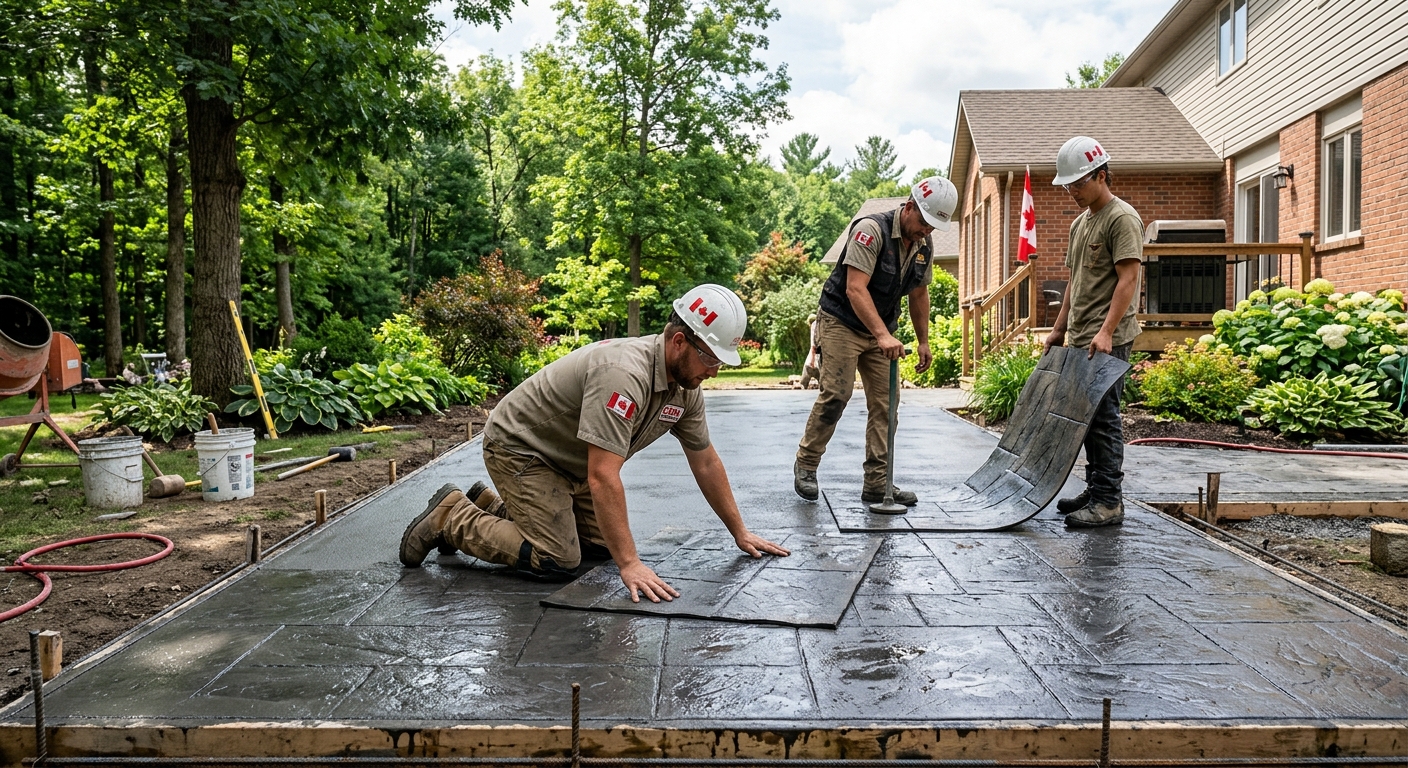
Concrete work options and costs in Erin Woods
Erin Woods, Alberta is a typical fast-growing pocket of the Calgary region, where concrete flatwork and foundation work get scheduled around winter conditions and spring thaw. With a population of 6,790 in 2021 (Statistics Canada, 2021 Census), the local market is not huge, so trades tend to book up quickly when weather windows open. Most concrete demand centers on single-family homes and the related exterior projects—driveways, patios, walkways, and garage floors—so pricing is driven by both volume and the engineered specs required for our cold continental climate.
In this area, concrete costs are shaped by the design frost depth of about 1.2 m (roughly 4 ft) used for footing design. That means more excavation and higher footing volumes than you’d see in milder areas. Add frequent freeze–thaw cycles and you get a higher priority on air-entrained mixes, proper granular base prep, and control joints that are well-spaced to limit cracking and spalling. Exterior pours also have a tighter placement and curing window, so contractors often plan for insulated blankets or temporary heat to keep concrete from scaling.
You’ll notice especially strong demand in newer subdivisions around Erin Woods / the Erin Woods community area where owners are adding or upgrading driveways and building patios for backyard use. The next step is comparing the common options and typical price ranges so you can benchmark quotes before you book a site visit.
| Application |
Typical Size |
Key Spec |
Finish Option |
Price Range |
| Concrete driveway (standard broom finish) |
400–600 sq ft |
Air-entrained mix, compacted base, control joints, edges formed |
Broom finish |
$12,000–$18,000 |
| Exposed aggregate driveway |
400–600 sq ft |
Air-entrained mix, proper wash timing, reinforced edges |
Exposed aggregate (washed surface) |
$14,000–$20,500 |
| Stamped concrete driveway or patio |
300–500 sq ft |
Air-entrained mix, release agent, sealed surface |
Stamped pattern + sealer |
$15,000–$26,000 |
| Plain concrete patio or walkway |
200–400 sq ft |
Compacted granular base, air-entrainment, joints as needed |
Float + broom/hand finish |
$5,000–$9,000 |
| Garage floor (interior slab) |
600–900 sq ft |
Vapour barrier, insulation (if required), reinforcement as specified |
Float + hardener (optional) |
$10,000–$16,500 |
| Foundation footings (structural, below frost) |
Per house/footprint (often 1,000–2,000 sq ft of footing area) |
Excavation to design frost depth, rebar/engineering spec, formwork |
Structural concrete (not for appearance) |
$28,000–$45,000 |
Prices are estimates only and vary by project scope, site access and material selection.
What affects the price of concrete work in Erin Woods
In Erin Woods and across the Calgary economic region, two quotes for the same “simple” concrete job can differ by 30–50% because the real drivers aren’t just the concrete—they’re the engineered scope. Contractors price the whole system: excavation to design frost depth, granular base type and depth, reinforcement placement, air-entrained mix design, finish complexity, and curing precautions. When one contractor assumes an easy truck access route and the other has to work around tight yards, regrade, haul-away, or schedule for cold-weather placement, the numbers move fast.
Our frost depth requirement is a core reason quotes separate. In Alberta, footings and structural concrete elements are engineered to bear below the design frost depth (about 1.2 m in the regional approach). That increases excavation and increases the amount of concrete and rebar compared with shallower-frost regions. Exterior slabs also need air-entrained concrete to survive freeze–thaw, plus control joints to manage shrinkage and movement. Cold-weather placement shortens the practical pour season and may require heated enclosures, insulated blankets, or winter-grade practices—costs that show up even on patios and walkways. Finally, the way you deal with de-icing salts matters: sealing is often recommended to reduce surface scaling.
For example, a 400–600 sq ft broom-finished driveway may land near $12,000–$18,000 when site access is straightforward. The same footprint stamped and sealed typically pushes toward $15,000–$26,000 because it adds labour, timing constraints, and surface prep. If your backyard sits on clay that needs deeper base correction, you’ll see an increase due to additional granular haul and compaction work—while a site with well-drained soils and easy access can keep pricing closer to the lower end.
| Price Factor |
Why It Matters |
Cost Impact |
| Frost line depth — determines footing depth and form height |
Deeper frost requirements increase excavation and concrete volume |
Often raises structural scope costs materially (foundation/footings typically move within the $28,000–$45,000 band) |
| Site preparation — excavation, grading, compacted granular base |
Calgary soils often require correction, proper base depth, and compaction |
Can add significant labour and haul costs on uneven or soft areas |
| Reinforcement — rebar or wire mesh requirement |
Ensures load capacity and controls cracking behaviour |
Adds material and placement labour; may be required for driveways/garage slabs |
| Mix design — air-entrainment and compressive strength spec |
Air entrainment and strength targets affect durability in freeze–thaw |
Higher-spec mixes cost more but reduce long-term failure risk |
| Finish type — broom vs. stamped vs. exposed aggregate |
Complex finishes take extra labour, timing, and surface prep |
Stamped/exposed work typically moves toward higher bands (e.g., $15,000–$26,000) |
| Pour size and concrete truck access to site |
Access controls how quickly you can place concrete and minimize cold joints |
Limited access can increase labour time and equipment needs |
| Cold-weather curing precautions — heating and blankets |
Proper curing prevents scaling and surface defects in late fall/early spring |
May add a meaningful line item when temperatures drop |
| Control joint pattern and sealing cost |
Joints manage shrinkage; sealing improves resistance to de-icing salts |
Sealing is an added cost, but often cheaper than repairs after spalling |
Permits & regulations in Alberta
In Alberta, structural concrete work typically requires a building permit, and the design is often reviewed through engineered drawings. That usually includes footings, foundation walls, grade beams, and other below-grade structural elements. Concrete flatwork—like driveways, patios, walkways, and garage slabs—often does not require a permit by default, unless the work affects lot grading, drainage, impervious surface coverage limits, or the municipal right-of-way. Because local interpretations can vary, confirm requirements with the local authority before any excavation starts.
For a homeowner in Erin Woods, verifying a contractor the right way is straightforward:
- Check Alberta contractor eligibility using the appropriate provincial registry/licence look-up available through government or regulator guidance.
- Request a Certificate of Liability Insurance and verify it includes your project/ownership period and appropriate coverage limits.
- Ask for confirmation of WSIB/WCB coverage (workers’ compensation) and match the certificate to the company name on the quote/contract.
- Look for references on jobs with similar scope—especially exterior slabs in cold-weather conditions.
- If engineered drawings are involved (structural concrete), confirm the contractor is building to those specs and can coordinate inspections.
Do this before you sign. It protects you from schedule delays, hidden scope changes, and workmanship risk.
Getting concrete right in Erin Woods's freeze-thaw climate
Concrete failures in Erin Woods usually come down to three things: movement from frost, inadequate freeze–thaw durability, and poor curing. We’re working with a cold continental climate where freeze–thaw cycles are frequent, and the design frost depth approach (about 1.2 m, roughly 4 ft) means footings must be placed on undisturbed soil below that depth. For slabs—driveways, patios, and walkways—the job still starts with the base. If the compacted granular sub-base isn’t at the right depth and density for local soil and drainage, the slab can settle and crack, especially after thaw periods.
To spec concrete correctly here, insist on: (1) compacted granular base prep to the required depth and thickness; (2) air-entrainment for exterior flatwork—typically around 5–7% air; (3) control joints spaced to reduce random cracking; and (4) proper curing so the concrete reaches adequate strength without surface scaling. Finally, consider penetrating sealer applied after cure to repel de-icing salts that otherwise accelerate spalling.
Here’s a practical pricing example: a broom-finished patio/sidewalk job might be in the $5,000–$9,000 range. If you skip proper air-entrainment or rush curing in late fall, the “savings” can turn into repairs within a couple of winters due to scaling. Spending for winter-grade execution and correct joints/sealing is usually far cheaper than grinding out and re-pouring.
| Spec |
Why It Matters in Erin Woods |
What to Ask For |
Impact if Skipped |
| Compacted granular base (depth?) |
Prevents settlement and reduces moisture pumping during thaw cycles |
State base depth and compaction standard in writing for your soil conditions |
Early cracking, uneven slabs, and faster freeze–thaw deterioration |
| Air-entrained concrete mix (target air %?) |
Protects against scaling and spalling in repeated freeze–thaw |
Ask for an exterior target of about 5–7% air content |
Higher risk of surface scaling/spalling and durability failure |
| Compressive strength (MPa rating) |
Strength helps the slab resist loads and maintains integrity after curing |
Minimum 32 MPa compressive strength |
Surface wear, cracking under loads, and weak long-term performance |
| Control joints (spacing per ACI guidelines) |
Controls shrinkage cracking to predictable locations |
Request joint spacing and saw-cut timing plan |
Random cracks that can widen and trap moisture |
| Minimum 7-day curing period |
Strength gain and surface stability depend on curing conditions |
Plan for curing and temperature protection if cold weather hits |
Reduced strength and increased chance of scaling |
| Penetrating sealer (when applied after cure) |
Improves resistance to de-icing salts and chloride exposure |
Apply penetrating sealer after cure (commonly 28 days post-pour) |
Faster surface deterioration and more frequent maintenance cycles |
How to choose a concrete work contractor in Erin Woods
Choosing the right contractor in Erin Woods is mostly about verifying coverage and matching the quote to the technical requirements for cold-weather concrete. Start with Alberta licensing: ask for proof that the company and project lead are eligible to perform the work you’re hiring for. Then check liability insurance—request a current Certificate of Insurance and confirm it’s active for the project dates. Finally, verify WSIB/WCB coverage (workers’ compensation) so you’re not exposed if a worker is injured on site. A solid contractor will provide these documents quickly and will match the company name on your contract.
Next, don’t accept vague lump sums. Get 2–3 itemised written quotes that break labour and materials separately: excavation and hauling, granular base and compaction, reinforcement, concrete supply (including air-entrainment and strength spec), forms, finishing, saw-cut timing, and sealing (if included). Read the scope carefully for exclusions like disposal, rebar spacing, winter curing measures, and protection of landscaping.
Warranty and payment structure matter in this climate. Ask for workmanship warranty length, what it covers, and whether it includes labour to correct defects. Payment should follow a fair schedule—generally no more than 10–15% upfront—and you should hold back the remainder until the job is complete and cleaned up. Get the start date and a realistic completion estimate in writing, including what happens if temperatures drop.
- Provide a written scope that states frost/winter execution requirements and curing plan.
- Itemised pricing: base prep, reinforcement, concrete supply, finish work, sealing.
- Include access notes (truck paths, crane/boom needs, gate clearance).
- Verify current liability insurance certificate before work begins.
- Verify WSIB/WCB clearance for the company and crews.
- Confirm rebar/wire mesh type, size, and placement method.
- Require an air-entrained mix spec for exterior slabs.
- Ask for control joint spacing and whether joints are saw-cut or formed.
- Confirm curing method and protection in cold weather (blankets/heating if required).
- Ask whether sealing is included and when it will be applied (after proper cure).
- Get a start/completion timeline and weather contingency plan.
- Use a contract with holdback terms for incomplete items and cleanup.
Concrete red flags in Erin Woods: (1) no mention of air-entrainment for exterior flatwork, (2) skipping control joints or not detailing joint spacing, (3) offering a very low price without an itemised base prep/reinforcement breakdown, (4) pressuring for large upfront payments, and (5) refusing to provide insurance/WSIB/WCB documentation.
Frequently asked questions — concrete work in Erin Woods
Why does concrete crack in Erin Woods and how is it prevented?
In Erin Woods, cracking is usually caused by shrinkage and movement amplified by freeze–thaw cycles. When concrete dries, it shrinks; if there aren’t properly planned control joints, cracks appear randomly. Moisture then gets into openings, and repeated freezing and thawing can widen them and lead to surface scaling. Prevention starts with the right granular base prep and compaction, correct air-entrained mix for exterior durability, and a control joint layout set to manage where cracks should occur. Make sure joints are cut/specified at the right time so they form before uncontrolled cracking. Finally, sealing after the proper cure helps reduce de-icing-salt damage. If you’re budgeting, exterior broom-finish patios and walkways commonly fall in the $5,000–$9,000 range, but durable prep and joints are what protect that investment through winter.
Stamped vs broom-finish concrete — cost difference?
Stamped concrete typically costs more than broom-finished because it adds labour and timing constraints: the base prep needs to be consistent, crews must apply stamps/release correctly, and surfaces often require higher-end finishing and sealing. In Erin Woods, you’ll often see broom-finished driveways priced in the $12,000–$18,000 range, while stamped concrete driveways or patios commonly land in the $15,000–$26,000 band. That difference isn’t just appearance—stamped work still requires exterior-grade durability specs (air-entrainment, joints, and curing protection in cold weather). If winter temperatures are near the edge of the pour window, the contractor’s cold-weather execution plan can move the final number as well. The key is to compare the full spec in both quotes, not just the finish name.
When is the best time to pour concrete in Erin Woods?
The best time is when you can place and cure concrete without rapid temperature swings. In the Calgary region around Erin Woods, exterior slabs are usually planned for late spring through early fall, when the “practical pour season” is longer and curing is more predictable. If you pour too late into fall or too early in spring, you often need winter-grade mixes, insulated blankets, and sometimes temporary heat to reach proper curing conditions. That’s not optional if you want durability; cold-weather curing shortcuts raise the risk of surface scaling and long-term spalling. For homeowners, ask your contractor how they manage curing temperatures, what they do if weather changes mid-week, and whether blankets/heating are included or quoted as extras. A good quote will say how they’ll protect the concrete during the first 7 days and how that affects cost.
How long does concrete take to cure?
Concrete strength development is time- and temperature-dependent. A common expectation for residential work is a minimum 7-day curing period for stability before heavy exposure, but true performance and durability improve as curing continues. In cold-weather conditions in Alberta, curing may require protection (insulated blankets and/or heat) to prevent surface defects. For sealing, many contractors recommend waiting until the concrete has cured sufficiently—commonly 28 days post-pour—so the surface is ready to accept a penetrating sealer. If your contractor is quoting fast-track work without addressing curing protection, it’s a red flag in Erin Woods freeze–thaw conditions. Ask what curing method they’ll use, what temperatures they target during the first week, and whether their warranty accounts for weather protection.
Do I need a permit for concrete work in Alberta?
In Alberta, structural concrete work such as footings, foundation walls, and grade beams typically requires a building permit, and engineered drawings are often reviewed. For concrete flatwork like driveways, patios, and walkways, permits are usually not required unless the work impacts drainage, grading, impervious surface coverage limits, or the municipal right-of-way. Because specific circumstances can trigger additional approvals, confirm with the local authority before you dig. A practical step for Erin Woods homeowners: ask whether the contractor includes permit pulling (when required) and list any grading/drainage scope changes in writing. Also verify the contractor carries liability insurance and WSIB/WCB coverage before starting—those items are part of responsible compliance and risk control in Alberta.
Concrete vs pavers for a patio in Erin Woods?
Concrete is often the better value in Erin Woods when you want a durable, continuous surface built to winter specs. A plain concrete patio or walkway typically sits around $5,000–$9,000 for common residential sizes, and the job is easier to engineer for freeze–thaw with air-entrainment, proper base prep, and control joints. Pavers can look great and are modular, but they still need the right compacted base and correct drainage; if sub-base prep isn’t spot-on, you can get uneven settlement and movement, especially after spring thaw. Pavers may also involve more seams and the potential for weeds if not properly installed. Ask both contractors how they handle base depth, compaction, and drainage. If you’re worried about cracking aesthetics, note that concrete control joints can be planned to keep cracking orderly rather than random.