Concrete work options and costs in Tipaskan
Tipaskan is a smaller community in the Calgary economic region, with a population of 2,901 (Statistics Canada, 2021 Census). In practice, that means fewer crews are available locally, so scheduling can be tighter—especially when multiple homeowners are doing exterior upgrades the same season. Concrete flatwork is still the big driver of demand in this area, because most residential properties are single-detached homes, and those owners typically want durable driveways, patios and walkway slabs that can handle long winters and repeated freeze–thaw cycles.
In the cold continental climate around Calgary, concrete pricing isn’t just “materials plus labour.” The design frost depth is about 1.2 m (roughly 4 ft), and footings for houses, garages and retaining structures must bear on undisturbed soil below that depth. That typically increases excavation volume and formwork height compared with milder provinces. On exterior slabs, the frequent freeze–thaw cycle also pushes contractors to use air-entrained concrete and to plan control joints early—both of which affect cost. If you’re pouring in late fall or early spring, cold-weather placement procedures (insulated blankets and sometimes temporary heat) are often required to achieve proper curing, which protects against surface scaling and long-term deterioration.
In Tipaskan, trades tend to be especially busy around established residential pockets like the Tipaskan neighbourhood/area core, where driveways and back-yard patios are commonly upgraded as homes age. Below is a practical comparison of common options and typical price ranges, so you can line up your quote with the specifications that matter most.
| Application |
Typical Size |
Key Spec |
Finish Option |
Price Range |
| Concrete driveway (standard broom finish) |
400 sq. ft. (about 20 ft x 20 ft) |
Air-entrained mix, compacted granular base, control joints |
Broom finish |
$12,000–$18,000 |
| Exposed aggregate driveway |
400 sq. ft. (about 20 ft x 20 ft) |
Air-entrained mix, proper retarder/curing timing |
Exposed aggregate |
$15,000–$22,000 |
| Stamped concrete driveway or patio |
300 sq. ft. (about 15 ft x 20 ft) |
Reinforcement as required, integral colour, release/cure control |
Stamped |
$15,000–$26,000 |
| Plain concrete patio or walkway |
200 sq. ft. (about 10 ft x 20 ft) |
Air-entrained mix, compacted granular base, joints |
Plain broom or float finish |
$5,000–$9,000 |
| Garage floor (interior slab) |
500 sq. ft. (about 20 ft x 25 ft) |
Vapour barrier as required, reinforcement, proper curing |
Float/steel-trowel (light broom) |
$14,000–$22,000 |
| Foundation footings (structural, below frost) |
Typical house/garage footing package |
Excavate below design frost depth (~1.2 m), engineered rebar, forms |
Structural concrete |
$28,000–$45,000 |
Prices are estimates only and vary by project scope, site access and material selection.
What affects the price of concrete work in Tipaskan
In the Calgary region, it’s common to see quote swings of 30–50% for what looks like the same concrete job on paper. The differences are usually in engineering and execution details: how deep the excavation goes, how the granular base is built, what reinforcement is used, and what cold-weather curing precautions are included. Even the mix design and finishing plan can change the labour time on site. Because Tipaskan sits in a freeze–thaw climate, contractors also manage curing windows more carefully, which can reduce speed but improve long-term durability.
Frost depth drives a big portion of the “why” behind foundation and footing costs. In Alberta, footing excavations must extend to undisturbed soil below the design frost depth (about 1.2 m in this region). That means more truckloads, more shoring/form height, and larger concrete volumes than you’d see in warmer areas. Exterior slabs also need air-entrained concrete to survive freeze–thaw cycles; that’s why a basic patio can land in the $5,000–$9,000 band when the base is straightforward, but climb toward the higher end when thickness, reinforcement, or access changes. Similarly, driveway pricing is anchored to the $12,000–$18,000 range when it’s a typical broom-finished placement with normal site work, but can rise quickly with drainage corrections, thicker slabs, or more intricate finishes like exposed aggregate.
Here are a few realistic Tipaskan examples. If your driveway needs regrading to daylight away from the foundation, the excavation and forms increase—often adding thousands more even before concrete is poured. A garage slab over a compacted base with vapour barrier requirements can be more expensive than an exterior walkway, simply because the prep and curing discipline are stricter indoors. And sealing matters: de-icing salt accelerates surface spalling when the surface is not protected, so homeowners who plan for a penetrating sealer after cure tend to spend less on premature patching.
| Price Factor |
Why It Matters |
Cost Impact |
| Frost line depth |
Determines footing depth and form height |
Major cost driver for footings; deeper excavation and more concrete increase labour and materials significantly |
| Site preparation |
Excavation, grading, compacted granular base |
Can swing cost due to removal/haul-away, longer hauling distances, and base rebuilds |
| Reinforcement |
Rebar or wire mesh requirement |
Higher if engineering calls for more steel, thicker slabs, or additional dowels/mesh layers |
| Mix design |
Air-entrainment and compressive strength spec |
Exterior freeze–thaw needs air-entrainment; higher specs can add material cost but reduce failure risk |
| Finish type |
Broom vs. stamped vs. exposed aggregate |
Decorative work adds labour time (forms, colouring, finishing steps) and can cost substantially more |
| Pour size and concrete truck access to site |
Impacts batching logistics and labour sequencing |
Tighter access may require pumps, more labour, or multiple pours—driving up cost |
| Cold-weather curing precautions |
Heating and blankets |
Adds rental/labour/time, especially for exterior pours near late fall/early spring |
| Control joint pattern and sealing cost |
Limits random cracking and protects against salts |
Proper joints and sealing reduce long-term repairs; skipping can lead to costly patching |
Permits & regulations in Alberta
In Alberta, structural concrete work typically needs a building permit, and many projects require engineered drawings that are reviewed by the municipality. That includes work like foundation footings, foundation walls, grade beams and other elements that are part of the building’s structural system. If you’re building a new house, doing a structural addition, or replacing a foundation, expect permit and engineering involvement.
Concrete flatwork—like patios, walkways and most driveways—usually does not require a permit unless the work affects lot grading, impervious surface coverage limits, drainage to the right-of-way, or required setback/municipal approvals. Even when permits aren’t required, contractors should still ensure proper drainage and that any changes to surface water are handled correctly, since Alberta winter freeze–thaw makes small drainage mistakes show up quickly as frost issues.
For Tipaskan homeowners verifying a contractor, a solid step-by-step approach is:
- Ask for proof of liability insurance and ensure the certificate lists you as an interested party/appropriate contact where possible.
- Confirm WSIB/WCB coverage for the crews who will be on site (ask for clearance where applicable).
- Request references on similar footing/foundation or slab projects in the Calgary area.
- For structural work, confirm the contractor is coordinating engineering and submitting required documentation.
- Verify the project plan includes freeze–thaw specifications (air-entrainment for exterior slabs, curing procedures for cold weather).
When in doubt, always contact the local authority before breaking ground—especially if your scope changes drainage or building grade.
Getting concrete right in Tipaskan's freeze-thaw climate
Concrete failure in Tipaskan is usually tied to one thing: water and freeze–thaw working together to push and weaken the slab. The most common issues I see are spalling and surface scaling from insufficient air-entrainment, poor base compaction, and rushed curing when temperatures drop. In a Calgary-area climate with repeated freeze–thaw cycles, you need specs and site procedures that assume cold weather—not “summer concrete” assumptions.
To spec the job correctly, start with base preparation. The granular sub-base has to be compacted and built to the right depth for local soil and to support the slab below frost influence; for footings, that means extending below the design frost depth (about 1.2 m in this region). Next is mix design: exterior flatwork should use air-entrained concrete (target roughly 5–7% air content) and a minimum 32 MPa compressive strength so the material performs through cycles. Control joints must be planned and spaced to limit random cracking, and they must be installed with timing that matches the placement. Finally, curing needs proper conditions for at least 7 days—if you’re pouring when cold nights are expected, ask about insulated blankets and whether temporary heat is included to protect early-age strength. After curing, consider a penetrating sealer (applied 28 days post-pour) to repel de-icing salts.
Here’s a dollars-and-sense example. If a sealed, air-entrained exterior walkway is priced near the $5,000–$9,000 band, skipping air-entrainment or base depth might look cheaper upfront, but repairs later can cost a fraction of the original job—often more—once spalling starts. Proper curing and sealing typically prevent that “cheap today, patch tomorrow” cycle.
| Spec |
Why It Matters in Tipaskan |
What to Ask For |
Impact if Skipped |
| Compacted granular base (depth?) |
Reduces voids that trap water and heave during freeze–thaw |
Confirm excavation depth and compacted granular base thickness, plus proof of compaction |
Settlement, cracking, and premature slab failure from water movement |
| Air-entrained concrete mix (target air %?) |
Improves freeze–thaw durability for exterior exposure and de-icing |
Ask for air-entrainment target (about 5–7% for exterior flatwork) and mix documentation |
Spalling and scaling increase dramatically in Calgary-area winters |
| Compressive strength (MPa rating) |
Strength gain affects abrasion resistance and long-term performance |
Minimum 32 MPa specified and included in the quote |
Surface wear, cracking, and reduced durability under salt and traffic |
| Control joints (spacing per ACI guidelines) |
Controls where cracks form to protect edges and reduce water intrusion |
Joint spacing and layout plan based on slab dimensions |
Random cracking, harder repairs, and more water entry into the slab system |
| Minimum 7-day curing period |
Ensures early strength before freezes and temperature swings |
Confirm curing method and how cold nights are protected (blankets/heating if needed) |
Reduced strength, increased scaling risk, and durability issues |
| Penetrating sealer (when applied after cure) |
Helps repel de-icing salts and reduces moisture uptake |
Ask for application timing (28 days post-pour after proper cure) |
Faster salt damage and patching cycles |
How to choose a concrete work contractor in Tipaskan
Choosing the right concrete contractor in Tipaskan is less about who has the lowest number and more about who can prove their process. In Alberta, confirm licensing/registration requirements that apply to the contractor’s scope, and always verify liability insurance before work starts. For coverage for the people on site, ask for WSIB/WCB clearance or proof of coverage for your project—this is a practical safety check for your homeowner risk.
Next, demand 2–3 itemised, written quotes rather than one lump-sum. Good quotes break out labour and materials, including excavation/disposal, granular base, reinforcement, concrete mix type (air-entrained for exterior), pump/haul considerations, finishing, curing protections, and sealing if it’s included. Read the exclusions carefully: for example, is de-icing salt protection (sealer) included, are cold-weather blankets included if nights are forecast below acceptable thresholds, and is the permit coordination included for structural foundation work?
Warranty matters. Ask for the workmanship warranty length, what it covers (cracking vs. spalling vs. joint performance), and whether any manufacturer warranty transfers to you for decorative or specialty concrete materials. On payment, a safe rule of thumb is to avoid paying more than 10–15% upfront; hold back a portion until completion and final touch-ups are done. Finally, get the start date and completion estimate in writing so you can plan around Calgary’s shorter practical pour season.
- Ask what air-entrained mix is specified for exterior slabs.
- Confirm excavation depth and granular base thickness in writing.
- Require a joint layout plan and spalling-resistant practices.
- Check that curing procedures are spelled out (blankets/heating if needed).
- Request proof of liability insurance and that it’s current.
- Request WSIB/WCB coverage confirmation for the crews.
- Look for itemised haul/disposal costs (not hidden in “misc.”).
- Confirm truck access plan (and whether pumping is needed).
- Ask if reinforcement is included as required by thickness/engineering.
- Verify who supplies and applies sealer (and the 28-day timing).
- Get a clear warranty document in plain language.
- Avoid large deposits; schedule payments by milestones.
Concrete red flags I see around Tipaskan include: quotes that don’t mention air-entrainment for exterior work, “no joints needed” sales talk, curing promises that don’t address cold nights, vague base specs (no depth/compaction), and payment terms that ask for most funds upfront before formwork and prep are done.
Frequently asked questions — concrete work in Tipaskan
What is the difference between concrete and cement?
In Tipaskan and across Alberta, people often use the terms interchangeably, but they’re not the same. Cement is one ingredient—essentially the binding powder. Concrete is the full engineered material: cement plus water, sand and gravel (and sometimes air-entraining admixtures). For exterior slabs in the Calgary area, contractors usually specify an air-entrained concrete mix so the finished surface survives freeze–thaw cycles and reduces scaling risk. That mix design choice affects price more than homeowners expect. For example, if your walkway lands in the $5,000–$9,000 range, that typically includes the right exterior-grade concrete, proper base prep and finishing—not just “cement poured into a form.”
How much does concrete work cost in Tipaskan?
Concrete pricing in Tipaskan generally follows Calgary-region bands, with the biggest swings coming from excavation depth, reinforcement needs, truck access, and whether cold-weather curing precautions are included. For a typical broom-finished concrete driveway, many projects land in the $12,000–$18,000 range depending on slab thickness, base rebuilds and drainage work. Plain patios and walkways are commonly quoted around $5,000–$9,000 for typical backyard sizes, again with scope-driven variation. Foundations and footings—because they’re structural and must extend below the design frost depth—often fall in the $28,000–$45,000 band for a typical package. If you’re considering stamped or decorative concrete, expect a higher band like $15,000–$26,000 due to extra colour/material steps and finishing labour. Always compare like-for-like specs, not just the bottom line.
How deep must footings be for Tipaskan's frost line?
For Tipaskan (Calgary region), local engineering practice uses a design frost depth of about 1.2 m (roughly 4 ft). That means footings for houses, garages, decks and retaining structures typically need to bear on undisturbed soil below that depth to reduce frost heave and seasonal movement. Your exact footing size and embedment can vary with soil conditions, drainage, and engineered drawings, so you should treat 1.2 m as the frost-depth planning benchmark rather than a one-size-fits-all number. It also explains why foundation costs are often higher than in warmer provinces: excavation is more intensive and footing volumes are larger. When you compare quotes in the $28,000–$45,000 foundation/footings range, the ones that itemise excavation depth and engineering details are usually the ones to trust.
Why does concrete crack in Tipaskan and how is it prevented?
Concrete cracking doesn’t automatically mean the slab is “bad”—concrete shrinks as it cures and expands/contracts with temperature swings. In Tipaskan, freeze–thaw and moisture are the bigger stressors: water getting under or into a slab can expand when it freezes, and that magnifies movement. Cracking is prevented (or at least managed) using a system of specs: correct compacted granular base, air-entrained exterior mix, proper reinforcement where required, and a control joint pattern designed to guide cracking to planned locations. Good contractors also plan timing so joints are cut/placed when the concrete can take them without uncontrolled tearing. Sealing helps too by reducing water/salt intrusion. If you’re paying driveway prices near the $12,000–$18,000 band, the best bids usually show joint layout and curing precautions—not just “we’ll pour it and hope.”
Stamped vs broom-finish concrete — cost difference?
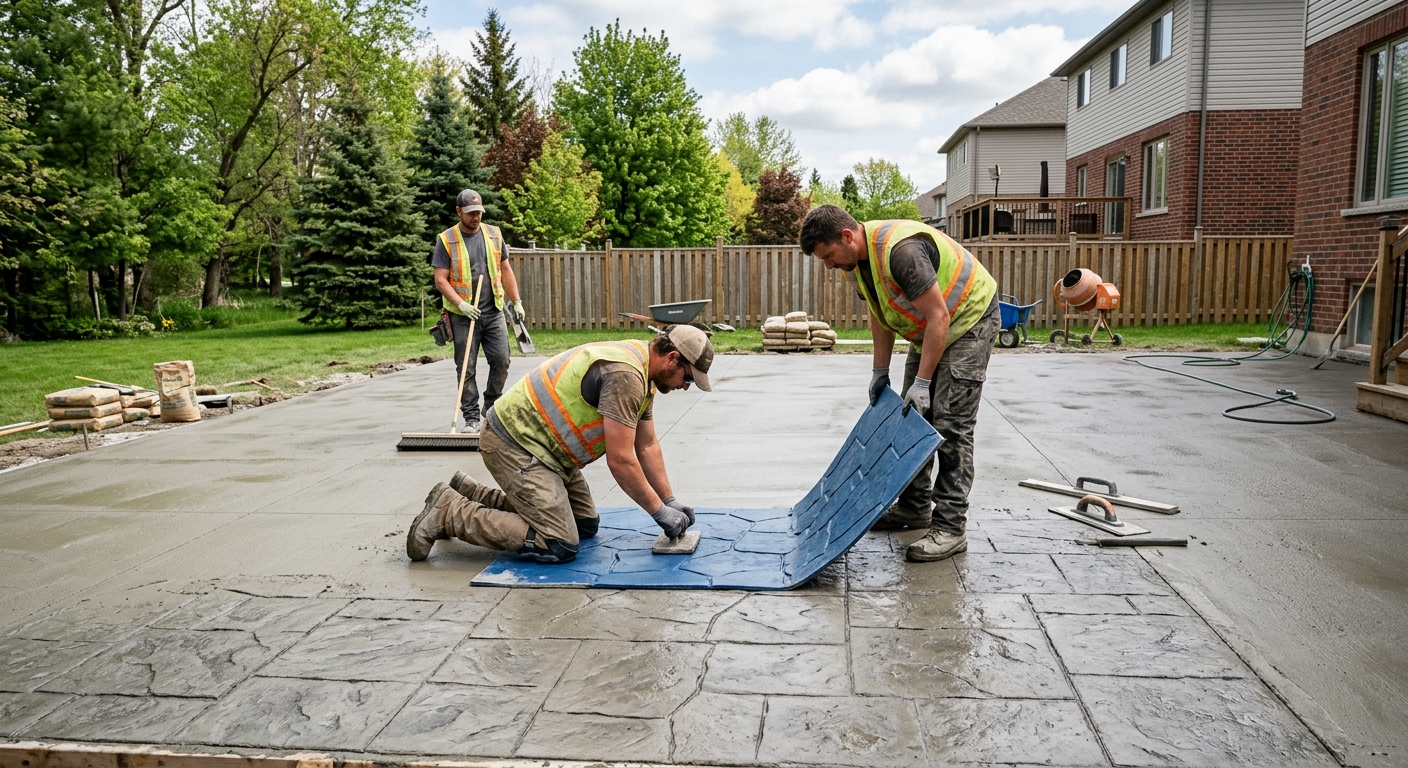
Stamped concrete costs more because it involves more steps: integral colour or topping colour, release agent, stamp tooling, careful cure timing, and typically more labour time to achieve a consistent pattern. In the Calgary region, a standard broom-finished driveway typically sits around $12,000–$18,000, while decorative stamped concrete often lands in the $15,000–$26,000 band depending on size, pattern complexity, and prep requirements. The difference isn’t only the “look”—stamped work still needs the same freeze–thaw durability specs (air-entrained mix for exterior applications, correct base, proper joints and curing). A lower decorative quote can be a red flag if it doesn’t clearly include those durability requirements. Ask your contractor to itemise the finish steps and confirm that the underlying structural specs are identical to the broom-finish option.
When is the best time to pour concrete in Tipaskan?
In Tipaskan and the wider Calgary area, the best time is typically when daytime and nighttime temperatures support proper curing without extreme cold snaps. Contractors plan around a shorter practical exterior pour season, because late fall or early spring pours can require winter-grade mixes, insulated blankets, and sometimes temporary heat to protect early-age strength. The curing window is critical: rushing curing increases the risk of surface scaling and longer-term performance problems, especially on exposed driveways, patios and walkways. If you’re aiming for a driveway around $12,000–$18,000 or a walkway in the $5,000–$9,000 band, ask your contractor how they will handle temperatures and wind, and whether cold-weather precautions are included in the scope. The right timing protects your warranty and your long-term repair costs.