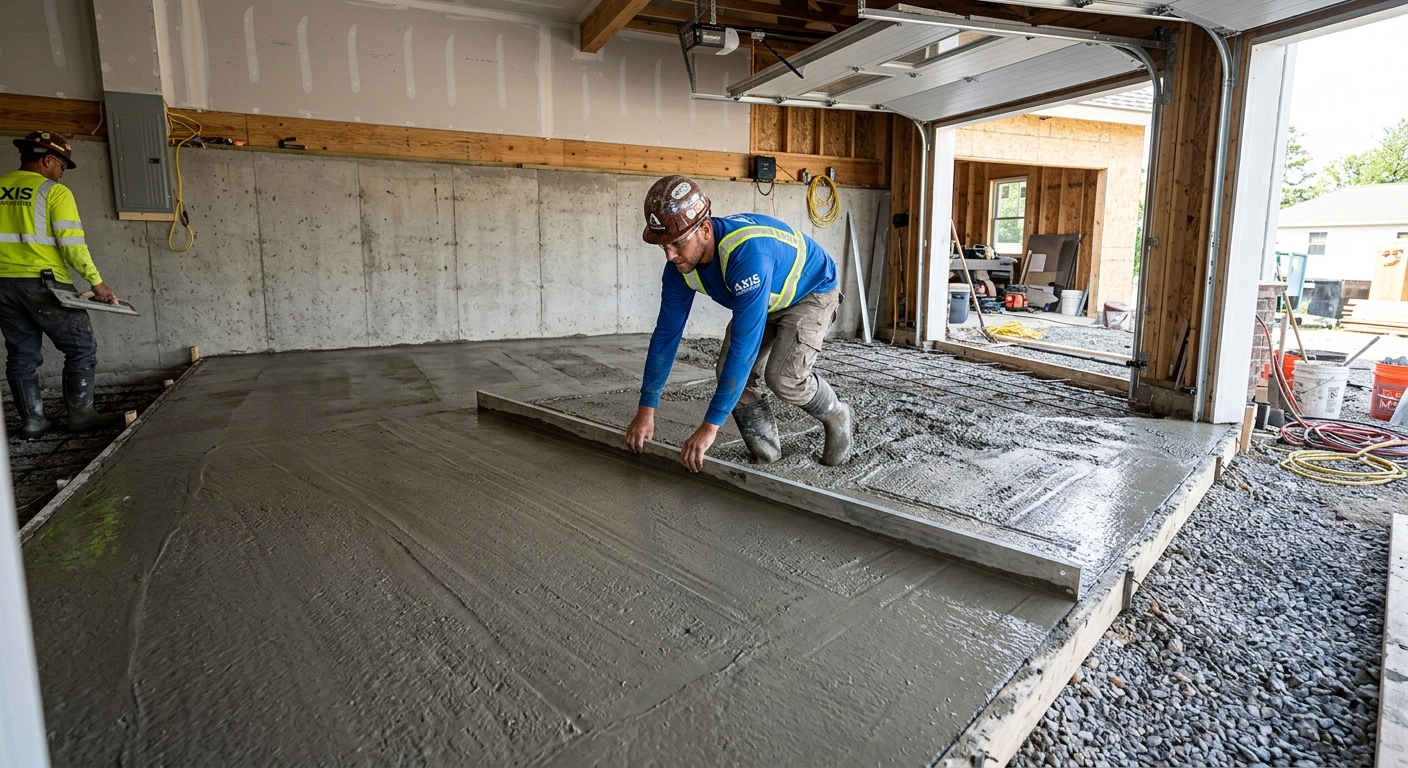
Concrete work options and costs in Mayfield
Concrete work in Mayfield, Alberta is all about doing it right the first time, because frost and freeze–thaw don’t give much forgiveness. Mayfield itself is a small community—population is 1,973 (Statistics Canada, 2021 Census)—and for many homeowners the concrete “flatwork” becomes the daily-use surfaces: driveways, patios, walkway connections to the house, and garage floors. In a market dominated by family housing, the demand for durable exterior slabs stays steady because these projects get used hard in winter and spring thaw.
In the Calgary area, the cold continental climate means engineered foundation and slab details matter more than in milder provinces. Local practice commonly works to a design frost depth of about 1.2 m, so footings and structural concrete have to be excavated deeper than many homeowners expect—this directly pushes foundation / footings pricing higher. For exterior slabs, we also plan around repeated freeze–thaw cycles: we use air-entrained mixes, build a granular base properly, and add control joints at the right spacing to manage cracking and spalling. The pour season is shorter in Mayfield’s shoulder months, so contractors often schedule weather-protected pours to meet curing requirements. If you’re in a neighbourhood where lot access is tight or where winter grading had to be corrected, you’ll often see costs trend toward the higher end of the bands.
Where this trade is especially busy around Mayfield is the newer growth pockets on the city’s edges where houses and garages are going in quickly and homeowners want driveways and patios completed to match the foundation schedule. Below is a practical comparison of typical scopes and costs.
| Application |
Typical Size |
Key Spec |
Finish Option |
Price Range |
| Concrete driveway (standard broom finish) |
24 ft x 10 ft (240 sq. ft.) |
Air-entrained, wire mesh, control joints |
Broom finish, stamped-free |
$12,000–$18,000 |
| Exposed aggregate driveway |
24 ft x 10 ft (240 sq. ft.) |
Air-entrained, retarder/aggregate wash system |
Exposed stone with light broom edges |
$14,500–$21,500 |
| Stamped concrete driveway or patio |
20 ft x 12 ft (240 sq. ft.) |
Air-entrained, integral colour, seal-ready finish |
Stamp patterns + texture release |
$15,000–$26,000 |
| Plain concrete patio or walkway |
12 ft x 12 ft (144 sq. ft.) |
Air-entrained, compacted base, joints |
Float/trowel light, broom edges |
$5,000–$9,000 |
| Garage floor (interior slab) |
22 ft x 20 ft (440 sq. ft.) |
Vapour barrier, thickened edges, mesh |
Light broom/steel trowel finish |
$10,000–$17,000 |
| Foundation footings (structural, below frost) |
Typical single-family home perimeter |
Engineered size, below design frost depth |
Structural concrete only (not decorative) |
$28,000–$45,000 |
Prices are estimates only and vary by project scope, site access and material selection.
What affects the price of concrete work in Mayfield
If you get three quotes for the “same” concrete project in the Calgary region, it’s common to see swings of about 30–50%. The difference usually isn’t the concrete itself—it’s the site preparation, engineering/spec requirements, and how teams manage cold-weather placement and curing. In Mayfield, frost depth and freeze–thaw cycles dictate nearly everything: footings must bear below the design frost depth (about 1.2 m in this region) to prevent frost heave, and exterior flatwork needs air-entrained concrete to survive repeated wetting, freezing, and thawing. When the pour season is shorter, contractors must use winter-grade mixes and curing precautions (insulation blankets and sometimes heating), which adds labour and equipment time.
De-icing salt is another Calgary-region cost driver. Salt accelerates surface scaling if the concrete is under-specified, so homeowners often end up paying for proper sealing timing—usually after the concrete has cured. In terms of foundation costs, the deeper excavation and larger concrete volumes in Alberta compared with milder climates are a big reason foundation / footings pricing commonly lands in the $28,000–$45,000 band, depending on soil conditions and the engineered footing plan.
For example, a standard driveway with broom finish may pencil closer to $12,000–$18,000 when the base is already well-graded and the forms are straightforward. If, however, the approach needs extensive regrading, thicker base, or more frequent joints due to site slope, you’ll see the price rise. On patios and walkways, adding decorative work or increasing thickness for drainage can also move a project out of the $5,000–$9,000 range. These local realities are especially noticeable on Mayfield homes built on typical prairie soils where proper granular base and compaction quality make or break long-term performance.
| Price Factor |
Why It Matters |
Cost Impact |
| Frost line depth — determines footing depth and form height |
Footings must extend below design frost to prevent movement |
Higher excavation depth increases concrete volume and labour |
| Site preparation — excavation, grading, compacted granular base |
Proper base controls settlement and reduces cracking |
More hauling/compaction time pushes the total up |
| Reinforcement — rebar or wire mesh requirement |
Controls cracking and improves load distribution |
Material cost plus extra labour for placement/spacers |
| Mix design — air-entrainment and compressive strength spec |
Air-entrainment helps resist freeze–thaw damage |
Specialty mix and testing can add cost |
| Finish type — broom vs. stamped vs. exposed aggregate |
Finishes require additional labour steps and curing/sealing care |
Stamped/exposed often land higher than standard broom |
| Pour size and concrete truck access to site |
Access limits can require pumping or more crew time |
Long carry distances or pumping can increase costs quickly |
| Cold-weather curing precautions — heating and blankets |
Cold slows strength gain and increases risk of scaling |
Blankets/heaters and tighter coordination add expense |
| Control joint pattern and sealing cost |
Joints manage shrinkage; sealing protects against salt damage |
More joints/detailing and sealing add line items |
Permits & regulations in Alberta
In Alberta, structural concrete work—things like foundation footings, foundation walls, and grade beams—typically falls under the building permit process, and you’ll often see engineered drawings required and reviewed as part of the permit. Concrete flatwork (patios, walkways, driveways) often does not need a permit by default, but it can require approvals if it affects lot grading, changes drainage patterns, or involves impervious surface coverage and drainage impacts near municipal right-of-way areas. Before anyone breaks ground in Mayfield, confirm what your specific project triggers.
Also verify the contractor is set up correctly for Alberta work. Start by asking for a current certificate of insurance showing general liability with appropriate coverage limits and checking that they have coverage for workers through the applicable provincial workers’ compensation system (WSIB/WCB). For licensing, Alberta contractor requirements can vary depending on scope and whether trades are being sub-contracted, but you should always confirm the contractor’s legal standing and that any required trade qualifications are in place for the work being performed.
Step-by-step for Mayfield homeowners:
- Ask the contractor for their certificate of insurance (COI) and confirm it names you/your property as additional insured if offered, and that it’s current.
- Request proof of workers’ compensation coverage (WSIB/WCB clearance letter or equivalent documentation).
- Check any applicable professional registry or licence listing on the provincial/government website for the business name and trade scope.
- Get references for similar slab sizes and frost-affected foundation work where possible.
- Confirm who pulls permits (if required) and whether that cost is included or excluded in the quote.
When in doubt, call the municipality or local building office and describe the exact scope; the permit requirement can turn on drainage/grade and engineered structural scope.
Getting concrete right in Mayfield's freeze-thaw climate
Concrete failures in Mayfield usually trace back to a few predictable issues: poor base prep, under-specified mix design, weak curing, or skipped sealing. In a freeze–thaw climate, water gets into the surface and pores; if the concrete isn’t air-entrained and strong enough, freeze–thaw pressures can cause spalling and scaling. The fix starts at the bottom of the assembly and works forward.
First is base preparation: excavation to the right depth, proper grading, and compacted granular sub-base that supports the slab. This is especially important because the region’s design frost depth of about 1.2 m governs how footings are engineered and how exterior slabs are detailed to resist seasonal movement. Second is mix design: for exterior flatwork, air-entrainment is commonly targeted in the 5–7% air content range and the concrete should meet at least 32 MPa minimum compressive strength to support long-term durability. Third is control joints: they’re not optional if you want cracks to happen where you planned. Fourth is curing: aim for at least 7 days under proper conditions. In cold snaps, curing needs protection—insulated blankets and sometimes heat—to prevent early strength loss. Finally, sealing: apply a penetrating sealer after cure (typically around 28 days) to reduce salt-driven surface deterioration.
For technical questions, ask your contractor directly: “What air content are you targeting?”, “How deep is the base to be compacted?”, “What’s the joint spacing?”, and “How are you protecting curing if temperatures drop at night?” For many Mayfield homeowners, the price difference is justified. Example: a stamped patio may run in the $15,000–$26,000 range for driveway-scale work, and you’re paying for colour + stamping labour—however, if the mix and joints aren’t engineered for freeze–thaw, you can’t “decorative your way out” of spalling. Conversely, upgrading from plain broom finish to proper sealing and correct joints is often a high-value durability move within the typical patio band of $5,000–$9,000.
| Spec |
Why It Matters in Mayfield |
What to Ask For |
Impact if Skipped |
| Compacted granular base (depth?) |
Supports the slab and resists frost-related movement |
Confirm the compacted base depth and compaction method |
Settlement and premature cracking |
| Air-entrained concrete mix (target air %?) |
Reduces freeze–thaw damage and scaling |
Target air content of 5–7% for exterior flatwork |
Spalling and surface deterioration |
| Compressive strength (MPa rating) |
Strength helps resist wear from traffic and salt exposure |
Minimum 32 MPa compressive strength spec |
Lower durability and increased surface wear |
| Control joints (spacing per ACI guidelines) |
Controls where cracks occur in shrinkage |
Ask for joint spacing plan on drawings/layout |
Random cracking and rough edges |
| Minimum 7-day curing period |
Allows strength gain before winter stress returns |
What curing protection is used if cold nights happen |
Reduced strength and scaling risk |
| Penetrating sealer (when applied after cure) |
Repels de-icing salt and reduces water ingress |
Penetrating sealer after cure (commonly after 28 days) |
Faster salt damage and surface pitting |
How to choose a concrete work contractor in Mayfield
Choosing the right concrete contractor in Mayfield starts with verification, because concrete is one of those trades where the details you can’t see—base thickness, air content, curing protection, joint spacing—make or break the outcome. For Alberta projects, confirm liability insurance and workers’ compensation coverage before you sign anything. Ask for a certificate of insurance (COI) showing current general liability and proof of WSIB/WCB coverage (often a clearance letter or equivalent documentation).
Next, get 2–3 quotes that are written and itemised. You want labour and materials clearly separated—especially for things that vary widely: excavation and disposal, granular base and compaction, reinforcement (mesh vs rebar), concrete mix design, finishing steps (broom vs stamped), and sealing. Avoid lump-sum quotes that don’t explain inclusions and exclusions. Ask whether permits are included if the scope is structural, and whether disposal and regrading are included or billed separately.
Warranty matters too. A workmanship warranty (commonly for a defined period after completion) should be clear about what’s covered. Product/manufacturer warranties for sealers, integral colour systems, or admixtures should be provided and confirm if they’re transferable to the homeowner. For payment, never pay more than 10–15% upfront; hold back a portion until the final surfaces, joints, and cleanup are complete.
Finally, request a written start date and completion estimate. In Mayfield’s freeze–thaw climate, weather-driven scheduling and curing protection should be part of the plan, not just a “we’ll see” timeline.
- COI for general liability—current dates and coverage amounts.
- Proof of workers’ compensation coverage (WSIB/WCB).
- Clear breakdown of excavation, haul-away, and disposal.
- Stated concrete mix spec: air-entrainment target and minimum 32 MPa strength.
- Reinforcement plan: mesh/rebar type, location, and cover.
- Base prep details: compacted granular depth and compaction method.
- Joint layout: spacing and whether they include control joints and sealant/caulking if needed.
- Cold-weather curing plan: blankets/heating details if temperatures drop.
- Finishing method stated: broom profile, stamp system, or exposed aggregate process.
- Sealing included or excluded—if included, confirm product and timing after cure.
- Permit responsibility noted (who pulls it and who pays).
- Warranty details in writing: workmanship term and what constitutes a defect.
Concrete red flags in Mayfield: (1) no written mix spec or “we always use the same concrete” answer; (2) skipping air-entrainment for exterior flatwork; (3) no plan for curing protection when night temperatures fall; (4) unclear disposal/haul-away and base depth in the quote; and (5) requesting large upfront payments (well above 10–15%) or refusing to hold a completion holdback.
Frequently asked questions — concrete work in Mayfield
Why does concrete crack in Mayfield and how is it prevented?
Concrete in Mayfield cracks mainly from shrinkage, temperature changes, and movement in the ground—then freeze–thaw makes minor issues more visible. The most important prevention is correct base preparation and a proper joint plan. In this Calgary region climate, concrete also needs air-entrainment so freeze–thaw won’t aggressively damage the surface, which helps keep cracks from turning into spalling. Your contractor should detail compacted granular base depth, reinforcement placement (mesh or rebar where needed), and control joint spacing so cracks form where they’re designed. Sealing after cure is also key because de-icing salts can worsen surface deterioration over time. If you’re comparing quotes, make sure both include the same air-entrainment and joint layout—those differences often explain price swings in the $12,000–$18,000 driveway range.
Stamped vs broom-finish concrete — cost difference?
Stamped concrete generally costs more than a broom-finished slab because it requires additional labour steps: colour setup (integral or hardener depending on system), stamping, texturing, release agents, and careful finishing/curing control to achieve a consistent pattern. In Mayfield, the same freeze–thaw durability specs still apply; you shouldn’t trade away air-entrainment or curing protection just to get a pattern. For homeowners, a standard driveway often sits around $12,000–$18,000, while stamped concrete driveway/patio projects commonly land in the $15,000–$26,000 band depending on size and complexity. If access is tight or you need more regrading, both types increase, but stamped always adds a finish premium. When quoting, compare the stated finish system and whether sealing is included after cure.
When is the best time to pour concrete in Mayfield?
The best time to pour concrete in Mayfield is when daytime temperatures are reliably above freezing and you can still protect curing overnight. Because of Calgary’s cold continental climate and frequent freeze–thaw cycles, the pour season is shorter and contractors plan around weather windows. If you’re late in fall or early in spring, you’ll often need cold-weather curing precautions such as insulated blankets and sometimes heating, which increases cost and coordination time. That doesn’t mean you can’t pour—experienced crews can—but you should require a written cold-weather plan in the quote. For exterior flatwork like patios, that’s especially important for achieving the minimum durability you expect (air-entrainment, proper curing duration). For major structural work like footings—engineered for the design frost depth around 1.2 m—scheduling also depends on excavation conditions and whether soil stays stable during the work.
How long does concrete take to cure?
Concrete curing depends on temperature and mix design, but for typical Alberta residential work, a minimum 7-day curing period is a common benchmark before you should expect the slab to handle normal stresses, provided curing conditions were maintained. In cold snaps, that curing period becomes even more critical—without protection, early strength development can be slower, raising the risk of surface scaling. While concrete continues gaining strength beyond a week, plan for full robustness closer to 28 days under proper conditions. If you’re sealing an exterior slab to protect against de-icing salt, penetrating sealer is usually applied after the concrete is fully cured (commonly around 28 days). When comparing Mayfield quotes, ask whether curing protection (blankets/heating) is included for night temperatures, and whether the timeline accounts for sealing after the cure window.
Do I need a permit for concrete work in Alberta?
In Alberta, structural concrete work such as foundation footings, foundation walls, and grade beams typically requires a building permit and often engineered drawings reviewed through the municipal process. Concrete flatwork—driveways, patios, and walkways—often does not require a permit, unless it affects lot grading, drainage, impervious surface considerations, or areas near municipal right-of-way. Because details vary by scope, the safest approach is to confirm with the local authority before work starts. As a homeowner in Mayfield, you can also ask your contractor who is responsible for permits and whether permit-related drawings are included in the scope. Regardless of permitting, verify the contractor carries liability insurance and workers’ compensation coverage. A reputable contractor will provide documents and won’t hide responsibilities in the fine print.
Concrete vs pavers for a patio in Mayfield?
Concrete and pavers can both work well in Mayfield, but they behave differently under Alberta freeze–thaw. A properly built concrete patio with air-entrained mix, compacted granular base, control joints, and curing protection is designed to manage cracking and resist spalling from salt exposure. Pavers can look great and allow partial repairs, but they still require excellent base prep and a stable drainage strategy; if the base is wrong or drainage is poor, you can get uneven settling or heaving. Price-wise, a plain concrete patio/walkway often falls around $5,000–$9,000, while more premium concrete finishes go higher. Pavers may compete depending on excavation complexity and area size, but you’ll want to compare the total system: base depth, edging, jointing sand, and drainage. For durability in Calgary’s winters, ask both installers what they’re doing to protect the base and manage water.