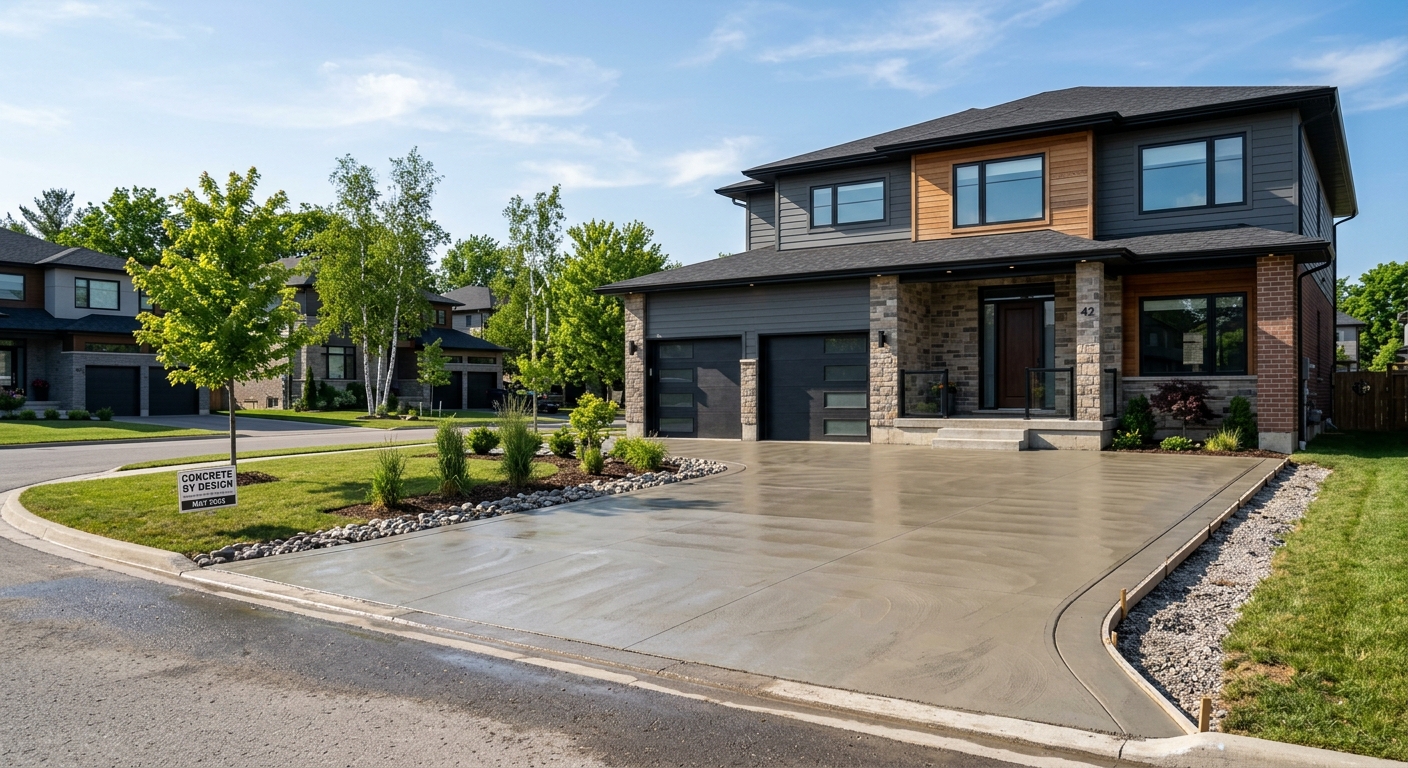
Concrete work options and costs in Westview Village
Westview Village homeowners usually start by comparing a few common concrete upgrades—driveways, patios, walkway repairs, and sometimes basement-related foundation work. In this market, the work demand is driven by housing patterns: single-detached homes are a major part of the local landscape (Statistics Canada, 2021 Census), and with a community population of 2,124 (Statistics Canada, 2021 Census), there’s a steady flow of small-to-mid projects like slab replacement and backyard patios. That matters because flatwork crews often juggle multiple residential pours, so scheduling and site readiness can affect your final price.
In the Calgary economic region, costs are shaped by a cold continental climate with repeated freeze–thaw cycles. Local engineering practice uses a design frost depth of about 1.2 m (roughly 4 ft), so foundation footings must bear below that depth to limit frost heave and seasonal movement. Exterior slabs also need air-entrained concrete mixes and the right base prep to reduce cracking and spalling as temperatures swing. On top of that, the exterior pour season is shorter, and cold-weather curing (insulated blankets, temperature control, and patience with curing time) is often required to achieve proper strength—especially if you’re aiming for late fall or early spring.
Concrete contractors are often most in-demand in Westview Village around newer growth pockets and busy infill areas—commonly near the busier commercial strips and along streets where access can be tight. If your project needs more excavation, reinforcement, or decorative finishing, your quote will climb quickly. Use the ranges below as a practical comparison before you request itemised proposals.
| Application |
Typical Size |
Key Spec |
Finish Option |
Price Range |
| Concrete driveway (standard broom finish) |
24 ft x 12 ft (288 sq ft) |
Air-entrained mix, granular base, control joints |
Broomed finish |
$12,000–$18,000 |
| Exposed aggregate driveway |
24 ft x 12 ft (288 sq ft) |
Air-entrained mix, base prep, aggregate selection |
Exposed aggregate finish |
$15,000–$21,000 |
| Stamped concrete driveway or patio |
200–400 sq ft |
Engineered base, colour hardeners, release system |
Stamped pattern + colour |
$15,000–$26,000 |
| Plain concrete patio or walkway |
12 ft x 12 ft (144 sq ft) to 200 sq ft |
Air-entrained mix, compacted base, joints |
Plain broom or smooth float |
$5,000–$9,000 |
| Garage floor (interior slab) |
22 ft x 22 ft (484 sq ft) |
Vapour barrier (as required), proper subgrade compaction |
Machine-finished + light broom texture |
$9,000–$15,000 |
| Foundation footings (structural, below frost) |
Typical single-detached build footprint |
Footings below design frost depth, rebar cage as required |
Structural concrete |
$28,000–$45,000 |
Prices are estimates only and vary by project scope, site access and material selection.
What affects the price of concrete work in Westview Village
In Westview Village and across the Calgary area, you can see surprisingly wide price swings—often 30–50% for what sounds like the same concrete job. The difference usually isn’t the “concrete” itself; it’s everything wrapped around it: excavation volumes, how deep the frost-related base must be built, what reinforcement is specified, and whether the contractor can place, protect, and cure the concrete properly within Alberta’s colder shoulder seasons.
Here’s the core driver: frost line depth and freeze–thaw cycles dictate every major specification. Footings for houses, garages, and retaining structures must extend below the design frost depth to prevent frost heave and seasonal movement. In Alberta, that means deeper excavation and larger footing volumes than warmer regions. At the same time, exterior slabs (driveways, patios, walkways) need air-entrained concrete mixes to survive repeated freeze–thaw exposure without surface scaling or spalling. When the calendar gets cold, the pour season shrinks and cold-weather curing becomes necessary—insulated blankets, temperature monitoring, and sometimes temporary heat—so concrete reaches strength targets. Finally, Calgary-area winter de-icing salt is hard on unsealed surfaces, so sealing is a practical “long-term cost” decision.
In Westview Village specifically, cost can rise when your site needs extra granular rebuild (low spots, clay soils, or drainage corrections), when access limits truck positioning (more labour and material handling), or when you’re switching from a broom-finished driveway to exposed aggregate or stamped work. Conversely, costs can come down if your existing subgrade is stable, grades are correct, and you’re staying with a simple finish. For reference, a standard driveway often lands within the $12,000–$18,000 band, while decorative options like stamped concrete commonly push toward $15,000–$26,000 depending on size and complexity.
| Price Factor |
Why It Matters |
Cost Impact |
| Frost line depth — determines footing depth and form height |
Deeper footings require more excavation and concrete volume |
Higher foundation costs; can add thousands on larger builds |
| Site preparation — excavation, grading, compacted granular base |
Correct base prevents settlement and limits frost movement |
Major swing factor, especially on older or poorly drained lots |
| Reinforcement — rebar or wire mesh requirement |
Controls cracking in structural and high-load slabs |
Adds material and labour; higher in garage floors/footings |
| Mix design — air-entrainment and compressive strength spec |
Improves durability through freeze–thaw |
Higher material cost; reduces premature surface damage |
| Finish type — broom vs. stamped vs. exposed aggregate |
More steps and materials for decorative finishes |
Stamped/exposed generally move pricing upward |
| Pour size and concrete truck access to site |
Smaller access issues increase time and handling |
May add labour and require extra equipment |
| Cold-weather curing precautions — heating and blankets |
Ensures proper strength gain despite colder nights |
Can increase cost and extend schedule |
| Control joint pattern and sealing cost |
Joints limit random cracking; sealing protects from salt |
Small line items that prevent costly repairs |
Permits & regulations in Alberta
In Alberta, structural concrete work typically requires a building permit, and you’ll often see engineered drawings reviewed by the municipality for consistency and safety. This usually includes foundation-related items such as footings, foundation walls, and grade beams. For these jobs, the design needs to match the soil conditions and the local frost considerations used for construction.
Concrete flatwork—driveways, patios, and walkways—often does not require a separate permit on its own. However, you should confirm first if your plan affects lot grading, changes how water drains toward/away from the foundation, or alters impervious surface coverage limits or municipal right-of-way requirements (for example, work near sidewalks or boulevards). When in doubt, ask before breaking ground.
Step-by-step for Westview Village homeowners:
- Ask the contractor for their Alberta licence and confirm it via the appropriate provincial registry online.
- Request a certificate of liability insurance naming you (or showing the project address) and confirm it’s current.
- Verify WSIB/WCB coverage paperwork or a clearance letter for the company and the relevant trades.
- Check references for similar-scope jobs (flatwork and/or foundations) in Calgary-area conditions.
- Make sure the quote clearly states what’s included (excavation, disposal, reinforcement, curing protection) so compliance items aren’t surprises.
These checks protect you from delays and workmanship issues and help ensure the concrete is installed to survive Alberta’s freeze–thaw cycles.
Getting concrete right in Westview Village's freeze-thaw climate
Concrete fails in Westview Village when water finds a path into the slab or subgrade, then freezes and expands. The result is often surface scaling, spalling, and early cracking—especially on driveways and patios exposed to Calgary-area snowmelt and de-icing salt. To spec the job correctly, the biggest levers are base preparation, mix design, joints, curing, and sealing.
(1) Base preparation: compacted granular sub-base to the right depth for the local soil and the frost movement you’re engineering around. Poor compaction is one of the fastest ways to get settlement-related cracking. (2) Mix design: exterior work should use air-entrained concrete (typically 5–7% air for many exterior flatwork applications) and a minimum 32 MPa compressive strength spec so the paste can tolerate freeze–thaw cycles. (3) Control joints: a planned joint pattern limits random cracking to predictable lines. (4) Curing: plan for at least 7 days of proper curing under suitable conditions; in cold weather, curing protection (blankets/heating) becomes critical to avoid weak surface layers. (5) Sealing: apply a penetrating sealer after the slab has cured—commonly about 28 days post-pour—to help repel brine and reduce salt-driven deterioration.
If you’re choosing between options, the price difference should make sense. For example, a broom-finished driveway at $12,000–$18,000 may be the best value if your goal is durable, cleanable performance. Stamped concrete often climbs toward $15,000–$26,000 because of extra labour and materials, and that premium is justified when you want an architectural finish that also includes proper base, joints, and air-entrainment to avoid decoration-on-top-of-damage.
Ask technical questions that target the most common failure: inadequate air-entrainment and rushed curing.
| Spec |
Why It Matters in Westview Village |
What to Ask For |
Impact if Skipped |
| Compacted granular base (depth?) |
Limits settlement and frost-related movement in cold Alberta conditions |
Base depth and compaction method matched to your soil and grades |
Cracking and uneven slab movement |
| Air-entrained concrete mix (target air %?) |
Improves freeze–thaw durability against scaling and spalling |
Target air content typically 5–7% for exterior flatwork and frost exposure |
Premature spalling, especially with de-icing salts |
| Compressive strength (MPa rating) |
Ensures strength gain and long-term durability |
Minimum 32 MPa specification for exterior durability |
Weak surface layer; increased scaling and joint failure |
| Control joints (spacing per ACI guidelines) |
Controls where cracking occurs during temperature cycles |
Joint spacing plan and sawcut timing before random cracking |
Random cracks, water intrusion, and faster deterioration |
| Minimum 7-day curing period |
Cold nights can slow strength gain and weaken surfaces |
How they will protect curing in Alberta cold (blankets/heating if needed) |
Lower strength and surface scaling risk |
| Penetrating sealer (when applied after cure) |
Helps repel salt brine and moisture in freeze–thaw seasons |
Sealer type and that it’s applied about 28 days after pour (or contractor’s required cure time) |
Faster salt damage and staining |
How to choose a concrete work contractor in Westview Village
Start with verification. In Alberta, you want a contractor with the right licence for the work they’re doing, plus proof of liability insurance and WSIB/WCB coverage for the trades on your site. To check: look up their licence online, request their current certificate of insurance (confirm the policy is active for the project period), and ask for WSIB/WCB documentation or a clearance letter showing the company is in good standing.
Next, require 2–3 itemised written quotes. Don’t accept a single lump-sum without breakdowns. You want a labour and materials line separating excavation/grading, granular base, reinforcement (if required), concrete supply, finishing, joint work, and protection/curing measures. Make sure the quote states whether permits (if applicable for structural scope) are included or excluded, and whether disposal of excavated material is included. In Calgary-area projects, disposal and trucking can vary more than homeowners expect.
For warranty, ask for two things: the workmanship warranty length and any product/manufacturer warranty (for sealers, admixtures, or decorative systems). Clarify whether warranties are transferable if you sell your home.
On payment, never pay more than about 10–15% upfront. Use a holdback (commonly 10–15%) until you confirm completion details like clean-up, sealing when scheduled, and joint condition. Finally, get the start date and estimated completion timeline in writing—cold-weather protection can extend schedules.
- Licence number and scope match (flatwork vs structural work).
- Active liability insurance certificate for your project address.
- WSIB/WCB clearance or coverage evidence for the contractor and trades.
- Itemised quote with labour/material separation, not just a total.
- Clear base prep scope (excavation depth, granular type, compaction).
- Mix details: air-entrainment and strength requirement for exterior exposure.
- Reinforcement included where required (not optional “if needed”).
- Control joint plan (spacing and sawcut timing).
- Cold-weather plan: blankets/heating and curing protection specified.
- Sealer included or scheduled with curing timeline (often after ~28 days).
- Disposal/trucking included in the quote if excavation is required.
- Written warranty terms and what failures are covered.
Concrete contractor red flags in Westview Village: they won’t show insurance/WSIB paperwork; they guarantee “no cracks” (nobody can with thermal movement); they skip or minimize air-entrainment for exterior slabs; they pour late fall without a curing protection plan; or they provide only a lump-sum estimate without excavation/base/joint details.
Frequently asked questions — concrete work in Westview Village
How do I compare concrete quotes?
To compare concrete quotes in Westview Village, look past the bottom-line total and compare the details that actually drive durability. Ask for an itemised breakdown: excavation/grading, granular base depth and compaction, reinforcement (if required), the concrete mix spec (especially air-entrainment for exterior work), finishing method, control joints, and curing protection. For pricing context, a standard driveway may sit around the $12,000–$18,000 band, while decorative stamped concrete often trends toward $15,000–$26,000 depending on size and pattern complexity. If one quote is much cheaper, it may be cutting base depth, using a less durable mix spec, or excluding cold-weather curing. Also confirm whether disposal is included and whether any permit steps apply to your scope (structural vs flatwork).
Can concrete be poured in cold weather in Westview Village?
Yes, concrete can be poured in Westview Village in cold weather, but it must be engineered for winter conditions. In Calgary-area freeze–thaw cycles, curing is the key. Contractors typically use cold-weather practices such as winter-grade mixes, insulated blankets, and—when needed—temporary heating/temperature monitoring to keep concrete in a workable and curing-ready range until it gains sufficient strength. Without these precautions, you can end up with surface scaling or weak top layers even if the slab “looks fine” initially. Ask your contractor what method they’ll use based on the forecast and night temperatures, and ensure the quote includes curing protection costs. Timing matters too: late-fall and early-spring pours often cost more due to protection labour and equipment, which is part of why concrete quotes can differ significantly across the season.
How do I maintain concrete in Westview Village's freeze-thaw climate?
Maintenance in Alberta is mainly about protecting the slab from water and salt. Start with cleaning: remove debris and surface grime so the sealer can do its job. For exterior flatwork, apply a penetrating sealer after the concrete has cured—commonly around 28 days post-pour—then recoat on the schedule recommended by the sealer product. In winter, use de-icing practices that limit aggressive salts when possible, since salt brine accelerates spalling on unprotected surfaces. Keep water from pooling by ensuring roof downspouts and landscaping drainage don’t direct water onto the slab. If you see small cracks, don’t ignore them—early repairs help prevent water intrusion and joint failure. These steps are especially important in Westview Village because repeated freeze–thaw cycles and seasonal temperature swings keep stressing any weak spots.
What causes concrete to spall in Westview Village winters?
Spalling in Westview Village winters is usually caused by a combination of freeze–thaw exposure and water/salt intrusion. The most common root cause is inadequate air-entrainment or the wrong mix spec for exterior durability—without the right air void system, water in the paste freezes, expands, and breaks down the surface. Base and drainage issues also contribute: if the slab sits on insufficiently compacted granular material, it can settle and allow more water to reach edges and joints. Another factor is curing: if cold-weather pours aren’t protected well enough, the surface layer can be weaker, making scaling and spalling more likely. Finally, de-icing salts accelerate surface damage, which is why sealing is a practical step after cure. If you’re comparing quotes, make sure the contractor states air content targets and curing/blanketing procedures for your pour date.
What is rebar and when is it required in Alberta?
Rebar (reinforcing steel) is a grid or cage of steel bars placed within concrete to control cracking and improve structural performance under load and temperature changes. In Alberta, whether it’s required depends on the engineered design, slab thickness, intended use, soil conditions, and whether the concrete is structural (like foundation footings) or an exterior flatwork application. Structural concrete such as footings and grade beams typically needs reinforcement as specified by engineering and code practice, and it also ties into frost depth requirements for Westview Village. For driveways and patios, contractors may use wire mesh or rebar in specific areas or when the design calls for it (for example, heavy vehicle loading, thicker slabs, or poor subgrade). Always ask for the reinforcement plan and placement details in writing—don’t assume every slab needs rebar, but don’t accept “we’ll decide later” either.
How long does a concrete project take in Westview Village?
Timelines in Westview Village depend on whether you’re doing flatwork or structural work and on weather conditions. A typical exterior flatwork project may take a few days on-site: prep and excavation, base work and inspections/verification (as needed), the pour, finishing and jointing, then curing protection if temperatures are cold. Decorative work (stamped concrete) usually takes longer because colour steps, pattern setup, and careful finishing are required, and that can push project schedules toward the higher decorative pricing band around $15,000–$26,000. Structural work like foundation footings takes longer because excavation, inspections/engineering requirements, reinforcement placement, and concrete pours for walls/footings are staged. In cold weather, curing time and protection can extend the schedule to ensure the slab reaches the strength targets needed for safe performance in freeze–thaw conditions. Ask for the start date, pour date, and completion estimate in writing.