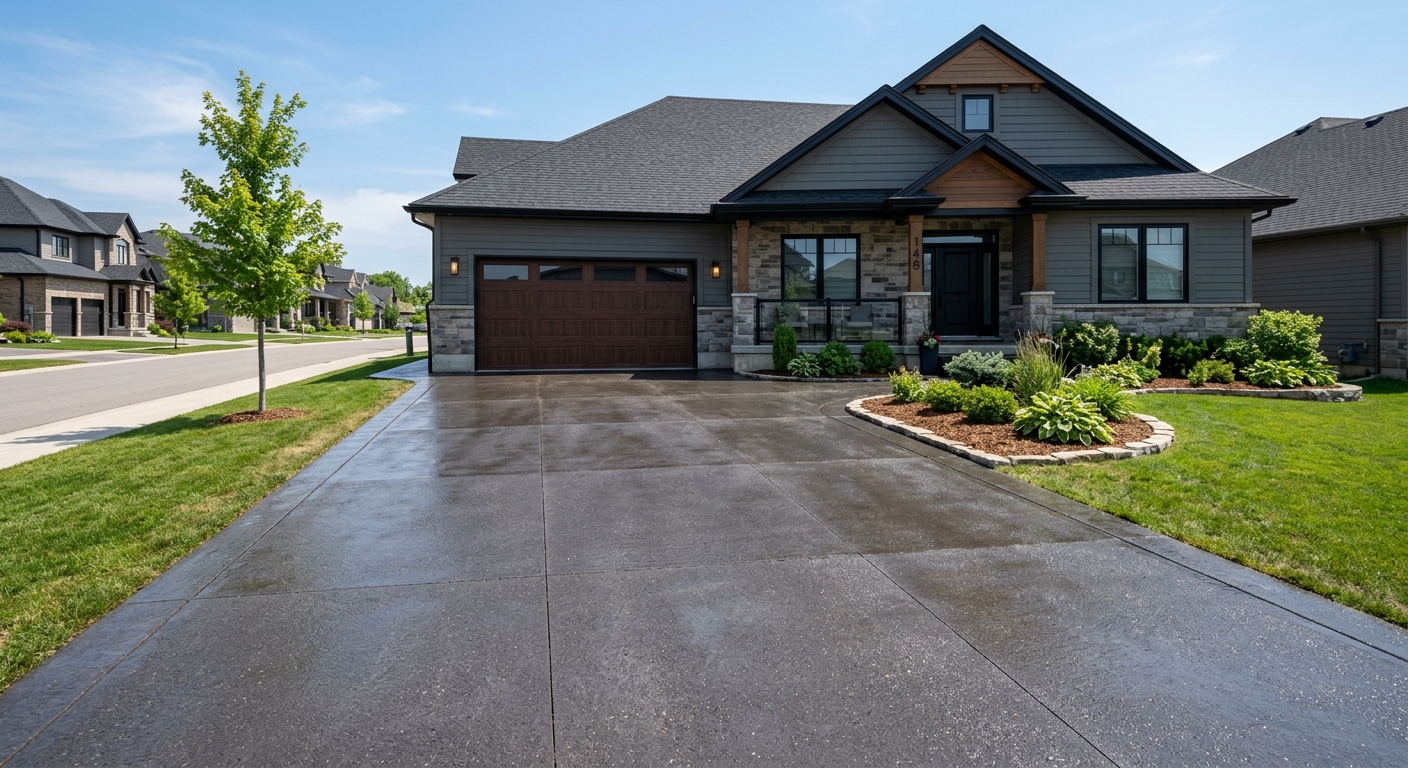
Concrete work options and costs in Forest Lawn
Concrete work in Forest Lawn, Alberta is all about timing and frost-proof detailing, because Calgary’s freeze–thaw cycles are rough on exterior flatwork. Forest Lawn has a growing residential base—about 7,230 people in the 2021 Census—so there’s steady demand for driveways, patios, walkways and foundation work as homes are built, renovated and upgraded (Statistics Canada, 2021 Census). Most homeowners are tackling concrete flatwork on properties in neighbourhood pockets where access and drainage planning matter, and in Forest Lawn that’s especially common around the older established residential streets where additions and re-grades happen.
In our market, quotes reflect the engineered reality of a deep design frost depth and the need to protect concrete during winter placement. In this region, footing excavations and concrete volumes are higher than in milder provinces, because footings generally must extend below the design frost depth to reduce frost heave and seasonal movement. Exterior slabs also need properly air-entrained mixes and careful curing, since cold weather shortens the practical pour season and increases the risk of scaling or long-term surface wear if the contractor cuts corners.
Pricing in Forest Lawn lines up with the Calgary region’s typical bands: for example, concrete driveways commonly fall in the $12,000–$18,000 range, while foundation/footings often land in the $28,000–$45,000 band depending on excavation and reinforcement scope. With that context, here’s a realistic comparison of common concrete applications—so you can map your project to the right spec and budget before you request quotes.
| Application |
Typical Size |
Key Spec |
Finish Option |
Price Range |
| Concrete driveway (standard broom finish) |
20 ft x 10 ft (200 sq. ft.) |
Air-entrained mix, compacted granular base, control joints |
Broom-finished, light saw-cut joints |
$12,000–$18,000 |
| Exposed aggregate driveway |
20 ft x 10 ft (200 sq. ft.) |
Proper set-time control, high-quality base prep |
Exposed aggregate with integral colour |
$15,000–$22,500 |
| Stamped concrete driveway or patio |
200 sq. ft. driveway or 150–250 sq. ft. patio |
Integral colour, air-entrained mix, sealer system |
Stamped pattern with textured finish |
$15,000–$26,000 |
| Plain concrete patio or walkway |
12 ft x 12 ft (144 sq. ft.) or 3 ft x 12 ft (36 sq. ft.) |
Sloped for drainage, compacted granular base, joints |
Plain broom finish (or smooth steel trowel for small areas) |
$5,000–$9,000 |
| Garage floor (interior slab) |
22 ft x 20 ft (440 sq. ft.) |
Vapour barrier (as needed), compacted sub-base, reinforcement |
Steel-trowel finish; optional saw-cut joints |
$14,000–$22,000 |
| Foundation footings (structural, below frost) |
For typical house/extension footing perimeter |
Excavation to design frost depth, rebar, engineered placement |
Structural concrete; formwork and waterproofing coordination |
$28,000–$45,000 |
Prices are estimates only and vary by project scope, site access and material selection.
What affects the price of concrete work in Forest Lawn
In Forest Lawn and across the Calgary region, two contractors can quote the “same” concrete job and still be 30–50% apart, even before you factor in finish upgrades. The biggest driver is that in a cold continental climate, the specs aren’t interchangeable: footing depth, granular base thickness, air-entrainment, reinforcement, and curing controls all have to match local freeze–thaw realities. If one crew assumes easy soil or shallow excavation and another designs for deep frost and tougher access, your quote difference isn’t cosmetic—it’s structural and operational.
First, frost line depth dictates where the contractor digs and how tall the forms must be. Alberta’s frost depth is substantially deeper than milder regions, so excavation is more intensive and footing volumes are higher—pushing foundation costs into the $28,000–$45,000 band more often, especially for additions and retaining structures. Second, frequent freeze–thaw cycles require air-entrained mixes for exterior slabs; that also means the contractor has to manage set time and curing rather than “pour and hope.” Third, the shorter pour season means winter-grade placement precautions—insulated blankets and sometimes temporary heating—to maintain proper curing. Finally, de-icing salts accelerate surface wear and spalling, so sealing and joint detailing aren’t optional if you want a driveway or patio that holds up.
In Forest Lawn, I see common cost swings. If the site needs heavier excavation (unstable soils, poor drainage, or frost-susceptible backfill), foundation and slab pricing can climb toward the top end. Conversely, a driveway with straightforward access and good base conditions can land near the $12,000–$18,000 concrete driveway range. The same logic applies to patios: a simple plain patio can stay around $5,000–$9,000, while decorative work with integral colour, stamp tools, and more labour typically pushes you toward the $15,000–$26,000 stamped band.
| Price Factor |
Why It Matters |
Cost Impact |
| Frost line depth — determines footing depth and form height |
Footings must bear below design frost depth to reduce frost heave and seasonal movement |
Higher excavation volume; often adds major cost on foundations and retaining work |
| Site preparation — excavation, grading, compacted granular base |
Concrete lasts only as long as the sub-base is graded and compacted for local soils |
Poor access/extra removal increases labour and materials |
| Reinforcement — rebar or wire mesh requirement |
Rebar/wire mesh controls cracking and improves performance under loads and freeze–thaw |
Adds material and placement labour, especially for driveways and garage slabs |
| Mix design — air-entrainment and compressive strength spec |
Air-entrainment (exterior) reduces freeze–thaw damage and scaling; strength ensures durability |
Winter-grade and higher-spec mixes typically cost more per cubic yard |
| Finish type — broom vs. stamped vs. exposed aggregate |
Decorative finishes require more labour, timing control, and often integral colour |
Stamped/exposed options commonly add significant labour and finishing costs |
| Pour size and concrete truck access to site |
Access affects whether pumping or multiple smaller loads are needed |
Hard access can increase truck time, hose/pump costs, and crew hours |
| Cold-weather curing precautions — heating and blankets |
Proper curing prevents surface scaling and strength loss when temperatures drop |
Can add labour and rental costs, especially for late-season pours |
| Control joint pattern and sealing cost |
Joints manage shrinkage cracking; sealing helps resist de-icing salt damage |
Skimping leads to earlier spalling; doing it right adds modest upfront cost |
Permits & regulations in Alberta
In Alberta, structural concrete work typically needs a building permit and often engineered drawings reviewed through the municipal process—especially when you’re building or altering foundations. This usually includes footings, foundation walls, grade beams and any structural elements that carry loads. For homeowners in Forest Lawn, that generally means if your project touches the foundation system, you should expect permit requirements and engineering/inspection steps.
Concrete flatwork—driveways, patios and walkways—usually does not require a permit on its own. However, it can trigger permit or approval requirements if the work affects lot grading, drainage plans, or impervious surface coverage limits, or if it encroaches on municipal right-of-way. The practical takeaway: confirm in advance with the local authority before breaking ground.
Step-by-step, here’s how you verify a contractor in Alberta:
- Check the contractor’s business and trade registration/labour authorization status through Alberta’s online directories (where applicable to concrete/contracting businesses).
- Ask for a current Certificate of Insurance (liability) listing your property/work site where appropriate—verify it’s active for the project dates.
- Confirm WSIB/WCB coverage for the crew doing the work; request proof and check that it matches the legal entity on the quote.
- Request written references from similar projects in the Calgary area—driveway/flatwork or footing pours of a comparable scope.
- If foundation/structural work is in scope, confirm the contractor will coordinate engineering, inspections and any permit requirements.
Don’t proceed until insurance and coverage are confirmed. It protects you if something goes wrong—especially with deep frost excavation and heavy finishing tasks common in Forest Lawn.
Getting concrete right in Forest Lawn's freeze-thaw climate
Concrete fails in Forest Lawn most often due to one of five issues: poor base preparation, inadequate air-entrainment, weak mix design, missed curing requirements, or insufficient jointing/sealing. Calgary’s freeze–thaw cycles are unforgiving, and de-icing salt exposure accelerates surface scaling when concrete isn’t specified to survive winter service. The good news is that you can avoid the worst outcomes by specifying the right system rather than just the final finish.
Start with base preparation: the contractor should excavate to the correct depth and install a compacted granular sub-base that’s suitable for frost conditions in Alberta. Next, mix design: for exterior flatwork, air-entrainment is typically targeted around 5–7% air content, paired with at least a 32 MPa compressive strength requirement. Then control cracking with a proper control joint pattern—spacing should be planned so cracks occur where intended, not randomly. Curing matters just as much: aim for a minimum 7 days under proper conditions, and in cold weather that often means insulated blankets and/or temporary heat to keep concrete working correctly. Finally, sealing is your defence against salts—use a penetrating sealer applied after curing (commonly 28 days post-pour) to help repel moisture and reduce early surface breakdown.
When homeowners compare quotes, it’s worth asking where the extra dollars go. For example, a plain broom-finished patio might be in the $5,000–$9,000 range, but a stamped patio can move toward $15,000–$26,000 because of labour intensity, integral colour, finishing tools, and timing controls—none of which replace the need for correct base, air-entrainment and joints. If a contractor offers stamped work at broom-finish pricing, that’s usually a sign the key durability specs were trimmed.
| Spec |
Why It Matters in Forest Lawn |
What to Ask For |
Impact if Skipped |
| Compacted granular base (depth?) |
Proper sub-base thickness and compaction reduce settlement and frost-related movement |
Documented excavation depth and compacted granular base thickness for your soil and frost conditions |
Cracking, uneven slabs, and accelerated deterioration through freeze–thaw |
| Air-entrained concrete mix (target air %?) |
Air pockets allow freeze–thaw expansion without damaging paste as quickly |
Specify air content target around 5–7% for exterior flatwork and confirm mix type on delivery |
Spalling/scaling risk rises sharply during Alberta winters |
| Compressive strength (MPa rating) |
Strength ties to durability and ability to resist surface wear and loading |
Minimum 32 MPa compressive strength (or higher as engineered/required) |
Higher chance of surface failure and premature repairs |
| Control joints (spacing per ACI guidelines) |
Joints manage shrinkage cracking so it doesn’t become random and wide |
Joint spacing plan (and whether saw cuts vs. forming is used) matched to your slab size/shape |
Wider uncontrolled cracks that allow water ingress and faster freeze damage |
| Minimum 7-day curing period |
Concrete needs time and stable conditions to develop strength, especially in cold snaps |
Clarify protection plan for cold weather (blankets/heating as required) |
Scaling and strength loss that can show up months later |
| Penetrating sealer (when applied after cure) |
Sealer reduces moisture and salt penetration, improving long-term surface performance |
Penetrating sealer application after cure—commonly about 28 days post-pour |
Faster salt-driven surface wear and possible spalling on driveways/walkways |
How to choose a concrete work contractor in Forest Lawn
Choosing the right concrete contractor in Forest Lawn starts with verification. In Alberta, confirm they carry active liability insurance and WSIB/WCB coverage for their workers. Ask for a Certificate of Insurance (liability) and WSIB/WCB proof before work begins—don’t rely on a verbal confirmation. The cleanest approach is to request documents, match the coverage to the legal name on the quote, and ensure they list coverage dates that cover your scheduled pour.
Then, get 2–3 itemised written quotes rather than only a lump sum. You want labour and material breakdowns, including concrete mix type/spec, base prep, reinforcement (if any), formwork, finishing, saw-cut pattern, and disposal. Ask whether the quote includes permit coordination (when needed), street/sidewalk protection (if near access points), and hauling/disposal fees for unsuitable material.
Look at warranty details carefully. A workmanship warranty should be stated in writing with a realistic duration and what it covers (and doesn’t cover). Also ask about product/manufacturer warranties for sealers and decorative products, and whether they transfer if you sell the home.
Payment schedule matters: never pay more than 10–15% upfront. Hold back a portion until the job is complete, inspected, and any agreed sealing/cleanup is done. Finally, insist on a start date and completion estimate in writing. In this climate, delays can impact curing, so schedules should account for cold-weather precautions rather than hoping for a warm week.
- Ask for the exact concrete mix spec: air-entrainment target and minimum compressive strength.
- Confirm they plan for frost protection and proper base thickness, not just “dig and pour.”
- Verify reinforcement decisions match the slab type (driveway/garage/foundation).
- Request their control joint approach (saw-cut timing or formed joints) for your slab size.
- Ask how they handle cold-weather curing (blankets/heating) when temperatures drop.
- Confirm whether sealing is included and when it will be applied after cure.
- Get disposal and debris removal details listed line-by-line.
- Check site access assumptions: truck placement, pumping/hose distance, and protection for landscaping.
- Require a pour-day plan for finishing manpower (especially for stamped/exposed aggregate).
- Verify insurance and WSIB/WCB coverage before signing.
- Review warranty length and exclusions in plain language.
- Keep retainage until sealing/cleanup are completed and you’ve had a walk-through.
Concrete red flags in Forest Lawn: vague mix specs, no clear joint plan, skipping air-entrainment talk for exterior slabs, missing cold-weather curing precautions, and quotes that bundle everything without listing base prep, reinforcement, or sealing details.
Frequently asked questions — concrete work in Forest Lawn
Stamped vs broom-finish concrete — cost difference?
In Forest Lawn and the Calgary area, stamped concrete typically costs more than a standard broom finish because it requires extra labour, integral colour/texture work, and tight timing so the pattern locks in correctly. A basic broom-finished driveway often fits the $12,000–$18,000 band depending on size, access, and base prep. If you step up to stamped concrete driveway or patio work, you’re commonly looking at the $15,000–$26,000 range because decorative finishing is labour-intensive and the contractor needs the right curing and protection steps to keep the surface looking good through winter service. The durability specs still matter: if air-entrainment and joint spacing are compromised, the stamped look won’t save it from spalling in freeze–thaw cycles. When comparing quotes, ask what’s included for base depth, reinforcement, and sealing—those are usually the real drivers of long-term performance.
When is the best time to pour concrete in Forest Lawn?
For Forest Lawn homeowners, the best pour window is late spring through early fall, when temperatures stay above the contractor’s cold-weather thresholds and concrete can cure with fewer add-ons. Calgary’s freeze–thaw conditions mean late-season pours often require winter-grade mix, insulated blankets, and sometimes temporary heat to maintain proper curing. Those precautions protect both surface appearance and long-term strength, but they add cost and scheduling complexity. If you’re planning a driveway or patio, book early so you’re not forced into a borderline date. For foundation/footings, timing is also important because excavation to design frost depth can be tougher when the ground is partially frozen. A good contractor will discuss temperature forecasts, curing plans, and whether they’ll protect the slab for the full curing window—not just until the surface looks set.
How long does concrete take to cure?
Concrete curing has two stages: development of strength and finishing/handling. For many residential flatwork projects in Alberta, you should plan on at least a minimum 7-day curing period under proper conditions, especially for exterior slabs exposed to Calgary winter cycles. Even when the concrete is “hard,” it’s still gaining strength—so crews should protect it from premature freeze risk and heavy traffic. For sealers, timing matters more: penetrating sealer is commonly applied after full cure, often about 28 days post-pour, so the concrete surface is ready to absorb the sealer properly. If you pour in cooler weather, curing may require blankets or heat to hold conditions steady. When you request a quote, ask the contractor to specify their curing/protection plan in writing, including how they’ll handle temperature drops at night in Forest Lawn.
Do I need a permit for concrete work in Alberta?
In Alberta, structural concrete work—like footings, foundation walls, and grade beams—typically requires a building permit and often engineered drawings reviewed through the municipal process. For concrete flatwork such as driveways, patios, and walkways, permits are usually not required by default. That said, permits/approvals can come into play if your concrete affects lot grading, drainage, impervious surface coverage limits, or touches municipal right-of-way. In Forest Lawn, the safe approach is to confirm with the local authority before breaking ground, especially if you’re re-grading the yard or expanding your driveway footprint. Also, ensure your contractor is properly insured and has the required WSIB/WCB coverage for their workers. If the contractor is unsure about permit triggers for your specific scope, pause and clarify—guessing creates delays and potential rework.
Concrete vs pavers for a patio in Forest Lawn?
Concrete and pavers can both perform well, but in Forest Lawn the decision usually comes down to maintenance tolerance and winter performance expectations. Concrete patio slabs rely on proper base prep, air-entrained mix (if exposed and exterior), correct jointing, and sealing to handle freeze–thaw and de-icing salt. A plain concrete patio is commonly in the $5,000–$9,000 range depending on size and site conditions. Pavers cost can compete for look and flexibility, and they’re easier to lift/replace individual stones if something settles, but paver installation still needs excellent base compaction and drainage. If you want the most predictable long-term “set it and forget it” performance, well-specified concrete often wins because there are fewer components to shift. If you prefer a custom look or you anticipate future minor access changes, pavers can be practical. Either way, ask how they’ll manage drainage slope and what they do about base thickness and compaction.
How long does a concrete driveway last?
With correct specs and installation practices, a concrete driveway in Forest Lawn can last for decades, but the timeline depends heavily on air-entrainment, base preparation, jointing, curing, and sealing. In Calgary’s climate, driveways see freeze–thaw movement and de-icing salt exposure every winter, which is why sealing and control joint detailing matter. A driveway poured with the right exterior mix (including target air content) and proper compacted granular base is much more likely to resist early scaling. Conversely, driveways that skip or under-spec air entrainment, have poor drainage slope, or use inadequate curing can show surface spalling within a few winters. If your driveway is within the $12,000–$18,000 budget range, expect contractors to include core durability items; if you’re going decorative (stamped/exposed aggregate) in the higher band, the finish adds labour, but the long-term performance still hinges on the same frost-proof foundation and exterior slab details.